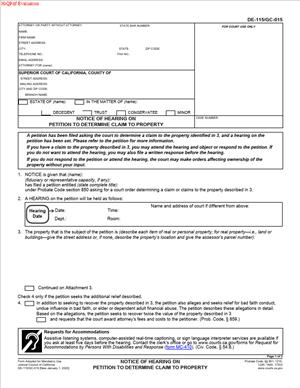
DE-115 and GC-015 – Notice of Hearing on Petition to Determine Claim to Property
Fill out nowJurisdiction: Country: United States | Province or State: California
If you are dealing with a dispute over property connected to a probate or guardianship case, you may come across the DE-115 and GC-015 – Notice of Hearing on Petition to Determine Claim to Property. This document tells interested parties that a court hearing has been scheduled to decide who owns certain property.
The DE-115 and GC-015 – Notice of Hearing on Petition to Determine Claim to Property is not the petition itself. It does not argue your case. Instead, it formally notifies others that the court will review and decide a claim to property.
You might be filling out this form because you filed a petition to determine ownership of property, or because someone else did. The court requires notice so that anyone affected has a fair chance to attend and respond.
This document plays a key role in due process. Without proper notice, the court may delay the hearing or refuse to make a decision. Understanding what this form does will help you complete and serve it correctly.
What is DE-115 and GC-015 – Notice of Hearing on Petition to Determine Claim to Property?
Clear definition
DE-115 and GC-015 – Notice of Hearing on Petition to Determine Claim to Property is a court notice used in California probate and guardianship proceedings. It informs interested parties that a petition has been filed asking the court to determine ownership of specific property, and it provides the date, time, and location of the hearing.
The form connects to a petition already on file. The petition explains why the filer believes the property belongs to the estate, the conservatorship, the guardianship, or another party. The notice simply communicates when and where the court will decide that issue.
In practical terms, this document ensures transparency. It allows people who may be affected by the outcome to prepare and appear in court if they choose.
Who typically uses this form?
This form is commonly used by personal representatives of estates, executors, administrators, guardians, or conservators. It may also be used by individuals claiming ownership of property that is currently treated as part of an estate or conservatorship.
If you filed a Petition to Determine Claim to Property, the court will usually require that notice of the hearing be given to specific people. You would prepare this notice for service on those parties.
Attorneys often prepare and serve this document on behalf of their clients. However, self-represented individuals frequently complete it when handling probate matters on their own.
Why might you need this form?
You may need this form if there is a dispute about whether certain property belongs to a deceased person’s estate or to someone else. The court cannot resolve that dispute without giving notice of a hearing.
This form becomes necessary after a petition is filed and a hearing date is set. It allows the process to move forward by formally informing all required individuals.
Without proper notice, the court may decline to issue an order. That can delay the distribution of assets or prevent a fiduciary from completing their duties.
Typical real-life scenarios
- A family member claims that a bank account listed in a probate estate was actually a joint account that belongs to them. The personal representative disagrees and files a petition asking the court to determine ownership. The notice of hearing is then prepared and served.
- A conservator believes that property titled in another person’s name actually belongs to the conservatorship estate. To clarify ownership, the conservator files a petition. The notice informs interested parties of the upcoming court date.
- An heir argues that a vehicle or piece of real estate should not be included in the estate inventory. The executor seeks a court ruling. The hearing notice is required so the heir and others can appear.
- A third party, such as a business partner, claims that certain funds held by the estate were never owned by the deceased. The petition to determine a claim to property is filed, and the notice ensures that all affected individuals are aware of the hearing.
When would you use DE-115 and GC-015 – Notice of Hearing on Petition to Determine Claim to Property?
You would use this form after a Petition to Determine Claim to Property has been filed in a California probate or guardianship case and the court has assigned a hearing date. The notice is part of the procedural steps required before the court can issue a ruling.
It is typically used when there is uncertainty or disagreement about ownership. The issue may involve real estate, personal property, financial accounts, business interests, or other assets.
The person filing the petition often has a formal role in the case, such as executor, administrator, guardian, or conservator. However, a claimant asserting ownership may also initiate the process. In either situation, once a hearing is scheduled, this notice is prepared and served.
Timing matters. The notice must usually be served a certain number of days before the hearing. If it is not served properly or on time, the court may continue the hearing to a later date.
You may also use this form when the court specifically directs you to provide notice to certain individuals. The judge may require notice to heirs, beneficiaries, creditors, or other parties with a potential interest in the property.
Legal characteristics of DE-115 and GC-015 – Notice of Hearing on Petition to Determine Claim to Property
This form is a procedural notice. Its legal effectiveness depends on accurate information and proper service. It must clearly identify the court, case number, petitioner, and the scheduled hearing details.
For the notice to function properly, it must correspond to a valid petition already on file. If there is no underlying petition, the notice alone has no effect.
Common problems include incorrect hearing dates, wrong department numbers, missing case numbers, or incomplete party information. Errors can cause confusion and may lead the court to postpone the matter.
Another frequent issue involves service. If the notice is not delivered in the manner required by court rules, the judge may decline to proceed. Proof of service is usually required to show that notice was given correctly.
Procedural requirements may vary depending on whether the case involves a decedent’s estate, a guardianship, or a conservatorship. Different categories of interested persons may need notice in each context.
It is also important to understand what this document does not do. It does not transfer ownership. It does not resolve the dispute. It does not prove that your claim is correct. Only a court order issued after the hearing can determine ownership.
Is it legally binding?
The notice itself is not a binding agreement between the parties. It does not create rights or obligations beyond informing others of the hearing.
However, it carries legal significance because it is part of the due process required before the court can make a decision. When properly completed and served, it supports the court’s authority to issue a binding order.
Once the hearing takes place and the judge signs an order determining ownership, that order can be legally binding. The notice is a necessary step leading up to that result.
If notice is defective or incomplete, the binding effect of any resulting order may be questioned. Courts generally require clear evidence that all required parties had an opportunity to be heard.
How to fill out DE-115 and GC-015 – Notice of Hearing on Petition to Determine Claim to Property
Step 1 – Complete the caption
At the top of the form, fill in the name of the court, the street address, city, and branch name if applicable. Enter the case name exactly as it appears on other filings in the case. Include the correct case number. This information must match the existing probate or guardianship file.
Step 2 – Identify the petitioner
Enter the name of the person who filed the Petition to Determine Claim to Property. This should be written exactly as it appears on the petition. Accuracy here ensures the notice is clearly connected to the correct filing.
Step 3 – Provide the hearing details
Insert the date, time, and department of the hearing as assigned by the court clerk. Use the information exactly as provided. Double-check for typographical errors. Even a small mistake in the hearing date can create serious delays.
Step 4 – Describe the petition
Indicate that the hearing concerns a petition to determine a claim to specific property. If the form includes space to reference the filing date of the petition, enter that date. This helps recipients understand which submission is being addressed.
Step 5 – Review notice recipients
Confirm who must receive notice of the hearing. This may include heirs, beneficiaries, personal representatives, guardians, conservators, or other interested parties. Make sure their names and addresses are complete and accurate before service.
Step 6 – Arrange for service
Have the notice served in the manner required for your type of case. Service is often completed by mail or personal delivery by someone who is not a party to the action and who meets the age requirements. The server must complete a proof of service form.
Step 7 – File the notice and proof of service
After service is completed, file the original notice and the signed proof of service with the court. Keep copies for your records. Filing confirms that notice was given and allows the hearing to proceed as scheduled.
Legal terms you might encounter in DE-115 and GC-015 – Notice of Hearing on Petition to Determine Claim to Property
- Petition to Determine Claim to Property: This is the underlying request filed with the court asking a judge to decide who owns specific property. The notice you are completing tells interested parties when and where that petition will be heard. It connects directly to that petition by case number and title.
- Claimant: A claimant is the person who says the property belongs to them and not to the estate or conservatorship. Their name must appear exactly as it does in the petition. Any mismatch can cause confusion about who is asserting ownership.
- Estate: The estate includes all property owned by a deceased person at the time of death. When a claim is made that certain property does not belong in the estate, this document helps notify others before the court decides.
- Conservatorship or Guardianship Estate: In some cases, the property may belong to a conservatorship or guardianship rather than a probate estate. The notice format accommodates both situations, which is why you may see dual form numbers.
- Interested Person: This refers to anyone who has a legal interest that could be affected by the court’s decision. That can include heirs, beneficiaries, creditors, or fiduciaries. You must ensure these individuals receive proper notice.
- Hearing Date: This is the scheduled date and time when the court will consider the petition. The accuracy of this information is critical. If it is wrong, parties may miss the opportunity to object.
- Department or Division: This identifies the specific courtroom or judicial department where the hearing will take place. Large courts often have multiple departments handling different matters.
- Proof of Service: This is a separate document showing that the notice was properly delivered to the required parties. The court will usually require proof of service before proceeding with the hearing.
- Fiduciary: A fiduciary is a person legally responsible for managing another’s property, such as an executor, administrator, guardian, or conservator. The fiduciary’s name often appears in the case caption and must match the court record exactly.
- Case Number: This unique identifier is assigned by the court when the probate or conservatorship case is opened. Every document, including this notice, must use the correct case number so it is filed in the proper record.
FAQs
Do I need to file DE-115 and GC-015 – Notice of Hearing on Petition to Determine Claim to Property if the court already set a hearing date?
Yes. Even if the court clerk gives you a hearing date, you still need to prepare and file this document to formally notify interested persons. The court sets the date, but you are responsible for completing the notice with that exact information and ensuring it is served as required.
What information must match exactly between this document and the petition?
The case number, court name, decedent or conservatee’s name, and the petitioner’s name must match the petition word for word. If the spelling or format differs, the clerk may reject the filing, or the judge may question whether proper notice was given. Always copy these details directly from the petition and the court’s case summary.
Who is allowed to sign this form?
The person who prepared the notice typically signs it. This is often the petitioner or their attorney. If you are self-represented, you sign your own name. Make sure the signature matches the name listed in the caption and that you include your contact information exactly as required by the form.
Do I need to attach a copy of the petition when serving this notice?
In most situations, interested persons must receive both the notice and a copy of the petition so they understand what property is at issue. Check the service instructions connected to your case type. When you arrange service, confirm that both documents are included in the mailing or delivery packet.
What happens if someone does not receive proper notice?
If an interested person does not receive proper notice, the court may continue the hearing or refuse to make a decision. This can delay your case. The judge may require you to correct service and provide new proof before proceeding.
Can I change the hearing date after filing this document?
You cannot change it on your own. Only the court can reschedule a hearing. If the court issues a new date, you must prepare and serve an updated notice reflecting that new date and file proof that the updated notice was delivered.
How do I know if the court accepted my filing?
After submission, the clerk will stamp or electronically mark the document as filed. Review the filed copy to confirm that the date and case number are correct. Keep that stamped version for your records and for the hearing.
What does this document change in the public court record?
This document adds formal notice of the scheduled hearing to the case file. It shows that interested persons were informed about the petition and gives them an opportunity to respond. It does not transfer ownership by itself; it simply sets the stage for the court’s decision.
Checklist: Before, During, and After DE-115 and GC-015 – Notice of Hearing on Petition to Determine Claim to Property
Before
- Confirm the court has assigned a hearing date, time, and department.
- Verify the exact spelling of all names from the petition and case file.
- Check the case number carefully against the court’s record.
- Identify all interested persons who must receive notice.
- Review service rules to confirm who can serve the documents.
- Prepare enough copies of the notice and petition for service.
- Make sure your contact information is current and complete.
- Review deadlines for serving notice before the hearing.
During
- Complete every section of the notice clearly and legibly.
- Insert the correct hearing date, time, and department.
- Double-check the property description matches the petition.
- Sign and date the notice where required.
- Arrange for service by an eligible adult who is not you.
- Ensure copies of the petition are included with the notice.
- Have the server complete a proof of service form.
- File the original notice and proof of service with the court.
After
- Confirm the clerk stamped your documents as filed.
- Keep a complete copy of everything in your records.
- Calendar the hearing date and any response deadlines.
- Monitor the case docket for objections or filings.
- Prepare any supporting documents you plan to present at the hearing.
- Bring filed copies and proof of service to court.
- Follow up if the court requests additional notice.
- Update your records after the judge makes a decision.
Common mistakes to avoid with DE-115 and GC-015 – Notice of Hearing on Petition to Determine Claim to Property
- Mistake: Entering the wrong hearing date or department because you relied on memory instead of the court notice, which can lead to improper notice and delays; do not forget to copy the details directly from the court’s scheduling document.
- Mistake: Misspelling the decedent’s or conservatee’s name because you typed it from recollection, which can cause filing rejection; do not forget to match the caption exactly as it appears in the case record.
- Mistake: Failing to serve all interested persons because you assumed only primary heirs needed notice, which may result in a continued hearing; do not forget to review the full list of legally required recipients.
- Mistake: Serving the documents yourself because it seems faster, which may invalidate service; do not forget that service usually must be completed by someone who is not a party to the case.
- Mistake: Forgetting to file proof of service because you believed mailing alone was enough, which can prevent the court from proceeding; do not forget to submit the completed proof form before the hearing.
- Mistake: Attaching the wrong petition or an outdated version because you had multiple drafts, which creates confusion for recipients; do not forget to confirm you are serving the final filed petition.
- Mistake: Leaving sections blank because they did not seem important, which can result in clerk rejection; do not forget to review every field and mark it appropriately, even if it says “N/A.”
What to do after filling out DE-115 and GC-015 – Notice of Hearing on Petition to Determine Claim to Property
Once you complete the form, your next focus is proper filing and service. Accuracy and timing matter. Small errors at this stage can delay the court’s decision.
- Step 1: Review the completed notice line by line and compare it to the filed petition and court scheduling information.
- Step 2: Make the required number of copies, including copies for yourself and each person who must receive notice.
- Step 3: Arrange for an eligible adult who is not a party to serve the notice and a copy of the petition on all required recipients.
- Step 4: Ensure the server completes a proof of service form fully and signs it.
- Step 5: File the original notice and the completed proof of service with the court using the approved filing method for your case.
- Step 6: Confirm the court has accepted and stamped the filing, whether electronically or in person.
- Step 7: Keep stamped copies in a secure folder dedicated to your probate or conservatorship matter.
- Step 8: Mark your calendar with the hearing date and any deadlines for objections or additional filings.
- Step 9: Prepare for the hearing by organizing documents that support the claim to the property.
- Step 10: After the hearing, obtain a copy of the court’s order and update your records to reflect the judge’s decision regarding ownership.
Stay organized throughout the process. Keep a checklist of who was served and when. Bring copies of everything to the hearing. Clear documentation shows the court that you followed the required procedures and helps move your matter forward efficiently.
Disclaimer: This guide is provided for informational purposes only and is not intended as legal advice. You should consult a legal professional.