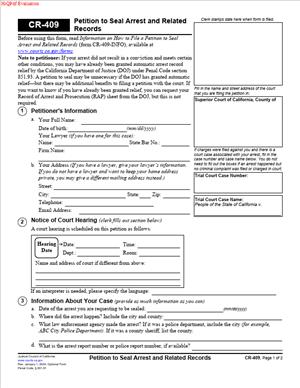
CR-409 – Petition to Seal Arrest and Related Records
Fill out nowJurisdiction: Country: United States | Province or State: California
The CR-409 – Petition to Seal Arrest and Related Records is a court form used in California to ask a judge to seal records connected to an arrest. When records are sealed, they are no longer publicly accessible in most background checks.
If you were arrested but not convicted, or your case was resolved in a way that qualifies for sealing, this form may be part of the process. It is a formal request filed with the court.
For many people, an arrest record affects employment, housing, and professional licensing. Even when charges were dropped, the record can still appear in searches. This document starts the legal process to limit who can see that information.
You are not arguing your innocence in this form. Instead, you are asking the court to order that certain arrest and related records be sealed under California law.
Understanding how this document works helps you complete it accurately and avoid delays.
What is CR-409 – Petition to Seal Arrest and Related Records?
Clear definition
CR-409 – Petition to Seal Arrest and Related Records is a written request filed in a California criminal court. It asks the court to seal records relating to a specific arrest and any related proceedings.
Sealing a record means that law enforcement agencies and courts limit public access to that record. In many situations, the sealed arrest is treated as though it did not occur, with certain exceptions.
This form identifies you, the arrest agency, the date of arrest, the charges, and the outcome of the case. It gives the court the details it needs to determine whether sealing is allowed.
The petition does not automatically seal anything. It triggers a review process by the court and, in some cases, by the prosecuting agency.
Who typically uses this form?
People who were arrested in California and want their arrest records sealed commonly use this form. Many were never charged, had charges dismissed, or were acquitted at trial.
Some individuals completed a diversion program and had their cases dismissed. Others were arrested, but prosecutors decided not to file charges.
Self-represented individuals often complete this form on their own. It may also be prepared by a private attorney or a public defender in certain cases.
Employers, landlords, and licensing boards do not use this form. It is filed by the person whose arrest record is at issue.
Why might you need this form?
An arrest record can appear on background checks. Even without a conviction, the record may raise questions for employers or property managers.
Sealing eligible records can reduce the visibility of that arrest. In many situations, you may lawfully state that you were not arrested for the sealed offense, except in specific circumstances.
You might need this form if you are applying for a job and discover that an old arrest still appears in your record. It may also matter when applying for housing, loans, or professional licenses.
This form is also used when you want to clear up inaccuracies in your criminal history after a case ended in your favor.
Typical real-life scenarios
- You were arrested after a traffic stop, but the district attorney declined to file charges. Years later, a background check for a new job shows the arrest. You file this petition to ask the court to seal that record.
- You were charged with a misdemeanor, but the case was dismissed after you completed a diversion program. The arrest and case remain visible in court records. You use this form to request sealing of both the arrest and related court records.
- You were arrested and went to trial. A jury found you not guilty. Despite the acquittal, the arrest still appears in law enforcement databases. This petition asks the court to seal those records.
- You were arrested as a young adult, and the charges were dismissed. Now you are applying for a professional license. The licensing board’s background review shows the arrest. Filing this document may limit public access to that history.
- You were arrested in connection with an investigation, but were never formally charged. The record continues to affect your housing applications. This form begins the process of addressing that issue.
When would you use CR-409 – Petition to Seal Arrest and Related Records?
You would use CR-409 – Petition to Seal Arrest and Related Records after your criminal case has reached a final outcome that may qualify for sealing. It is not used while a case is still pending.
Timing matters. The petition is typically filed after charges were dismissed, you were acquitted, or no charges were filed within the required time. If you completed a diversion program that resulted in dismissal, this form may also apply.
The form is filed in the court that handled the criminal case. If no charges were filed, it is usually filed in the court that would have had jurisdiction over the offense.
People often turn to this form when preparing for a major life step. Common examples include applying for a new job, renewing a license, seeking a promotion, or relocating for housing.
You may also use it when reviewing your own criminal history and noticing that an old arrest remains visible. The petition is a way to formally request that the court review your eligibility under California law.
In some situations, multiple arrests require separate petitions. Each case is reviewed based on its own facts and outcome.
Legal characteristics of CR-409 – Petition to Seal Arrest and Related Records
CR-409 – Petition to Seal Arrest and Related Records is a procedural court document. Its effectiveness depends on statutory eligibility and accurate information.
For the petition to be considered, it must clearly identify the arrest date, arresting agency, charges, and case number if one exists. Missing or incorrect information can delay processing or lead to rejection.
Courts generally require that the underlying case be resolved in a way that qualifies for sealing. Certain outcomes or offenses may not be eligible. The judge reviews the petition to determine whether legal requirements are met.
The form itself does not erase records. It asks the court to issue an order. If the court grants the petition, agencies listed in the order are directed to seal their records.
Common issues that cause problems include listing the wrong case number, filing in the wrong court, or requesting sealing for a case that does not meet statutory criteria. Incomplete contact information can also slow the process.
California has specific laws governing arrest record sealing. Other states have different procedures and standards. This form applies only within California courts.
Sealing an arrest record does not automatically restore rights unrelated to the arrest. For example, it does not function as a pardon. It also does not prevent all government agencies from accessing the record for limited purposes defined by law.
Is it legally binding?
The petition itself is not legally binding. It is a request.
If the court grants the petition and signs an order to seal, that order becomes legally binding on the agencies named in it. Those agencies are then required to seal the specified records in accordance with the order.
The legal effect begins only after the judge issues the order. Until that point, the records remain as they were.
Even after sealing, certain entities, such as criminal justice agencies, may retain limited access for specific purposes. The sealing order defines the scope and effect.
How to fill out CR-409 – Petition to Seal Arrest and Related Records
Step 1 – Identify the court
At the top of the form, enter the name and address of the California court where you are filing. This is typically the court that handled your case or would have handled it if charges had been filed. Use the official court name and location.
Step 2 – Provide your personal information
Fill in your full legal name, date of birth, and any other identifying details requested. If you used a different name at the time of the arrest, include that information as instructed on the form. Accuracy here helps the court and agencies match the correct records.
Step 3 – List the arrest details
Enter the date of arrest, the law enforcement agency that made the arrest, and the city or county where it occurred. If available, include the arrest report number. This section connects your petition to a specific incident.
Step 4 – Include case information
If charges were filed, provide the court case number and the charges listed. State the outcome of the case, such as dismissal, acquittal, or completion of diversion. If no charges were filed, indicate that clearly in the space provided.
Step 5 – State the legal basis for sealing
The form includes checkboxes or spaces to indicate why you believe the arrest qualifies for sealing. Select the option that matches your case outcome. Ensure that your selection aligns with the actual disposition of the case.
Step 6 – Confirm eligibility statements
Read each statement in the petition carefully. Some sections require you to declare that you meet certain conditions, such as not having certain types of convictions. Complete these sections truthfully and fully.
Step 7 – Review for completeness
Before signing, review every section. Confirm that names, dates, and case numbers match your official records. Small errors can cause delays or require corrections later.
Step 8 – Sign and date the petition
Sign your name where indicated and enter the date of signing. Your signature confirms that the information provided is true and correct to the best of your knowledge. Some courts may require the signature to be in ink if filing on paper.
Step 9 – Prepare for filing and service
After completing the form, make the required copies. The court may require that a copy be provided to the prosecuting agency. Follow the court’s filing procedures for submission, whether in person, by mail, or electronically, as allowed.
Legal terms you might encounter in CR-409 – Petition to Seal Arrest and Related Records
- Petitioner: This is you. On this form, you are the person asking the court to seal your arrest and related records. Your name must appear exactly as it does on the arrest record and any related court documents.
- Respondent: In criminal matters, the respondent is usually the government entity involved, often represented by a prosecuting agency. This form may require you to identify the law enforcement agency that made the arrest or the prosecuting office connected to the case.
- Arresting Agency: This refers to the law enforcement department that arrested you. You must list the correct agency name on the form. If you name the wrong agency, the sealing order may not reach the right records custodian.
- Case Number: This is the court’s tracking number for any charges filed after your arrest. If charges were filed, you must include the correct case number. If no charges were filed, you may need to indicate that clearly on the form.
- Disposition: This means the final outcome of the case. It could be dismissal, acquittal, conviction, or a decision not to file charges. You must state the disposition accurately because eligibility to seal often depends on how the case ended.
- Sealing Order: This is the court’s written order directing agencies to seal your arrest and related records. The petition you file asks the judge to issue this order. Without a signed sealing order, your records will not be sealed.
- Proof of Service: This is a document showing that you delivered a copy of your petition to the required agency or prosecutor. Courts usually require proof that the other side was properly notified before a judge will act on your request.
- Relief Requested: This section describes what you are asking the court to do. In this form, you are requesting that the court seal specific arrest and related records. You must be precise about which arrest and which records you want sealed.
- Eligibility Criteria: These are the conditions you must meet for the court to grant your petition. The form often includes statements you must check or confirm, such as that you were not convicted of certain offenses or that the case was dismissed.
- Hearing Date: Some courts set a date for a hearing before deciding your petition. If a hearing is required, the date, time, and department will be listed after filing. You may need to attend and be prepared to answer questions.
FAQs
Do I need to include every arrest on CR-409 – Petition to Seal Arrest and Related Records?
No. You should include only the specific arrest you want sealed. Each arrest is treated separately. If you have multiple arrests, you may need to file a separate petition for each one, depending on court procedures. Make sure the date, location, and agency information match the exact arrest you are asking the court to seal.
What if I do not know my case number?
Start by checking any paperwork you received from the court or your attorney. You can also search court records using your name and date of birth. If no charges were ever filed, state that clearly in the section asking for case information and indicate that there is no case number. Do not leave the section blank without explanation.
How do I know if I am eligible to file this document?
Read each eligibility statement carefully. The form will usually require you to confirm facts about the outcome of your case, such as dismissal or acquittal. You must be able to truthfully check or confirm those statements. If your case resulted in a conviction, review whether that affects your ability to request sealing before you submit this document.
What happens after I file this form with the court?
The court will review your filing to make sure it is complete. In some situations, the prosecutor or arresting agency may have time to respond. The judge may issue a decision based on the paperwork or set a hearing. If granted, the court will issue a sealing order directing agencies to seal the listed records.
Do I have to attend a hearing?
Not always. Some requests are decided without a hearing. If the court schedules one, you must attend or risk denial of your petition. Check the notice you receive after filing to confirm whether a court appearance is required and note the department and time listed.
What does it mean that records are “sealed”?
When records are sealed, they are no longer available to the general public. Agencies covered by the order restrict access according to the law. However, certain government entities may still be able to view sealed records in limited circumstances. The order applies only to the arrest and related records identified in your petition.
What if my name has changed since the arrest?
List your current legal name on the form. Also include any prior names used at the time of the arrest in the space provided. This helps the court and agencies match your request to the correct record. Make sure the spelling and date of birth match the original arrest record to avoid delays.
How will I know if my petition was granted?
You will receive a signed order from the court if your request is approved. Review the order carefully to confirm that it lists the correct arrest date and agency. Keep a certified copy for your records. If your request is denied, the court’s notice will usually explain the reason and may outline your next options.
Checklist: Before, During, and After CR-409 – Petition to Seal Arrest and Related Records
Before
- Obtain a copy of your criminal history or arrest record to confirm details.
- Gather court documents showing the final disposition of the case.
- Verify the exact name of the arresting agency.
- Confirm your eligibility based on the case outcome.
- Check whether a filing fee applies or if a fee waiver is available.
- Make sure you have your correct case number, if one exists.
- Prepare any supporting documents that may need to be attached.
During
- Print or type your full legal name clearly and consistently.
- Enter the arrest date exactly as shown on official records.
- Provide the correct case number or state that none was assigned.
- Complete every eligibility statement truthfully.
- Attach required documents, such as proof of dismissal if requested.
- Review all sections for blanks before signing.
- Sign and date the petition where indicated.
- Prepare the required number of copies for filing and service.
After
- File the petition with the correct court clerk’s office.
- Obtain a filed-stamped copy for your records.
- Serve copies on the required agencies or the prosecutor.
- Complete and file proof of service if required.
- Calendar any response deadlines or hearing dates.
- Check the status of your petition if you do not receive updates.
- Obtain a certified copy of the sealing order if granted.
- Store all documents in a safe and organized place.
Common mistakes to avoid with CR-409 – Petition to Seal Arrest and Related Records
- Mistake: Listing the wrong arrest date because you rely on memory instead of official records; this happens when paperwork is missing, and it can lead to denial or sealing the wrong record, so do not forget to verify the exact date from court or law enforcement documents.
- Mistake: Leaving the case number blank without explanation; people often assume it is optional, but this can delay processing or cause rejection, so do not forget to clearly state if no case number was ever assigned.
- Mistake: Failing to serve the correct agency; this happens when you are unsure which office handled the case, and it may result in the court refusing to act, so do not forget to confirm the proper prosecuting or arresting agency before service.
- Mistake: Forgetting to sign and date the petition; this is common when focusing on attachments, and an unsigned form is usually rejected, so do not forget to review the signature line before filing.
- Mistake: Providing a name that does not match the arrest record; this can cause record mismatches and delays, especially after a name change, so do not forget to include prior names used at the time of arrest.
- Mistake: Assuming records are sealed immediately after filing; this misunderstanding can lead to premature job applications or disclosures, so do not forget that sealing only occurs after the judge signs the order.
What to do after filling out CR-409 – Petition to Seal Arrest and Related Records
Once you complete the form, pause and review it carefully. Check every name, number, and date against your official documents. Small errors can slow down the process.
Make at least two copies of the completed petition. One copy is for you. The other copies are for service on the required agencies. If the court requires additional copies, prepare those before you go to file.
- Step 1: Organize your original petition and all attachments in the correct order.
- Step 2: Make the required number of copies, including one for your records.
- Step 3: File the original with the clerk of the appropriate court.
- Step 4: Pay any required filing fee or submit a fee waiver request if applicable.
- Step 5: Obtain filed-stamped copies from the clerk before leaving.
- Step 6: Serve the filed-stamped copies on the required agency or prosecutor.
- Step 7: Complete and file proof of service if the court requires it.
- Step 8: Mark your calendar with any hearing date or response deadline.
- Step 9: Monitor your mail for notices from the court.
- Step 10: If the petition is granted, request a certified copy of the sealing order.
After you receive a decision, read it carefully. If the judge grants your request, confirm that the order correctly lists the arrest date, agency, and identifying details. Keep certified copies in a secure place. You may need them to correct background checks in the future.
If your petition is denied, review the reason given by the court. You may be able to correct errors and refile, depending on the circumstances. Keep all paperwork together so you have a clear record of what was submitted and how the court responded.
Finally, update your personal records. Create a simple file labeled with the arrest date and the court’s decision. Store digital scans securely. Staying organized helps you respond quickly if questions come up later about your record status.
Disclaimer: This guide is provided for informational purposes only and is not intended as legal advice. You should consult a legal professional.