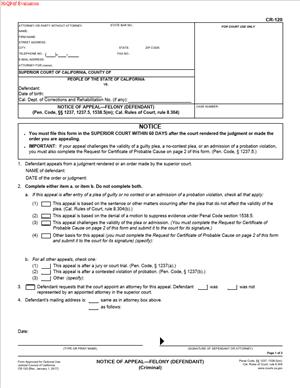
CR-120 – Notice of Appeal – Felony (Defendant) (Criminal)
Fill out nowJurisdiction: Country: United States | Province or State: California
CR-120 – Notice of Appeal – Felony (Defendant) (Criminal) is the form a defendant uses to start an appeal in a California felony case. If you were convicted or sentenced in a felony matter and want a higher court to review what happened, this is the document that formally begins that process.
Filing this form does not mean you are arguing your case all over again. It means you are asking an appellate court to review possible legal errors that may have affected the outcome. The appeal focuses on what occurred in the trial court.
This document is time-sensitive. Appeals in criminal cases usually must be filed within a strict deadline after sentencing or the final judgment. Missing that deadline can limit your ability to move forward.
If you are representing yourself, this form may feel intimidating. It is structured and direct. Once you understand what each section is asking for, it becomes more manageable.
What is CR-120 – Notice of Appeal – Felony (Defendant) (Criminal)?
Clear definition
CR-120 – Notice of Appeal – Felony (Defendant) (Criminal) is a formal written notice filed in the trial court stating that you are appealing a felony conviction or certain related orders. It tells the court and the prosecution that you are asking a higher court to review your case.
The form identifies the case, the judgment or order being appealed, and whether the appeal challenges the conviction after trial, a plea, or another specific ruling. It does not contain detailed legal arguments. It simply starts the appeal.
Once filed, the trial court clerk processes the notice and begins preparing the record for the appellate court. The appellate process then follows its own procedures and deadlines.
Who typically uses this form?
This form is typically used by a defendant in a California felony case. That includes people convicted after a jury trial, a court trial, or after entering a plea, depending on the issue being appealed.
In some situations, a defense attorney files the form on the defendant’s behalf. In other cases, especially if someone is self-represented after sentencing, the defendant files it personally.
The prosecution does not use this form to appeal. It is specifically designed for defendants in felony criminal matters.
Why might you need this form?
You may need this form if you believe there was a legal error during your case. Examples can include mistakes in jury instructions, improper admission or exclusion of evidence, or sentencing errors.
You might also use it if you entered a plea but later want to challenge certain aspects of the case, such as the validity of the plea or a specific post-judgment order.
The form is also used when you want appellate review of a sentence imposed in a felony case, if that type of issue is eligible for appeal.
Without filing this notice, the appellate court generally does not have authority to review your case. The notice is what transfers the matter into the appellate system.
Typical real-life scenarios
- After a jury trial, you are found guilty of a felony and sentenced. You believe the judge made a legal mistake when allowing certain evidence to be presented. You file the notice to have the appellate court review that ruling.
- You plead no contest to a felony charge, but later question whether your plea was properly taken. If the issue qualifies for appeal, you file the notice to start the review process.
- You receive a sentence that you believe does not follow the applicable sentencing rules. You file the notice so the appellate court can determine whether the sentence was legally correct.
- A post-judgment order affects your rights in a felony case, such as a ruling on a motion after sentencing. If that order is appealable, you may use this form to challenge it.
When would you use CR-120 – Notice of Appeal – Felony (Defendant) (Criminal)?
You use this form after the trial court has entered a judgment or issued an appealable order in a felony case. Most often, this occurs after sentencing. In felony matters, sentencing usually marks the point when the judgment becomes final for purposes of appeal.
Timing is critical. In California felony cases, a notice of appeal is generally due within a specific number of days after the judgment or order. The exact deadline depends on the type of issue being appealed. The clock usually starts running from the date of sentencing or the date the order was made.
If you entered a plea of guilty or no contest, different rules may apply to what issues can be appealed. In some situations, additional steps or certificates may be required for certain claims. The notice of appeal is still the starting point for many types of review, but the scope of the appeal may be limited.
If you were represented by counsel at sentencing, that attorney may handle the filing. If you are no longer represented, you may complete and submit the form yourself. The filing is made in the same superior court where your case was heard, not directly in the appellate court.
You would not use this form for misdemeanor convictions. There are separate forms for misdemeanor appeals. This document is specifically for felony cases.
Legal characteristics of CR-120 – Notice of Appeal – Felony (Defendant) (Criminal)
This form functions as a procedural trigger. It does not argue the merits of your case. It simply informs the court system that you are invoking your right to appellate review.
For the notice to be effective, it must clearly identify the case. That includes the correct court name, case number, and the defendant’s name as it appears in the criminal file. It must also indicate what judgment or order is being appealed.
The notice must be filed within the required deadline. Filing late is one of the most common reasons appeals encounter problems. Courts generally enforce appeal deadlines strictly.
Incomplete or unclear information can also cause delays. If the form does not specify the type of judgment being appealed or if it lacks a required signature, the clerk may notify you of issues. In some cases, filing defects can be corrected, but missed deadlines are harder to fix.
The form does not automatically stay all consequences of a conviction. It does not vacate the judgment. It does not erase the conviction. It simply begins the appellate process. The trial court’s judgment remains in effect unless another order changes it.
While appellate procedures are governed by statewide rules, local practices in different California counties may affect how filings are processed. The core requirements of the notice itself are generally consistent across the state.
Is it legally binding?
CR-120 – Notice of Appeal – Felony (Defendant) (Criminal) is legally significant once properly filed. It invokes the jurisdiction of the appellate court over the issues identified as appealable.
When you sign and file the form, you are formally stating your intention to seek appellate review. That declaration has procedural consequences. It sets in motion deadlines for preparing transcripts, designating the record, and filing briefs.
However, the form does not create a contract or agreement between you and the court. It is not “binding” in the sense of obligating the appellate court to rule in your favor. It simply secures your place in the appellate process if filed correctly and on time.
If the notice is not filed within the required time, the appellate court may lack authority to consider the appeal. In that sense, the timing and proper completion of the document are what give it legal effect.
How to fill out CR-120 – Notice of Appeal – Felony (Defendant) (Criminal)
Step 1 – Identify the court and case information
At the top of the form, enter the name of the superior court where your felony case was heard. Include the branch name if applicable. Provide the case number exactly as it appears on court documents. Add your full legal name as the defendant. Accuracy here ensures the appeal is connected to the correct file.
Step 2 – State that you are appealing
The form includes a section where you indicate that you are appealing from a judgment or order in a felony case. Mark or complete the portion that reflects your situation, such as an appeal after conviction or after a plea. Read each option carefully so your selection matches the type of proceeding in your case.
Step 3 – Specify the judgment or order being appealed
Enter the date of the judgment or order. This is often the date you were sentenced. If you are appealing a specific post-judgment order, use the date that the order was made. The date helps determine whether the filing is within the allowable time period.
Step 4 – Address plea-related information if applicable
If your conviction followed a guilty or no contest plea, the form may ask for additional details. Complete this section as it applies to your case. Some appeals after a plea involve limits on what issues can be raised, so the form separates those situations from appeals after trial.
Step 5 – Provide contact information
Include your current mailing address. If you are in custody, provide the facility name and address as required by the form. The appellate court and clerk use this information to send notices and updates about your case.
Step 6 – Sign and date the form
Sign your name where indicated and write the date of signing. Your signature confirms that you are the defendant filing the notice. If an attorney is filing on your behalf, the attorney completes and signs the appropriate section instead.
Step 7 – File the form with the trial court
Submit the completed form to the clerk of the superior court where your case was decided. Filing is typically done in that court, not in the appellate court. The clerk processes the notice and forwards the necessary information to begin the appellate proceedings.
Legal terms you might encounter in CR-120 – Notice of Appeal – Felony (Defendant) (Criminal)
- Appellant: The appellant is the person who files the appeal. On this form, that is you, the defendant in a felony case. By completing this document, you are officially identifying yourself as the party asking a higher court to review what happened in your trial court case.
- Respondent: The respondent is the opposing party in the appeal. In a criminal case, this is typically the government. The form does not require you to argue against the respondent, but it recognizes that the appeal will be between you and the government as parties.
- Judgment: A judgment is the final decision in your case. In a felony matter, this usually includes your conviction and sentence. On this form, you must clearly indicate the date of the judgment you are appealing, because that date affects filing deadlines.
- Appealable Order: An appealable order is a court decision that the law allows you to challenge. Not every ruling can be appealed right away. On the form, you may need to specify whether you are appealing a final judgment or another order that qualifies for review.
- Notice of Appeal: This is the formal written statement that starts your appeal. It does not explain your arguments. It simply tells the court and the other side that you are seeking review of a specific decision.
- Certificate of Probable Cause: In some felony cases, especially those involving certain types of pleas, you may need a certificate of probable cause to challenge issues related to your plea. This certificate is requested separately, but the form may require you to indicate whether one is involved.
- Trial Court: The trial court is the court where your case was originally heard and decided. Even though your appeal goes to a higher court, you usually file this document with the trial court clerk.
- Court of Appeal: The Court of Appeal is the higher court that reviews your case after you file your notice. This court does not hold a new trial. Instead, it reviews the record from the trial court to decide whether legal errors occurred.
- Record on Appeal: The record on appeal includes transcripts, filings, and evidence from your trial court case. Although this form does not require you to list the entire record, filing it triggers the process that leads to the preparation of that record.
- Timeliness: Timeliness refers to whether you file your appeal within the legal deadline. Missing the deadline can result in your appeal being dismissed. When completing this form, you must pay close attention to the judgment date and any related time limits.
FAQs
What deadline applies to filing CR-120 – Notice of Appeal – Felony (Defendant) (Criminal)?
The deadline usually runs from the date the judgment was entered in your case. You must look at your sentencing date or the date listed on the judgment paperwork. Entering the correct judgment date on this document is critical because the court uses that date to determine whether your filing is timely. If you are unsure of the exact date, review your minute order or sentencing paperwork before completing the form.
Do I need to explain my legal arguments on this form?
No. This document is not where you explain why the trial court was wrong. You only identify the judgment or order you are appealing. Your legal arguments will come later in written briefs filed with the appellate court.
What if I pleaded guilty or no contest?
If your case involved a plea, certain issues may require a certificate of probable cause. This form may ask whether your appeal challenges the validity of the plea. You must carefully read that section and check the appropriate box based on what you are appealing. If a certificate is required, you generally must request it separately and ensure the record reflects that request.
Where do I file this document?
You file this document with the clerk of the trial court where your felony case was decided. Even though the appeal goes to a higher court, you do not start by filing directly with that higher court. Confirm the court’s name and case number before submitting the form.
What case number should I use?
Use the same case number assigned in your felony case at the trial court. You can find it on your charging documents, sentencing paperwork, or prior court orders. Make sure the number on this form exactly matches the court’s records so the clerk can correctly associate your appeal with your case.
What happens after I file this form?
After you file this form, the trial court clerk processes it and notifies the appellate court. The record on appeal will be prepared. You will later receive instructions or deadlines related to briefing and other appellate steps. Filing CR-120 – Notice of Appeal – Felony (Defendant) (Criminal) simply starts that process.
Can I change or withdraw my appeal after filing?
In many situations, you can request to dismiss your appeal, but you must follow the proper procedure. If you realize you made an error on this document, you should contact the clerk promptly to ask about correcting it. Do not assume you can simply submit a new version without addressing the original filing.
Will this document change my conviction or sentence right away?
No. Filing this form does not automatically change your conviction or sentence. It does not erase the judgment. It only starts the review process. The public record will show that you have filed an appeal, but the original judgment remains in effect unless and until a higher court changes it.
Checklist: Before, During, and After CR-120 – Notice of Appeal – Felony (Defendant) (Criminal)
Before
- Confirm the exact date of the judgment or order you want to appeal.
- Verify your full legal name as it appears on court records.
- Locate your correct trial court case number.
- Review whether your case involved a plea, and if a certificate of probable cause may be relevant.
- Check the filing deadline based on the judgment date.
- Gather any sentencing documents or minute orders for reference.
- Confirm the correct trial court location for filing.
During
- Clearly print or type your full legal name without abbreviations.
- Enter the case number exactly as shown in court records.
- Accurately state the date of the judgment or order.
- Check the correct boxes indicating what you are appealing.
- Complete any sections related to plea issues carefully.
- Provide your current mailing address and contact information.
- Sign and date the form where required.
- Review the entire form for completeness before submission.
After
- Make at least one copy of the completed form for your records.
- File the original with the trial court clerk.
- Request a stamped copy as proof of filing.
- Note the date you filed for your records.
- Monitor mail for notices from the court.
- Keep all court correspondence in one organized file.
- Update your contact information with the court if it changes.
- Track upcoming deadlines related to the appeal process.
Common mistakes to avoid with CR-120 – Notice of Appeal – Felony (Defendant) (Criminal)
- Mistake: Missing the filing deadline because you misread the judgment date, which happens when you rely on memory instead of court documents; this can lead to dismissal of your appeal, so do not forget to verify the exact date on official paperwork.
- Mistake: Using the wrong case number because you confuse multiple charges or related cases; this can delay processing or misfile your appeal, so do not forget to copy the number exactly as shown on your court records.
- Mistake: Leaving sections blank because you assume they do not apply; this happens when instructions seem unclear and may result in clerk rejection, so do not forget to review every section and mark boxes accurately.
- Mistake: Failing to address plea-related questions, which often occurs in cases resolved by guilty or no contest pleas; this can limit the issues on appeal, so do not forget to carefully read and complete those sections.
- Mistake: Forgetting to sign and date the form, which happens when you focus only on the legal details; an unsigned form may not be accepted, so do not forget to complete the signature line.
- Mistake: Not keeping a copy for yourself, often due to rushing to meet a deadline; this can create confusion later, so do not forget to retain a stamped copy as proof of filing.
- Mistake: Providing outdated contact information because you recently moved; this can cause you to miss critical notices, so do not forget to list your current mailing address and update it if needed.
- Mistake: Assuming filing the notice automatically pauses all consequences of the judgment, which happens due to misunderstanding the appeal process; this can create false expectations, so do not forget that the original judgment generally remains in effect unless changed by a higher court.
What to do after filling out CR-120 – Notice of Appeal – Felony (Defendant) (Criminal)
Once you complete the form, your focus shifts from drafting to filing and tracking. Accuracy and timing matter just as much now as they did while filling it out.
- Step 1: Make at least two copies of the completed form.
- Step 2: Review each copy to ensure every page is legible and complete.
- Step 3: File the original with the clerk of the trial court that handled your felony case.
- Step 4: Ask the clerk to stamp your copies to show the filing date.
- Step 5: Keep one stamped copy in a secure folder dedicated to your appeal.
- Step 6: Record the filing date in a calendar or planner.
- Step 7: Watch for written confirmation or notices from the court.
- Step 8: Respond promptly to any instructions about the record or next steps.
- Step 9: Keep your address current with the court at all times.
- Step 10: Organize all future appellate documents together in date order.
After filing, the clerk forwards notice of your appeal to the appropriate appellate court. The next stage usually involves preparation of the record on appeal. This may include transcripts of hearings and copies of filings from your trial court case.
You should monitor your mail carefully. Courts typically communicate important deadlines in writing. Missing a later deadline can harm your appeal even if your notice was filed on time.
Keep detailed records. Create a simple timeline of what has happened and what is expected next. Write down the dates you receive notices and any deadlines listed in them.
If you are representing yourself, stay organized and proactive. Read every court document fully. Highlight dates and required actions. If you have questions about the procedure, contact the court clerk for information about filing requirements, but remember, they cannot give legal advice.
Filing the notice is the first formal step. From there, your role is to stay attentive, meet deadlines, and maintain clear records so your appeal can move forward without unnecessary delay.
Disclaimer: This guide is provided for informational purposes only and is not intended as legal advice. You should consult a legal professional.