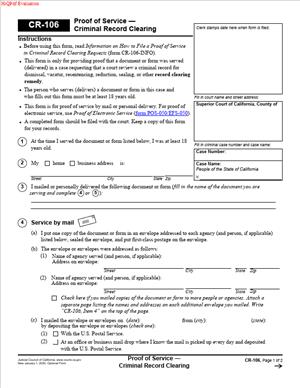
CR-106 – Proof of Service – Criminal Record Clearing
Fill out nowJurisdiction: Country: United States | Province or State: California
If you are asking the court to clear your criminal record, you may come across CR-106 – Proof of Service – Criminal Record Clearing. This form shows the court that you properly delivered copies of your paperwork to the required parties.
CR-106 – Proof of Service – Criminal Record Clearing does not ask for new facts about your case. Instead, it confirms that someone served your documents according to the rules. Courts rely on this confirmation before they review your request.
You will usually deal with this form after you complete and prepare your record clearing petition or motion. It works as a companion document. Without it, the court may delay or reject your filing.
If you are representing yourself, this form matters because it proves you followed the correct procedure. Service is not optional. It is part of the process that allows your case to move forward.
Understanding what this document does can prevent unnecessary delays. When you know what information it requires, you can complete it accurately the first time.
What is CR-106 – Proof of Service – Criminal Record Clearing?
Clear definition
CR-106 – Proof of Service – Criminal Record Clearing is a court form used to confirm that legal documents related to clearing a criminal record were properly delivered to the appropriate party. In most situations, that party is the prosecuting agency, often the district attorney.
The form is completed by the person who performed the service, not by you if you are the one requesting record clearing. That person states when, how, and to whom the documents were delivered. The court then relies on this signed declaration as evidence that service was completed.
This document is procedural. It does not argue your case. It does not explain why your record should be cleared. It simply verifies that the required notice was given.
Who typically uses this form?
People who are asking the court to dismiss a conviction, reduce a felony to a misdemeanor, or otherwise clear their criminal record often use this form as part of the process.
Self-represented individuals commonly encounter it when filing a petition for dismissal or similar relief. Attorneys also use it when representing clients in record clearing matters.
The person who actually fills out and signs the form is usually an adult who is not a party to the case. In many situations, that may be a friend, relative, or professional process server. The key point is that the person serving the documents must meet basic eligibility requirements set by court rules.
Why might you need this form?
Courts require proof that all required parties received notice of your request. Record clearing affects official records and, in some cases, the interests of the prosecution. Because of that, notice is a standard part of the process.
Without proof of service, the court may not consider your petition. The judge needs confirmation that the prosecuting agency had an opportunity to review and respond.
This form also creates a written record. If there is ever a question about whether notice was given, the signed proof of service helps clarify what happened and when.
In short, the form supports fairness. It shows that your request was not handled without informing the other side.
Typical real-life scenarios
- You file a petition to dismiss a conviction after successfully completing probation. The court requires you to send a copy of your petition to the district attorney. After someone mails it, that person completes this form to confirm the mailing.
- You request to reduce a qualifying felony to a misdemeanor. The court instructions state that you must notify the prosecuting agency. The individual who hand-delivers the paperwork fills out the proof of service form and signs it under penalty of perjury.
- You submit a motion to seal certain arrest records. The court requires notice to a law enforcement agency. Once the documents are served by mail, the server completes the proof of service to document the date and address used.
- You are correcting or updating a previous filing related to criminal record relief. The court instructs you to serve amended papers on the prosecutor. After service is completed, the server uses the form to confirm that the updated documents were delivered.
- Each of these situations involves the same principle. The court wants confirmation that the proper party received notice before it takes action.
When would you use CR-106 – Proof of Service – Criminal Record Clearing?
Use CR-106 – Proof of Service—Criminal Record Clearing when a California criminal-record-clearing request must be served on the prosecuting agency or another legally required recipient. File the completed proof with the same court in which the underlying petition, application, or motion was filed.
CR-106 is not a request for record-clearing relief by itself. It documents service of the main filing. The court uses it to confirm that the prosecutor and any other required agencies received notice and had an opportunity to respond.
The form is designed for a broad range of criminal-record remedies, including:
- A petition to dismiss a conviction
- A request to reduce a felony to a misdemeanor
- A motion to vacate a conviction or sentence
- A petition for resentencing and dismissal
- A petition to seal arrest and related records
- Certain petitions based on military service
- Other record-clearing requests requiring notice
The law governing the particular remedy determines who must be served. The prosecuting agency—usually the district attorney—is commonly entitled to notice. Depending on the request, service may also be required on a city attorney, law-enforcement agency, probation department, or another government office. Do not assume that serving only the court is sufficient.
In most cases, the record-clearing request should be filed first so the copies served can include the case number, filing stamp, hearing date, or other information added by the clerk. Some courts, however, require service before filing and expect the proof of service to accompany the original request. Review the governing statute and local court procedures before choosing the sequence.
CR-106 can document service by first-class mail or personal delivery. For service by mail, the server records each recipient’s name and address, the mailing date, and the city and state from which the documents were mailed. For personal delivery, the form records the recipient, agency, delivery address, date, and time.
Contrary to the original description, the applicant may serve the documents personally in many record-clearing proceedings. The person completing service must be at least 18 years old, but CR-106 does not universally require an unrelated third-party server. The statute governing the requested relief may impose additional requirements, so confirm the rule for the particular petition or motion.
If another person completes service, that individual must fill out and sign CR-106. The applicant should not sign as the server unless the applicant actually mailed or personally delivered the documents. The form is signed under penalty of perjury, so all service details must be accurate.
CR-106 does not document electronic service. When electronic service is authorized, California’s instructions direct users to follow California Rules of Court, rule 2.251 and use POS-050/EFS-050 instead.
After service, file the completed CR-106 with the court and keep a copy. If multiple agencies or individuals were served, list each recipient and use the designated attachment procedure if additional space is required.
Legal characteristics of CR-106 – Proof of Service – Criminal Record Clearing
This form functions as a declaration under penalty of perjury. The person who signs it is stating that the information provided is true and correct. That includes the date of service, the method used, and the address where the documents were sent or delivered.
For the form to be effective, it must be complete and accurate. The server’s name, address, and signature are essential. Missing dates, incorrect case numbers, or incomplete service details can cause delays.
Courts often reject or return filings if the proof of service is unsigned or if the server appears to be the same person requesting relief. Service rules generally require that the server be an adult who is not a party to the case.
Another common issue involves incorrect addresses. If the documents were sent to the wrong office or an outdated address, the court may question whether valid notice occurred.
The form itself does not clear your record. It does not grant relief. It simply verifies that a procedural step was completed. Even if the proof of service is properly filed, the judge still reviews your underlying request separately.
Procedural rules can vary depending on the type of record clearing relief requested. Some requests may require personal delivery, while others allow service by mail. The proof of service reflects the method used, and the method must match what the court requires for that filing.
Is it legally binding?
The statements made on the form are legally significant because they are signed under penalty of perjury. That means the person signing is making a sworn declaration that the information is true.
If the information is false, there can be serious consequences for the person who signed the form. The court treats the declaration as evidence that service occurred.
However, the form does not create a contract or agreement between parties. It does not impose new legal obligations beyond confirming that the service took place.
Its legal effect is procedural. Once accepted by the court, it establishes that the notice requirements were met. That allows the judge to move forward with reviewing the request for record clearing.
How to fill out CR-106 – Proof of Service – Criminal Record Clearing
Step 1 – Identify the case information
At the top of the form, enter the court name and location exactly as it appears on your other record clearing documents. Fill in the case number and case name to match your petition or motion. Accuracy here links the proof of service to the correct file.
Step 2 – Identify the server
The person who served the documents enters their full name, residence or business address, and contact information as requested on the form. This section identifies who performed the service and confirms that they are not a party to the case.
Step 3 – Confirm eligibility to serve
The server states that they are at least 18 years old and not involved in the case as a party. This statement is important because service rules require a neutral adult to complete delivery.
Step 4 – Describe what was served
The server lists the title of each document delivered. This may include your petition, motion, or other related filings. The titles must match the actual documents provided to the prosecuting agency or other required party.
Step 5 – Provide service details
The server fills in the date of service and the method used, such as mailing or personal delivery. If the service was by mail, the form typically asks for the address used. If it were a personal delivery, the form asks for the name of the person who received the documents and the location.
Step 6 – Identify the recipient
The form requires the name of the office or individual served, such as the prosecuting agency handling the original case. The server includes the complete address where the documents were delivered or mailed.
Step 7 – Sign under penalty of perjury
The server signs and dates the form, declaring under penalty of perjury that the information is true and correct. This signature makes the proof of service legally effective. Once signed, the completed form is ready to be filed with the court, along with or after your record clearing documents.
Legal terms you might encounter in CR-106 – Proof of Service – Criminal Record Clearing
- Proof of Service: This is a written statement confirming that someone delivered legal documents to another person or agency. In this form, it shows that the required criminal record clearing paperwork was properly served. The court or agency relies on this proof before taking further action.
- Server: The server is the person who actually delivers the documents. This person cannot be you if you are the petitioner. The server must meet eligibility rules and complete the form accurately.
- Petitioner: The petitioner is the person asking the court for criminal record relief, such as dismissal or sealing. If you filed the underlying request, you are the petitioner. Your name must match exactly across all related forms.
- Service by Mail: This means the documents were sent through the postal system. The server places the documents in an envelope, addresses it correctly, and deposits it with proper postage. The date of mailing becomes important for calculating deadlines.
- Personal Service: This is the hand-delivery of documents directly to the recipient. The server physically gives the paperwork to the appropriate party. This method is often used when strict notice requirements apply.
- Declaration Under Penalty of Perjury: This is a signed statement affirming that the information provided is true. When the server signs this declaration, they are legally confirming accuracy. False statements can lead to penalties.
- Case Number: This is the unique number assigned to your criminal case. It must match exactly what appears on your record clearing request. Even a small error can cause processing delays.
- Recipient: The recipient is the person or agency that must receive your documents. In criminal record clearing matters, this is often a prosecuting agency or government office. The name and address must be complete and accurate.
- Date of Service: This is the exact date the documents were mailed or delivered. It affects response timelines. The date must reflect when the service actually occurred, not when the form was filled out.
- Agency Address: This refers to the official mailing or physical address of the agency being served. It must be current and correctly formatted. Using an outdated or incomplete address can invalidate service.
FAQs
Who is allowed to complete and sign this form?
The person who serves the documents must complete and sign this document. You cannot serve your own papers. The server must be an adult who is not a party to the case and who actually performed the mailing or delivery. Their name and contact details must be clearly written so the court can identify them if needed.
Do I need to file CR-106 – Proof of Service – Criminal Record Clearing at the same time as my record clearing request?
In most situations, the proof of service is filed after the documents have been served, not before. You first ensure the correct agency receives the paperwork. Then the server completes this form to confirm how and when the service happened. Filing it too early, before service is complete, can cause rejection.
What information must match exactly between this document and my original request?
Your full legal name, case number, and court information must match exactly. If your petition includes multiple case numbers, each one must be listed correctly. Differences in spelling, missing middle initials, or incorrect numbers can raise questions and delay review.
What date do I put as the date of service?
You enter the actual date the documents were mailed or personally delivered. If the server placed the envelope in the mail on a specific day, that is the date of service. Do not use the date you prepared the petition or the date you signed this form unless that is also the true mailing or delivery date.
What happens if I serve the wrong agency or use the wrong address?
Service may be considered invalid. That means the court or agency may refuse to process your request until proper service is completed. You would likely need to serve the correct agency again and submit new proof confirming accurate delivery.
Do I need to attach anything to this form when I file it?
Generally, this form stands on its own as confirmation of service. However, make sure all required underlying documents were actually served. If multiple documents were mailed together, they should be clearly described so the court knows exactly what the recipient received.
How does the court use this document after I file it?
The court reviews this document to confirm that notice requirements were met. In criminal record clearing cases, proper notice gives the prosecuting agency an opportunity to respond. Without this confirmation, the court may pause or deny further action until service is proven.
Will filing this document change my public criminal record immediately?
No. This document only proves that the required parties were notified. Your record changes, if approved, happen after the court reviews your request and issues an order. This form supports the process but does not grant relief by itself.
Checklist: Before, During, and After CR-106 – Proof of Service – Criminal Record Clearing
Before
- Confirm which agency or office must receive your record clearing documents.
- Verify the correct and current mailing or physical address.
- Choose someone eligible to serve the documents.
- Make complete copies of all documents to be served.
- Double-check that your case number and name are accurate on every page.
- Decide whether the service will be by mail or personal delivery.
- Review any timing rules related to notice requirements.
During
- Ensure the server places all required documents in the envelope or delivers them together.
- Confirm the address on the envelope matches the official agency address.
- Apply correct postage if serving by mail.
- Record the exact date of mailing or personal delivery.
- Have the server complete every required field on the form.
- Make sure the server signs under penalty of perjury.
- Review the completed form for missing information before filing.
After
- Make a copy of the signed proof for your records.
- File the original form with the appropriate court or agency.
- Confirm the filing was accepted and stamped if applicable.
- Track any response deadlines that run from the date of service.
- Store copies with your full criminal record clearing packet.
- Monitor mail for any objections or notices from the agency served.
- Update your personal records with the service date for future reference.
Common mistakes to avoid with CR-106 – Proof of Service – Criminal Record Clearing
- Mistake: Serving the documents yourself because it feels faster, which happens when you want to move quickly, but this can invalidate service and delay your case, so do not forget that the server must be a separate eligible adult.
- Mistake: Listing the wrong case number due to copying from memory, which can confuse the court and cause rejection, so do not forget to copy the number exactly from your official court documents.
- Mistake: Using an outdated agency address found online, which may result in the documents never reaching the correct office, so do not forget to confirm the current official address before mailing.
- Mistake: Writing the date you signed the form instead of the true mailing date, which affects response timelines and may create credibility issues, so do not forget to record the actual date of service.
- Mistake: Forgetting to have the server sign under penalty of perjury, which makes the form incomplete and unusable, so do not forget to check for a proper signature.
- Mistake: Failing to describe all documents served, which creates uncertainty about what the agency received and can slow review, so do not forget to clearly list every document included.
- Mistake: Filing the form before service is actually completed, often due to a misunderstanding of the order of steps, which can lead to rejection, so do not forget that service must happen first.
- Mistake: Keeping no copy for yourself, which makes it hard to prove what was done if questions arise later, so do not forget to retain a complete copy of the signed form.
What to do after filling out CR-106 – Proof of Service – Criminal Record Clearing
Once the server has completed and signed the form, your next steps focus on filing, tracking, and organizing. This part is about protecting your progress.
- Step 1: Review the entire form carefully for missing information, incorrect dates, or incomplete addresses.
- Step 2: Make at least one clear copy of the signed form for your personal records.
- Step 3: Attach the proof to your criminal record clearing paperwork if it is being submitted together.
- Step 4: File the original signed form with the correct court or agency handling your case.
- Step 5: Request a filed-stamped copy if filing in person, or keep electronic confirmation if filing electronically.
- Step 6: Mark the service date on your calendar to track any waiting period or response deadline.
- Step 7: Monitor your mail and any court notices for responses from the prosecuting agency.
- Step 8: Keep the proof of service stored with your petition, court orders, and related correspondence.
- Step 9: If you discover an error after filing, arrange for corrected service promptly and prepare a new proof reflecting accurate information.
- Step 10: Once the court issues a decision, keep the proof of service as part of your permanent records in case questions arise later about notice.
Stay organized. Keep every document in one secure place. If anyone questions whether proper notice was given, this form is your written evidence. Treat it as a key piece of your criminal record clearing file.
Disclaimer: This guide is provided for informational purposes only and is not intended as legal advice. You should consult a legal professional.