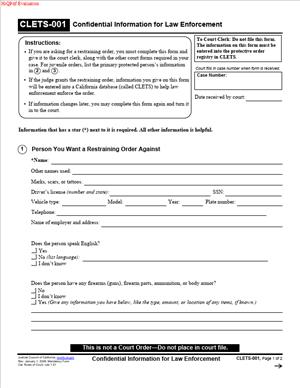
CLETS-001 – Confidential Information for Law Enforcement
Fill out nowJurisdiction: Country: United States | Province or State: California
If you are completing CLETS-001 – Confidential Information for Law Enforcement, you are likely dealing with a court matter that involves protected personal information. This form is designed to keep certain sensitive details out of the public court file while still making them available to law enforcement.
In California, many court documents become part of the public record. That means anyone can view them unless the law requires otherwise. CLETS-001 – Confidential Information for Law Enforcement creates a separate, confidential record for specific identifying details.
You may be filling out this form along with a restraining order request or another protective court filing. It is often submitted at the same time as the main documents in your case.
This form matters because it helps law enforcement accurately identify and locate the people involved. It also helps protect privacy by keeping certain information out of public view.
Understanding how this document works will help you complete it clearly and avoid delays in processing your filing.
What is CLETS-001 – Confidential Information for Law Enforcement?
Clear definition
CLETS-001 – Confidential Information for Law Enforcement is a California court form used to provide identifying information about a person involved in a case, usually in connection with a protective or restraining order.
The information you enter on this form is not placed in the public court file. Instead, it is transmitted to law enforcement through the California Law Enforcement Telecommunications System (CLETS). This allows officers to see and enforce court orders accurately.
The form typically asks for details such as full legal name, date of birth, physical description, and other identifiers. These details help prevent confusion between people with similar names.
Who typically uses this form?
This form is commonly used by individuals requesting restraining orders. That includes people seeking protection in cases involving domestic violence, civil harassment, workplace violence, elder abuse, or gun violence prevention.
Self-represented individuals often complete this document when filing their paperwork at a courthouse. Attorneys and legal aid professionals may also prepare it for clients.
Court clerks and judicial officers do not fill it out for you. You are responsible for providing accurate information based on what you know.
Law enforcement agencies rely on the completed form after it is processed by the court.
Why might you need this form?
You may need this form when the court requires confidential identifying details to enter a protective order into law enforcement databases.
Without accurate identifiers, officers may have difficulty confirming who is restrained or protected under an order. That can delay enforcement in urgent situations.
The form also protects sensitive data. For example, your date of birth or driver’s license number is generally not included in publicly accessible court papers. This separate document allows the court to collect that information without exposing it.
In many cases, the court will not process certain restraining orders unless this form is submitted.
Typical real-life scenarios
- You file for a domestic violence restraining order against a former partner. The court requires detailed information about that person so officers can enforce the order if needed. You complete this form to provide those details confidentially.
- You request a civil harassment restraining order against a neighbor who has threatened you. You know their full name and approximate age. You use the form to record that information so law enforcement can identify the correct individual.
- You are asking for protection on behalf of an elderly parent. You provide identifying details about the restrained person to reduce the risk of mistaken identity.
- You are seeking a gun violence restraining order. Accurate identifying information helps officers enforce firearm restrictions safely and efficiently.
When would you use CLETS-001 – Confidential Information for Law Enforcement?
You typically use this form when submitting paperwork that results in a court order entered into a statewide law enforcement database.
It is most often used in protective order proceedings. That includes situations involving alleged threats, harassment, abuse, stalking, or violence.
You may complete it at the start of a case, when you first file your request for court protection. In some situations, updated information may be submitted later if details change or were previously unknown.
If you are filing as a guardian, conservator, employer, or family member, you may provide information about the person to be restrained. The form focuses on identifying the restrained person and sometimes the protected person, depending on the type of case.
Court staff use the information after a judge issues an order. Law enforcement officers then rely on what is entered into the system when responding to calls or conducting enforcement actions.
Legal characteristics of CLETS-001 – Confidential Information for Law Enforcement
This form functions as a confidential data sheet rather than a public pleading. It supports the enforcement of court orders but does not itself request relief from the court.
For the form to be effective, it must be complete and legible. Missing dates of birth, incomplete names, or unclear handwriting can cause delays or data entry problems. Inaccurate details may result in difficulties when officers attempt to confirm identities.
The form is associated with orders that may carry significant legal consequences, such as firearm restrictions or arrest for violations. Because of that, accuracy is critical.
In California, courts follow specific procedures for transmitting protective orders into the CLETS system. Other states use different systems and may have different forms or processes. This document is specific to California’s procedures and databases.
The form does not replace the main restraining order request. It does not explain the facts of your case. It does not serve as proof of abuse or harassment. It strictly provides identifying information to support enforcement.
If the information appears inconsistent with the main court documents, the court may need clarification before processing the order.
Is it legally binding?
The form itself is not a court order. It does not create legal obligations by itself.
However, it supports orders that can be legally binding once signed by a judge. When the court issues a restraining order and enters it into the law enforcement system, officers can enforce it based on the data provided.
If you knowingly provide false information, that can carry legal consequences because the document is submitted in connection with a court proceeding.
Once processed, the information becomes part of a confidential law enforcement record linked to the court’s order. The enforceability comes from the judge’s signed order, not from this document alone.
How to fill out CLETS-001 – Confidential Information for Law Enforcement
Step 1 – Identify the case and court
At the top of the form, enter the court name and location exactly as shown on your other court papers. Include the case number if one has already been assigned. Make sure this information matches your main filing so the documents are connected correctly.
Step 2 – Provide the restrained person’s full legal name
Enter the complete legal name of the person to be restrained. Include first, middle, and last names, and any known aliases. If the person uses other spellings or nicknames, list them in the space provided. Accurate naming reduces confusion in law enforcement records.
Step 3 – Add physical description details
Fill in the physical characteristics requested, such as sex, date of birth, height, weight, hair color, and eye color. If you do not know an exact detail, provide your best estimate rather than leaving it blank, unless the form instructs otherwise. Clear descriptions help officers confirm identity in the field.
Step 4 – Include identifying numbers if known
The form may ask for a driver’s license number, state identification number, or other identifying numbers. Provide this information only if you know it. Double-check each digit for accuracy. Even small errors can lead to incorrect records.
Step 5 – Enter additional identifying information
If the form includes space for social security number, vehicle information, or other identifiers, complete those sections carefully. Only provide information you genuinely know. This section strengthens the reliability of the record entered into the law enforcement system.
Step 6 – Review for consistency with your main filing
Before submitting, compare the details on this form with your restraining order request or other related documents. Names, spellings, and dates should match across all papers. Consistency helps prevent processing delays.
Step 7 – Sign and date if required
Some versions of the form require a signature. If so, sign and date where indicated. By signing, you confirm that the information is accurate to the best of your knowledge.
Step 8 – Submit the form with your court papers
File this document at the same time as your main request for a protective order, unless instructed otherwise. Keep a copy for your records if allowed. Once filed, the court will handle transmitting the information to law enforcement as part of the order process.
Legal terms you might encounter in CLETS-001 – Confidential Information for Law Enforcement
- CLETS: This stands for California Law Enforcement Telecommunications System. It is the statewide computer system law enforcement uses to access protective orders and other critical safety information. This form supplies the data that gets entered into that system.
- Restrained Person: This is the individual the court order applies to. In this document, you provide detailed identifying information about this person so law enforcement can correctly identify them.
- Protected Person: This is the individual who is protected by the court’s order. While this document focuses on the restrained person’s identifiers, it connects to a case that names the protected person.
- Confidential Information: This refers to personal identifying details that are not placed in the public court file. The court uses this information for law enforcement purposes only, which is why accuracy matters.
- Physical Description: This includes details such as sex, race, height, weight, hair color, eye color, and age or date of birth. These details help officers distinguish between people with similar names.
- Identifying Numbers: These may include a driver’s license number or other government-issued identification number. If known, these numbers greatly reduce the risk of mistaken identity.
- Case Number: This is the unique number assigned by the court to your case. You must enter it exactly as it appears on your other court documents so the information is matched correctly.
- Law Enforcement Entry: This means the process of entering the order and identifying data into the law enforcement database. The information you provide on this document supports that entry.
- Service of Process: This refers to formally delivering court papers to the restrained person. While this document does not itself prove service, the information you provide helps officers confirm they are serving the correct individual.
FAQs
Do I have to file CLETS-001 – Confidential Information for Law Enforcement with every restraining order request?
In most situations involving protective or restraining orders, this document is required because law enforcement needs identifying details to enter the order into their system. Check your court’s filing instructions or packet list to confirm it is included. If your packet lists this form, complete and submit it at the same time as your main request.
What happens if I do not know the restrained person’s date of birth?
Provide as much information as you reasonably can. If you do not know the exact date of birth, leave that field blank rather than guessing. Then make sure you complete other identifiers, such as physical description or known ID numbers, so this form still helps law enforcement identify the correct person.
Will the restrained person see the information I list in this document?
This document is designed for law enforcement use and is not part of the public court file. It is used to enter accurate data into the law enforcement system. You should still assume that basic identifying information may become known during the case, so keep your entries truthful and consistent with your other filings.
Can I estimate height and weight if I am not sure?
You should avoid wild guesses. However, reasonable estimates based on your knowledge are generally better than leaving the fields blank. Make sure your estimates are realistic and consistent with any police reports or prior court documents connected to the case.
Do I need to attach copies of identification documents?
This form usually does not require you to attach copies of identification. Instead, you enter the information directly into the fields provided. Only attach additional pages if the form itself gives you space for extra details and you truly need more room.
What if the name on this form does not exactly match the name on my main request?
The names must match exactly across your documents. Before filing, compare the spelling, middle initials, and suffixes like Jr. or Sr. If there is a mismatch, correct it so the court and law enforcement do not treat them as two different people.
Does this document change anything in the public court record?
This document supports law enforcement entry of the order, but does not change the legal terms of your restraining order. The judge’s signed order controls what is enforceable. This form simply ensures officers can find and confirm that order quickly.
What should I do if I later learn new identifying information?
If you discover additional details, such as a correct birth date or ID number, contact the court clerk to ask about updating your filing. Accurate information helps prevent confusion during enforcement. Do not alter filed documents on your own without following proper court procedures.
Checklist: Before, During, and After CLETS-001 – Confidential Information for Law Enforcement
Before
- Review your main restraining order request to confirm the exact spelling of names.
- Gather any documents that show the restrained person’s full legal name.
- Locate any known identifying numbers, such as a driver’s license number.
- Write down the restrained person’s date of birth, if known.
- Note the physical description details you are confident about.
- Confirm your court case number from the clerk or your stamped paperwork.
- Read the form once fully before writing anything.
- Set aside time to complete it without rushing.
During
- Print clearly or type if possible.
- Enter the case number exactly as it appears on your other filings.
- Spell the restrained person’s name consistently with your main documents.
- Fill in each identifying field you know without guessing.
- Use realistic estimates only when exact details are unknown.
- Double-check numbers for transposed digits.
- Keep handwriting legible and within the boxes.
- Review each line before moving to the next section.
After
- Compare the completed form against your main request for consistency.
- Make a copy for your personal records.
- Submit it together with your restraining order paperwork.
- Confirm with the clerk that all required forms were accepted.
- Store your copy in a safe, organized file.
- Note the filing date for your records.
- Follow up if the court notifies you of missing information.
- Update your records if any corrections are later filed.
Common mistakes to avoid with CLETS-001 – Confidential Information for Law Enforcement
- Mistake: Guessing critical identifiers like date of birth or ID numbers because you feel pressure to fill every box, which can lead to incorrect law enforcement database entries and enforcement confusion; do not forget that leaving a field blank is better than inserting false information.
- Mistake: Spelling the restrained person’s name differently than on your main restraining order forms because you are rushing, which may cause mismatched records; do not forget to compare every version of the name before filing.
- Mistake: Transposing numbers in a driver’s license or case number due to simple typing errors, which can delay proper entry into the system; do not forget to read each number digit by digit.
- Mistake: Leaving out physical description details you actually know because you think they are unimportant, which reduces clarity for officers in the field; do not forget that even basic traits help confirm identity.
- Mistake: Failing to include the correct case number because you assume the clerk will add it later, which can disconnect the form from your file; do not forget that you are responsible for entering the correct case reference.
- Mistake: Forgetting to make a personal copy before submitting, which leaves you without proof of what information you provided; do not forget to keep an organized record for your own protection.
- Mistake: Submitting the form separately from your restraining order packet because you completed it later, which can delay processing; do not forget to file all required documents together whenever possible.
- Mistake: Writing illegibly due to stress or haste, which increases the risk of data entry errors by court staff; do not forget to slow down and print clearly.
What to do after filling out CLETS-001 – Confidential Information for Law Enforcement
Once you complete the form, pause and review it line by line. Make sure the case number matches your other documents. Confirm the spelling of names and check every number carefully.
Next, organize your full restraining order packet. This document should be grouped with your main request and any required attachments. Keep the pages in the correct order according to your court’s filing instructions.
- Step 1: Make at least one clear copy of the completed form for your personal records.
- Step 2: Place the original form with the rest of your court paperwork.
- Step 3: Submit the packet to the court clerk using the filing method allowed in your case, such as in person or another approved method.
- Step 4: Ask the clerk to confirm that all required forms, including this one, have been received.
- Step 5: Check whether the clerk stamps or marks your copy to show it was filed.
- Step 6: Store your copy in a safe location with your other case documents.
- Step 7: Monitor your case status and watch for any notice from the court about missing or incomplete information.
- Step 8: If you later learn new identifying details, contact the clerk to ask about the proper way to update the record.
- Step 9: Keep a written log of filing dates, hearing dates, and any follow-up actions you take.
- Step 10: Bring your copy of the filed paperwork to any related hearing in case questions arise about the identifying information provided.
Staying organized after filing helps you respond quickly if the court requests clarification. It also gives you confidence that law enforcement has the information they need to enforce the order accurately.
Disclaimer: This guide is provided for informational purposes only and is not intended as legal advice. You should consult a legal professional.