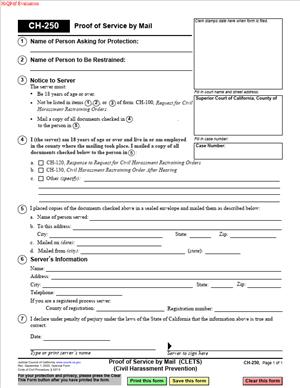
CH-250 – Proof of Service by Mail
Fill out nowJurisdiction: Country: United States | Province or State: California
If you are involved in a civil harassment case in California, you may need to complete CH-250 – Proof of Service by Mail. This form confirms that court papers were mailed to another party in the case.
CH-250 – Proof of Service by Mail is not the document that starts your case. It is the document that proves you properly delivered paperwork to someone else. Courts rely on this form to confirm that everyone received notice.
If you are representing yourself, this form helps you show the court that you followed the correct mailing process. Without proof of service, the judge may not review your documents.
This form is commonly used in civil harassment matters handled by California courts. It connects directly to court filings related to restraining orders and related hearings.
Understanding how this form works makes the filing process smoother. It also reduces the risk that your submission will be delayed or rejected.
What is CH-250 – Proof of Service by Mail?
Clear definition
CH-250 – Proof of Service by Mail is a California court form used to confirm that legal documents were mailed to another party in a civil harassment case. It creates a written record of who mailed the documents, what was mailed, when it was mailed, and where it was sent.
In court procedures, “service” means delivering legal papers in a legally recognized way. This form specifically documents service by mail, not personal delivery.
The person who mails the documents completes and signs the form. That person states, under penalty of perjury, that the mailing occurred as described.
Once completed, the form is filed with the court. It becomes part of the official case record.
Who typically uses this form?
This form is often used in civil harassment restraining order cases. The person requesting the order, or the person responding to it, may need to use it.
If you filed documents after the initial request, such as a response, declaration, or other court papers, you may need to serve them by mail. When that happens, CH-250 – Proof of Service by Mail documents that mailing.
The person who fills out the form is not the party to the case if they are the one mailing the papers. In many situations, someone over 18 who is not involved in the case handles the mailing and completes the form.
Self-represented individuals frequently use this form when managing their own case without an attorney.
Why might you need this form?
Courts require proof that each party received copies of documents filed in the case. If you file a document but do not prove service, the court may not act on it.
This form provides that proof when mailing is the chosen method of delivery. It confirms that notice was given in a way the court recognizes.
You may need this form after filing a response to a restraining order request. You may also need it when submitting additional declarations, evidence, or written arguments.
If the court orders you to serve documents by mail, this form is how you show compliance with that order.
Typical real-life scenarios
- You filed a response to a civil harassment restraining order. The court requires that the other party receive a copy. A friend mails the response for you and completes this form to confirm it was sent.
- You are the petitioner and submitted additional evidence before the hearing. You mailed copies to the respondent. The person who mailed them fills out this form so the judge knows notice was given.
- The court continued your hearing and required updated documents to be served. You arranged for mailing and used this form to show the court that the updated papers were delivered.
- You received a court date change and needed to inform the other side by mail. The mailing is documented using this form and filed with the court before the next hearing.
- Each of these situations involves written communication between parties. The form ensures the court sees that the process was followed.
When would you use CH-250 – Proof of Service by Mail?
Use CH-250 – Proof of Service by Mail when documents in a California civil harassment restraining order case are permitted to be served by mail. The form records who mailed the documents, what was mailed, the recipient’s address, and the date and location of mailing.
CH-250 cannot ordinarily be used for the initial restraining-order papers that must be personally served on the person to be restrained. Those documents generally require personal service and a different proof-of-service form. CH-250 is primarily used for later documents when the applicable rules or a court order allow service by mail.
For example, a person responding to a civil harassment restraining-order request may have a copy of CH-120, Response to Request for Civil Harassment Restraining Orders, mailed to the person seeking protection. The server then completes CH-250 to prove that the response was mailed. The form may also document mailing of CH-130, Civil Harassment Restraining Order After Hearing, or another document that may lawfully be served by mail.
Either side may rely on CH-250 when mailing is permitted, but the protected person or restrained person does not ordinarily complete the service personally. The server must:
- Be at least 18 years old
- Not be a party identified in the applicable sections of CH-100
- Live or work in the county where the mailing occurs
- Place the documents in a sealed envelope
- Mail them to the correct address
- Complete and sign CH-250 under penalty of perjury
The server should list every document included in the envelope. Multiple documents mailed together to the same person on the same date may generally be recorded on one form. Separate forms may be appropriate when documents are mailed on different dates, sent to different recipients, or mailed from different locations.
CH-250 may also be used after a hearing is continued if the court permits updated declarations, evidence, or other materials to be served by mail. However, the parties should review the continuance order carefully because it may require personal service of particular documents or establish a specific method and deadline.
Timing is important. The mailing date recorded on CH-250 may determine whether service was completed early enough for the court to consider the documents. Mailing rules may add time or require service a certain number of court or calendar days before the hearing. The filing deadline and service deadline are not necessarily the same.
After signing the form, the server should return it to the party who arranged service. That party should file it with the court before the hearing or other deadline and retain a filed copy. CH-250 proves mailing; it does not prove that the recipient personally read the documents.
Do not use CH-250 merely because mailing is more convenient. Confirm that the particular documents may legally be served by mail. If personal service is required, mailing the papers and filing CH-250 will not satisfy that requirement.
Legal characteristics of CH-250 – Proof of Service by Mail
This form becomes part of the official court record once filed. It serves as evidence that service was completed in the manner described.
For the form to be effective, it must be filled out completely and signed by the person who performed the mailing. That person declares the information is true under penalty of perjury.
Common problems include missing signatures, incorrect addresses, incomplete document descriptions, or listing the wrong case number. Any of these issues can cause delays.
The mailing must be done by someone who meets the basic requirements for serving documents. If the wrong person performs the service, the proof may not be accepted.
The address used must match the recipient’s last known address as provided in the case. If the address is incorrect, service may be challenged.
This form does not replace the documents being served. It only confirms they were mailed. The court will still review the actual documents separately.
It also does not guarantee that the recipient actually read the papers. It confirms that the mailing occurred as stated.
Procedural details can vary depending on the type of hearing and stage of the case. Some documents require personal service rather than mail. This form is only used when mailing is permitted.
Is it legally binding?
CH-250 – Proof of Service by Mail carries legal weight because it is signed under penalty of perjury. That means the person signing declares that the information is true to the best of their knowledge.
If the information is false, there can be serious legal consequences. This declaration gives the form credibility in court.
The form itself does not create new rights or obligations between the parties. Instead, it verifies that procedural requirements were met.
Its legal effect depends on accurate completion and proper filing. If the service did not actually occur as stated, the court may disregard it.
When properly completed and filed, the form supports the court’s authority to proceed with hearings or rulings because it shows notice was provided.
How to fill out CH-250 – Proof of Service by Mail
Step 1 – Identify the court and case information
At the top of the form, enter the name and address of the court handling your civil harassment case. Fill in the case number exactly as it appears on other court documents. Write the names of the petitioner and respondent in the spaces provided. This information must match the existing court record.
Step 2 – Provide the server’s information
Enter the name, address, and contact details of the person who mailed the documents. This person must be at least 18 years old and not a party to the case if required by court rules. The server is the one who completes and signs the form.
Step 3 – Confirm eligibility to serve by mail
The form includes statements confirming that the server is over 18 and not involved in the case. The server reads these statements carefully. By completing this section, the server confirms they meet the basic requirements to perform service by mail.
Step 4 – List the documents mailed
Clearly identify each document that was mailed. Use the full title of each document, such as a response, declaration, or notice. If more space is needed, attach an additional page and reference it on the form. The descriptions must match the titles on the filed documents.
Step 5 – Enter the name and address of the person served
Write the full name of the person who received the mailing. Provide the complete mailing address used, including street, city, state, and zip code. This should be the address where the documents were actually sent.
Step 6 – Provide mailing details
Enter the date the documents were placed in the mail. Include the city and state from which they were mailed. The date must reflect the actual mailing date, not the date the form is signed unless they are the same.
Step 7 – Choose the mailing method description
The form may include options describing how the mailing was handled, such as depositing the sealed envelope with prepaid postage in the mail. The server selects or confirms the statement that accurately reflects what was done.
Step 8 – Sign under penalty of perjury
The server prints their name, signs the form, and enters the date of signing. By signing, the server declares under penalty of perjury that the information is true and correct. The signature must be handwritten unless electronic filing rules allow otherwise.
Step 9 – File the completed form with the court
After signing, the completed CH-250 – Proof of Service by Mail is filed with the court clerk or submitted through the appropriate filing process. A copy may be kept for personal records. Once filed, the proof of service becomes part of the official case file.
Legal terms you might encounter in CH-250 – Proof of Service by Mail
- Proof of Service: This is a written statement confirming that legal documents were delivered to another party. On this form, it specifically confirms that the documents were sent by mail. Courts rely on proof of service to confirm that everyone received proper notice.
- Declarant: The declarant is the person who fills out and signs the form stating that they mailed the documents. This person must meet eligibility requirements, such as being at least 18 years old and not a party to the case. The declarant signs under penalty of perjury.
- Party: A party is someone directly involved in the case, such as the petitioner or respondent. The person completing this form cannot be a party. The form asks you to identify who was served and their role in the case.
- Service by Mail: This means delivering legal documents by sending them through the postal system. The form records the date and location of mailing. It also confirms the address used.
- Penalty of Perjury: When the declarant signs the form, they state that the information is true and correct. Making a false statement under penalty of perjury can lead to serious consequences. The signature confirms the truthfulness of the mailing details.
- Address of Record: This is the official mailing address listed with the court for a party or attorney. Service by mail must be sent to the correct address of record. The form requires you to clearly write this address.
- Date of Service: This is the date the documents were placed in the mail. It is not the date they were received. The form requires you to specify this exact date.
- Court Case Number: This is the unique number assigned to your case. You must enter it exactly as it appears on other court documents. The court uses this number to match the proof of service to the correct file.
- Documents Served: These are the specific forms or papers you mailed. The form requires you to list each document clearly. If you served multiple items, you must name them all.
- Server: The server is the individual who physically mailed the documents. The server must meet eligibility rules and provide their name and address. The server signs the declaration.
FAQs
Who is allowed to complete and sign this form?
Only someone who is at least 18 years old and not involved as a party in the case may complete and sign this document. If you are the petitioner or respondent, you cannot mail the documents yourself and sign the declaration. The person who actually places the documents in the mail must be the one who signs under penalty of perjury.
Do I need to list every document I mailed?
Yes. This document requires you to list each item that was mailed. If you mailed multiple forms, attachments, or notices, you must name them clearly so the court knows exactly what was sent. Leaving out a document can create confusion about what the other side received.
What date should I enter as the date of service?
You must enter the exact date the documents were placed in the mail. Do not use the date you prepared the paperwork unless that is also the mailing date. The court calculates certain deadlines from the mailing date, so accuracy matters.
What address do I use for the person being served?
Use the mailing address listed in the court file for that person or their attorney. If an attorney represents the party, you typically mail the documents to the attorney’s address of record. Double-check spelling, suite numbers, and zip codes to avoid delivery issues.
What happens if I make a mistake on CH-250 – Proof of Service by Mail?
If you notice an error before filing, correct it neatly or complete a new form. If the form has already been filed and the mistake affects important details such as the mailing date or address, you may need to complete and file a corrected CH-250 – Proof of Service by Mail. The court needs accurate information to confirm valid service.
Do I file this form before or after I mail the documents?
You complete and sign this document after the documents are mailed. The signature confirms that the mailing has already occurred. Once signed, you file it with the court to show that service has been completed.
What if the person says they never received the documents?
This form does not guarantee that the other party actually received the documents. It confirms that the documents were properly mailed. As long as mailing was done correctly and documented, the court generally treats service as completed on the mailing date listed.
Does this form change anything in the public court record?
This document updates the case record to show that notice was provided. It does not change the restraining order or other filings. It simply creates a record that specific documents were mailed on a specific date to a specific address.
Checklist: Before, During, and After CH-250 – Proof of Service by Mail
Before
- Confirm that the person serving is at least 18 years old and not a party in the case.
- Gather all documents that need to be mailed.
- Verify the correct mailing address for the person or attorney being served.
- Confirm the correct court name and case number.
- Make copies of all documents to be mailed.
- Check that envelopes are properly addressed and include sufficient postage.
- Review deadlines to ensure mailing occurs on time.
During
- Place the correct documents into the envelope.
- Double-check that the address on the envelope matches the address written on the form.
- Deposit the envelope in the mail on the stated date.
- Complete all required sections of the form clearly and legibly.
- List each document served without skipping any items.
- Enter the exact date and city/state of mailing.
- Have the server sign under penalty of perjury.
After
- Make a copy of the signed proof of service for your records.
- Attach the proof of service to the documents if required for filing.
- File the completed form with the court clerk.
- Confirm that the clerk accepts and processes the filing.
- Keep stamped copies in a safe place.
- Track any response deadlines triggered by the mailing date.
- Update your case file to reflect the service date.
Common mistakes to avoid with CH-250 – Proof of Service by Mail
- Mistake: Letting a party to the case mail the documents because it feels faster, which happens due to convenience, can invalidate service and delay your case, so do not forget that the server must be independent and over 18.
- Mistake: Listing only one document when multiple forms were mailed because you assume the court already knows, which can create disputes about what was served, so do not forget to name every single document.
- Mistake: Writing the wrong mailing date because you used the date you signed the paperwork instead of the mailing date, which can affect deadlines, so do not forget to confirm the exact date the envelope entered the mail.
- Mistake: Using an outdated or incomplete address because you relied on memory, which may result in returned mail and service challenges, so do not forget to verify the current address of record.
- Mistake: Forgetting to sign under penalty of perjury because you focused on mailing first, which makes the form invalid, so do not forget that the server’s signature is required.
- Mistake: Filing the form before the documents are actually mailed because you are trying to stay ahead, which makes the declaration inaccurate, so do not forget to sign only after the mailing occurs.
- Mistake: Writing illegibly or leaving blank spaces because you rushed, which can cause clerk rejection, so do not forget to complete every required field clearly.
- Mistake: Failing to keep a copy of the signed form because you assume the court keeps everything accessible, which can create problems if questions arise later, so do not forget to retain a stamped copy for your records.
What to do after filling out CH-250 – Proof of Service by Mail
Once the server signs the form, your next steps focus on filing and recordkeeping. The court needs this document to confirm that proper notice was provided. Without it, your case may stall.
- Step 1: Make at least two copies of the signed form. One is for your records. One may be for the other party if required.
- Step 2: Attach the proof of service to the documents you are filing, if they are being submitted together.
- Step 3: File the signed form with the court clerk in the same case listed on the form.
- Step 4: Confirm that the case number and party names match the court’s file before submitting.
- Step 5: Ask the clerk to stamp your copy as “filed” so you have confirmation.
- Step 6: Store your stamped copy in your case folder with the documents that were mailed.
- Step 7: Mark the mailing date on your calendar to track any response deadlines.
- Step 8: Monitor the court docket or case file to ensure the filing appears in the record.
- Step 9: Keep mailing details, including receipts or notes, in case questions arise later.
- Step 10: Review upcoming hearing dates and confirm that all required parties were properly served in advance.
Stay organized. Accurate service records protect you if the other side claims they were not notified. The form creates a clear paper trail showing when and how documents were mailed. Maintaining copies and tracking deadlines helps you move your case forward without unnecessary delays.
Disclaimer: This guide is provided for informational purposes only and is not intended as legal advice. You should consult a legal professional.