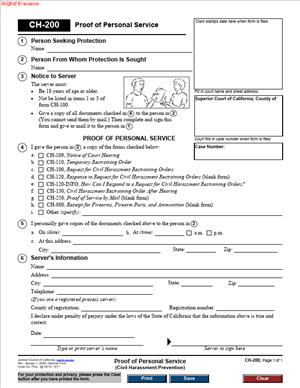
CH -200 – Proof of Personal Service (Civil Harassment Prevention)
Fill out nowJurisdiction: Country: United States | Province or State: California
If you are involved in a civil harassment case, CH -200 – Proof of Personal Service (Civil Harassment Prevention) plays a critical role in your filing. This document shows the court that the other party was properly handed the required legal papers.
In California civil harassment cases, the court cannot move forward unless the restrained person has been officially served. This form provides written confirmation that the service happened correctly.
You may be the person requesting protection, or you may be helping someone who is. Either way, the completion of this form directly affects whether your hearing can proceed.
CH -200 – Proof of Personal Service (Civil Harassment Prevention) is not about proving your claims. It is about proving delivery. Courts rely on it to confirm fairness and proper notice.
Understanding what this form does will help you avoid delays and rejected filings. Below, you will find a clear explanation of how it works and how to complete it accurately.
What is CH -200 – Proof of Personal Service (Civil Harassment Prevention)?
Clear definition
CH -200 – Proof of Personal Service (Civil Harassment Prevention) is a court form used to confirm that legal documents were personally delivered to the restrained person in a civil harassment case.
“Personal service” means someone physically handed the papers to the other party. It does not include mailing them or leaving them at a doorstep. The delivery must be direct.
This document is completed by the person who performed the service, not by the person who filed the request for protection. The server fills out the form to describe when, where, and how the documents were delivered.
Once signed, the form is filed with the court as part of your case record.
Who typically uses this form?
This form is commonly used by petitioners in civil harassment cases. The petitioner is the person asking the court for protection.
However, the petitioner did not complete the service section. Instead, an adult who is not involved in the case performs the service and fills out the form. This may be a friend, a relative, a professional process server, or a law enforcement officer, depending on the situation.
The restrained person does not complete this form. It is strictly a record of delivery created by the server.
Court clerks and judges review the completed document to determine whether proper service occurred.
Why might you need this form?
You need this form to show the court that the restrained person received notice of the hearing and any temporary orders.
Without proof of personal service, the court may not move forward with your hearing. In many cases, the judge cannot issue long-term orders unless proper service is confirmed.
The form protects both parties. It ensures the restrained person has a fair opportunity to prepare and appear in court.
It also creates a written record in case the other party later claims they were never notified.
Typical real-life scenarios
- You requested a civil harassment restraining order against a neighbor. The court scheduled a hearing and issued temporary orders. Before the hearing, someone over 18 personally hands the neighbor the court papers. That person then completes this form to confirm delivery.
- You are helping a family member who filed for protection against a former roommate. You agree to serve the papers. After handing them directly to the roommate, you complete the proof of service form and provide it for filing.
- A professional process server is hired to deliver documents to a coworker accused of harassment. The server completes the form after confirming the identity of the person served.
- A law enforcement officer personally serves the restrained person because of safety concerns. The officer completes the form, which is later submitted to the court.
- In each example, the case cannot proceed properly unless the court receives written proof of personal service.
When would you use CH -200 – Proof of Personal Service (Civil Harassment Prevention)?
You use this form after the court has issued a hearing date and provided documents that must be delivered to the restrained person.
Typically, this occurs shortly after filing a request for civil harassment restraining orders. The court clerk returns stamped copies of your paperwork, including a notice of hearing.
Before the scheduled court date, someone who is at least 18 years old and not involved in the case personally hands those documents to the restrained person. Immediately after service is completed, the server fills out this form.
The timing matters. Courts generally require service to be completed a certain number of days before the hearing. If the service happens too late, the hearing may be postponed.
This form is also used when temporary restraining orders were granted. The restrained person must receive those orders directly so they understand the restrictions placed on them.
Petitioners, process servers, friends, and sometimes law enforcement officers are involved in the process. The court relies on the form to verify that proper steps were taken.
Legal characteristics of CH -200 – Proof of Personal Service (Civil Harassment Prevention)
This form becomes part of the official court file once submitted. It serves as sworn evidence that personal service occurred.
The person who performed the service signs the form under penalty of perjury. That means they are declaring the information is true to the best of their knowledge.
For the form to be effective, it must include accurate details. This usually includes the name of the person served, the date and time of service, the address where service took place, and a list of documents delivered.
Incomplete information often causes problems. Missing dates, unsigned declarations, or incorrect case numbers may result in rejection or delays.
The server must meet eligibility requirements. In California civil harassment cases, the server must be at least 18 years old and not a party to the case. If the petitioner personally served the papers, the proof may not be accepted.
This form does not establish whether the harassment occurred. It does not prove the claims in your request. It only confirms the delivery of documents.
Courts focus closely on proper service because it relates to due process. The restrained person must receive notice before orders affecting them can be enforced long term.
Is it legally binding?
The form itself does not create restraining orders. Instead, it supports the court’s authority to move forward.
Because the server signs under penalty of perjury, the statements on the form carry legal weight. False statements may have serious consequences.
Once accepted by the court, the completed form becomes part of the official case record. Judges rely on it to confirm that notice requirements were met.
If the court determines that service was improper or incomplete, it may delay the hearing or require service to be completed again.
How to fill out CH -200 – Proof of Personal Service (Civil Harassment Prevention)
Step 1 – Enter the case information
At the top of the form, fill in the court name and address exactly as shown on your other case documents. Enter the names of the petitioner and the restrained person in the spaces provided. Write the case number carefully. It must match the number assigned by the court.
Step 2 – Identify the server
The person who delivered the documents fills in their full name, address, and contact information. This confirms who performed the service. The server must verify that they are at least 18 years old and not involved in the case.
Step 3 – Identify the person served
Enter the full name of the restrained person who received the documents. Make sure the spelling matches the court paperwork. Accuracy here is important for court review.
Step 4 – Provide the service details
The server records the exact date and time the documents were handed to the restrained person. The address or location of service must also be listed. This could be a home, workplace, or another location where personal delivery occurred.
Step 5 – List the documents delivered
The form includes a section to check or describe which papers were served. This often includes the request for civil harassment restraining orders, the notice of hearing, and any temporary restraining orders issued. The server confirms each document that was handed over.
Step 6 – Confirm method of service
The server indicates that the service was personal. This confirms that the papers were directly handed to the restrained person. If additional forms were included, those are noted in this section.
Step 7 – Sign under penalty of perjury
The server signs and dates the declaration at the end of the form. By signing, the server confirms that all information provided is true. The signature must be original if filing on paper, unless electronic filing rules apply in your court.
Step 8 – File the completed form with the court
After signing, the completed form is returned to the petitioner for filing, or the server files it if arranged. The form is then submitted to the court clerk before the hearing date so the judge can review proof of service.
Legal terms you might encounter in CH -200 – Proof of Personal Service (Civil Harassment Prevention)
- Personal Service: Personal service means the documents were physically handed to the person being served. On this form, the server confirms that they directly delivered the papers to the restrained person. This is different from mailing. The court relies on this statement to confirm proper notice.
- Server: The server is the person who delivers the documents. This person must be at least 18 years old and not a party to the case. The form requires the server’s name, address, and contact details so the court can verify who performed the service.
- Person Served: This is the individual who received the documents. The form asks for the full name of the person served and sometimes a physical description if needed to confirm identity. Accuracy here is critical because the court needs proof that the correct individual was notified.
- Case Number: The case number is assigned by the court when the harassment case is filed. It appears at the top of the form. The number must match exactly with the number on all other filed documents so the proof of service is placed in the correct court file.
- Protected Person: In civil harassment cases, the protected person is the individual seeking protection. While this form focuses on serving the restrained person, the protected person’s name appears in the case caption. You must ensure names are spelled exactly as shown in the court’s records.
- Restrained Person: The restrained person is the individual against whom protection is requested. This is the person who must be personally served. The form confirms that this individual received copies of the petition, temporary orders, and notice of hearing.
- Notice of Hearing: This is the document that tells the restrained person the date, time, and location of the court hearing. The form requires the server to list this as one of the documents delivered. Without proof that the notice was served, the hearing may be delayed.
- Temporary Restraining Order (TRO): A TRO is a short-term court order that may be issued before a full hearing. If granted, it must be personally served along with the petition. The form confirms whether a TRO was included in the documents delivered.
- Declaration Under Penalty of Perjury: The server signs the form under penalty of perjury. This means the information provided must be true. False statements can lead to serious legal consequences, including fines or criminal charges.
- Date and Time of Service: The form requires the exact date and time when the documents were handed to the restrained person. This detail helps the court confirm that service occurred within the required timeframe before the hearing.
FAQs
Does the server have to use CH -200 – Proof of Personal Service (Civil Harassment Prevention) for every civil harassment case?
Yes. When documents are handed directly to the restrained person, this form is used to show the court that proper notice was given. If the court requires personal delivery, you cannot substitute a different proof of service form. Make sure you are using the version that matches the type of service completed.
What if the restrained person refuses to take the papers?
If the server clearly identifies the person and informs them that the papers are court documents, the server can leave the documents in their presence. The server should note the date, time, and location accurately. Refusal to physically accept the papers does not necessarily invalidate service if the documents were left close to the person after identification.
Can I serve the papers myself?
No. You cannot serve the papers if you are a party in the case. The server must be at least 18 years old and not involved in the case. This document requires the server to confirm that they are not a party, and the court may reject it if this requirement is not met.
What happens if the name on this form does not exactly match the court documents?
The court may question whether the correct person was served. Even small spelling errors can create confusion. Check the case caption and copy the names exactly as shown. Consistency helps prevent delays or challenges at the hearing.
Do I need to file this form before the hearing date?
Yes. The court must receive proof that the restrained person was served before the hearing can move forward. File the completed document as soon as possible after service. Waiting too long can result in the hearing being postponed.
What if the server made a mistake on the form after signing it?
If the mistake is minor and caught before filing, the server can complete a new form with the correct information and sign it again. If the form was already filed, you may need to file a corrected version. The court must have accurate details about who was served and when.
How do I confirm the court accepted the filing?
After filing, check with the clerk to confirm the document was entered into the case record. You may receive a stamped copy showing the filing date. Keep this copy for your records so you can prove the court has proof of service on file.
What documents must be listed as served on this form?
The server must list every document handed to the restrained person. This often includes the petition, notice of hearing, and any temporary orders. If a document is missing from the list, the court may treat it as not served, which can affect what the judge is allowed to enforce.
Checklist: Before, During, and After CH -200 – Proof of Personal Service (Civil Harassment Prevention)
Before
- Confirm the correct case number and court name.
- Review all documents that must be personally delivered.
- Ensure the server is at least 18 and not involved in the case.
- Make clear, complete copies of every document to be served.
- Verify the hearing date and service deadline.
- Double-check the restrained person’s full legal name.
- Provide the server with clear instructions about identifying the person.
- Prepare a blank copy of the form for the server to complete.
During
- Identify the restrained person before handing over documents.
- Clearly inform the person that the papers are court documents.
- Hand the documents directly to the person whenever possible.
- Note the exact date of service.
- Record the exact time of service.
- Write down the full address where the service occurred.
- List every document delivered.
- Avoid confrontation and remain calm and professional.
After
- Have the server complete the form immediately.
- Review the form for accuracy and completeness.
- Ensure the server signs under penalty of perjury.
- Make copies of the signed form.
- File the original with the court clerk.
- Confirm the court accepted the filing.
- Keep a stamped copy for your records.
- Bring a copy to the hearing.
- Update your case file with the service details.
Common mistakes to avoid with CH -200 – Proof of Personal Service (Civil Harassment Prevention)
- Mistake: Letting a party to the case serve the papers, which happens when someone tries to save time, but the court can reject the proof of service and delay the hearing; do not forget the server must be independent and over 18.
- Mistake: Writing the wrong case number, which often happens when copying from memory, and this can cause the form to be filed in the wrong case or rejected; do not forget to copy the number exactly from the petition.
- Mistake: Forgetting to list all documents served, which occurs when multiple papers are attached, and the judge may refuse to enforce orders not listed; do not forget to check each document against your service packet.
- Mistake: Leaving out the time of service, which seems minor but can raise questions about whether deadlines were met; do not forget to include both date and exact time.
- Mistake: Illegible handwriting, which happens when forms are completed quickly, and the clerk may reject unclear entries; do not forget to print clearly or type if possible.
- Mistake: Failing to file the completed form before the hearing, which can lead to postponement; do not forget that the court must have proof of service on record.
- Mistake: Signing before confirming all details are correct, which may require refilling if errors are discovered; do not forget to review every entry before signing under penalty of perjury.
- Mistake: Serving too close to the hearing date, which can violate required notice periods and delay your case; do not forget to check service deadlines early.
What to do after filling out CH -200 – Proof of Personal Service (Civil Harassment Prevention)
Once the server completes and signs the form, your job is to make sure it reaches the court and is properly recorded. Do not assume that service alone is enough. The court must see written proof.
Start by reviewing the completed form carefully. Confirm that the case number matches your other documents. Check that the restrained person’s name is spelled correctly. Make sure the date, time, and address of service are filled in.
- Step 1: Make at least two copies of the signed form.
- Step 2: Keep one copy for your personal records.
- Step 3: File the original with the court clerk as soon as possible.
- Step 4: Ask the clerk to stamp your copy as “filed.”
- Step 5: Confirm that the document is entered into the case record.
- Step 6: Place the stamped copy in your case file folder.
- Step 7: Bring a copy with you to the hearing.
- Step 8: Review your hearing paperwork to ensure all served documents are listed.
- Step 9: Update your calendar and notes to reflect that the service is complete.
- Step 10: Prepare to explain service details at the hearing if the judge asks.
If the clerk identifies an issue, correct it immediately. You may need the server to complete a new form. Act quickly so your hearing date is not affected.
Keep your filed copy in a safe place. Courts rely heavily on proof of service. If questions arise at the hearing, you will be ready to show that proper notice was given. Being organized and proactive reduces stress and keeps your case on track.
Disclaimer: This guide is provided for informational purposes only and is not intended as legal advice. You should consult a legal professional.