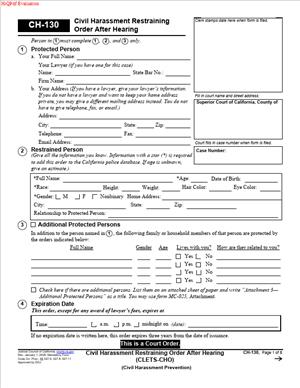
CH-130 – Civil Harassment Restraining Order After Hearing (CLETS-CHO) (Civil Harassment Prevention)
Fill out nowJurisdiction: Country: United States | Province or State: California
If you recently went to court for a civil harassment restraining order, the CH-130 – Civil Harassment Restraining Order After Hearing (CLETS-CHO) (Civil Harassment Prevention) is the document that reflects the judge’s final decision. It is the official order issued after the hearing.
This form is not the request for protection. It is the court’s signed order that states what the restrained person can and cannot do. It may include personal conduct orders, stay-away orders, and other specific restrictions.
You may be filling it out because the judge granted your request at the hearing. In many cases, the judge approves the terms in court, and someone must prepare this written order for signature.
This document matters because it becomes enforceable once signed and entered. Law enforcement agencies rely on it. The restrained person is legally bound by its terms once it is properly issued and served.
Understanding how this form works helps you avoid delays. Small mistakes can slow down the entry of the order or cause confusion about what protections are in place.
What is CH-130 – Civil Harassment Restraining Order After Hearing (CLETS-CHO) (Civil Harassment Prevention)?
Clear definition
CH-130 – Civil Harassment Restraining Order After Hearing (CLETS-CHO) (Civil Harassment Prevention) is a court order issued after a judge holds a hearing in a civil harassment case. It sets out the final terms of the restraining order.
The document summarizes what the court decided. It identifies the protected person, the restrained person, and the specific orders made. It also states how long the order will last.
This form is part of the civil harassment process in California. It is entered into a statewide law enforcement system so officers can confirm the order if needed.
Who typically uses this form?
The protected person, also called the petitioner, often prepares this form after the hearing if the judge grants protection. In some cases, court staff may prepare it.
The restrained person, also called the respondent, receives a copy after it is signed and filed. Law enforcement agencies may also access it through official channels.
Self-represented individuals commonly encounter this form. Many people in civil harassment cases do not have attorneys, so they must understand how the order is written and processed.
Why might you need this form?
You need this form when the judge decides to issue a civil harassment restraining order after a hearing. The temporary order you may have had before the hearing does not last forever.
If the judge grants ongoing protection, the court must issue a written order that clearly states the rules. Without this signed document, enforcement becomes difficult.
This form also clarifies details discussed in court. Verbal rulings are important, but the written order controls day-to-day enforcement.
Typical real-life scenarios
- You may have ongoing problems with a neighbor who repeatedly threatens or harasses you. After filing a request and attending a hearing, the judge grants a restraining order. This form reflects that decision.
- You may be dealing with harassment from a former friend, roommate, or acquaintance. The court finds that the behavior meets the legal standard for civil harassment and issues an order to prevent further contact.
- In some cases, someone experiences stalking behavior from a person they do not have a close relationship with. After presenting evidence at a hearing, the court orders the restrained person to stay a certain distance away.
- Workplace-related conflicts can also lead to civil harassment cases, especially when the parties are not close family members. If a judge determines protection is necessary, this document sets the enforceable boundaries.
When would you use CH-130 – Civil Harassment Restraining Order After Hearing (CLETS-CHO) (Civil Harassment Prevention)?
Use Form CH-130, Civil Harassment Restraining Order After Hearing, after the court conducts a hearing and grants a civil harassment restraining order. It is not the form used to begin the case or request temporary protection.
Typically, the petitioner first files a Request for Civil Harassment Restraining Orders and may receive temporary orders. The court then schedules a hearing, where the petitioner and respondent can present evidence, testimony, and arguments. After considering the evidence, the judge decides whether longer-term protection should be ordered.
If the judge grants the request, Form CH-130 records the court’s final terms. Depending on the ruling, the order may prohibit harassment, threats, stalking, contact, or surveillance. It may also require the restrained person to stay a specified distance from the protected person, their home, workplace, school, vehicle, or other identified locations. The form can include additional protected persons, firearm and ammunition restrictions, and other orders made at the hearing.
The judge may announce the principal terms in court and direct the petitioner, an attorney, or court staff to prepare the written order. The completed form must accurately reflect the judge’s ruling and should not add restrictions that were not ordered. It becomes enforceable once the judge signs it and it is filed by the court.
The restrained person must receive a copy of the signed order. Whether personal service is required depends on attendance at the hearing and whether the final order differs from any temporary orders previously served. The petitioner should also keep a copy available and confirm that law enforcement receives the information needed for entry into the California restraining-order system.
If the court denies the request, Form CH-130 generally is not used to create an active restraining order. Any temporary orders normally expire as directed by the court, and the judge or clerk may document the denial or dismissal through the appropriate court record.
Carefully review the signed form for the expiration date, protected persons, prohibited conduct, stay-away distances, and any exceptions. Only the court may change or terminate the order. The parties should follow its terms unless and until the judge signs a later order modifying or ending it.
Legal characteristics of CH-130 – Civil Harassment Restraining Order After Hearing (CLETS-CHO) (Civil Harassment Prevention)
This document becomes effective once it is signed by the judge and filed with the court. It contains identifying information about both parties and describes the prohibited conduct in clear terms.
It typically includes personal conduct orders, such as no harassment, no threats, and no contact. It may also include stay-away distances from home, work, school, or other locations.
The order often has a fixed duration. Civil harassment restraining orders commonly last up to several years, depending on what the judge orders. The expiration date is stated on the form.
For the order to function properly, it must be accurate and complete. Missing names, incorrect addresses, or unclear terms can create enforcement issues. Inconsistent information between what the judge said and what is written may lead to delays in signing.
The form is entered into a law enforcement system so officers can confirm the order if a violation is reported. That entry depends on correct information.
This document does not resolve unrelated legal disputes. It does not decide property ownership, divide assets, or address broader civil claims unless specifically included and authorized. Its main purpose is to prevent harassment and protect personal safety.
Procedures and terminology can differ slightly between states. In California, civil harassment restraining orders are distinct from domestic violence restraining orders, which apply to certain close relationships. This form is used in civil harassment cases involving non-intimate or non-family relationships.
Is it legally binding?
Yes, once the judge signs and the order is properly issued and served, it is legally binding on the restrained person. The restrained person must follow all listed terms.
The order gains legal force because it is a court directive. Violating its terms can lead to enforcement action, including possible criminal consequences or further court proceedings.
For the order to be enforceable, the restrained person must receive proper notice. Service of the signed order is a key part of the process. Without proper service, enforcement may become complicated.
The protected person is not restricted by the order unless the form specifically includes mutual orders, which are less common and require certain findings. In most cases, the restrictions apply only to the restrained person.
How to fill out CH-130 – Civil Harassment Restraining Order After Hearing (CLETS-CHO) (Civil Harassment Prevention)
Step 1 – Complete the case caption
Fill in the court name and address exactly as shown on your other court documents. Enter the case number assigned to your matter. List the full legal names of the petitioner and respondent in the correct spaces.
Step 2 – Identify the protected and restrained persons
Clearly state who is protected by the order and who is restrained. Use full legal names. If there are additional protected persons, such as household members, include them where the form allows.
Step 3 – Record the hearing details
Enter the date of the hearing and the name of the judicial officer who presided. Indicate whether both parties were present or if one did not appear, based on what occurred in court.
Step 4 – Specify the personal conduct orders
Mark the boxes that reflect the judge’s rulings. These often include no harassment, no threats, no contact, and no stalking. Only include terms that the judge actually granted at the hearing.
Step 5 – Add stay-away orders
If the judge ordered the restrained person to stay a certain distance away, enter the specific number of yards and list the protected locations. These may include home, workplace, school, or vehicle.
Step 6 – Include any additional orders
If the judge made other specific orders, such as related to firearms or property return, record them exactly as stated. Keep the wording consistent with the court’s oral ruling.
Step 7 – State the expiration date
Write the date when the restraining order ends, as ordered by the judge. Confirm that the duration matches what was announced at the hearing.
Step 8 – Review for accuracy and clarity
Read the entire form carefully. Check names, dates, distances, and case numbers. Make sure the written terms match the judge’s decision and that no required sections are left blank.
Step 9 – Submit for the judge’s signature and filing
Provide the completed form to the court as directed so the judge can review and sign it. After it is signed and filed, obtain filed copies for service and recordkeeping.
Legal terms you might encounter in CH-130 – Civil Harassment Restraining Order After Hearing (CLETS-CHO) (Civil Harassment Prevention)
- Restrained Person: This is the person the court orders to follow specific restrictions. Their full legal name, date of birth, and identifying details must be accurate. Law enforcement relies on this information to enforce the order correctly.
- Protected Person: This is the person who asked for protection and whom the court has decided to protect. The order lists each protected person by name. Only those listed receive the legal protection described in the document.
- Personal Conduct Orders: These are direct commands about behavior. They usually prohibit harassment, threats, stalking, contacting, or disturbing the peace of the protected person. The restrained person must follow these terms exactly as written.
- Stay-Away Orders: These orders set minimum distance requirements. The document may list specific places, such as a home, workplace, school, or vehicle. The restrained person must stay at least the stated number of yards away from each location.
- CLETS: This stands for California Law Enforcement Telecommunications System. When the order is entered into CLETS, law enforcement agencies can see and enforce it statewide. The accuracy of names and dates is critical because the system matches by identifying information.
- Expiration Date: This is the date the restraining order ends. The order remains fully enforceable until 11:59 p.m. on that date unless the court changes it earlier. You must check this section carefully to know how long the protections last.
- Service: Service means officially delivering court documents to the restrained person. The order is enforceable once it has been properly served, unless the restrained person was present in court when the judge made the order. Proof of service becomes part of the court record.
- Firearms Prohibition: This section states that the restrained person may not own, possess, buy, or receive firearms or ammunition. The order may require them to turn in or sell firearms within a specific time frame. Violating this term can lead to criminal consequences.
- Proof of Service: This is a separate document showing that the restrained person received the order. It includes details about when, where, and how the service occurred. Without proper proof of service on file, enforcement may be delayed.
- Modification or Termination: These terms refer to later court actions that change or end the order. Any changes must be made by a judge and reflected in a new court order. Until then, the existing order remains in full effect.
FAQs
When does the CH-130 – Civil Harassment Restraining Order After Hearing (CLETS-CHO) (Civil Harassment Prevention) take effect?
It takes effect as soon as the judge signs it. If the restrained person was present at the hearing, the order is enforceable immediately. If they were not present, it becomes enforceable once they are properly served and proof of service is completed.
How do I confirm the expiration date of this form?
Look at the section that states the duration of the order. You will see a specific calendar date and sometimes a time. Make sure the date is clearly written and matches what the judge announced in court.
What if the restrained person’s name or date of birth is spelled incorrectly?
You should review every identifying detail before leaving the courthouse. If you notice an error, bring it to the clerk’s attention right away. Law enforcement uses this information in CLETS, and even small errors can cause enforcement problems.
Does this document need to be filed separately after the hearing?
Usually, the clerk files it once the judge signs it. You should confirm with the clerk that it has been entered into the system. Ask for stamped copies for your records.
What attachments might be included with this form?
Additional pages may list extra protected persons, detailed stay-away locations, or specific conditions. Review all attached pages carefully. Every attachment is part of the court order and is legally enforceable.
What happens if the restrained person was not at the hearing?
You must arrange for personal service of this document unless the court states otherwise. After service, file the proof of service form with the court. Keep a stamped copy with you in case law enforcement needs to see it.
Is this form entered into a law enforcement database?
Yes. Once processed, the information is transmitted to CLETS. That allows officers to confirm the order during a traffic stop or emergency call. Accurate names and dates are essential for proper entry.
Can the terms be changed after the judge signs the CH-130 – Civil Harassment Restraining Order After Hearing (CLETS-CHO) (Civil Harassment Prevention)?
Yes, but only through a new court order. Either party must file a request to modify or terminate the order. Until the court approves a change in writing, the existing terms remain fully enforceable.
Checklist: Before, During, and After CH-130 – Civil Harassment Restraining Order After Hearing (CLETS-CHO) (Civil Harassment Prevention)
Before
- Review your hearing notes to confirm what the judge ordered.
- Verify the correct spelling of all names and identifying details.
- Confirm all protected persons are listed.
- Check that all requested locations are included in stay-away orders.
- Prepare a list of specific distances ordered by the judge.
- Bring photo identification to court.
- Organize any attachments the judge referenced.
- Allow extra time for the clerk to process after the hearing.
During
- Listen carefully as the judge states each order.
- Compare the written terms to what was said in court.
- Confirm the expiration date before leaving.
- Ask the clerk how and when the order will be entered into CLETS.
- Request multiple certified copies.
- Clarify service requirements if the restrained person is absent.
- Check that firearm restrictions are clearly marked.
- Ensure all attachments are stapled and referenced properly.
After
- Make several copies of the signed order.
- Keep one copy with you at all times.
- Provide copies to your workplace or school if needed.
- Arrange for service if required.
- File proof of service promptly.
- Store the original in a safe place.
- Calendar the expiration date.
- Document any violations in writing.
- Contact law enforcement if the order is violated.
Common mistakes to avoid with CH-130 – Civil Harassment Restraining Order After Hearing (CLETS-CHO) (Civil Harassment Prevention)
- Mistake: Leaving the courthouse without checking the spelling of names, which happens when you assume the court has everything correct; this can cause enforcement delays because law enforcement may not find the order in CLETS, so do not forget to review every identifying detail before you leave.
- Mistake: Failing to confirm the expiration date, often because you rely on memory from the hearing; this can lead to confusion about whether the order is still active, so do not forget to read the exact end date printed on the document.
- Mistake: Not arranging for proper service when the restrained person missed the hearing, which happens when you assume mailing is enough; this can make the order unenforceable, so do not forget to complete and file proof of service.
- Mistake: Ignoring attached pages, which happens when you focus only on the first sheet; this can cause you to miss key protections or restrictions, so do not forget to review every attachment carefully.
- Mistake: Failing to keep accessible copies, often because you store the order away and forget about it; this can delay law enforcement response, so do not forget to keep a copy with you and provide copies where needed.
- Mistake: Assuming verbal changes override the written order, which happens when informal conversations occur after the hearing; this can expose you to risk because only written court orders control, so do not forget that modifications require a new signed order.
What to do after filling out CH-130 – Civil Harassment Restraining Order After Hearing (CLETS-CHO) (Civil Harassment Prevention)
Once the judge signs the order, your focus shifts to enforcement and recordkeeping. This document is not just paperwork. It is a court command that may need to be shown quickly in a stressful situation.
Start by confirming that the clerk has filed the signed original. Ask whether the order has been entered into CLETS. This step ensures law enforcement can see it in their system.
- Step 1: Obtain at least three to five certified copies from the clerk.
- Step 2: Review each copy to make sure it matches the signed original exactly.
- Step 3: If the restrained person was not present, arrange for personal service promptly.
- Step 4: Complete and file proof of service with the court.
- Step 5: Keep one copy with you at all times, such as in a folder or bag you regularly carry.
- Step 6: Provide copies to security personnel, your employer, your child’s school, or building management if the order includes those locations.
- Step 7: Store the original in a safe but accessible place at home.
- Step 8: Mark the expiration date on your calendar and set reminders in advance.
- Step 9: Keep a written log of any contact or attempted contact by the restrained person.
- Step 10: If a violation occurs, contact law enforcement and provide your copy of the order.
You should also update any personal safety plans you have in place. Inform trusted individuals about the order so they understand the boundaries set by the court. Clear communication helps others support enforcement if needed.
Maintain organized records. Keep copies of service documents, any police reports, and notes about incidents together in one folder. If you later request a modification or renewal, you will need this documentation.
Finally, monitor the expiration date well in advance. If you believe you need continued protection, begin preparing early so there is no gap between orders. Staying organized and proactive ensures the protections granted by the court remain meaningful and enforceable.
Disclaimer: This guide is provided for informational purposes only and is not intended as legal advice. You should consult a legal professional.