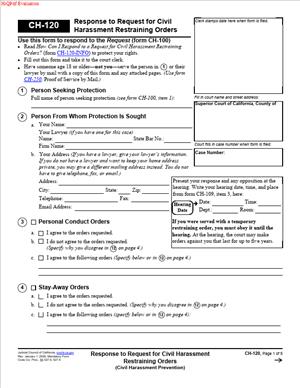
CH-120 – Response to Request for Civil Harassment Restraining Orders (Civil Harassment Prevention)
Fill out nowJurisdiction: Country: United States | Province or State: California
If you have been served with a request for a civil harassment restraining order in California, CH-120 – Response to Request for Civil Harassment Restraining Orders (Civil Harassment Prevention) is the form you use to tell the court your side of the story. It is your written response to the allegations made against you.
This document gives you a structured way to agree, disagree, or clarify what the other person has asked for. It also lets you explain what happened from your perspective before the court hearing.
You are typically the “respondent” on this form. The person who filed the restraining order request is the “petitioner.” The court reviews both sides before deciding whether to issue or extend a restraining order.
Filling out this form carefully matters. What you write may affect whether the court grants orders that can limit contact, communication, or proximity to another person.
Understanding how this document works can help you complete it clearly and confidently.
What is CH-120 – Response to Request for Civil Harassment Restraining Orders (Civil Harassment Prevention)?
Clear definition
CH-120 – Response to Request for Civil Harassment Restraining Orders (Civil Harassment Prevention) is a court form used in California civil courts. It allows a person who has been accused of harassment to formally respond to a request for a civil harassment restraining order.
The form is part of the civil harassment process. It is not used for family law restraining orders involving spouses, domestic partners, or close family members. Instead, it applies to situations such as disputes between neighbors, roommates, coworkers, classmates, or more distant relatives.
This document becomes part of the court record. A judge may read it before or during the hearing, where both sides can speak.
Who typically uses this form?
You use this form if someone has filed a Request for Civil Harassment Restraining Orders against you and you want to respond in writing. You are the respondent in the case.
Respondents can include neighbors involved in ongoing disputes, former friends, coworkers, business associates, landlords or tenants, or individuals who had brief personal interactions that led to conflict.
Sometimes a person uses this form to deny the allegations completely. In other cases, the respondent may agree to certain parts, such as staying a certain distance away, while disputing other claims.
Attorneys can complete this form on behalf of a client. However, many people fill it out on their own when representing themselves.
Why might you need this form?
If you were served with court papers requesting a restraining order, this form gives you a structured way to respond. Without a written response, the judge may rely mostly on the petitioner’s written statements and evidence before the hearing.
This form allows you to explain facts that you believe are missing or inaccurate. You can address specific incidents described in the request and provide your version of events.
You may also use the form to tell the court whether you agree to some or all of the requested orders. For example, you might state that you do not object to a no-contact order but dispute claims of violence or threats.
In addition, the form gives you space to request your own related orders in some situations, such as asking that the petitioner stop certain behavior toward you. This does not automatically create a restraining order against the other person, but it informs the court of your concerns.
Typical real-life scenarios
- A neighbor files a restraining order after repeated arguments about noise and property boundaries. You believe the situation has been exaggerated and want to explain that there were no threats or harassment. This form allows you to respond point by point.
- A former friend claims you sent threatening messages. You believe the messages were taken out of context and want to provide a fuller explanation. Completing this form lets you clarify what happened.
- A coworker alleges that you followed them or contacted them repeatedly. You may want to state that any communication was work-related and not intended as harassment. Your response becomes part of the record the judge reviews.
- A roommate claims you damaged property and made threats during a dispute. You may use the form to deny those claims and describe your version of events, including any witnesses or documents that support you.
- In each of these situations, the form gives you a formal way to present your position before the hearing.
When would you use CH-120 – Response to Request for Civil Harassment Restraining Orders (Civil Harassment Prevention)?
You use this form after you have been served with a Request for Civil Harassment Restraining Orders, and a hearing date has been set. The court papers you received will usually include information about when and where the hearing will take place.
Timing matters. The response is generally filed before the hearing, so the court and the petitioner have notice of your position. Filing earlier can allow the judge to review your written explanation in advance.
You might use this form if you disagree with the claims made against you. It allows you to state that you did not engage in harassment, threats, stalking, or violence.
You may also use it if you agree to certain practical restrictions but do not admit to wrongdoing. For example, you may indicate that you do not object to staying a certain distance away, even if you dispute the reasons given.
If you believe the petitioner has also engaged in concerning behavior toward you, this form provides limited space to describe that context. It does not automatically create a cross-case, but it can inform the court’s understanding of the situation.
In general, you use this document whenever you want your voice included in the court’s review of the restraining order request.
Legal characteristics of CH-120 – Response to Request for Civil Harassment Restraining Orders (Civil Harassment Prevention)
This form is part of an official court process in the California civil court. To be effective, it must be completed accurately, signed, and filed with the court handling the case. Court clerks typically require that the case number and party names match the original request exactly.
The document usually must be served on the petitioner or their attorney after filing. Service means delivering a copy in a way allowed by court rules. The court may require proof that this was done.
Common problems that delay or weaken a response include leaving sections blank, failing to address key allegations, not signing the form, or missing the filing deadline. Incorrect case numbers or party names can also create confusion.
What you write should be consistent with other documents and any evidence you plan to present at the hearing. Large contradictions between your written response and oral statements in court can raise questions about credibility.
Procedural details can vary slightly by county, such as filing hours or local formatting requirements. The core purpose of the form remains the same throughout California.
This document does not replace the hearing. Even if you file a response, the judge will usually hold a hearing where both sides can speak and present evidence.
It also does not automatically dismiss or cancel any temporary restraining orders that may already be in place. Temporary orders often remain effective until the hearing unless the court changes them.
Is it legally binding?
The act of filling out and filing the form itself does not create a restraining order or impose restrictions. It is a response document, not an order.
However, when you sign the form, you are typically declaring under penalty of perjury that the information is true to the best of your knowledge. That declaration carries legal significance.
The content of the form becomes part of the official court file. A judge may rely on it when deciding whether to grant, deny, or modify a restraining order.
If the court ultimately issues a restraining order after considering the request and your response, that court order is legally binding. Violating a court-issued restraining order can carry serious legal consequences.
How to fill out CH-120 – Response to Request for Civil Harassment Restraining Orders (Civil Harassment Prevention)
Step 1 – Read the request carefully
Before writing anything, review the Request for Civil Harassment Restraining Orders that was served on you. Pay attention to each allegation, the specific orders requested, and the hearing date. Understanding what the petitioner is asking for helps you respond clearly and directly.
Step 2 – Complete the caption information
At the top of the form, fill in the court name, branch location, and case number exactly as they appear on the original paperwork. Enter the petitioner’s name and your name in the correct spaces. Accuracy here ensures your response is filed in the correct case.
Step 3 – Identify yourself as the respondent
In the section that asks who you are, confirm that you are the person responding to the request. Provide your contact information as required on the form. This helps the court and the other party identify you properly in the case record.
Step 4 – Respond to the requested orders
The form lists different types of orders the petitioner may have requested, such as personal conduct orders or stay-away orders. For each type, indicate whether you agree, disagree, or partially agree. Be clear and direct when marking your responses.
Step 5 – Explain your version of events
Use the space provided to describe what happened from your perspective. Address specific incidents mentioned in the request. Focus on facts, dates, and actions rather than general statements. If you need more space, you may attach additional pages as allowed by the form instructions.
Step 6 – Mention any related court cases if applicable
If there are other court cases involving you and the petitioner, such as prior restraining orders or related disputes, the form may ask you to disclose them. Provide the requested information accurately so the court has a full picture of the situation.
Step 7 – Review your statements carefully
Read through your completed form slowly. Check that names, dates, and details are correct. Make sure your responses are consistent and complete. Clear and organized information makes it easier for the judge to understand your position.
Step 8 – Sign and date the form
Sign the declaration section where required. By signing, you are confirming that the information is true to the best of your knowledge. Include the date of signing in the space provided.
Step 9 – File and arrange for service
Submit the completed form to the court listed on the paperwork. After filing, ensure that a copy is properly served on the petitioner or their attorney according to court procedures. Keep copies for your records and bring them to the hearing along with any supporting documents you plan to present.
Legal terms you might encounter in CH-120 – Response to Request for Civil Harassment Restraining Orders (Civil Harassment Prevention)
- Petitioner: The person who asked the court for protection. On this form, the petitioner is the person whose allegations you are responding to. Their name must match exactly what appears on the original request and court paperwork.
- Respondent: You. This is the person accused of harassment and against whom restraining orders are requested. Your name must be written exactly as it appears in the case caption, even if it includes a middle initial or suffix.
- Temporary Restraining Order (TRO): A short-term order that may already be in effect before the hearing. The court may have issued it without hearing your side. This document allows you to state whether you agree or disagree with continuing those restrictions.
- Personal Conduct Orders: Specific behavior the petitioner wants the court to prohibit, such as contacting, threatening, or harassing them. You respond directly to these requested limits and explain your position.
- Stay-Away Orders: Distance requirements. The petitioner may ask the court to order you to stay a certain number of yards away from them, their home, job, school, or other locations. You must indicate whether you agree or object to these distances.
- Protected Person: The individual the restraining order is meant to protect. Sometimes this includes additional family or household members. Check carefully who is listed so you can respond accurately.
- Hearing Date: The scheduled court date when a judge will decide whether to grant longer-term orders. This date appears on the notice you received. You must file and serve your response before this date.
- Proof of Service: A separate form showing that someone else delivered your completed response to the petitioner. The court will not consider your response unless service is properly completed and documented.
- Firearm Restriction: A possible court order requiring you to surrender, sell, or store firearms. If a temporary order includes this, you must comply immediately and use this response to state your position regarding any continued restriction.
- Attachments: Extra pages you include if you need more space to explain your side. Each attachment should clearly reference the section number of this document that it relates to and include the case number.
FAQs
Do I have to file CH-120 – Response to Request for Civil Harassment Restraining Orders (Civil Harassment Prevention) before the hearing?
You are not always legally required to file a written response, but it is strongly recommended. If you want the judge to review your side in writing before the hearing, you must file this form on time. Check the hearing date on your notice and make sure your response is filed and served before that date so it becomes part of the court file.
What if I agree with some requests but not others?
This document allows you to respond to each requested order separately. You can agree to certain personal conduct or stay-away terms and disagree with others. Make sure you clearly mark which items you accept and which you oppose so the judge understands your position.
How detailed should my explanation be in the section where I tell my side of the story?
Focus on specific facts. Include dates, locations, and what was actually said or done. Avoid general statements like “this is not true.” Instead, describe the event from your perspective and clarify what the judge needs to know to decide whether the requested orders are necessary.
Can I attach evidence to this form?
Yes. If you have text messages, emails, photos, or other documents that support your explanation, you can attach copies. Clearly label each attachment and refer to it in your written explanation. Bring the originals with you to the hearing, even if you attach copies to your response.
What happens if I miss the filing deadline?
If you do not file before the hearing, the judge may still let you speak in court. However, the court may not have reviewed your written position in advance. Filing on time ensures your response is officially recorded and shared with the other party.
Do I need to serve the petitioner with a copy of my response?
Yes. After you complete and file this form, someone who is not you and is legally allowed to serve documents must deliver a copy to the petitioner. That person must complete a proof of service form. Without proof of service, the court may not consider your written response.
What if the information in the request is completely false?
Use the explanation section of this document to clearly deny the specific statements you believe are false. Address each major allegation separately. Judges look for organized, fact-based responses rather than emotional reactions.
Will anything I write in this document become part of the public record?
Yes. Once filed, this form becomes part of the court file. The statements you make may be accessible as part of the official record. Write carefully, stick to relevant facts, and avoid including unnecessary private details that are not related to the case.
Checklist: Before, During, and After CH-120 – Response to Request for Civil Harassment Restraining Orders (Civil Harassment Prevention)
Before
- Read the original request and any temporary orders line by line.
- Highlight each allegation so you can respond to it directly.
- Confirm the hearing date, time, and department.
- Gather documents, messages, photos, or witness information that support your version of events.
- Make a timeline of relevant incidents to keep your explanation organized.
- Check the case number and spelling of names exactly as listed.
- Review any firearm-related terms in existing temporary orders.
During
- Complete the caption exactly as it appears on court documents.
- Mark clearly whether you agree or disagree with each requested order.
- Write specific facts with dates and locations.
- Attach additional pages if you need more space and label them correctly.
- Review your statements for clarity and accuracy.
- Sign and date the form where required.
- Make at least two copies of everything for your records and for service.
After
- File the original with the court clerk before the hearing date.
- Arrange for proper service by someone who is not you.
- Ensure a proof of service form is completed and filed.
- Keep a complete copy of all filed documents in a safe place.
- Prepare your documents and evidence for the hearing.
- Note any deadlines or additional court instructions.
- Comply with any existing temporary orders until the judge changes them.
Common mistakes to avoid with CH-120 – Response to Request for Civil Harassment Restraining Orders (Civil Harassment Prevention)
- Mistake: Ignoring specific allegations because you feel they are minor; this happens when you assume the judge will overlook them, but unanswered claims may appear admitted, so do not forget to address each major point directly.
- Mistake: Writing emotional or insulting statements; this often happens when you feel attacked, but it can hurt your credibility in court, so do not forget to stay factual and professional.
- Mistake: Forgetting to serve the petitioner; many people think filing is enough, but without proper service, the court may disregard your response, so do not forget to complete and file proof of service.
- Mistake: Missing the hearing date; this can occur if you rely only on memory, and the judge may issue orders in your absence, so do not forget to calendar the date and confirm the time and location.
- Mistake: Failing to attach supporting documents; people assume verbal explanations are enough, but written evidence strengthens your position, so do not forget to label and reference attachments properly.
- Mistake: Not reading existing temporary orders carefully; this happens when you focus only on your response, but violating current restrictions can have serious consequences, so do not forget to comply with all active orders until the court changes them.
- Mistake: Using a different version of your name than what appears on court records; this often occurs when you shorten or modify your name, but mismatched names can cause filing issues, so do not forget to match the caption exactly.
What to do after filling out CH-120 – Response to Request for Civil Harassment Restraining Orders (Civil Harassment Prevention)
Once you complete your response, your job is not finished. You must make sure the court and the petitioner receive it correctly and on time.
- Step 1: Review the entire form one more time for accuracy, spelling of names, and the correct case number.
- Step 2: Make at least two copies of the completed form and any attachments.
- Step 3: File the original with the court clerk handling your case, either in person or through the court’s accepted filing method.
- Step 4: Confirm that the clerk stamps your copies or provides confirmation that the filing was accepted.
- Step 5: Arrange for someone over 18 who is not involved in the case to serve the filed copy on the petitioner.
- Step 6: Have the server complete a proof of service form immediately after delivery.
- Step 7: File the completed proof of service with the court before the hearing date.
- Step 8: Organize a hearing folder that includes your filed response, proof of service, original evidence, and notes.
- Step 9: Continue to follow any temporary restraining orders currently in place.
- Step 10: Prepare a short outline of what you plan to say in court so your presentation is clear and focused.
Keep all copies in a safe place. You may need them if questions arise about what was filed or served. If the judge issues new orders at the hearing, review them carefully and update your personal records to reflect any new restrictions or obligations. Staying organized helps you respond calmly and confidently throughout the process.
Disclaimer: This guide is provided for informational purposes only and is not intended as legal advice. You should consult a legal professional.