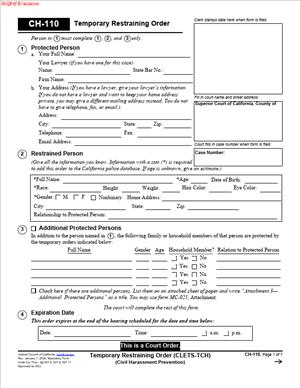
CH-110 – Temporary Restraining Order (CLETS-TCH) (Civil Harassment Prevention)
Fill out nowJurisdiction: Country: United States | Province or State: California
The CH-110 – Temporary Restraining Order (CLETS-TCH) (Civil Harassment Prevention) is a court document used in California civil harassment cases. It sets out temporary orders that a judge makes to protect someone from harassment, threats, stalking, or violence.
You usually see this form after a person files a request for a civil harassment restraining order. If the judge reviews that request and believes immediate protection may be needed, the judge completes and signs this form.
If you are involved in a civil harassment case, this document directly affects you. It may limit contact, require someone to stay away, or include other restrictions that take effect quickly.
Understanding this form matters because it is enforceable. Law enforcement can act on it. It also sets the stage for the court hearing, where a longer-term order may be decided.
Whether you are the person asking for protection or the person being restrained, you need to read every part carefully. The details control what is allowed and what is prohibited until the court hearing.
What is CH-110 – Temporary Restraining Order (CLETS-TCH) (Civil Harassment Prevention)?
Clear definition
The CH-110 – Temporary Restraining Order is a court-issued order that provides short-term protection in a civil harassment case. It is signed by a judge after reviewing the request filed by the person seeking protection.
This form is not something you draft yourself in the usual sense. The judge completes key sections, including what specific orders are granted or denied. Once signed, it becomes an official court order.
It typically lasts until the court hearing date listed in the document. At that hearing, the judge decides whether to issue a longer-term restraining order.
Who typically uses this form?
This form is used in civil harassment cases. These cases often involve neighbors, roommates, coworkers, distant relatives, or acquaintances. They are different from domestic violence cases, which use other forms.
The person asking for protection is called the petitioner. The person the order is against is called the respondent. Both parties are named clearly in the document.
If you filed a request for a civil harassment restraining order, you will receive this form if the judge grants temporary protection. If you are the respondent, you will be served with this form along with other case papers.
Law enforcement may also rely on this form. Once entered into the appropriate system, officers can confirm the existence of the temporary order.
Why might you need this form?
You may need this form if you believe someone is harassing, threatening, stalking, or harming you, and you need immediate protection before a full court hearing.
Civil court hearings take time. The temporary order fills the gap between filing your request and the hearing date. It provides short-term rules designed to reduce risk.
If you are the respondent, you need this form because it tells you exactly what restrictions apply to you right now. Violating it can lead to arrest or other consequences.
The form also clarifies what the judge did and did not grant. Sometimes a judge grants some requests but denies others. The details matter.
Typical real-life scenarios
- You and a neighbor have an ongoing dispute that escalates into repeated threats and aggressive confrontations. You file for protection, and the judge issues a temporary order requiring the neighbor to stay a certain distance away from you and your home.
- A former friend sends repeated threatening messages and shows up uninvited at your workplace. You request a restraining order, and the court grants a temporary no-contact order until the hearing.
- A roommate who has moved out continues to return to the property and harass you. The temporary order may prohibit contact and require the person to stay away from the residence.
- An acquaintance posts threatening statements about you and follows you in public. The judge may include personal conduct orders that prohibit harassment, stalking, or intimidation.
- In each of these situations, the temporary order is meant to reduce immediate risk while the court reviews the case more fully at a scheduled hearing.
When would you use CH-110 – Temporary Restraining Order (CLETS-TCH) (Civil Harassment Prevention)?
You use this document when a civil harassment case has already been started, and a judge has reviewed a request for protection. It comes into play after the initial filing, not before.
If you are the petitioner, you receive this form after the judge considers your written request. The judge may issue the temporary order the same day or shortly after you file.
If you are the respondent, you use this form to understand the restrictions placed on you. It informs you of the hearing date and the specific rules you must follow until then.
This form is commonly used in disputes that do not involve close family or dating relationships. For example, conflicts between neighbors, coworkers, or unrelated individuals often fall under civil harassment rules.
It is also used when the situation involves credible threats of violence or a pattern of harassment that causes substantial emotional distress. The temporary order addresses urgent concerns without waiting for both sides to appear in court.
The document may include orders about personal conduct, staying a certain distance away from a person or place, and firearm restrictions. Each case is different, and the judge selects which protections apply.
Legal characteristics of CH-110 – Temporary Restraining Order (CLETS-TCH) (Civil Harassment Prevention)
This form becomes effective once a judge signs it and it is properly issued by the court. It is an official court order, not a private agreement between individuals.
For the order to be enforceable against the respondent, it generally must be properly served. Service means the respondent is formally given the court papers in a legally recognized way. Without proper service, enforcement can become complicated.
The order is temporary. It usually remains in effect only until the hearing date listed in the document. At that hearing, the judge may end the order, extend it, or replace it with a longer-term restraining order.
Common problems that affect enforceability include incomplete information, incorrect names, or failure to serve the respondent correctly. If identifying details are wrong, law enforcement may have difficulty confirming the order.
The form often includes firearm restrictions. If granted, these provisions require the restrained person to follow specific rules about possession or control of firearms. These restrictions are taken seriously and are often enforced quickly.
It is important to understand what this document does not do. It does not resolve money disputes, divide property, or decide custody of children. It is focused on protection from harassment and related conduct.
While restraining order procedures are broadly similar across states, the specific forms and timelines vary. In California, this document is tailored to civil harassment cases and follows state court procedures.
Is it legally binding?
Yes, once signed by a judge and properly issued, this order is legally binding. It carries the authority of the court.
For the restrained person, this means the listed restrictions must be followed exactly as written. Violating the order can result in arrest, criminal charges, or other legal consequences.
For the protected person, the order provides a legal basis to seek enforcement. Law enforcement officers can rely on the signed order when responding to a reported violation.
The binding effect generally depends on proper notice. The restrained person must be formally served with the order before it can be fully enforced against them. The document itself includes sections related to service and notice.
The order remains binding until it expires on the date listed or until a judge changes it. Only the court can modify or terminate it before that time.
How to fill out CH-110 – Temporary Restraining Order (CLETS-TCH) (Civil Harassment Prevention)
Step 1 – Review the case caption
At the top of the form, you will see the court name, address, and case number. The names of the petitioner and respondent must match the original request exactly. Check spelling and identifying details carefully to avoid confusion.
Step 2 – Identify the protected person
The form lists the person or people protected by the order. This may include the petitioner and, in some cases, additional household members. Make sure all protected individuals are clearly named if the judge includes them.
Step 3 – Review personal conduct orders
This section states whether the respondent is prohibited from harassing, threatening, stalking, contacting, or disturbing the peace of the protected person. Read each line to see which boxes the judge checked. Only the checked items apply.
Step 4 – Review stay-away orders
The judge may order the respondent to stay a specific distance away from the protected person, their home, workplace, vehicle, or other locations. The distance is usually stated in yards. Confirm which locations are listed and the exact distance required.
Step 5 – Check for additional protected locations
Some orders include schools, childcare providers, or other frequent locations. These are written directly into the form. Make sure each address or description is clear and complete.
Step 6 – Look for firearm and ammunition restrictions
If granted, the form will state that the respondent must not own, possess, or control firearms or ammunition while the order is in effect. The form may also reference deadlines or procedures related to surrender. Read this section closely.
Step 7 – Note any denied requests
The judge may deny certain requested orders. The form usually indicates which requests were not granted. This helps you understand the limits of the temporary protection.
Step 8 – Confirm the expiration date and hearing information
The form lists the court hearing date, time, and department. It also states when the temporary order expires, usually at the end of the hearing. Record this information carefully, as the order generally ends if not extended by the judge.
Step 9 – Review service information
The order includes instructions about service on the respondent. Proper service is necessary for enforcement. The form may also include information for law enforcement entry into statewide systems.
Step 10 – Check the judge’s signature and date
The order is not valid without a judge’s signature and the date signed. Verify that both appear clearly on the document. Once signed and issued, the order takes effect as described in its terms.
Legal terms you might encounter in CH-110 – Temporary Restraining Order (CLETS-TCH) (Civil Harassment Prevention)
- Petitioner: The person asking the court for protection. This name appears at the top of the form and in the orders section. Make sure it matches the name used in the original request papers. Any difference can cause confusion when law enforcement reviews the order.
- Respondent: The person the restraining order is against. This name must be exact. It should match the respondent’s legal name as closely as possible. If there are known aliases, they may appear in the case caption or attachments.
- Temporary Restraining Order (TRO): A short-term court order that provides immediate protection. It stays in effect until the court hearing date listed in the document. This form shows what the judge granted, changed, or denied from the original request.
- Personal Conduct Orders: These are specific behavior restrictions. They usually prohibit harassment, threats, stalking, contact, or disturbing the peace. The document will list exactly what conduct is banned.
- Stay-Away Order: This section sets a required distance the respondent must keep from the protected person and specific locations. The distance is typically measured in yards. The order may include home, workplace, school, vehicle, or other listed places.
- Protected Person: The individual who is protected by the order. Sometimes it is only the petitioner. In other cases, additional people such as family members or household members are listed. Each protected person should be clearly named.
- Hearing Date: The scheduled court date when a judge will decide whether to issue a longer-term restraining order. The temporary order expires at the time stated unless extended by the court.
- Service of Process: The legal delivery of court papers to the respondent. The form usually includes instructions about how and when the respondent must be served. Proper service is required before the court can issue a longer-term order.
- Firearm Surrender: A requirement that the respondent turn in, sell, or store firearms and ammunition while the order is in effect. The order will state whether this restriction applies and may reference deadlines for compliance.
- Expiration Date: The exact date and time when the temporary order ends. It is printed on the first page. After this date, the temporary protections no longer apply unless the court extends or replaces them.
FAQs
When does this order actually start?
This order becomes effective as soon as the judge signs it and the date is entered on the document. You should look for the judge’s signature and the date near the end of the form. The protections are active even before the hearing, but they must be properly served on the restrained person before enforcement can usually occur.
How do I know what the judge approved or denied?
You need to carefully review each checked box on the form. Judges mark what is granted, modified, or denied from the original request. If a section is crossed out or marked “denied,” that protection is not in effect. Do not assume everything you asked for was approved. Only the marked sections apply.
Do I need to file CH-110 – Temporary Restraining Order myself?
In most cases, the court prepares and issues this document after reviewing your request. You usually do not draft it yourself. However, you must confirm that the clerk filed it and that you received a filed copy with a court stamp. Without a filed copy, you do not have proof of an active order.
What information must match exactly in this document?
Names, case number, and court location must match the original request and other case papers. Check spelling carefully. Even a small error in a name can cause problems with service or enforcement. Make sure the case number is the same on every page and attachment.
What happens if the restrained person violates the order?
If the restrained person does something prohibited in this document, that may be a violation. Law enforcement can only enforce what is clearly written in the order. That is why you should read each restriction closely and understand what behavior is banned. Keep a copy of the order available in case you need to show it.
Does this document change the public record?
Once filed, this document becomes part of the court record for the case. Law enforcement may enter the order into a statewide system for enforcement. The case number and names are part of the record. Review the filed copy to confirm it reflects accurate information before relying on it.
What if the hearing date listed does not work for me?
The hearing date is set by the court and printed on the form. If you have a serious conflict, you may need to request a continuance using the appropriate court process. Until the court changes the date, the listed hearing remains in effect. The temporary protections usually continue only until the stated expiration time.
What should I do if I notice an error on the CH-110 – Temporary Restraining Order?
Review the filed copy immediately. If you see a misspelled name, a wrong address, or an incorrectly checked box, contact the court clerk as soon as possible. Some errors require a formal correction by the judge. Do not ignore mistakes, because enforcement depends on what is written in this document.
Checklist: Before, During, and After CH-110 – Temporary Restraining Order (CLETS-TCH) (Civil Harassment Prevention)
Before
- Review the original request papers you submitted to understand what you asked the court to order.
- Gather identifying information for both parties, including correct legal names and case numbers.
- Prepare a list of locations that need protection, such as home, work, or school.
- Confirm current contact information so the court can notify you of updates.
- Check whether there are any related family, criminal, or civil cases.
- Arrange your schedule so you can attend the hearing on the listed date.
- Make a plan for the safe service of the documents to the respondent.
During
- Read every page of the signed order carefully before leaving the courthouse.
- Confirm the judge checked or marked the sections you expected.
- Verify the hearing date, time, and department are clearly listed.
- Check that the expiration date is printed and legible.
- Make sure the judge signed and dated the order.
- Request certified copies if available.
- Ask the clerk about the next steps for service and proof of service.
After
- Make multiple copies of the filed order for your records.
- Keep one copy with you at all times if possible.
- Provide copies to protected locations such as the workplace or school if appropriate.
- Arrange for proper service on the respondent according to court rules.
- File proof of service with the court before the hearing.
- Document any violations in writing with dates and details.
- Prepare evidence and witnesses for the hearing on the permanent order.
- Calendar the expiration date so you are not caught off guard.
Common mistakes to avoid with CH-110 – Temporary Restraining Order (CLETS-TCH) (Civil Harassment Prevention)
- Mistake: Assuming all requested protections were granted, which happens because people skim the form; this can lead to relying on restrictions that are not legally in effect, so do not forget to check every marked and unmarked box.
- Mistake: Failing to confirm the correct spelling of names and case numbers, often due to rushing at the clerk’s window; errors can delay enforcement or service, so do not forget to review the caption carefully.
- Mistake: Not arranging proper service, which happens when someone thinks the order is automatically delivered; without valid service, the court may not extend protection, so do not forget to file proof of service.
- Mistake: Missing the hearing date because it was not calendared, often due to stress or confusion; missing court can result in dismissal, so do not forget to record the date, time, and department immediately.
- Mistake: Ignoring firearm surrender terms, which can happen if you overlook that section; noncompliance can lead to serious legal consequences, so do not forget to read any firearm restrictions carefully.
- Mistake: Keeping only one copy of the order, usually because you assume you will not need more; this creates problems if you need to show proof quickly, so do not forget to make and store multiple copies.
- Mistake: Waiting until a violation happens to read the order closely, which occurs when you rely on memory; this can weaken enforcement efforts, so do not forget to understand each restriction in advance.
- Mistake: Not updating contact information with the court, often because you move or change phone numbers; missed notices can affect your case, so do not forget to inform the court of changes promptly.
What to do after filling out CH-110 – Temporary Restraining Order (CLETS-TCH) (Civil Harassment Prevention)
Once the judge signs the order, your focus shifts to implementation and preparation. This stage is just as important as filing the initial request. You need to make sure the order is enforceable and that you are ready for the next court date.
Start by reviewing the signed copy line by line. Confirm that all granted protections are clearly marked. Check that the hearing date and expiration date are visible and correct. Small clerical mistakes should be addressed immediately.
- Step 1: Obtain at least three filed copies of the signed order from the clerk.
- Step 2: Make additional personal copies for your home, vehicle, and workplace.
- Step 3: Arrange for proper service of the order and related papers on the respondent.
- Step 4: Ensure the person who serves the documents completes a proof of service form.
- Step 5: File the completed proof of service with the court before the hearing date.
- Step 6: Provide copies of the order to any protected schools, employers, or building security if needed.
- Step 7: Create a written log to document any contact or potential violations.
- Step 8: Save all messages, voicemails, emails, or social media contacts that may violate the order.
- Step 9: Prepare your evidence and organize it clearly for the upcoming hearing.
- Step 10: Arrive early on the hearing date with copies of all documents and proof of service.
You should also think about personal safety planning. Consider adjusting routines if necessary. Inform trusted individuals that an order is in place. Keep emergency numbers accessible.
Maintain organized records. Store your court documents together in a folder. Label them with the case number. This helps if you need to reference them quickly or provide them to law enforcement.
Finally, treat the expiration date seriously. Temporary protection does not automatically continue past that date. The hearing is your opportunity to request longer-term orders. Preparation and careful follow-through make a real difference in how smoothly your case proceeds.
Disclaimer: This guide is provided for informational purposes only and is not intended as legal advice. You should consult a legal professional.