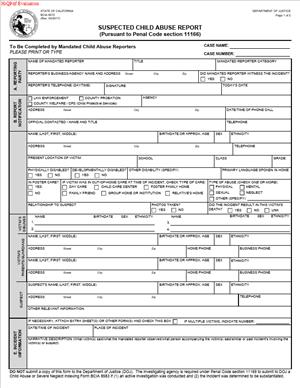
BCIA 8572 – Suspected Child Abuse Report (Pursuant to Penal Code section 11166)
Fill out nowJurisdiction: Country: United States | Province or State: California
The BCIA 8572 – Suspected Child Abuse Report (Pursuant to Penal Code section 11166) is the standard written form used in California to report suspected child abuse or neglect. It is commonly completed by professionals who are legally required to report concerns about a child’s safety.
If you are about to fill out this form, you are likely acting as a mandated reporter. That means your job or role places you in a position where the law requires you to report certain types of suspected abuse. This form is part of that reporting process.
The document captures specific details about the child, the suspected abuse, and the person believed to be responsible. It also records when and how the report was made to the appropriate agency.
This form matters because it creates an official record. It helps child welfare or law enforcement agencies assess risk and decide what action to take. Completing it clearly and accurately supports a timely response.
What is BCIA 8572 – Suspected Child Abuse Report (Pursuant to Penal Code section 11166)?
Clear definition
BCIA 8572 – Suspected Child Abuse Report (Pursuant to Penal Code section 11166) is a standardized California reporting document used to document suspected child abuse or neglect. It is typically submitted after a mandated reporter makes an initial report by phone.
The form organizes key facts in writing. It includes identifying information about the child, details about the suspected incident, and information about the reporter. The written submission helps confirm and supplement the initial verbal report.
This document belongs to the California Department of Justice and is used statewide. Its structure ensures that agencies receive consistent information from different reporters.
Who typically uses this form?
Most people who complete this form are mandated reporters. These often include teachers, school staff, health care providers, therapists, social workers, childcare providers, clergy members, and certain law enforcement personnel.
You may also use this form if your job brings you into regular contact with children and state law classifies you as a mandated reporter. In many workplaces, employers train staff on when and how to complete the form.
In some cases, a supervisor may assist with the process. However, the individual who observed or received the information usually completes and signs the report.
Why might you need this form?
You may need this form if you have a reasonable suspicion that a child has been abused or neglected. The standard for reporting is generally suspicion, not proof.
The form is used after you make an immediate or initial report to a designated agency, typically by phone. The written report follows to document the details in a structured format.
Completing the form helps ensure that the receiving agency has accurate information. It also documents that you fulfilled your reporting obligation within the required time frame.
Typical real-life scenarios
- You are a teacher and notice repeated, unexplained bruises on a student. The child gives a vague explanation that does not match the injury. You make a phone report and then complete the written form to document what you observed and what the child said.
- You are a nurse in an emergency department. A child arrives with injuries that appear inconsistent with the caregiver’s explanation. After contacting child protective services, you complete the written report with medical observations and statements made during the visit.
- You are a therapist, and a minor client discloses ongoing physical abuse at home. You contact the appropriate agency and then use the form to record the disclosure and relevant background information.
- You work at a childcare center and observe signs of severe neglect, such as chronic hunger and poor hygiene, along with concerning statements from the child. You file the required verbal report and then document the situation in writing.
- In each of these examples, the form serves as the official written follow-up to a serious concern about a child’s safety.
When would you use BCIA 8572 – Suspected Child Abuse Report (Pursuant to Penal Code section 11166)?
You would use this form when you are required to submit a written report after making an initial report of suspected child abuse or neglect. The written report typically follows a phone call to child protective services or a local law enforcement agency.
The form is used when a suspicion arises in your professional capacity. If you learn about possible abuse through your work duties, that often triggers the reporting process.
You may also use the form when you receive a direct disclosure from a child. Even if the child later recants or seems unsure, the initial disclosure may be enough to require a report.
In some situations, you may observe behavioral indicators rather than physical injuries. Sudden changes in behavior, extreme fear of a caregiver, or age-inappropriate sexual knowledge may lead to a report. The form allows you to document these observations in detail.
The timing of the written submission often follows specific internal or statutory time frames. Many workplaces have procedures to ensure the written report is completed promptly after the verbal report.
Legal characteristics of BCIA 8572 – Suspected Child Abuse Report (Pursuant to Penal Code section 11166)
This form is designed to meet California’s statutory reporting requirements for suspected child abuse and neglect. It includes required fields that help agencies evaluate the credibility and urgency of the report.
For the form to be effective, it generally needs to be complete, legible, and submitted to the appropriate agency. Missing identifying information, unclear descriptions, or failure to sign the document can cause delays or follow-up requests.
Accuracy is important. The form is meant to record what you observed, what was said to you, and why you suspect abuse. It is not meant to include conclusions beyond your knowledge or to investigate the matter yourself.
Different states have their own reporting forms and procedures. This document is specific to California and reflects its legal framework. Using the correct form helps ensure compliance with local reporting standards.
The form does not determine guilt or liability. It does not replace an investigation by authorities. Its purpose is to notify the appropriate agency and provide enough detail for them to assess risk.
Is it legally binding?
The form itself is not a contract or agreement. It does not create a binding obligation between you and another party. Instead, it serves as a formal written report under a legal reporting scheme.
Once you sign and submit the form, you are affirming that the information is true to the best of your knowledge. Providing knowingly false information may carry legal consequences.
For mandated reporters, completing and submitting the form is part of fulfilling a legal duty. The binding aspect relates to the obligation to report, not to the form of a contract.
How to fill out BCIA 8572 – Suspected Child Abuse Report (Pursuant to Penal Code section 11166)
Step 1 – Reporter Information
Enter your full name, job title, and the name of your employer or organization. Provide your work address and contact details. This section identifies you as the reporting party and allows agencies to follow up if clarification is needed.
If the form asks whether you are a mandated reporter, indicate your role accurately. Your professional capacity is part of the legal context for the report.
Step 2 – Agency Notified and Report Details
Record the date and time you made the initial phone report. Include the name of the agency contacted, such as child protective services or a law enforcement department.
If you were given the name or badge number of the person who received the call, enter it here. This confirms that the verbal report occurred and supports the timeline of your submission.
Step 3 – Child’s Information
Provide the child’s full name, date of birth or approximate age, gender, and current address. If some details are unknown, fill in what you reasonably know.
Include information about the child’s school or place of care if requested. Clear identification helps the agency locate and assess the child’s situation.
Step 4 – Information About the Suspected Abuse or Neglect
Describe the type of suspected abuse or neglect. The form may include categories such as physical abuse, sexual abuse, emotional abuse, or neglect.
Write a factual narrative of what led to your suspicion. Include specific observations, statements made by the child, and any visible injuries. Focus on dates, times, and direct quotes when possible.
Avoid speculation. Record what you saw, heard, or were told, and explain why it raised concern.
Step 5 – Information About the Person Suspected of Abuse
If known, provide the name, relationship to the child, and contact information of the person suspected of abuse or neglect. If you do not know certain details, indicate that clearly rather than guessing.
Include any relevant information about the person’s access to the child or role in the child’s life. This helps agencies assess potential risk.
Step 6 – Other Relevant Information
Add information about other children in the home, prior incidents, or safety concerns if the form requests it. You may also note whether the child appears to be in immediate danger.
If you are aware of previous reports, include that information if it is part of your direct knowledge. Keep your statements factual and based on what you personally know.
Step 7 – Signature and Date
Review the completed form for accuracy and completeness. Make sure all required sections are filled in.
Sign and date the form where indicated. Your signature confirms that the information is true to the best of your knowledge and that you are submitting the report as required.
After signing, submit the form according to your organization’s procedures or the instructions provided by the agency that received your initial report.
Legal terms you might encounter in BCIA 8572 – Suspected Child Abuse Report (Pursuant to Penal Code section 11166)
- Mandated Reporter: A person who is legally required to report suspected child abuse or neglect. On this form, you identify your role or profession to show why you are required to report. Your status as a mandated reporter affects timelines and how the report is handled.
- Reasonable Suspicion: The standard that triggers the duty to report. You do not need proof. You only need facts or observations that would cause a reasonable person in your position to suspect abuse or neglect. This form documents those facts.
- Child Protective Services (CPS): The public agency that investigates reports of child abuse or neglect. When you complete this document, you list the agency notified, which is often CPS or a local law enforcement agency.
- Neglect: A failure to provide adequate food, shelter, medical care, supervision, or protection. The form includes sections where you describe conditions that may show neglect, such as lack of supervision or unsafe living conditions.
- Physical Abuse: Non-accidental physical injury to a child. You may need to describe visible injuries, the child’s statements, or how the injury was discovered. The form captures details such as location and severity.
- Sexual Abuse: Any sexual activity imposed on a child. The form includes space to document statements made by the child, behavioral indicators, and any physical findings, without conducting your own investigation.
- Emotional Abuse: Conduct that causes serious emotional harm, such as extreme humiliation, threats, or isolation. You describe observable behaviors or statements that support your suspicion.
- Reporter’s Confidentiality: Legal protection that keeps your identity confidential in most circumstances. When you enter your name and contact information, it is used for follow-up, but it is not generally disclosed to the alleged abuser.
- Written Follow-Up Report: A required written report that follows an initial phone report. This form serves as the written documentation that supplements the oral notification made to authorities.
- Alleged Perpetrator: The person suspected of committing the abuse or neglect. The form asks for identifying details, relationship to the child, and known contact information to assist the investigation.
FAQs
Do I have to complete BCIA 8572 – Suspected Child Abuse Report (Pursuant to Penal Code section 11166) if I already called the authorities?
Yes. The phone call satisfies the immediate reporting requirement, but the written report documents the details in a structured way. You must enter the date and time of your call and the name of the agency contacted. This document becomes part of the official record and supports the initial oral report.
What if I do not know all of the child’s information?
Provide as much identifying information as you reasonably can. This includes the child’s name, approximate age, address, school, or caregiver details. If something is unknown, leave it blank rather than guessing. The agency uses partial information to begin locating and protecting the child.
Do I need proof before submitting this form?
No. You are reporting reasonable suspicion, not confirmed abuse. Use the section that asks for a narrative description to explain what you observed, what the child said, and when it happened. Focus on facts and direct statements. Do not include conclusions or personal opinions beyond what you observed.
What date should I list as the incident date?
Enter the date the suspected abuse occurred if you know it. If the exact date is unclear, provide an approximate time frame, such as “within the past week.” Also, enter the date you first became aware of the concern. These dates help investigators assess urgency.
Who signs this document, and what if more than one person observed the issue?
The mandated reporter who is making the report signs the form. If multiple staff members observed the same incident, one reporter may file the report on behalf of the group, depending on internal policy. Make sure the signer’s name and contact information are complete and accurate.
What happens after I submit this form?
The receiving agency reviews the information to determine the next steps. They may contact you for clarification using the phone number or email you provided. The information you entered becomes part of the official investigative record.
Can I change or correct information after I submit the report?
If you realize you made an error or learn new facts, contact the agency that received this form as soon as possible. Provide the child’s name, the date of the original report, and clearly explain the correction. Timely updates help avoid confusion in the investigation.
Will the family or the suspected person see what I wrote?
Your identity is generally kept confidential. The narrative and details you provide may be summarized or referenced during the investigation, but the document itself is handled by authorized agencies. Make sure your statements are factual and professional, since they may be reviewed by investigators or a court if the case proceeds.
Checklist: Before, During, and After BCIA 8572 – Suspected Child Abuse Report (Pursuant to Penal Code section 11166)
Before
- Confirm that you have already made the required phone report.
- Gather the child’s full name, date of birth, and address if available.
- Write down the exact statements made by the child, if any.
- Note the date, time, and location where you observed signs of abuse.
- Collect names and contact information of parents or guardians.
- Identify the suspected person’s name and relationship to the child.
- Review your notes to separate facts from assumptions.
During
- Enter your full legal name and professional title clearly.
- Record the date and time of your phone report accurately.
- Fill in every known identifying detail about the child.
- Describe injuries or conditions using objective language.
- Include direct quotes from the child when possible.
- Avoid medical or legal conclusions unless you are qualified.
- Double-check spelling of names and addresses.
- Sign and date the form before submitting.
After
- Make a secure copy of your confidential records, if permitted.
- Submit the form to the same agency you contacted by phone.
- Confirm receipt if your organization requires confirmation.
- Document internally that the report was filed.
- Store any related notes in a secure location.
- Be available for follow-up questions from investigators.
- Do not conduct your own investigation after reporting.
- Continue to monitor and document any new concerns.
Common mistakes to avoid with BCIA 8572 – Suspected Child Abuse Report (Pursuant to Penal Code section 11166)
- Mistake: Waiting for proof before filing because you feel unsure, which happens due to fear of being wrong, leading to delayed protection for the child; do not forget that reasonable suspicion is enough.
- Mistake: Leaving sections blank without explanation because you lack complete information, which can slow the investigation; do not forget to provide all known details and clarify when something is unknown.
- Mistake: Including personal opinions instead of facts because emotions run high, which may weaken the report’s credibility; do not forget to focus on observable behavior and direct statements.
- Mistake: Forgetting to document the date and time of the initial phone report, which happens during complicated situations and can create compliance issues; do not forget to record this information clearly.
- Mistake: Misspelling names or entering incorrect dates due to rushing, which can cause confusion in identifying the child; do not forget to review every entry before submission.
- Mistake: Discussing the report with unauthorized individuals out of concern or frustration, which can breach confidentiality; do not forget that information must remain restricted to those with a need to know.
- Mistake: Failing to sign the form because you assume submission alone is enough, which may render the document incomplete; do not forget your signature and date.
- Mistake: Conducting your own follow-up investigation after reporting because you want more answers, which can interfere with official procedures; do not forget that your role is to report, not investigate.
What to do after filling out BCIA 8572 – Suspected Child Abuse Report (Pursuant to Penal Code section 11166)
Once you complete the form, act promptly. Timing matters. The written report supports the phone notification and must reach the appropriate agency within the required period.
- Step 1: Review every page for completeness and accuracy.
- Step 2: Confirm that your contact information is correct and legible.
- Step 3: Ensure you signed and dated the document.
- Step 4: Submit the form to the agency you notified by phone, using the accepted delivery method such as fax, secure electronic submission, or in-person delivery.
- Step 5: If submission is electronic or by fax, keep confirmation of successful transmission.
- Step 6: Retain a confidential copy according to your organization’s recordkeeping policy.
- Step 7: Secure your handwritten notes or supporting documentation in a restricted file.
- Step 8: Inform your supervisor or designated compliance officer if internal policy requires notice.
- Step 9: Record the submission date in any required internal tracking system.
- Step 10: Remain available for follow-up contact from investigators.
You should not attempt to interview the child again for investigative purposes unless your professional role specifically requires it. Additional questioning can complicate an official inquiry. If new information comes to light after submission, contact the receiving agency and reference your original report date.
Maintain professionalism at all times. Your written report may later be reviewed in administrative or court proceedings. Clear, factual documentation strengthens the integrity of the process and supports the child’s safety.
Disclaimer: This guide is provided for informational purposes only and is not intended as legal advice. You should consult a legal professional.