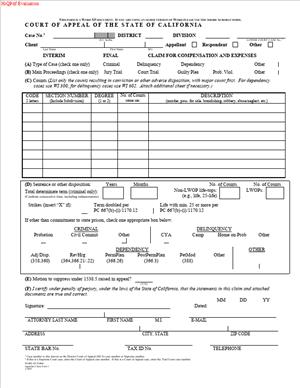
Appellate Court Compensation Claim Form
Fill out nowJurisdiction: Country: United States | Province or State: California
The Appellate Court Compensation Claim Form is a court document used to request payment for work connected to an appellate court case. It is part of the administrative side of an appeal, not the legal argument itself. You use it to explain who you are, what you did, and why compensation is requested.
This form matters because appellate courts handle compensation differently than trial courts. Payment is not automatic. The court relies on this document to decide whether compensation is allowed and how much is approved.
If you are filling this out yourself, you are likely doing so under time pressure. You may also be working from memory or incomplete records. Understanding what the form is asking for helps you avoid delays or rejection.
The Appellate Court Compensation Claim Form is structured and detail-oriented. Each section serves a specific purpose. Knowing that purpose makes the completion process more manageable.
What is the Appellate Court Compensation Claim Form?
Clear definition
The Appellate Court Compensation Claim Form is a written request submitted to an appellate court for payment related to services provided in an appeal. The form records identifying information, case details, and the basis for the requested compensation.
It is not a contract or an agreement between private parties. It is a court-facing filing used to support a payment decision. The court reviews the information and determines whether compensation is authorized under applicable rules.
The form functions as both a claim and a record. It creates a clear trail showing who is requesting payment, for what work, and in connection with which appellate matter.
Who typically uses this form/document?
This form is commonly used by individuals appointed or approved to provide services in an appellate case. This may include legal professionals or other participants authorized by the court.
In some situations, self-represented individuals encounter this form when compensation is available for specific appellate-related work. The exact eligibility depends on the role played in the case.
Court staff and administrative reviewers also rely on this document. They use it to verify details before processing payment or forwarding the claim for judicial review.
Why you might need this form/document
You might need this form when you have completed work connected to an appeal and compensation is permitted by the court. Without submitting the form, payment is usually not considered.
The form allows you to explain the scope of your involvement. It gives context to your request and links it to the appellate case record.
It also helps prevent misunderstandings. By putting information in writing, you reduce the chance of conflicting assumptions about what work was performed or approved.
Typical real-life scenarios
- You were involved in an appeal and provided services after being appointed by the court. Once the appellate process reaches a stage where compensation is addressed, this form becomes relevant. You use it to summarize your contribution.
- You participated in an appellate matter that required additional work beyond initial expectations. The form allows you to describe that work and request compensation tied to it.
- You completed appellate-related services some time ago and are now prompted to submit a claim. The form helps organize information that may otherwise be scattered across emails or case notes.
- You are instructed by the appellate court to submit a compensation claim using a specific format. The Appellate Court Compensation Claim Form serves as that standardized format.
When would you use the Appellate Court Compensation Claim Form?
You typically use the Appellate Court Compensation Claim Form after work on an appeal has been performed. It is not used at the start of a case. It comes into play once there is something to compensate.
The timing often aligns with milestones in the appellate process. This may occur after briefing, after oral argument, or after the appeal is resolved. The form captures completed work, not future plans.
This document is also used when the court requests formal documentation before releasing funds. Even if compensation is expected, the form provides the structure the court needs.
In broader terms, this form is used by people whose role in the appellate case is recognized by the court. It bridges the gap between participation in the case and administrative payment processing.
Legal characteristics of Appellate Court Compensation Claim Form
The Appellate Court Compensation Claim Form has specific characteristics that affect how it is reviewed. It must be complete, accurate, and internally consistent. Missing or unclear information often leads to delays.
The form generally requires identification of the appellate case. This ties the compensation request to an existing court record. Claims without a clear case connection commonly raise issues.
Signatures and dates matter. They indicate that the information provided is affirmed by the person submitting the form. Unsigned forms are frequently returned without processing.
There can be differences in how appellate courts handle compensation forms. Some courts apply stricter review standards, while others focus primarily on completeness. These differences are often procedural rather than substantive.
This form does not decide whether compensation is legally allowed. It does not change court orders or create new rights. It simply presents information for the court’s consideration.
Is it legally binding?
The Appellate Court Compensation Claim Form is not legally binding in the way a contract is. Submitting it does not guarantee payment. The court retains discretion to approve, reduce, or deny the requested amount.
The form is binding in a limited sense because the information you provide is treated as a formal representation to the court. Inaccurate or misleading entries can create problems.
Once submitted, the form becomes part of the court’s administrative record. It may be relied on by judges or court staff when making compensation decisions.
How to fill out the Appellate Court Compensation Claim Form
Step 1 – Identify the appellate case
Begin by entering the appellate case name and case number exactly as they appear on court documents. This information anchors the entire form. Without it, the court cannot link your claim to the correct appeal.
Accuracy is critical here. Even small discrepancies can slow review. Use the same formatting as the court to avoid confusion.
Step 2 – Provide your personal or professional information
Enter your name and any identifying details requested by the form. This may include an address or other contact information. The court uses this section to identify who is requesting compensation.
Make sure the information matches what the court already has on file, if applicable. Consistency helps the court process the claim efficiently.
Step 3 – Describe your role in the appellate matter
This section explains how you were involved in the appeal. You may be asked to state your role or capacity. Keep the description factual and focused on your connection to the case.
Avoid general statements. Clear descriptions help reviewers understand why compensation is being requested.
Step 4 – Detail the work performed
Here, you describe the services provided in connection with the appeal. This often includes the type of work and the timeframe. The goal is to show what was done, not to argue its importance.
Use clear language. Separate different types of work if the form allows narrative space. This helps the reviewer follow your explanation.
Step 5 – State the compensation requested
Enter the amount being requested as compensation. This section may require a breakdown or a total figure. Follow the structure provided by the form.
Make sure the numbers align with the work described earlier. Inconsistencies are a common source of questions or rejection.
Step 6 – Review for completeness and accuracy
Before signing, review every section of the Appellate Court Compensation Claim Form. Check for missing fields, incorrect dates, or unclear descriptions. This review reduces processing delays.
Pay attention to small details. Administrative review often focuses on completeness before substance.
Step 7 – Sign and date the form
Sign the form where indicated and add the date of signing. This confirms that the information is being submitted formally. Unsigned forms are typically not processed.
The date also helps the court track when the claim was submitted in relation to the appellate timeline.
Step 8 – Prepare the form for submission
Once signed, ensure the form is ready for submission in the format required by the court. This may involve printing, copying, or assembling additional pages if included.
Keeping a copy for your records helps you reference what was submitted if questions arise.
Legal terms you might encounter in Appellate Court Compensation Claim Form
- Claimant: The claimant is the person asking to be paid. On this form, that is you if you performed compensable work connected to the appeal. Your name must match how you are identified in the appellate case record and any appointment or authorization paperwork.
- Compensation: Compensation is the payment you are requesting for your work. The form usually asks for amounts broken down by category, such as hours worked or expenses incurred. You must state the total requested clearly so the court can approve or adjust it.
- Appellate Case Number: This is the unique number assigned to the appeal by the court. You enter it exactly as it appears on court notices. A mismatch can delay processing because the clerk cannot link your claim to the correct case.
- Authorized Services: Authorized services are tasks the court or appointing authority allowed you to perform. The form ties your request to these services, so you should describe work that fits within that authorization. Work outside the authorization may not be paid.
- Itemization: Itemization means listing work or expenses in detail rather than as a lump sum. On the form, itemization shows dates, descriptions, time spent, and amounts. This helps the court review whether the request is reasonable.
- Hourly Rate: The hourly rate is the amount requested per hour of work. If the form asks for it, you must state a rate that matches what you were allowed to charge. Inconsistent rates across entries can trigger questions or reductions.
- Expenses: Expenses are out-of-pocket costs related to the appellate work, such as copying or mailing. The form often requires you to list these separately from labor. You may need to confirm that the expenses were necessary for the appeal.
- Certification: Certification is your statement that the information you provided is true and correct. You usually make this certification by signing the form. Signing without checking accuracy can create problems if errors are later discovered.
- Approval: Approval is the court’s acceptance of your request, in full or in part. The form itself does not guarantee payment; it starts the review process. Payment follows only after approval is granted.
FAQs
Do I need to file the Appellate Court Compensation Claim Form if I was already paid part of my fees?
If you received partial payment, this document is typically used to request any remaining amount. You should enter only the unpaid portion and clearly show prior payments so the total requested reflects what is still owed.
What case information must exactly match the appellate record?
You need to match the case number, case title, and party names as they appear in court notices. Small differences, like missing initials or reversed names, can slow acceptance because staff rely on exact matches.
How detailed should my description of work be?
You should describe what you did, when you did it, and how long it took. Vague entries make it hard for reviewers to understand the value of the work and can lead to reductions.
Where do I list expenses, and do I combine them with time?
Expenses are usually listed in a separate section from hours worked. You should not combine them into a single total because the court reviews labor and costs differently.
What date should I use as the effective or ending date of work?
Use the last date you performed compensable appellate work included in this request. This tells the court the time period covered and helps avoid overlap with earlier or later claims.
Who must sign this document if I worked as part of a team?
The signer is typically the person who is authorized to request payment. If more than one person worked, the form still needs one responsible signer who certifies the accuracy of all entries.
Can I attach additional pages if I run out of space?
Yes, additional pages are commonly attached for itemized entries. Each attachment should clearly reference the same case number and your name so it stays connected to this form.
Will filing this form change anything in the public case record?
Filing usually adds a compensation request to the case file. It does not change the outcome of the appeal, but the requested amounts and approval may become part of the court’s administrative record.
Checklist: Before, During, and After Appellate Court Compensation Claim Form
Before
- Confirm the appellate case number and exact case title from court notices.
- Gather appointment orders or authorizations tied to your role.
- Compile time records with dates, descriptions, and hours.
- Collect receipts or notes for any expenses claimed.
- Check that your name and contact details are consistent across documents.
- Review any limits that applied to your work authorization.
- Decide which work period this request will cover.
During
- Enter identifying case information exactly as shown on court documents.
- Fill in your name and role as it appears in the appellate record.
- Itemize work entries in a clear, chronological order.
- Separate labor amounts from expense amounts.
- Calculate totals carefully and double-check your math.
- Review each entry to confirm it fits within authorized services.
- Sign and date the form where required.
After
- Make a complete copy of the signed form and all attachments.
- Submit the form using the method accepted by the appellate court.
- Note the date and method of submission for your records.
- Watch for confirmation, acceptance, or follow-up questions.
- Respond promptly if the court asks for clarification.
- Record any approved amounts and payment dates internally.
- Keep the form and approval with your case files.
Common Mistakes to Avoid with Appellate Court Compensation Claim Form
- Mistake: Using an incorrect or outdated case number because you relied on memory, which can cause the claim to be misfiled or rejected, so do not forget to verify it against a current court notice.
- Mistake: Listing a lump-sum amount without itemization because it feels faster, which can lead to reductions or delays, so do not forget to break down work and expenses clearly.
- Mistake: Including work outside the authorized scope because boundaries were unclear, which may result in nonpayment for those entries, so do not forget to tie each task to authorized services.
- Mistake: Math errors in totals due to manual calculations, which can undermine credibility and slow review, so do not forget to recheck all numbers.
- Mistake: Forgetting to sign or date the form because the focus stayed on the numbers, which can invalidate the submission, so do not forget the certification section.
- Mistake: Attaching extra pages without identifiers because space ran out, which can separate them from the main form, so do not forget to label attachments with your name and case number.
- Mistake: Using a name variation or nickname because it seems harmless, which can create identity confusion, so do not forget to match the appellate record exactly.
- Mistake: Failing to keep copies because you expect electronic access later, which can leave you without proof of submission, so do not forget to save complete records.
What to do after filling out Appellate Court Compensation Claim Form
Once you have completed the form, your next steps focus on submission, confirmation, and recordkeeping. Acting promptly and methodically helps avoid delays. You want a clear trail showing what you submitted, when you submitted it, and what the court did in response.
Start by reviewing the finished document one last time. Look for missing fields, unsigned sections, or attachments that are referenced but not included. Confirm that totals match the itemized entries. Small checks at this stage can prevent weeks of back-and-forth later.
- Step 1: Make a full copy of the signed form and all attachments for your personal records.
- Step 2: Label your copies with the submission date and the appellate case number.
- Step 3: Submit the form using the filing method accepted by the court handling the appeal.
- Step 4: Record how and when you submitted it, such as mail, in person, or electronic delivery.
- Step 5: Watch for acknowledgment, confirmation, or a docket entry showing receipt.
- Step 6: Respond quickly if the court requests clarification, corrections, or additional detail.
- Step 7: Once a decision is made, note whether the request was approved in full or in part.
- Step 8: Track payment timing and amounts against what was approved.
- Step 9: Update your internal records to reflect the court’s decision and payment status.
- Step 10: Keep the form, approval, and proof of payment together in your case file for future reference.
Staying organized after submission is just as important as filling out the document correctly. Clear records help you answer questions later and support any follow-up you may need to do.
Disclaimer: This guide is provided for informational purposes only and is not intended as legal advice. You should consult a legal professional.