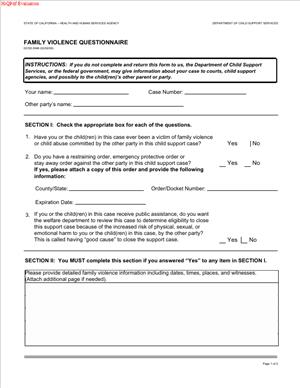
DCSS-0048 – Family Violence Questionnaire
Fill out nowJurisdiction: Country: United States | Province or State: California
If you are involved in a child support case and have experienced abuse or threats, you may be asked to complete the DCSS-0048 – Family Violence Questionnaire. This form is used within California’s child support system to identify concerns about family violence.
The DCSS-0048 – Family Violence Questionnaire helps the local child support agency understand whether there are safety risks between you and the other parent. The information you provide can affect how your case is handled and how communication takes place.
This document is not about proving a crime. It focuses on safety. It allows you to share details about past or current abuse, threats, or intimidation that may impact your child support case.
If you are filling out this form, you are likely trying to protect yourself or your child while participating in the child support process. Understanding what the form does—and what it does not do—can help you complete it with clarity and confidence.
What is DCSS-0048 – Family Violence Questionnaire?
Clear definition
The DCSS-0048 – Family Violence Questionnaire is a written questionnaire used by California’s Department of Child Support Services. It gathers information about family violence between parents involved in a child support case.
It asks whether you have experienced physical harm, threats, stalking, harassment, or emotional abuse from the other party. It may also ask whether there are restraining orders or court cases related to violence.
The purpose of the form is to identify safety concerns. It allows the agency to decide whether special handling procedures are needed in your child support case.
This form does not decide custody. It does not issue restraining orders. It provides information that may influence how the child support agency communicates and processes your case.
Who typically uses this form?
You may complete this form if you are a parent involved in a child support case in California. This includes custodial parents, noncustodial parents, or alleged parents.
The local child support agency may give you the questionnaire when you apply for services. It may also be provided later if you report safety concerns.
Both mothers and fathers can use this form. The focus is not on gender. The focus is on whether there is a risk of harm or intimidation.
If you receive public assistance related to your child, you may encounter this document as part of your case setup. It is part of the broader child support process administered through a government agency.
Why might you need this form?
You might need this form if you are afraid of the other parent. That fear may be based on past violence, recent threats, or ongoing harassment.
The questionnaire gives you a structured way to describe your concerns. Instead of explaining everything verbally, you can put the information in writing.
Completing this document can affect how the agency handles contact between you and the other party. In some cases, it may limit direct communication or change how information is shared.
If there is a history of domestic violence, the form creates a record within the child support case. This record can be important if safety issues arise later.
Typical real-life scenarios
- You left an abusive relationship and are now seeking child support. You are worried that pursuing support will alert the other parent to your location. The questionnaire allows you to explain those concerns.
- You have an active restraining order against the other parent. The child support agency needs to know this so it can handle your case appropriately and avoid unsafe interactions.
- The other parent has threatened you about going to court for child support. You want the agency to understand that those threats affect your ability to communicate safely.
- There has been stalking or harassment through calls, messages, or social media. Even if there has been no recent physical harm, the behavior creates fear and safety risks that may impact the child support process.
When would you use DCSS-0048 – Family Violence Questionnaire?
You typically use this form when you are opening or participating in a child support case and there is a concern about family violence. The agency may ask you to complete it during your initial intake interview.
You may also use it later in the process if new safety issues arise. For example, if the other parent begins making threats after the case starts, the agency may request updated information.
In some situations, the form is part of screening procedures. Child support agencies often screen for family violence to determine whether special case handling is needed.
If you are receiving services through public assistance programs that require cooperation with child support, the questionnaire may be presented to identify whether safety exceptions apply.
The form can be relevant before court hearings, before establishing paternity, or before setting a support order. The timing depends on how and when the agency becomes aware of safety concerns.
Legal characteristics of DCSS-0048 – Family Violence Questionnaire
This questionnaire is an administrative document. It is part of a government process managed by a Health and Human Services agency in California.
For the form to be effective, it generally needs to be complete and truthful. Incomplete answers or missing identifying information may delay case processing. Clear, specific descriptions tend to be more useful than vague statements.
Providing false information on a government form can create serious problems. The agency may rely on your statements when deciding how to handle the case. Accuracy matters.
The form itself does not create a restraining order. It does not automatically stop court proceedings. It does not change custody arrangements. It informs the child support agency’s internal handling procedures.
In California, child support services are handled at the county level under state guidelines. Procedures may vary slightly by county, but the purpose of the questionnaire remains consistent: to identify and manage safety risks.
Common issues that cause delays include unsigned forms, unanswered sections, or missing details about existing court orders. If the agency cannot understand your safety concerns, it may need to follow up for clarification.
The document may become part of your child support case file. In many cases, certain safety-related information is handled with additional confidentiality protections. However, how information is shared can depend on agency policies and case circumstances.
Is it legally binding?
The DCSS-0048 – Family Violence Questionnaire is not a contract. You are not entering into an agreement with the other parent by completing it.
It is a formal statement provided to a government agency. While it does not create legal obligations between parents, it can influence how the agency manages your case.
For example, your answers may affect whether the agency uses alternative service methods or limits certain disclosures. The form can also impact whether cooperation requirements are modified in public assistance cases.
Although it is not “binding” in the way a court order is, it is an official document. The information you provide may be considered in administrative decisions related to your child support case.
How to fill out DCSS-0048 – Family Violence Questionnaire
Step 1 – Review the entire form before writing
Start by reading the full questionnaire from beginning to end. This helps you understand what information is being requested and how the sections connect.
Pay attention to questions about physical violence, threats, stalking, harassment, and existing court orders. Knowing what is ahead can help you provide complete answers the first time.
Step 2 – Provide your identifying information
Enter your full legal name and any other identifying details requested. This may include your case number, address, or contact information.
Make sure the information matches your child support case records. Small errors in names or case numbers can cause processing delays.
If you have confidentiality concerns about your address, read the form carefully to see how contact information is handled within the agency.
Step 3 – Identify the other parent or party
The form will ask for the name of the other parent or person involved. Provide accurate identifying details as requested.
This ensures the agency understands which relationship the safety concerns relate to. If there are multiple cases, clarity is especially important.
Avoid using nicknames unless the form specifically asks for aliases.
Step 4 – Describe the history of violence or threats
Answer each question about past or current abuse carefully. Include relevant details such as the type of behavior, approximate dates, and frequency.
Focus on clear facts. For example, describe specific incidents rather than general feelings. If you do not remember exact dates, you can provide an approximate timeframe.
If the form includes yes-or-no questions, answer each one before moving on. Do not leave items blank unless instructed.
Step 5 – Provide information about court orders
If there are restraining orders, protective orders, or related court cases, list them as requested. Include the court name, case number, and whether the order is active.
This information helps the agency understand the legal context. It may affect how documents are served or how hearings are scheduled.
If an order has expired, indicate that clearly if the form asks for the current status.
Step 6 – Explain safety concerns related to child support
Some sections may ask how pursuing child support could increase risk. Use this space to explain practical concerns, such as fear of retaliation or disclosure of your location.
Be specific about what you are worried might happen. Clear explanations help the agency evaluate the level of risk.
If there are concerns about contact at hearings or meetings, describe them in straightforward terms.
Step 7 – Review your answers for completeness
Before signing, read through every page. Confirm that you answered all required questions.
Check names, dates, and case numbers for accuracy. Make sure your statements are consistent throughout the document.
If something is unclear, rewrite it in plain language. Clarity reduces the chance of follow-up questions.
Step 8 – Sign and date the form
Sign your name where indicated. Add the date of signing.
Your signature confirms that the information you provided is true to the best of your knowledge. An unsigned form may not be processed.
After signing, follow the instructions given to you for submission, whether that involves returning it to the local child support office or providing it during an appointment.
Legal terms you might encounter in DCSS-0048 – Family Violence Questionnaire
- Protected Party: This is the person who is seeking protection from harm or threats. On this form, you may identify yourself or your child as the protected party. The term helps the agency understand who needs safety measures in place.
- Alleged Abuser: This refers to the person accused of committing family violence. The form may ask for this person’s name, relationship to you, and details about their behavior. “Alleged” means the claim has been made but not yet decided by a court in this context.
- Restraining Order: A court order that limits the contact or behavior of one person toward another. The questionnaire may ask whether a restraining order exists, its case number, and its expiration date. This helps determine safety precautions.
- Protective Order: Similar to a restraining order, this is a legal order intended to protect someone from abuse or threats. You may need to attach a copy if one is active. The agency reviews this to align child support actions with court-imposed restrictions.
- Confidential Information: Personal details such as your home address, phone number, workplace, or school information that must be kept private. The form collects this information to assess risk, but may limit disclosure to protect your safety.
- Incident: A specific event involving violence, threats, stalking, or harassment. The questionnaire may ask you to describe incidents, including dates, locations, and what happened. Clear descriptions help establish a pattern of behavior.
- Custody or Visitation Order: A court order describing where a child lives and how parenting time is shared. The form may ask about existing custody arrangements because violence can affect how child support and communication are handled.
- Safety Concern: Any risk to you or your child’s physical or emotional well-being. The form asks you to explain these concerns so the agency can decide whether special procedures are needed, such as limited contact or alternative service methods.
- Retaliation: Harm or threats made in response to legal action or cooperation with authorities. The questionnaire may ask whether you fear retaliation if the other party learns about your involvement in a child support case.
- Mandatory Reporting: A legal requirement for certain professionals to report suspected abuse. While this form is not a report to law enforcement, information you provide may trigger required actions under agency rules.
FAQs
Do I have to complete the DCSS-0048 – Family Violence Questionnaire if I feel unsafe?
If you have safety concerns connected to your child support case, completing this form allows the agency to document those concerns and adjust how it handles your case. You are typically asked to fill it out when family violence may affect communication, service of documents, or enforcement. If you skip it, the agency may not know to apply safety precautions.
What details should I include when describing incidents?
Focus on facts. Include approximate dates, locations, what was said or done, whether there were injuries, and whether police were called. If you do not remember exact dates, provide your best estimate and note that it is approximate. Clear, specific details help the reviewer understand the seriousness and frequency of events.
Do I need to attach copies of restraining or protective orders?
Yes, if you have an active or past court order related to family violence, attach a copy if possible. Include the case number and expiration date on this form exactly as they appear on the order. If you do not have a copy, state that and provide the court name and date so the agency can verify it.
Will the other parent see what I write in this document?
Information in this form is used by the agency to assess safety. Some information in child support cases may be shared as part of legal proceedings, but certain confidential details, such as your address, may be protected. Read each section carefully and clearly mark any information identified as confidential.
What if I am not sure whether my situation counts as family violence?
If you experienced physical harm, threats, stalking, harassment, intimidation, or controlling behavior that made you fear for your safety, it is appropriate to describe it. You do not need a criminal conviction for this form to be relevant. Describe what happened and let the agency evaluate the information.
Can I update this form if something new happens?
Yes. If there is a new incident, a new court order, or a change in your safety concerns, notify the agency handling your case. You may be asked to submit an updated questionnaire or provide a written statement reflecting the new information.
Does completing this form change my existing child support order?
This form itself does not change the amount of support ordered. It helps the agency decide how to manage communication, service, and enforcement safely. Any change to a support order would require a separate legal process.
What happens after I submit the DCSS-0048 – Family Violence Questionnaire?
The agency reviews your responses to determine whether special handling is needed. This may include limiting direct contact, protecting your address, or coordinating with court orders already in place. Keep a copy of what you submitted in case you need to refer to it later.
Checklist: Before, During, and After DCSS-0048 – Family Violence Questionnaire
Before
- Read the entire form from start to finish.
- Gather copies of any restraining or protective orders.
- Collect police reports, case numbers, or court documents if available.
- Write down a timeline of incidents to help you stay organized.
- Confirm the correct spelling of names and case numbers.
- Check the deadline, if one was provided.
- Find a private, safe place to complete the form.
During
- Answer every question truthfully and clearly.
- Use complete sentences when describing incidents.
- Provide approximate dates if exact ones are unknown.
- Clearly identify any active court orders and their expiration dates.
- Mark confidential information where the form instructs you to do so.
- Do not leave required fields blank.
- Review each page before moving to the next.
- Sign and date the form where indicated.
After
- Make at least one copy for your personal records.
- Store your copy in a safe place.
- Submit the form using the method instructed (mail, online portal, or in person).
- Confirm receipt if possible.
- Note the submission date in your calendar.
- Follow up if you do not receive confirmation within a reasonable time.
- Update the agency if your contact information changes.
- Keep copies of any new court orders related to safety.
Common mistakes to avoid with DCSS-0048 – Family Violence Questionnaire
- Mistake: Giving vague descriptions of abuse because it feels overwhelming, which can lead to the agency not fully understanding the risk; do not forget to include specific actions, dates, and impacts.
- Mistake: Leaving out old incidents because they seem too far in the past, which may hide a pattern of behavior; do not forget that repeated conduct over time can be important.
- Mistake: Failing to attach copies of restraining or protective orders because you assume the agency already has them, which can delay review; do not forget to include case numbers and expiration dates.
- Mistake: Providing contact information you are not comfortable sharing, which can create safety concerns; do not forget to follow instructions about confidential information.
- Mistake: Not signing and dating the form because you focused only on the narrative sections, which may result in rejection; do not forget to complete the signature section.
- Mistake: Waiting too long to submit the form due to fear or uncertainty, which may limit available safety measures; do not forget to meet any stated deadlines.
- Mistake: Using emotional language without factual detail because the situation is painful, which can make the review harder; do not forget to describe concrete events and behaviors.
- Mistake: Failing to update the agency after new incidents occur, which may leave your case handled under outdated information; do not forget to report significant changes promptly.
What to do after filling out DCSS-0048 – Family Violence Questionnaire
Once you complete the form, pause and review it carefully. Make sure every required field is filled in, and your handwriting is readable if you completed it on paper. Confirm that dates, case numbers, and names match your court documents exactly.
- Step 1: Make at least one complete copy of the signed form for your records.
- Step 2: Attach copies of any referenced court orders or reports.
- Step 3: Submit the form using the method instructed by the agency handling your case.
- Step 4: If mailing, consider using a method that provides proof of delivery.
- Step 5: If submitting online, save or print the confirmation screen.
- Step 6: Mark your calendar with the submission date and any follow-up deadlines.
- Step 7: Watch for written confirmation or further instructions from the agency.
- Step 8: Respond promptly if the agency requests clarification or additional documents.
- Step 9: Update your personal records to reflect that you disclosed safety concerns in your child support case.
- Step 10: Notify the agency in writing if your address or phone number changes, especially if confidentiality is a concern.
Keep your copy in a secure location. You may need to reference your statements later if questions arise or if your case moves to court. Staying organized helps you protect your rights and your safety.
Disclaimer: This guide is provided for informational purposes only and is not intended as legal advice. You should consult a legal professional.