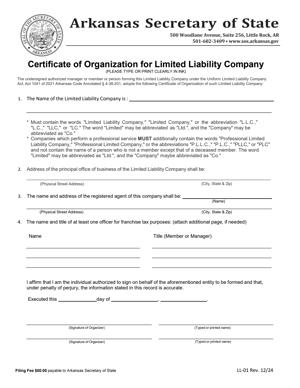
LL-01 – Certificate of Organization for Limited Liability Company
Fill out nowJurisdiction: Country: United States | Province or State: Arkansas
If you are starting a limited liability company in Arkansas, the LL-01 – Certificate of Organization for Limited Liability Company is the form that officially creates your business. This document is filed with the Arkansas Secretary of State to register your LLC as a legal entity.
Until this form is properly completed and accepted, your LLC does not legally exist as a separate business structure. Filing it marks the formal beginning of your company’s legal life.
This document is short, but each section matters. The information you provide becomes part of the public record and defines key details about how your company is identified and contacted.
If you are about to fill out this form, you likely want to make sure you understand each part before you submit it. This guide walks you through what the form is, why it matters, and how to complete it clearly and accurately.
What is LL-01 – Certificate of Organization for Limited Liability Company?
Clear definition
The LL-01 – Certificate of Organization for Limited Liability Company is a formation document used to create a limited liability company in Arkansas. It is a formal filing submitted to the state to establish your LLC as a separate legal entity.
When accepted, this document confirms that your business exists under Arkansas law. It identifies the LLC’s name, registered agent, and other basic structural details.
This form is sometimes referred to as “articles of organization” in other states. In Arkansas, the Certificate of Organization serves that same foundational purpose.
Who typically uses this form?
This form is used by individuals or groups who want to form a limited liability company in Arkansas. That includes single owners, business partners, families starting a business, and investors launching a new venture.
Entrepreneurs starting service businesses often complete this filing. Real estate investors also use it when setting up an LLC to hold property. Professionals forming a company structure may use it as well, depending on licensing rules.
In many cases, one person called the “organizer” completes and signs the document. The organizer may or may not be a member (owner) of the LLC.
Why might you need this form?
You need this form if you want your business to operate as a limited liability company rather than as a sole proprietorship or general partnership.
An LLC structure is commonly used to separate personal assets from business liabilities. Filing the Certificate of Organization is what creates that legal separation.
Banks often require proof that your LLC has been formed before opening a business account. Lenders, vendors, and clients may also request confirmation that your company is properly registered.
Without filing this document, you cannot hold your business out as an Arkansas LLC in a formal legal sense.
Typical real-life scenarios
- You are launching a small consulting business and want your company name to end with “LLC.” To use that designation legally, you file this form to create the entity.
- You and a partner plan to open a retail store. You want to define ownership interests and operate under a shared company name. Filing the Certificate of Organization is the first step.
- You are purchasing a rental property and want to hold it under a company name instead of your personal name. Forming an LLC through this document allows the property to be titled in the LLC’s name.
- You are moving an existing business concept from informal operations into a formal structure. Filing this document shifts your business from an individual activity into a registered legal entity.
When would you use LL-01 – Certificate of Organization for Limited Liability Company?
You use this document at the very beginning of your LLC’s formation process. It is typically filed before you begin formal operations under the LLC name.
This form is often completed after you have chosen your business name and confirmed that it is available. It may also follow discussions between future members about ownership and management structure.
If you are transitioning from operating as a sole proprietor to operating as an LLC, this filing marks that structural change. It does not automatically transfer contracts or assets, but it establishes the new entity.
Organizers, founders, or designated representatives usually prepare and submit the form. In some situations, a business partner, administrative assistant, or third party may handle the submission, but the organizer remains responsible for the information provided.
You would not use this form to modify an existing LLC. Changes such as name updates or amendments are typically handled through separate filings. The Certificate of Organization is specifically for creating a new LLC in Arkansas.
Legal characteristics of LL-01 – Certificate of Organization for Limited Liability Company
This document becomes legally effective once it is properly filed and accepted by the Arkansas Secretary of State. Acceptance generally depends on completing required fields accurately and paying the required filing fee.
The form must contain clear and complete information. Missing required details, using an unavailable business name, or providing an invalid registered agent address commonly leads to rejection or delay.
The LLC name must typically meet state naming rules. It usually needs to include a designator such as “Limited Liability Company,” “LLC,” or a similar abbreviation. Names that are too similar to existing entities may not be accepted.
The registered agent information must be valid and complete. The agent must have a physical address in Arkansas where legal documents can be delivered. A post office box alone is generally not sufficient.
This filing establishes the LLC as a separate legal entity. However, it does not set out internal rules for how the business will operate. Those details are commonly addressed in an operating agreement, which is a separate document.
The Certificate of Organization also does not replace required licenses, permits, or tax registrations. Forming the LLC is one step in a broader setup process.
State requirements can vary across the United States. While many states use similar formation documents, naming conventions, required disclosures, and filing procedures often differ. This form is specific to Arkansas.
Is it legally binding?
Yes, in the sense that once filed and accepted, it creates a legally recognized entity under Arkansas law. The LLC becomes capable of entering into contracts, owning property, and conducting business in its own name.
The information you provide is legally significant. If it is false or misleading, it may create administrative or legal issues. Accuracy matters because the document becomes part of the public record.
However, the Certificate of Organization itself does not govern daily operations. It does not spell out how profits are divided, how decisions are made, or how disputes are resolved. Those matters are typically handled in separate internal agreements.
Its legal force comes from state acceptance. Before acceptance, it is simply a submitted document. After acceptance, it serves as formal proof that the LLC exists.
How to fill out LL-01 – Certificate of Organization for Limited Liability Company
Step 1 – Provide the LLC name
Enter the full legal name of your limited liability company exactly as you intend to use it. The name must include an approved designator such as “Limited Liability Company” or “LLC.” Make sure the spelling, spacing, and punctuation are consistent throughout the form.
Before writing the name, confirm that it is distinguishable from existing business names on record in Arkansas. Using an unavailable or restricted name is a common reason filings are rejected.
Step 2 – List the principal office address
Provide the street address of the LLC’s principal office. This is the main location where business records are kept or where the company primarily operates.
Use a complete physical address, including street number, city, state, and ZIP code. Double-check for accuracy, since this information may be used for official correspondence.
Step 3 – Name the registered agent
Enter the full legal name of the registered agent. The registered agent is the person or entity designated to receive legal documents on behalf of the LLC.
This can be an individual who resides in Arkansas or a business entity authorized to act as a registered agent in the state. The name must be clearly stated and match official records if it is a business entity.
Step 4 – Provide the registered agent’s physical address
Include the registered agent’s physical street address in Arkansas. This address is where legal notices, such as service of process, may be delivered.
A post office box alone is generally not acceptable. Make sure the address is complete and accurate, since errors here can interfere with receiving important legal documents.
Step 5 – Indicate management structure
State whether the LLC will be managed by its members or by designated managers. A member-managed structure means the owners run the company directly. A manager-managed structure means one or more managers handle daily operations.
Select the option that reflects how you intend the company to function. This choice helps clarify authority within the LLC.
Step 6 – Identify the organizer
Provide the name and address of the organizer. The organizer is the person completing and submitting the form to create the LLC.
The organizer does not have to be an owner. However, the information entered must be accurate and complete, since the organizer is responsible for the filing.
Step 7 – Sign and date the document
The organizer signs and dates the form in the space provided. The signature confirms that the information in the document is true to the best of the organizer’s knowledge.
Use the correct format required for submission, whether filing online or on paper. Review the entire document before signing to ensure there are no omissions or typographical errors.
Once completed, submit the form to the Arkansas Secretary of State along with the required filing fee. After acceptance, you will receive confirmation that your LLC has been officially formed.
Legal terms you might encounter in LL-01 – Certificate of Organization for Limited Liability Company
- Organizer: The organizer is the person who prepares and signs the formation document. This does not have to be the owner of the company. On this form, the organizer’s name and signature officially submit the LLC for creation.
- Registered Agent: A registered agent is the individual or business authorized to receive legal papers for your LLC. The form requires you to list the agent’s full name. This information becomes part of the public record.
- Registered Office: This is the physical street address where the registered agent can be found during normal business hours. It cannot be a P.O. box. The address must be complete and accurate because courts and state agencies rely on it.
- Principal Office: The principal office is your LLC’s main business address. It may be inside or outside the state. This is where official correspondence and business records are typically kept.
- Perpetual Duration: Duration refers to how long your LLC will exist. Most LLCs select perpetual duration, meaning the company continues until it is formally dissolved. If you want a specific end date, you must state it clearly.
- Member-Managed: In a member-managed LLC, the owners (members) run the day-to-day operations. When you select this structure on the form, you are telling the state who has the authority to act for the company.
- Manager-Managed: In a manager-managed LLC, the members appoint one or more managers to operate the business. If you choose this option, you are identifying that management authority is separate from ownership.
- Effective Date: The effective date is when your LLC legally comes into existence. Some forms allow you to choose a delayed effective date instead of the filing date. If you select a future date, it must meet the state’s timing rules.
- Certificate of Organization: This is the legal document that creates your LLC once accepted. It includes the company’s basic identifying details. After approval, it becomes part of the public business registry.
FAQs
Does filing this form automatically create my LLC?
Your LLC is created when the state accepts and processes the LL-01 – Certificate of Organization for Limited Liability Company, not when you simply complete it. After submission, you must wait for confirmation. The approval notice or stamped copy is your proof of formation.
Can I choose a future effective date?
If the form allows a delayed effective date, you may enter a specific future date in the space provided. Make sure the date is written clearly and follows any limits stated on the document. If you leave it blank, the LLC usually becomes effective on the filing date.
Who is allowed to sign this document?
The organizer signs this form. This person is responsible for submitting accurate information. The signer does not have to be a member, but the signature confirms that the details entered are true and complete.
What happens if the LLC name is slightly different from my business plan?
The name you enter must match exactly across all formation paperwork and future filings. Even small differences in punctuation, spacing, or abbreviations can cause rejection. Double-check that the name includes the required “LLC” or “Limited Liability Company” designation as shown on this document.
Do I need to attach anything to this form?
Most filings do not require attachments unless you are adding special provisions. If you include additional pages, make sure they clearly reference the company name and are properly labeled. Do not staple or alter the format in a way that makes scanning difficult.
Will my home address become public?
The addresses you provide on this form may appear in the public business database. If you list your home as the principal office or registered office, that information can be publicly accessible. Review each address field carefully before submitting the LL-01 – Certificate of Organization for Limited Liability Company.
What if my registered agent changes after filing?
If your registered agent or registered office changes later, you must file a separate update form. The information in this document reflects the details at the time of filing only. Keeping it current ensures you receive legal notices without delay.
How will I know the filing was accepted?
You will receive confirmation from the filing office once the document is processed. This may include a stamped copy or an official certificate. Keep this confirmation with your permanent company records.
Checklist: Before, During, and After LL-01 – Certificate of Organization for Limited Liability Company
Before
- Confirm your desired LLC name is distinguishable from existing businesses.
- Verify the name includes “Limited Liability Company” or an approved abbreviation.
- Decide whether your LLC will be member-managed or manager-managed.
- Choose a reliable registered agent with a physical street address.
- Confirm the principal office address is complete and accurate.
- Decide whether you want the LLC to be effective immediately or on a future date.
- Gather the full legal name of the organizer.
- Review filing fee requirements and payment method options.
During
- Enter the LLC name exactly as approved or reserved.
- Print or type all information clearly to avoid rejection.
- Double-check spelling of names and street addresses.
- Confirm the management structure box is correctly selected.
- Ensure the registered agent information matches their consent.
- Review any optional provisions before including them.
- Sign and date the form in the correct place.
- Re-read the entire document before submission.
After
- Submit the completed form with the required filing fee.
- Track the status of your filing if a tracking option is available.
- Save the approval confirmation once received.
- Store a digital and paper copy of the approved document.
- Create an operating agreement for internal governance.
- Apply for a federal tax identification number if needed.
- Open a separate business bank account.
- Mark your calendar for annual report deadlines.
Common mistakes to avoid with LL-01 – Certificate of Organization for Limited Liability Company
- Mistake: Using a business name that is already taken because you skipped a name search, which can lead to rejection and lost filing fees; do not forget to confirm availability before completing the form.
- Mistake: Listing a P.O. box as the registered office because it seems convenient, which may cause the filing to be refused; do not forget that a physical street address is required.
- Mistake: Selecting the wrong management structure because you did not understand the difference, which can create confusion about authority later; do not forget to align the selection with how your LLC will actually operate.
- Mistake: Misspelling the registered agent’s name due to rushing, which can delay processing or create record errors; do not forget to verify spelling directly with the agent.
- Mistake: Forgetting to sign and date the document because you focused only on filling in fields, which makes the submission incomplete; do not forget that an unsigned form will not be processed.
- Mistake: Entering inconsistent addresses across documents because you copied from different drafts, which can cause compliance issues later; do not forget to standardize addresses before filing.
- Mistake: Ignoring confirmation after submission because you assumed approval is automatic, which leaves you without proof of formation; do not forget to obtain and store the official acceptance.
- Mistake: Including unnecessary attachments without labeling them clearly, which may confuse processing staff; do not forget to identify any additional pages with the LLC name.
What to do after filling out LL-01 – Certificate of Organization for Limited Liability Company
Once you complete the form, your next focus is proper filing and follow-through. Formation does not end with signing. You must ensure the document is submitted correctly and that you receive confirmation.
- Step 1: Make at least one paper copy and one digital copy of the signed document for your records before submitting it.
- Step 2: Prepare the correct filing fee using an accepted payment method and confirm the total amount due.
- Step 3: Submit the form using the approved filing method, whether online, by mail, or in person, and keep proof of submission.
- Step 4: Monitor your email, mail, or online account for filing confirmation or rejection notices.
- Step 5: If approved, download or store the stamped Certificate of Organization in a secure folder dedicated to company records.
- Step 6: If rejected, review the stated reason carefully, correct the issue exactly as described, and resubmit promptly.
- Step 7: Draft and sign an operating agreement, even if you are the only member, to define ownership and management terms.
- Step 8: Apply for a federal Employer Identification Number if your LLC will hire employees, open a bank account, or elect certain tax treatments.
- Step 9: Open a separate business bank account using your approved formation documents to keep personal and company finances separate.
- Step 10: Register for any required state or local tax accounts related to your business activities.
- Step 11: Obtain any professional or industry licenses required before beginning operations.
- Step 12: Create a compliance calendar so you do not miss annual reports or other ongoing filing obligations.
Taking these steps helps you move from formation to active operation smoothly. Good recordkeeping and early organization reduce stress later and help protect your limited liability status.
Disclaimer: This guide is provided for informational purposes only and is not intended as legal advice. You should consult a legal professional.