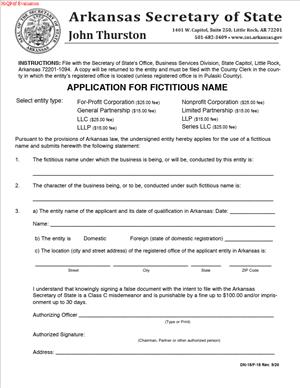
DN-18 and F-18 – Application for Fictitious Name
Request DocumentJurisdiction: Country: United States | Province or State: Arkansas
If you plan to operate a business under a name that is different from your legal name, the DN-18 and F-18 – Application for Fictitious Name is the form used to register that name in Arkansas. This filing connects your chosen business name to the individual or entity that owns it.
You might be starting a small business, expanding an existing one, or rebranding. In each of these situations, you may want to use a name that is easier to market or more descriptive than your personal or registered company name.
This form is not complicated, but it is important. It creates a public record showing who is behind a particular business name. That transparency protects consumers and clarifies ownership.
Before you complete the document, you need to understand what it does, what information it asks for, and how it fits into your broader business setup.
What is DN-18 and F-18 – Application for Fictitious Name?
Clear definition
DN-18 and F-18 – Application for Fictitious Name is a state filing used to register a fictitious name, sometimes called a “doing business as” or trade name. A fictitious name is any business name that is different from your legal name as an individual or your officially registered company name.
For example, if your legal name is John Smith and you operate as “Smith Home Repairs,” that business name may need to be registered as a fictitious name. If you own “Arkansas Home Services LLC” but advertise as “Natural State Handyman,” that trade name may also require registration.
This form records the fictitious name and links it to the responsible person or entity. It becomes part of the public business records maintained by the state.
Who typically uses this form?
Sole proprietors often use this form when they do not want to operate under their full personal name. It allows them to present a more professional or descriptive business name to customers.
Limited liability companies and corporations also use it when they want to conduct business under a name that differs from their registered entity name. This is common when launching a new product line or service brand.
Partnerships may file as well if the partnership’s operating name is not identical to the names of the partners or the official partnership name.
In short, anyone conducting business in Arkansas under a name other than their legal or registered name may need this filing.
Why might you need this form?
You may need this form to open a business bank account under your trade name. Financial institutions often require proof that the fictitious name has been properly registered.
You may also need it to enter into contracts using your business name. Vendors and clients commonly expect that the name on the contract matches a registered business name.
It can also be required when applying for certain licenses or permits. Licensing agencies frequently verify that the name you are using is officially recorded.
Finally, registering a fictitious name helps avoid confusion. It clarifies who owns and operates the business behind the name.
Typical real-life scenarios
- You start a landscaping service as an individual and want to call it “River Valley Lawn Care.” Since that name is not your personal legal name, you complete the form to register it before printing signs and business cards.
- You own a corporation that runs a restaurant. You decide to open a second location with a different theme and name. Rather than creating a new corporation, you register the new restaurant name as a fictitious name under the existing company.
- You operate an online store under a creative brand name. Even though customers only see the brand, the state records must show who owns it. Filing the form connects the brand to you or your entity.
- You and a partner begin offering consulting services together. Instead of using both of your full names in the business title, you choose a short, memorable name. The filing makes that name officially recognized as connected to your partnership.
- You purchase an existing business and continue operating it under its well-known name. To reflect the new ownership, you submit the appropriate application so the state record shows the correct owner behind the fictitious name.
When would you use DN-18 and F-18 – Application for Fictitious Name?
You use this form when you plan to advertise, market, sign contracts, or receive payments under a name that is not your legal personal name or your entity’s registered name.
It is typically completed before you begin actively using the name in commerce. Many business owners handle the filing during the early setup phase, along with obtaining tax identification numbers and licenses.
If you already operate a registered entity and later decide to introduce a new brand, you would use this form at the point you choose to start using that new name.
You may also use it if you previously filed but need to update information, depending on the version of the document and the purpose of the filing. Changes in ownership, address, or business structure can affect how the fictitious name is recorded.
For sole proprietors, it often comes into play when transitioning from informal work to a more structured business. For corporations and limited liability companies, it commonly arises during expansion or rebranding.
Legal characteristics of DN-18 and F-18 – Application for Fictitious Name
This form becomes effective when it is properly completed, signed, and accepted by the appropriate state office. Acceptance generally depends on providing complete and accurate information.
The document typically requires the exact fictitious name you intend to use. Spelling, punctuation, and formatting matter. Inconsistent names across filings can create delays or confusion.
It also requires identifying information about the owner. That may include the full legal name of an individual, the name of a corporation or limited liability company, and a business address. Inaccurate or incomplete owner information is a common reason filings are rejected.
Another key element is compliance with naming rules. Certain words may be restricted or require additional approvals, especially if they suggest a regulated activity. If the name is misleading or conflicts with an existing registered name, the filing may not be accepted.
High-level differences can exist depending on the type of business entity. For example, corporations and limited liability companies often have different internal approval requirements before filing. However, the core purpose remains the same: to publicly link a trade name to its owner.
It is important to understand what this form does not do. It does not create a separate legal entity. Filing a fictitious name does not give you limited liability protection. It also does not automatically grant exclusive rights to the name in all contexts. It simply registers the use of that name under state records.
Is it legally binding?
The filing itself is not a contract between private parties. Instead, it is a formal registration with the state. Once accepted, it becomes an official public record.
It is legally significant because it represents a declaration that you or your entity is operating under the stated fictitious name. Providing false information on a government filing can carry consequences.
The legal effect depends on proper completion and acceptance. If the form is incomplete, unsigned, or rejected, the fictitious name may not be considered properly registered.
The filing supports the enforceability of contracts and financial arrangements made under the fictitious name. It shows that the name is formally connected to the responsible party. However, the rights and obligations in those contracts come from the agreements themselves, not from the filing alone.
How to fill out DN-18 and F-18 – Application for Fictitious Name
Step 1 – Identify the correct form version
Start by confirming you are using the correct version of DN-18 and F-18 – Application for Fictitious Name for your situation. There may be separate sections or variations depending on whether you are an individual, a partnership, a corporation, or a limited liability company. Make sure the form matches your business structure.
Step 2 – Enter the fictitious name exactly as you will use it
Write the full fictitious name in the space provided. Use the exact spelling, capitalization, and punctuation you intend to use in commerce. Do not abbreviate or alter the name unless that is how you plan to present it publicly. Consistency is important across all business records.
Step 3 – Provide the legal name of the owner
Enter the full legal name of the individual or the exact registered name of the entity that owns the fictitious name. For individuals, this typically means your complete personal name. For entities, use the name as it appears in official formation documents.
Step 4 – Provide the principal business address
Fill in the main business address connected to the fictitious name. This is usually the location where the business operates or maintains its primary office. Ensure the address is complete, including street, city, state, and ZIP code.
Step 5 – Indicate the business structure
Select or state the type of business structure that owns the fictitious name. This may include sole proprietorship, partnership, corporation, or limited liability company. The structure helps clarify who is legally responsible for the business activities under the name.
Step 6 – Include additional required details
Some versions of the form ask for supplementary information, such as the state of formation for an entity, a filing number, or the names of partners. Provide each requested detail carefully and match it to your existing official records.
Step 7 – Review for accuracy and completeness
Before signing, read through the entire document. Confirm that names, addresses, and other details are accurate and consistent. Even small errors can cause delays or require corrective filings later.
Step 8 – Sign and date the form
Sign the form in the designated area. The signer is typically the individual owner or an authorized representative of the entity. Add the date of signing as required. Unsigned forms are generally not processed.
Step 9 – Submit the form to the appropriate office
Submit the completed DN-18 and F-18 – Application for Fictitious Name according to the stated filing instructions. This may involve mailing, delivering, or electronically filing the document, depending on available options. Keep a copy of the signed form and any confirmation of submission for your records.
Step 10 – Retain proof of acceptance
After submission, monitor for confirmation that the filing has been accepted. Once approved, store the confirmation with your other business records. You may need to present proof of registration when opening accounts, applying for licenses, or entering contracts under the fictitious name.
Legal terms you might encounter in DN-18 and F-18 – Application for Fictitious Name
- Fictitious Name: This is the assumed name you plan to use in public instead of your legal business name. On this form, you must enter it exactly as you intend to display it on signs, contracts, invoices, and marketing materials. Even small differences in spelling, spacing, or punctuation can matter.
- Legal Name of Owner: This is the official name of the person or entity that owns the business. If you are an individual, this is your full legal name. If you operate through a corporation, limited liability company, or partnership, you must use the exact registered name on file with the state.
- Entity Type: This refers to your business structure, such as sole proprietorship, corporation, limited liability company, or partnership. The form asks you to identify this clearly. Your answer affects how ownership and responsibility are reflected in the public record.
- Principal Office Address: This is the main physical location where the business operates or where records are kept. The form usually requires a street address, not just a post office box. Make sure the address matches your other official filings to avoid inconsistencies.
- Registered Agent: If your business is a corporation or limited liability company, you may see this term. A registered agent is the person or company authorized to receive legal papers on behalf of the entity. While the fictitious name form focuses on the business name, your entity’s registered agent information must already be current in state records.
- Good Standing: This means your business entity has met its ongoing state requirements, such as annual reports and fees. If your entity is not in good standing, the state may reject or delay processing your fictitious name filing. You should confirm your status before submitting the application.
- Effective Date: Some filings allow you to indicate when the fictitious name should become active. If the form provides this option, you must enter a specific date in the required format. If you leave it blank, the filing typically becomes effective on the date it is accepted.
- Authorized Signer: This is the person who has legal authority to sign on behalf of the business. For a sole proprietorship, that is usually you. For a corporation or limited liability company, it must be an officer, member, manager, or other person allowed to bind the entity.
- Public Record: Once accepted, the fictitious name filing becomes part of the state’s public database. Anyone can search and see the name and ownership information you provide. You should review the form carefully because the details you enter will be visible to others.
FAQs
Do I need to check if the fictitious name is available before filing?
Yes. Before you complete this form, you should search the state’s business name database to see if the name is already in use or too similar to another registered name. If you skip this step, your filing may be rejected. On the form itself, you must enter the name exactly as you want it recorded, so confirm availability first to avoid rewriting and resubmitting.
What name do I enter as the owner on this document?
You must enter the full legal name of the person or entity that owns the business. If you are filing as an individual, use your complete legal name, not a nickname. If you are filing for a corporation or limited liability company, use the exact name as it appears in state records. Do not use the fictitious name in the owner field.
Can I list more than one fictitious name on the DN-18 and F-18 – Application for Fictitious Name?
No. Each fictitious name generally requires its own filing. If you plan to operate under multiple assumed names, you must complete and submit a separate application for each one. Make sure each version clearly identifies the same legal owner if that is the case.
What address should I provide on the form?
You should provide the principal office address of the business. This is usually a physical street address where business activities occur or records are kept. Double-check that the address matches what the state already has on file for your entity to prevent processing delays.
Who is allowed to sign this form?
The signer must have authority to bind the business. If you are a sole proprietor, you sign yourself. If the owner is a corporation or limited liability company, the signer must be an officer, member, manager, or other authorized person. Print the signer’s name and title clearly so the state can confirm authority.
When does the fictitious name become active?
In most cases, the name becomes active once the state accepts and processes the filing. If this document includes an effective date field, you must enter the date in the required format. If you leave that section blank, the effective date is typically the date of acceptance, not the date you signed it.
Will filing this document change my legal business name?
No. Filing the DN-18 and F-18 – Application for Fictitious Name does not change your legal entity name. It only registers an additional name that you are allowed to use in business. Your contracts, tax filings, and state records will still reference your legal name as the owner.
What proof will I receive after filing?
After acceptance, you should receive confirmation from the state, either electronically or by mail, depending on how you submitted the filing. Review the confirmation carefully. Make sure the fictitious name, owner name, and address match what you entered on the form so the public record reflects your information accurately.
Checklist: Before, During, and After DN-18 and F-18 – Application for Fictitious Name
Before
- Search the state database to confirm the fictitious name is distinguishable.
- Verify your business entity is in good standing.
- Confirm the exact legal name of the owner as shown in state records.
- Gather the principal office address and ensure it is current.
- Identify the correct entity type for your business.
- Confirm who has the authority to sign the form.
- Review your existing filings for consistency in names and addresses.
During
- Enter the fictitious name exactly as you plan to use it.
- Double-check spelling, spacing, and punctuation.
- Provide the full legal name of the owner without abbreviations unless officially part of the name.
- Fill in the principal office address completely.
- Indicate the correct entity type.
- Print the authorized signer’s name and title clearly.
- Review every field for completeness before signing.
- Sign and date the form in the required format.
After
- Make a copy of the signed form for your records.
- Submit the filing using the approved method.
- Track confirmation of receipt or processing.
- Review the acceptance notice for accuracy.
- Update your business licenses and permits with the fictitious name if needed.
- Begin using the fictitious name consistently in marketing and contracts.
- Store the confirmation with your other formation and compliance documents.
Common mistakes to avoid with DN-18 and F-18 – Application for Fictitious Name
- Mistake: Entering a fictitious name that is already taken because you skipped a name search, which can lead to rejection and delays; do not forget to confirm availability before completing the form.
- Mistake: Listing the fictitious name as the owner instead of the legal entity name, often due to confusion about terminology, which can invalidate the filing; do not forget to use the exact legal name from state records.
- Mistake: Using an outdated or inconsistent business address, which happens when records are not reviewed, causing processing issues; do not forget to match the address to your current official filings.
- Mistake: Having someone sign without proper authority, often in small businesses where roles are informal, which may result in rejection; do not forget to confirm the signer’s official capacity.
- Mistake: Leaving required fields blank because they seem optional, leading to incomplete filings; do not forget to review each section carefully before submission.
- Mistake: Assuming the filing changes your legal entity name, which can create confusion in contracts and tax records; do not forget that this form only registers an additional trade name.
- Mistake: Failing to keep proof of acceptance, which can cause problems when opening accounts or applying for licenses; do not forget to save and store the confirmation.
- Mistake: Using inconsistent spelling of the fictitious name across documents, which often happens during branding updates, leading to public record discrepancies; do not forget to standardize the exact name everywhere.
What to do after filling out DN-18 and F-18 – Application for Fictitious Name
Once you complete the form, slow down and review it one more time. Small errors can delay acceptance. Compare the fictitious name and legal owner name against your official records.
- Step 1: Make a clean copy of the signed and dated form for your files.
- Step 2: Confirm the correct filing method, whether online or by mail.
- Step 3: Submit the form using the approved submission process.
- Step 4: Pay any required filing fee and keep proof of payment.
- Step 5: Monitor your email or mail for confirmation of acceptance.
- Step 6: Review the filed record to ensure the fictitious name and owner details are correct.
- Step 7: Save the confirmation with your formation documents, annual reports, and compliance records.
- Step 8: Update your bank, vendors, and internal accounting records to reflect the fictitious name, if needed.
- Step 9: Update signage, marketing materials, invoices, and contracts to use the name consistently.
- Step 10: Calendar any renewal or reporting requirements tied to your business entity to maintain good standing.
After acceptance, treat the fictitious name as part of your compliance framework. Use it consistently. Keep your entity in good standing. If your ownership, address, or entity type changes later, review whether you need to update or refile your fictitious name registration to keep the public record accurate.
“mainEntity”: [ { “@type”: “Question”, “name”: “Do I need to check if the fictitious name is available before filing?”, “acceptedAnswer”: { “@type”: “Answer”, “text”: “Yes. Search the state’s business name database before filing to confirm the fictitious name is available and not too similar to another registered name.” } }, { “@type”: “Question”, “name”: “What name do I enter as the owner on this document?”, “acceptedAnswer”: { “@type”: “Answer”, “text”: “Enter the full legal name of the person or entity that owns the business. Do not enter the fictitious name as the owner.” } }, { “@type”: “Question”, “name”: “Can I list more than one fictitious name on the DN-18 and F-18 – Application for Fictitious Name?”, “acceptedAnswer”: { “@type”: “Answer”, “text”: “No. Each fictitious name generally requires its own filing, so submit a separate application for each assumed name.” } }, { “@type”: “Question”, “name”: “What address should I provide on the form?”, “acceptedAnswer”: { “@type”: “Answer”, “text”: “Provide the principal office address of the business, usually a physical street address where business activities occur or records are kept.” } }, { “@type”: “Question”, “name”: “Who is allowed to sign this form?”, “acceptedAnswer”: { “@type”: “Answer”, “text”: “The signer must have authority to bind the business, such as the sole proprietor, an officer, member, manager, or another authorized person.” } }, { “@type”: “Question”, “name”: “When does the fictitious name become active?”, “acceptedAnswer”: { “@type”: “Answer”, “text”: “The fictitious name usually becomes active once the state accepts and processes the filing, unless a valid effective date is provided.” } }, { “@type”: “Question”, “name”: “Will filing this document change my legal business name?”, “acceptedAnswer”: { “@type”: “Answer”, “text”: “No. Filing this application registers an additional business name but does not change the owner’s legal name.” } }, { “@type”: “Question”, “name”: “What proof will I receive after filing?”, “acceptedAnswer”: { “@type”: “Answer”, “text”: “After acceptance, you should receive confirmation from the state electronically or by mail, depending on how you submitted the filing.” } } ] }
Disclaimer: This guide is provided for informational purposes only and is not intended as legal advice. You should consult a legal professional.