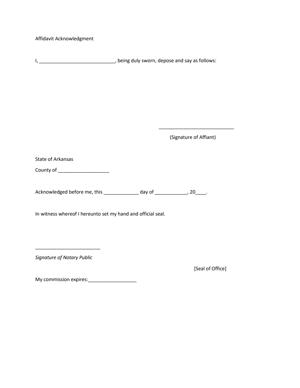
Affidavit Acknowledgement
Fill out nowJurisdiction: Country: United States | Province or State: Arkansas
An Affidavit Acknowledgement is a formal written statement that confirms a person signed a document willingly and in the presence of an authorized official. If you are about to complete an Affidavit Acknowledgement, you are likely finalizing an important filing that needs verification.
This form is often used to add credibility and formality to another document. It connects your identity to your signature. It also confirms that you declared the contents to be true under oath or affirmation.
In Arkansas, many legal and administrative processes require signatures to be acknowledged before a notary public or other authorized officer. The Affidavit Acknowledgement helps show that proper procedures were followed.
If you are representing yourself, understanding this form can prevent delays. Courts, county offices, and other agencies may reject documents that are not properly acknowledged. Knowing what the form does and how to complete it helps your submission move forward.
You do not need a legal background to understand this document. You do need attention to detail. Small mistakes in names, dates, or signatures can create problems.
What is Affidavit Acknowledgement?
Clear definition
An Affidavit Acknowledgement is a written declaration that confirms a person signed a document voluntarily and that the signature was witnessed by an authorized official. That official is commonly a notary public in Arkansas.
The form typically states that the signer appeared in person before the notary. It confirms that the signer proved their identity. It also confirms that the signer acknowledged signing the document for the purposes stated in it.
The acknowledgement is not the same as the main affidavit. The affidavit contains the facts or statements. The acknowledgement verifies the act of signing.
In simple terms, this document answers three questions: Who signed? Did they appear in person? Did they confirm that the signature is theirs?
Who typically uses this form?
Individuals use this form when submitting sworn statements to a court or government office. This includes self-represented parties in civil cases, probate matters, family law filings, and property transactions.
Property owners often use an acknowledgement when signing deeds, mortgage documents, or lien-related filings. Businesses may use it when filing corporate statements or official certifications.
Attorneys, title agents, and financial institutions frequently require acknowledged documents. However, self-represented individuals also encounter this requirement when handling personal legal matters.
If you are filing paperwork that affects ownership rights, financial obligations, or court proceedings, you may encounter an Affidavit Acknowledgement requirement.
Why might you need this form?
You may need this form because the receiving office requires proof that your signature is authentic. The acknowledgement reduces the risk of fraud. It creates a record that you personally appeared and confirmed your identity.
Courts often require sworn affidavits to support motions or petitions. When those affidavits must be notarized, the acknowledgement becomes part of the completed document.
County recorders often require acknowledged signatures before recording real estate documents. Without proper acknowledgement, the document may not be accepted for recording.
In some situations, the acknowledgement helps enforce the document later. If someone challenges the validity of your signature, the notary’s confirmation can serve as evidence that the signing was legitimate.
Typical real-life scenarios
- You are filing a sworn statement in a family law case. The court requires that your affidavit be notarized. The Affidavit Acknowledgement confirms that you signed the statement under oath in front of a notary.
- You are transferring property to a family member. The deed must be recorded with the county. Before recording, your signature must be acknowledged so the county office can accept the document.
- You are submitting an affidavit to correct an error in a public record. The agency requires verification of your identity and signature. The acknowledgement provides that verification.
- You are responding to a court motion and attaching a sworn statement of facts. The court rules require that your statement be notarized. The acknowledgement section completes that requirement.
- You are settling an estate and filing documents related to property distribution. The probate court may require acknowledged signatures to confirm that documents were signed voluntarily.
- Each of these situations involves an important legal or financial consequence. The acknowledgement adds a layer of formal confirmation to your submission.
When would you use Affidavit Acknowledgement?
You would use an Affidavit Acknowledgement when a document must be signed in front of a notary or other authorized officer. This usually happens when the document affects legal rights, ownership, or court proceedings.
If you are filing papers with a court in Arkansas, review the filing instructions carefully. Some documents require verification under oath. When notarization is required, the acknowledgement confirms that the requirement has been met.
You may also use this form when dealing with county offices, such as the circuit clerk or recorder. Real estate filings commonly require acknowledged signatures before they can be recorded.
Businesses may use an acknowledgement when submitting official certifications, corporate resolutions, or statements to government agencies. In those cases, an authorized representative signs on behalf of the business, and the acknowledgement confirms the representative’s identity and authority.
Financial matters can also involve acknowledged documents. Loan modifications, releases, or affidavits of identity may require notarization. The acknowledgement ensures the signer personally appeared and confirmed the signature.
In general, if a document includes language stating that it must be “acknowledged before a notary,” you will use an Affidavit Acknowledgement as part of the completion process.
Legal Characteristics of Affidavit Acknowledgement
An Affidavit Acknowledgement has specific elements that make it effective. First, the signer must personally appear before the notary or authorized officer. Remote procedures may be available in some circumstances, but they must follow applicable rules.
Second, the notary must verify the identity of the signer. This usually involves reviewing a government-issued photo identification. The notary records that verification in their journal, if required.
Third, the acknowledgement certificate must include certain basic information. This typically includes the state and county, the date, the name of the signer, and the notary’s signature and seal.
If any of these elements are missing, the document may be rejected. Common issues include incomplete notary information, missing seals, incorrect dates, or mismatched names.
Name consistency is important. The name on the acknowledgement should match the name on the main document. If you sign with a middle initial, the acknowledgement should reflect that accurately.
Another frequent problem is signing the document before appearing before the notary when the instructions require signing in the notary’s presence. Some forms allow prior signing if you confirm it is your signature, but procedures vary. The safest approach is to follow the instructions provided with the document.
An Affidavit Acknowledgement does not confirm that the contents of the document are true. It confirms the identity of the signer and the voluntary act of signing. The truth of the statements in the affidavit is a separate matter.
Requirements can vary slightly by state. In Arkansas, notaries must follow state rules regarding identification, recordkeeping, and use of official seals. The wording of the acknowledgement certificate may follow a standard format, but minor variations are common as long as required elements are included.
Is it legally binding?
An Affidavit Acknowledgement is legally effective as a formal verification of a signature. It becomes part of the overall document and supports its enforceability.
The acknowledgement itself does not create new obligations. Instead, it strengthens the underlying document by confirming that it was signed properly. If the main affidavit creates legal responsibilities, those responsibilities come from the affidavit, not from the acknowledgement section alone.
Courts and government offices rely on acknowledgements to confirm authenticity. If properly completed, the acknowledgement can serve as evidence that the signer acted voluntarily and appeared before an authorized official.
If the acknowledgement is defective, the document may still exist, but it may not be accepted for filing or recording. In some cases, a defective acknowledgement can delay enforcement or create disputes about validity.
Its binding effect depends on proper execution. When the signer appears in person, proves identity, and the notary completes the certificate correctly, the acknowledgement fulfills its purpose.
How to fill out Affidavit Acknowledgement
Step 1 – Review the Main Document
Before focusing on the acknowledgement section, read the entire affidavit or related document carefully. Make sure all blanks are filled in and the information is accurate. The acknowledgement confirms your signature, so the main content must be complete before signing.
Check your name as it appears in the document. It should match the name you will use when signing and the name on your identification. Consistency prevents rejection or questions later.
Step 2 – Confirm the Required Format
Look at the acknowledgement section to see if it follows a specific format. Many forms include preprinted language that begins with the state and county. Do not alter the wording unless you are instructed to do so as part of the form’s completion.
If the form is separate from the affidavit, ensure it clearly references the document being acknowledged. The connection between the two should be clear to anyone reviewing the submission.
Step 3 – Locate an Authorized Notary
An Affidavit Acknowledgement must be completed in the presence of a notary public or other authorized officer. Arrange a time to appear in person unless the process specifically allows a lawful remote method.
Bring valid identification. The name on your identification should match the name on the document. If there are differences, resolve them before completing the signing.
Step 4 – Appear in Person Before the Notary
Go to the notary with the unsigned document, unless the form’s instructions allow acknowledgment of a previously signed document. The notary will confirm your identity using your identification.
You will be asked to confirm that you are the person named in the document. You will also confirm that you signed the document voluntarily.
This appearance is a key part of the process. The acknowledgement is based on the notary witnessing your confirmation and signature.
Step 5 – Sign the Document
Sign the affidavit or related document as directed. In many cases, you will sign in the notary’s presence. Use the same version of your name that appears in the document.
Write clearly and avoid altering your signature after signing. If a mistake is made, the notary may require a fresh copy of the document rather than allowing corrections.
Your signature is the act of being acknowledged. The acknowledgement certificate confirms this act.
Step 6 – Allow the Notary to Complete the Certificate
After you sign or confirm your signature, the notary will complete the acknowledgement section. This typically includes filling in the date, the location, and your name.
The notary will then sign the certificate and apply their official seal or stamp. Review the completed section to ensure all fields are filled in and legible.
Do not leave with an incomplete acknowledgement. Missing information can cause your filing to be rejected.
Step 7 – Make Copies for Your Records
Once the Affidavit Acknowledgement is complete, make copies of the fully executed document. Keep at least one copy for your personal records.
If you are submitting the original to a court or county office, confirm whether copies are also required. Some offices stamp and return copies for your records.
Store your copy in a safe place. If questions arise later about your signature or filing, the acknowledged document provides important proof.
Step 8 – Submit the Completed Document
Submit the acknowledged affidavit or related document according to the filing instructions provided. This may involve delivering it to a court clerk, county recorder, or other agency.
Ensure that all required pages are included. The acknowledgement must remain attached to the document it verifies.
After submission, keep any receipts or confirmations you receive. These records show that your acknowledged document was properly filed or recorded.
Legal terms you might encounter in Affidavit Acknowledgement
- Affiant: The affiant is the person who signs the affidavit and swears that the statements in it are true. In this document, you are the affiant if you are making the sworn statement. Your name must appear exactly as it does in the main affidavit and on your identification.
- Acknowledgment Certificate: This is the section completed by the notary public. It confirms that you appeared in person, were identified properly, and acknowledged that you signed the document voluntarily. This certificate is what makes the notarization valid.
- Notary Public: A notary public is an authorized official who verifies your identity and witnesses your signature. The notary does not confirm whether your affidavit is true. Their role is to confirm who you are and that you signed willingly.
- Venue: The venue refers to the state and county where the acknowledgment takes place. You will usually see this at the top of the notary section. It must reflect the actual location where you appear before the notary.
- Commission Expiration Date: This is the date when the notary’s authority ends. It appears near the notary’s signature and seal. If the commission expires on the date you sign, the acknowledgment may be rejected.
- Official Seal: The official seal is the stamp or embossed mark placed by the notary. It typically includes the notary’s name, state of commission, and commission expiration date. Many offices will not accept your document without a clear and complete seal.
- Personal Appearance: This means you must physically appear before the notary at the time you sign or acknowledge your signature. Remote or prior signatures are not valid unless specific remote notarization procedures are properly followed.
- Acknowledgment Statement: This is the wording in which you confirm that you executed the document voluntarily. It does not require you to swear to the truth of the contents, only that you signed it willingly.
- Jurisdiction: Jurisdiction refers to the legal authority under which the notary acts. It is usually identified by the state named in the notary certificate. The acknowledgment must match the notary’s authorized state.
- Instrument: The term “instrument” is a formal way to refer to the document being acknowledged. In this context, it means the affidavit or attached document that you are signing and having notarized.
FAQs
Do I need to sign this document before I meet the notary?
In most cases, you should wait to sign until you are in front of the notary. The notary must either witness your signature or have you confirm that the existing signature is yours. If you sign ahead of time, be prepared to acknowledge to the notary that you signed it voluntarily.
What identification should I bring to complete this form?
Bring a current, government-issued photo ID that matches the name on your document. The notary will compare your ID to the name printed in the affidavit. If the names do not match exactly, you may be asked to correct the document or provide additional proof of identity.
What happens if my name is spelled differently on the affidavit and on my ID?
The notary must be able to reasonably confirm your identity. If the spelling difference is significant, the notary may refuse to proceed. You should correct the name on the document so it matches your identification before completing the Affidavit Acknowledgement.
Can I use this document for any type of affidavit?
This document is used to verify that your signature on an affidavit was properly acknowledged. It does not replace the affidavit itself. Make sure it is attached to or printed with the affidavit it is meant to support.
Does the notary check whether the statements in my affidavit are true?
No. The notary does not review the accuracy of your statements. The notary’s role is limited to verifying your identity and confirming that you signed voluntarily. You are responsible for the truth of the contents.
What date should appear on the notary section?
The date in the notary certificate should be the actual date you appear before the notary. It does not have to match the date written in the body of your affidavit, but it must reflect when the acknowledgment occurred.
Will this document become part of a public record?
It depends on where you file it. If you submit it to a court or county office, it may become part of the public file. Review the filing process carefully so you understand whether the information will be publicly accessible.
What if the office rejects my Affidavit Acknowledgement?
First, review the reason for rejection. Common issues include a missing seal, incomplete venue, or expired commission date. Correct the specific problem and have the document properly notarized again before resubmitting.
Checklist: Before, During, and After Affidavit Acknowledgement
Before
- Confirm the affidavit is fully completed with no blank spaces.
- Review the spelling of your name and other identifying details.
- Ensure all required attachments are included.
- Verify which office or agency will receive the document.
- Bring a valid, government-issued photo ID.
- Confirm the notary’s availability and location.
- Do not sign the document yet unless instructed.
- Check whether multiple originals are required.
During
- Appear in person before the notary.
- Present your photo identification.
- Confirm that your name matches the document.
- Sign the document in the notary’s presence, if required.
- Verbally acknowledge that you signed voluntarily.
- Watch the notary complete every part of the certificate.
- Confirm the venue lists the correct state and county.
- Check that the notary applies a clear official seal.
After
- Review the completed notary section for accuracy.
- Make at least one copy for your personal records.
- Submit the original to the required office or party.
- Note the submission date for tracking purposes.
- Confirm receipt if filing by mail.
- Store copies in a safe and organized location.
- Update any related internal records.
- Follow up if you do not receive confirmation.
Common mistakes to avoid with Affidavit Acknowledgement
- Mistake: Signing the document before meeting the notary without confirming the acknowledgment process, which happens because people want to save time, but it can lead to refusal or delay if the notary cannot properly verify your signature. Do not forget to ask whether you must sign in front of the notary.
- Mistake: Bringing expired or mismatched identification, which often occurs when you assume any ID is acceptable, and it can cause the notarization to be denied—do not forget to check that your ID is current and matches the document exactly.
- Mistake: Leaving blanks in the affidavit, which happens when sections seem irrelevant, but incomplete forms may be rejected—do not forget to fill in all required fields or mark them appropriately.
- Mistake: Failing to check the notary’s commission expiration date, which people overlook because they assume the notary is active, but an expired commission can invalidate the acknowledgment—do not forget to confirm the date on the seal.
- Mistake: Submitting a copy instead of the original notarized document, which happens when you make copies for convenience, but many offices require the original with a live seal—do not forget to keep the original separate for filing.
- Mistake: Forgetting required attachments, which occurs when you focus only on the acknowledgment page, but missing exhibits can delay acceptance—do not forget to attach every referenced document.
- Mistake: Allowing errors in the venue section, which happens if the county or state is pre-filled incorrectly, and this can result in rejection—do not forget to confirm the location matches where the notarization occurred.
- Mistake: Assuming notarization makes the statements legally correct, which happens due to misunderstanding the notary’s role, but you remain responsible for the truth of the content—do not forget that you are accountable for what you sign.
What to do after filling out the Affidavit Acknowledgement
Once the notarization is complete, your next steps matter. A properly completed acknowledgment can still be delayed or rejected if you mishandle submission or recordkeeping.
Start by reviewing the entire document carefully. Look at the affidavit and the notary section together. Confirm names, dates, and the seal are clear and readable. Make sure no pages are missing.
- Step 1: Make at least two copies of the signed and notarized document, including all attachments.
- Step 2: Store one copy in your personal records in a secure location.
- Step 3: Prepare the original for submission to the appropriate court, county office, or requesting party.
- Step 4: Confirm the correct submission method, whether in person, by mail, or through an approved filing system.
- Step 5: If mailing, use a method that provides delivery confirmation and keep the receipt.
- Step 6: Note the date you submitted the document and any tracking numbers.
- Step 7: Follow up with the receiving office to confirm the document was accepted and processed.
- Step 8: If the document relates to an ongoing case or transaction, update your internal file or calendar with the acknowledgment date.
- Step 9: Keep all correspondence related to the filing in one organized folder.
If the document is part of a legal case, check the case docket or confirmation notice to verify it has been added to the file. If it supports a property, financial, or administrative transaction, confirm that the receiving party has no additional requirements.
Staying organized protects you. Keep copies for several years, especially if the affidavit relates to property, contracts, or court matters. If questions arise later, you will have proof of what you signed and when it was acknowledged.
Finally, review whether the affidavit triggers any additional steps. For example, you may need to notify another party, update a related agreement, or meet a deadline connected to the filing. Completing the acknowledgment is important, but following through ensures your document achieves its intended purpose.
Disclaimer: This guide is provided for informational purposes only and is not intended as legal advice. You should consult a legal professional.