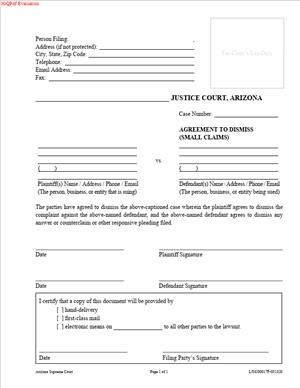
LJSC00017F – Agreement to Dismiss (Small Claims)
Fill out nowJurisdiction: Country: United States | Province or State: Arizona
If you have reached a point where you no longer want to move forward with a small claims case, the LJSC00017F – Agreement to Dismiss (Small Claims) is the document used to formally close that case. It tells the court that the parties agree the dispute is resolved or that the claim will not continue.
This form is part of the Arizona small claims process. It is commonly used after payment has been made, a settlement has been reached, or both sides decide not to pursue the matter further.
Filing this document matters because a case does not automatically disappear just because you and the other party worked things out. The court must receive written notice. Without it, hearings may remain scheduled, and the case can stay active.
If you are representing yourself, this form gives you a clear, structured way to notify the court that the dispute is finished. Understanding how it works helps you avoid delays and confusion.
What is LJSC00017F – Agreement to Dismiss (Small Claims)?
Clear definition
LJSC00017F – Agreement to Dismiss (Small Claims) is a written agreement filed with the small claims court stating that the plaintiff and defendant agree to dismiss the case. In simple terms, it asks the court to close the file.
The form documents that both sides consent to ending the lawsuit. It usually includes basic case information, such as the names of the parties and the case number. It may also indicate whether the dismissal is with or without prejudice, depending on how the form is structured.
Once filed and accepted, the court updates its records to show that the case has been dismissed. No further hearings or trial dates are expected after that point.
Who typically uses this form?
This form is most often used by plaintiffs and defendants in Arizona small claims cases. Either side can suggest dismissal, but both typically need to agree if it is labeled as an agreement.
Self-represented individuals use this form frequently. Small claims court is designed for people without attorneys, so it is common for both sides to complete and sign the document themselves.
In some situations, a business representative may also sign on behalf of a company involved in the case. The key requirement is that the person signing has the authority to agree to dismissal.
Why might you need this form?
You might need this form if the dispute has been resolved outside of court. For example, the defendant may have paid the amount claimed. Once payment is received and accepted, there may be no reason to continue.
You may also use it if you reached a written or verbal settlement agreement. The agreement could involve payment over time, returning property, or another resolution both sides accept.
Sometimes the plaintiff decides not to proceed. This could happen if the claim was filed in error, the wrong party was named, or the cost and effort of continuing are no longer worthwhile.
Without filing a dismissal, the case remains open. That means court dates may still be scheduled, and the court may expect appearances.
Typical real-life scenarios
- In one common situation, a plaintiff sues for unpaid rent or services. After the case is filed, the defendant pays the full amount. Both sides sign the agreement to dismiss, and the case ends without a hearing.
- In another scenario, the parties attend mediation before the hearing. They agree on a reduced payment amount and a payment schedule. As part of that agreement, they sign the dismissal form so the court can close the case.
- Sometimes the plaintiff realizes the claim was filed against the wrong person. Rather than proceed incorrectly, the parties signed the form and dismissed the case. A new claim may be filed separately if needed.
- There are also cases where both sides simply want to avoid further conflict. They may decide the dispute is not worth continuing. By signing and submitting the dismissal agreement, they formally end the lawsuit.
When would you use LJSC00017F – Agreement to Dismiss (Small Claims)?
You would use this form after a small claims case has already been filed and assigned a case number. It is not used to prevent a case from being filed. It is used to close an existing one.
Timing matters. Many people use the form before the hearing date once a settlement is reached. Filing it early helps prevent unnecessary court appearances.
It can also be used on or near the hearing date if both parties agree to dismiss. In some situations, parties bring the completed form to court and submit it there.
The plaintiff is often the one who initiates the dismissal because they started the case. However, the form is an agreement, which means both sides typically sign. If only one party wants to dismiss, a different procedure may apply.
You may also use this form after partial discussions that fully resolve the claim. Once there are no remaining issues for the court to decide, dismissal is the formal way to close the matter.
Legal characteristics of LJSC00017F – Agreement to Dismiss (Small Claims)
This form becomes effective once it is properly completed, signed by the required parties, and filed with the court. The court must process and enter the dismissal in its records.
For the document to be valid, it usually needs accurate case information. The names must match the court record. The case number must be correct. Missing or incorrect details can delay processing.
Signatures are critical. If the form is labeled as an agreement, both the plaintiff and defendant generally must sign. Unsigned or partially signed forms may be rejected or returned for correction.
Another important feature is whether the dismissal is with prejudice or without prejudice. A dismissal with prejudice typically means the claim cannot be filed again. A dismissal without prejudice may allow refiling in the future. The form may specify this, or the court’s default rules may apply.
Common problems include failing to file the form after signing it, assuming a private settlement automatically closes the case, or misunderstanding the effect of dismissal. The court only acts on what is formally submitted.
Small claims procedures can vary slightly from one state to another. In Arizona, small claims courts follow specific procedural rules set by the judicial branch. The form is designed to align with those rules.
It is also important to understand what this form does not do. It does not enforce a settlement agreement. If someone later fails to follow through, the dismissal itself does not automatically create a new judgment. It simply closes the current case.
Is it legally binding?
Yes, once properly signed and filed, the agreement reflected in the dismissal is legally recognized by the court. The dismissal becomes part of the official court record.
The binding effect depends on the type of dismissal. If it is with prejudice, the claim is typically considered permanently resolved. If it is without prejudice, the plaintiff may have the option to bring the claim again, subject to applicable rules and time limits.
The agreement between the parties may also be binding as a contract if it reflects a settlement. However, the dismissal form itself mainly serves to end the court case. Its primary legal effect is procedural, meaning it changes the status of the case.
If the court accepts and enters the dismissal, hearings are canceled, and the case is marked closed. At that point, the court no longer expects further action in that case.
How to fill out LJSC00017F – Agreement to Dismiss (Small Claims)
Step 1 – Review the case information at the top of the form
Start by carefully reviewing the case caption area. This section usually includes the court name, case number, and the names of the plaintiff and defendant.
Copy the information exactly as it appears on prior court documents. Check spelling, order of names, and the case number. Even small errors can cause processing delays.
Make sure you are using the correct form for small claims and that the case is still active. If a judgment has already been entered, different procedures may apply.
Step 2 – Confirm the agreement between the parties
Before filling in the main body of the form, confirm that both sides truly agree to dismiss the case. The form reflects a mutual decision.
Discuss whether the dismissal is with prejudice or without prejudice, if the form provides that option. Make sure both sides understand what that means in practical terms.
If the dismissal is tied to a settlement, confirm that the settlement terms are clear and understood. The form itself may not describe the settlement details, so clarity between the parties is important.
Step 3 – Complete the dismissal section
In the section where the dismissal is requested, fill in any required details. This may include checking a box or selecting a language that indicates the type of dismissal.
Read each line carefully. Do not skip sections unless the form clearly states they are optional. If a section does not apply, follow the form’s instructions for leaving it blank or marking it as not applicable.
Ensure that the information matches what you and the other party agreed to. The written document should reflect the exact nature of your agreement to end the case.
Step 4 – Sign and date the form
Each party that is required to agree must sign the form. Sign your full legal name as it appears in the case caption.
Write the date of your signature in the space provided. The date helps establish when the agreement was made.
If a business is a party, the person signing should include their title or capacity if the form asks for it. This shows they have the authority to act for the business.
Make sure all required signatures are present before moving to the next step. An incomplete form may not be processed.
Step 5 – Make copies for your records
After the form is fully completed and signed, make copies for both sides. Keep a copy for your own records.
Having a copy helps you confirm what was submitted and when. It can also be useful if questions arise later about the case status.
Ensure the copies are clear and legible. If any part of the form is difficult to read, consider rewriting it neatly before submission.
Step 6 – File the form with the court
Submit the completed LJSC00017F – Agreement to Dismiss (Small Claims) to the same court where the case was filed. Filing methods may include in-person submission or other accepted filing procedures.
Provide the original signed document unless instructed otherwise. The court clerk will process the filing and update the case record.
After filing, monitor the case status if possible. Once the dismissal is entered, the case is officially closed, and no further appearances should be required.
Legal terms you might encounter in LJSC00017F – Agreement to Dismiss (Small Claims)
- With Prejudice: This means the case is permanently closed. The same claim cannot be filed again between the same parties about the same issue. If this phrase appears in the dismissal section, it signals that the dispute is fully resolved and cannot return to court.
- Without Prejudice: This means the case is closed for now, but it may be filed again in the future. In small claims matters, this option is less common when parties have settled, but it may appear if the dismissal is procedural or temporary.
- Plaintiff: The person or business who started the small claims case. On this form, the plaintiff’s name must match exactly how it appears on the court’s records. Any mismatch can delay processing.
- Defendant: The person or business being sued. The defendant’s name must also match the court file. If there are multiple defendants, the form may need to clarify whether the dismissal applies to all or only some.
- Case Number: The unique number assigned by the court when the small claims case was filed. This number connects the dismissal to the correct court file. Entering the wrong case number can cause the court to reject or misfile the document.
- Stipulation: A written agreement between both parties. An agreement to dismiss is a type of stipulation. It shows the court that both sides consent to closing the case under agreed terms.
- Settlement: An agreement that resolves the dispute without a trial. The settlement details are usually not written in full on this form. Instead, the form confirms that the case is being dismissed because the parties reached an agreement.
- Court Clerk: The court official who receives and processes filed documents. The clerk reviews the form for completeness and enters the dismissal into the court record once accepted.
- Judgment: A court’s final decision after a hearing or trial. If a judgment has already been entered, an agreement to dismiss may not undo it automatically. The timing of your filing matters.
- Entry of Dismissal: The official act of recording the dismissal in the court system. Once entered, the case status changes to closed. This entry becomes part of the public record.
FAQs
Do both parties have to sign this form?
In most situations, yes. This document reflects a mutual agreement, so both the plaintiff and defendant typically sign to confirm they consent to the dismissal. Check the signature section carefully and make sure each required party signs in the correct space and includes the date.
What if we already had a hearing scheduled?
You should still complete and file the form as soon as your agreement is finalized. The court does not cancel hearings automatically just because you settled. Until the dismissal is entered into the record, you are still expected to appear.
Does the dismissal take effect on the date we sign or when the court files it?
The dismissal is generally effective when the court processes and enters it into the record, not simply when you sign it. Look for confirmation that the clerk accepted and filed the document. Keep proof of filing so you can show the case was officially closed.
What happens if only one party signs LJSC00017F – Agreement to Dismiss (Small Claims)?
If only one party signs, the court may treat it differently or reject it. This form is designed to show a joint agreement. Review the signature lines and confirm that all required parties have signed before submitting it.
Do I need to attach our settlement agreement?
Usually, you do not attach the full settlement unless the form specifically asks for it. This document generally confirms that an agreement exists, not the details of that agreement. If you choose to attach anything, make sure personal or sensitive information is handled carefully.
Can I change the form after I file it?
Once the court accepts and files the form, changing it can be difficult. If you notice an error before filing, correct it neatly and clearly. After filing, you may need to submit an additional document to address the mistake.
Will the dismissal appear on my court record?
Yes. When the clerk enters the dismissal, it becomes part of the official case history. Anyone reviewing the case record will see that the matter was dismissed, and whether it was with or without prejudice.
What should I double-check before submitting LJSC00017F – Agreement to Dismiss (Small Claims)?
Verify that the case number matches the court file, the party names are spelled exactly as listed, the correct dismissal option is selected, and all required signatures and dates are included. Small errors can delay acceptance, so review every section line by line before filing.
Checklist: Before, During, and After LJSC00017F – Agreement to Dismiss (Small Claims)
Before
- Confirm that both parties fully agree to dismiss the case.
- Review your settlement terms and ensure all conditions are understood.
- Verify the exact case number from prior court documents.
- Check the spelling and order of all party names.
- Decide whether the dismissal is with or without prejudice.
- Confirm whether any upcoming hearings are still on the calendar.
- Make sure you have the current contact information for the other party.
- Read the entire form from top to bottom before writing anything.
During
- Write clearly and legibly in black or blue ink if completing by hand.
- Enter the case number exactly as it appears on court documents.
- Fill in all required party names without abbreviations unless they match the court record.
- Select the correct dismissal option.
- Review each section for completeness before signing.
- Sign your name exactly as it appears in the case.
- Date the form on the day you actually sign it.
- Ensure the other party signs and dates in the correct space.
After
- Make at least two copies of the completed form.
- File the original with the appropriate court clerk.
- Confirm that the clerk has accepted the filing.
- Request a file-stamped copy for your records.
- Notify the other party once filing is confirmed, if required.
- Check the court docket to ensure the case status changes to dismissed.
- Keep your copy with your settlement documents.
- Mark your calendar to verify no further court appearances are scheduled.
Common mistakes to avoid with LJSC00017F – Agreement to Dismiss (Small Claims)
- Mistake: Selecting “with prejudice” without understanding it is final, often because parties focus on ending the case quickly; this can permanently prevent refiling, so do not forget to confirm you truly want the claim closed forever.
- Mistake: Writing the wrong case number due to copying from memory instead of a court document; this can lead to rejection or misfiling, so do not forget to verify the number directly from official paperwork.
- Mistake: Leaving out a party’s signature because you assume one signature is enough; the court may refuse to process it, so do not forget to check every required signature line.
- Mistake: Using nicknames or shortened business names for convenience; this can cause confusion in the record, so do not forget to match the exact legal names shown in the case.
- Mistake: Filing the form but failing to confirm it was entered by the clerk; this can result in missed hearings or enforcement actions, so do not forget to obtain proof of filing.
- Mistake: Assuming a verbal agreement is enough and delaying filing until the dismissal is recorded, the case remains active, so do not forget to submit the written document promptly.
- Mistake: Forgetting to keep a copy of the signed form; without proof, you may struggle to show the case was closed, so do not forget to store a file-stamped copy safely.
- Mistake: Rushing through the form and skipping sections you think do not apply; incomplete forms can be rejected, so do not forget to review every line before submission.
What to do after filling out LJSC00017F – Agreement to Dismiss (Small Claims)
Once you complete the form, your job is not finished. You need to make sure the court processes it correctly and that your records reflect the dismissal.
- Step 1: Review the entire document one more time for accuracy and completeness.
- Step 2: Confirm that all required signatures and dates are present.
- Step 3: Make at least two copies of the signed form.
- Step 4: File the original with the court clerk handling your small claims case.
- Step 5: Ask the clerk to stamp your copy as proof of filing.
- Step 6: Check how the court accepts filings, whether in person, by mail, or electronically, and follow that method carefully.
- Step 7: Monitor the case status through the court’s record system to confirm the dismissal has been entered.
- Step 8: Notify the other party once the court confirms acceptance, if you agreed to do so.
- Step 9: Keep your file-stamped copy with your settlement agreement and other case documents.
- Step 10: Review your calendar and remove any scheduled court dates only after you see confirmation that the case is dismissed.
You should also update your personal records. If you track disputes for business or financial reasons, mark the case as closed. If payment was part of the settlement, confirm that all funds have cleared and note the completion date.
Store your documents in a safe place. Even after dismissal, you may need proof that the case was resolved. A clear paper trail protects you if questions come up later.
Finally, give yourself a moment to review the outcome. Make sure all agreed-upon steps between you and the other party are completed. A properly filed dismissal closes the court case. Careful follow-through closes the loop in your records as well.
Disclaimer: This guide is provided for informational purposes only and is not intended as legal advice. You should consult a legal professional.