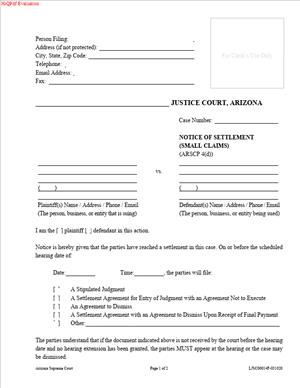
LJSC00014F – Notice of Settlement (Small Claims)
Fill out nowJurisdiction: Country: United States | Province or State: Arizona
If you have resolved your small claims dispute outside of court, the LJSC00014F – Notice of Settlement (Small Claims) is the document that tells the court your case has been settled. It is a simple but important filing. It formally notifies the court that the dispute is no longer active.
You use this form after you and the other party reach an agreement. That agreement might involve payment, return of property, or another solution. Once you settle, the court still expects to be informed.
Filing this document helps prevent unnecessary hearings. It also reduces the risk of a default judgment or other court action moving forward without knowing the case has been resolved.
If you are representing yourself, this form gives you a clear way to close the loop. It ensures the court’s record reflects what has actually happened in your case.
What is LJSC00014F – Notice of Settlement (Small Claims)?
Clear definition
LJSC00014F – Notice of Settlement (Small Claims) is a court form used in Arizona small claims cases to inform the court that the parties have reached a settlement. It does not describe the full terms of the agreement. Instead, it serves as a formal notice that the dispute has been resolved.
The form is part of the small claims process within the Arizona Judicial Branch. Small claims court is designed to handle lower-dollar disputes in a simplified way. This notice keeps that process accurate and up to date.
When filed, the document alerts the court that further action may not be necessary. It signals that the parties have handled the matter privately or through negotiation.
Who typically uses this form?
Most often, the plaintiff files this form after reaching an agreement with the defendant. The plaintiff is the person who started the case. However, depending on the situation, either party may take responsibility for submitting the notice.
Self-represented individuals commonly use this form. Small claims court is designed for people without lawyers. As a result, many users of this document are individuals handling their own cases.
Businesses that file or defend small claims cases may also use the form. For example, a small business that sues for unpaid services may submit the notice once payment is arranged.
Why might you need this form?
You may need this form if you and the other party settle before the hearing. Settlement can happen at any time, including before the defendant files an answer or even on the courthouse steps.
Without filing a notice, the court may assume the dispute is still active. The case could remain scheduled for a hearing. That can lead to wasted time or unintended consequences.
Filing the notice helps protect both sides from confusion. It shows that the dispute has been resolved voluntarily.
It also supports accurate court records. Once a case is settled, the court file should reflect that status.
Typical real-life scenarios
- You sue a former tenant for unpaid rent. Before the hearing, the tenant agrees to pay a reduced amount in exchange for closing the case. After you both sign a written agreement, you file the notice to inform the court.
- You are sued over a minor car accident. After discussing the matter, you and the other driver agree that their insurance payment resolves the issue. The plaintiff filed the notice, so the hearing is canceled.
- You file a claim for unpaid freelance work. The client sends full payment after being served. You accept the payment and complete the notice to show that the matter is settled.
- You and a contractor disagree about home repairs. After mediation, you reach an agreement that includes partial payment and additional work. Once the agreement is finalized, the notice is submitted to update the court.
- In each example, the form is not about arguing the case. It is about confirming that the dispute has ended through agreement.
When would you use LJSC00014F – Notice of Settlement (Small Claims)?
You use this form after a settlement is reached but before the court has entered a final judgment. Timing matters. The notice is most relevant while the case is still open.
If you are the plaintiff and the defendant pays you in full before the hearing, you may use the form to inform the court that the case no longer needs to proceed. This avoids a hearing where no dispute remains.
If you are the defendant and you resolve the claim directly with the plaintiff, the notice may be part of the final steps in closing the case. In many situations, the plaintiff handles the filing since they started the case.
The form is commonly used after informal negotiations. It may also follow a court-sponsored settlement discussion or mediation session.
You would not use this form to start a case. You would not use it to request judgment. It is specifically for notifying the court of a completed agreement.
In general, it is used once both parties have clearly agreed to resolve the dispute. The agreement may be written or verbal, though written agreements are common for clarity. The notice itself does not replace the agreement. It simply communicates that one exists.
Legal characteristics of LJSC00014F – Notice of Settlement (Small Claims)
This form becomes effective when it is properly completed and filed with the correct court handling the small claims case. It must accurately identify the case number and parties. If key information is missing, the clerk may reject it or request corrections.
The document does not typically require detailed terms of the settlement. Its purpose is notification, not enforcement. Because of that, it is usually straightforward.
Common problems include incorrect case numbers, misspelled party names, or filing in the wrong court location. Any mismatch between the form and the court’s records can delay processing.
The form does not automatically dismiss the case in every situation. In many small claims procedures, the court takes further action after receiving notice, such as closing or dismissing the case. The exact administrative step may vary by court.
It also does not enforce the settlement terms. If one party later fails to follow through, the notice itself does not compel payment or performance. Enforcement issues are separate from the act of notifying the court.
Different courts may have slightly different filing procedures. Some may allow electronic submission. Others may require in-person or mailed filing. The core purpose of the document, however, remains consistent: to inform the court that the dispute has been resolved.
Is it legally binding?
The notice itself is generally not the settlement agreement. It does not create binding obligations between the parties. The binding effect usually comes from the underlying agreement.
If both parties have entered into a valid settlement agreement, that agreement may be legally binding under contract principles. The notice simply communicates that such an agreement exists.
Once the court receives and processes the notice, it may close the case. At that point, the court typically stops moving the case forward. That administrative action is separate from the enforceability of the agreement itself.
If the settlement is fully performed, such as when payment has been made, the case effectively ends. If performance is still pending, the notice still reflects that the parties chose to resolve the matter privately.
In short, the binding force usually lies in the agreement between you and the other party. The form serves as official communication to the court about that agreement.
How to fill out LJSC00014F – Notice of Settlement (Small Claims)
Step 1 – Review your case information
Start by gathering your case details. You will need the correct case number exactly as it appears on prior court documents. You will also need the full legal names of the plaintiff and defendant.
Check a previous filing or court notice to confirm spelling and formatting. Accuracy at this stage prevents delays.
Step 2 – Identify the court
Enter the name of the justice court handling your small claims case. Make sure the court location matches the one where the case was filed.
Small claims matters are handled in specific justice courts. Using the wrong court name can cause processing issues.
Step 3 – Complete the caption section
Fill in the caption at the top of the form. This includes the court name, case number, and names of the parties.
The caption must match the court’s existing records. Do not shorten names unless they were originally filed that way.
Step 4 – Indicate that a settlement has been reached
In the main body of the form, state that the parties have reached a settlement. The form is designed to provide a simple notice rather than a detailed explanation.
Follow the wording provided in the document. Avoid adding extra statements unless the form specifically allows for them.
Step 5 – Confirm the status of the agreement
Some versions of the form may ask whether the settlement has been fully completed or is in the process of being completed. Read each line carefully.
Select or fill in the section that reflects your situation. Ensure that what you state is accurate at the time of signing.
Step 6 – Sign and date the form
Sign your name where indicated. Print your name clearly if the form requires it. Add the date of signing.
If both parties are required to sign, make sure each signature is included. An unsigned form may not be accepted.
Step 7 – Provide contact information
Include your current mailing address and any other required contact details. This allows the court to send confirmation or additional notices if needed.
Double-check that your contact information is legible and up to date.
Step 8 – Make copies
Before submitting the document, make a copy for your records. Keep it with your other case papers.
If the other party needs a copy, prepare one for them as well. Maintaining your own copy helps you confirm what was filed.
Step 9 – File the form with the court
Submit the completed form to the justice court handling your case. Follow the court’s standard filing process.
After filing, monitor your case status to ensure the court has processed the notice and updated the case record accordingly.
Legal terms you might encounter in LJSC00014F – Notice of Settlement (Small Claims)
- Caption: The caption is the top section of the form that lists the court name, case number, and the names of the plaintiff and defendant. It must match exactly what appears on other court documents in your case. If the names or case number are inconsistent, the clerk may reject the filing or misfile it.
- Plaintiff: The plaintiff is the person or business that filed the small claims case. On this form, the plaintiff’s name should appear exactly as it does in the court’s records. If you are the plaintiff, you are notifying the court that the dispute has been resolved.
- Defendant: The defendant is the person or business being sued. The defendant’s name must also match the court record. If there are multiple defendants, you must ensure each one is properly listed in the caption.
- Case Number: This is the unique number assigned to your small claims case when it was filed. It links this notice to your specific case. Entering the wrong case number can delay processing or cause the notice to be placed in the wrong file.
- Settlement: A settlement is an agreement between the parties to resolve the dispute without continuing to trial. In this form, you are informing the court that such an agreement has been reached. The form does not usually require you to list the settlement terms, only to confirm that the matter has been resolved.
- Dismissal: A dismissal ends the court case. When you file a notice of settlement, the court may dismiss the case based on that notice or may require a separate dismissal document. You should understand whether your filing will automatically close the case or whether further action is needed.
- Judgment: A judgment is a formal decision by the court. If a settlement is reached before a judgment is entered, the notice tells the court that a judgment is no longer necessary. If a judgment has already been entered, different procedures may apply.
- Signature: Your signature confirms that the information on the form is true and accurate. The court relies on your signature as a certification. If you are signing on behalf of a business, you must have authority to do so.
- Certificate of Service: Some court documents require proof that you provided a copy to the other party. If this form includes a certificate of service section, you must complete it accurately. It shows how and when the other party received notice.
- Clerk of the Court: The clerk processes and files your documents. When you submit this form, the clerk reviews it for completeness. The clerk does not provide legal advice but ensures the document meets filing requirements.
FAQs
Do I need to attach the actual settlement agreement to LJSC00014F – Notice of Settlement (Small Claims)?
In most situations, you do not need to attach the written settlement agreement unless the court specifically requires it. This document is generally used to inform the court that the dispute has been resolved. Before filing, check whether the form asks for attachments or references an attached agreement. If your agreement includes payment over time, confirm whether the court expects a copy for the file.
What happens to my court date after I file this form?
If the court accepts this document, the scheduled hearing is usually vacated or canceled. However, you should not assume it is canceled until you receive confirmation from the court. Check the case status after filing and keep any written confirmation showing that the hearing is no longer set.
Do both parties have to sign this document?
Some versions of this form only require the party filing it to sign, while others may include signature lines for both parties. Look carefully at the signature section. If there are multiple signature lines, complete each required one before submitting the form to avoid rejection.
What if we settle but the other party has not paid yet?
You can still notify the court that a settlement has been reached, but you should confirm whether the agreement is fully completed or still in progress. This form typically records that the case has been resolved, not whether payment has been made. If payments will occur later, make sure your agreement clearly states the schedule and keep your own copy.
Can I file this form online?
That depends on the court’s filing options. Some courts allow electronic filing, while others require in-person or mail submission. Review your court’s filing instructions and confirm whether electronic signatures are accepted. If filing in person, bring enough copies for the clerk to stamp.
What if I entered the wrong case number on this form?
An incorrect case number can cause delays or misfiling. If you realize the error before submission, correct it neatly or complete a new form. If the form has already been filed, contact the clerk promptly to ask about correcting the record and submit an amended notice if required.
Will this document automatically close my case?
In many small claims cases, filing this notice leads to dismissal, but it may not happen instantly. The court may issue a separate dismissal order. Monitor your case record to confirm that it shows as dismissed and keep a copy of any dismissal notice for your records.
What changes in the public record after I submit LJSC00014F – Notice of Settlement (Small Claims)?
Once filed and processed, the court record will reflect that the matter has been settled. This may appear as a settlement entry or a dismissal in the case docket. Review the updated record to ensure the entry accurately reflects that the dispute has been resolved.
Checklist: Before, During, and After LJSC00014F – Notice of Settlement (Small Claims)
Before
- Confirm that a full settlement agreement has been reached.
- Verify the correct court name and location.
- Locate your exact case number from prior court documents.
- Check the spelling of all party names as listed in the court record.
- Review the form to see whether both parties must sign.
- Determine whether a certificate of service section must be completed.
- Make sure you have current contact information for yourself.
During
- Complete the caption exactly as it appears on prior filings.
- Enter the correct case number without transposing digits.
- Indicate clearly that the case has been settled.
- Fill in any required details about the status of the agreement.
- Sign and date the form in the designated area.
- Complete the certificate of service if required.
- Double-check all entries for accuracy before submitting.
After
- Make at least two copies of the completed form.
- File the original with the court clerk using the approved method.
- Obtain a stamped copy for your records.
- Deliver or mail a copy to the other party if required.
- Confirm that any scheduled hearing has been vacated.
- Monitor the case status for a dismissal entry.
- Store the settlement agreement and filed notice together in a safe place.
Common mistakes to avoid with LJSC00014F – Notice of Settlement (Small Claims)
- Mistake: Using a nickname or shortened business name because it seems informal, which happens when parties rely on memory instead of the court record; this can cause rejection or confusion in the docket, so do not forget to copy names exactly as they appear in prior filings.
- Mistake: Entering the wrong case number due to digit transposition or referencing another document, which can misdirect the filing into the wrong case file; this may delay closure of your case, so do not forget to verify the number directly from the latest court notice.
- Mistake: Assuming the hearing is automatically canceled once you sign the form, which happens when parties confuse signing with filing; this can result in missing a scheduled court date, so do not forget to confirm the court has processed and updated your case.
- Mistake: Forgetting to sign and date the document because you focused on the caption details; an unsigned form may be rejected, so do not forget to review the signature section before submission.
- Mistake: Failing to complete the certificate of service when required, often because it appears at the bottom of the page; this omission can prevent proper filing, so do not forget to confirm whether service details must be included.
- Mistake: Not keeping a stamped copy for your records, which happens when filing in a hurry; without proof of filing, you may struggle to show the case was settled, so do not forget to request and store a file-stamped copy.
What to do after filling out LJSC00014F – Notice of Settlement (Small Claims)
Once you complete the form, your next steps matter. Filing properly ensures the court updates its records and prevents unnecessary hearings or further action.
- Step 1: Review the entire form one more time for accuracy, including names, case number, and signature.
- Step 2: Make at least two copies of the completed document before submitting it.
- Step 3: File the original with the court clerk using the method accepted by your court, such as in person, by mail, or electronically if permitted.
- Step 4: Obtain confirmation of filing, such as a stamped copy or electronic receipt.
- Step 5: Provide a copy to the other party if required and note the date and method of delivery.
- Step 6: Check the court’s case status online or through the clerk’s office to confirm the filing has been entered.
- Step 7: Verify that any upcoming hearing date has been removed from the calendar.
- Step 8: Watch for a formal dismissal or settlement entry in the case docket.
- Step 9: Keep the filed notice together with your written settlement agreement and any proof of payment.
- Step 10: Update your personal or business records to reflect that the dispute has been resolved and the case is closed.
Staying organized protects you if questions arise later. If the settlement includes future payments, track them carefully and retain proof of each transaction. Once the court record shows dismissal and all settlement terms are satisfied, your small claims case is fully resolved.
Disclaimer: This guide is provided for informational purposes only and is not intended as legal advice. You should consult a legal professional.