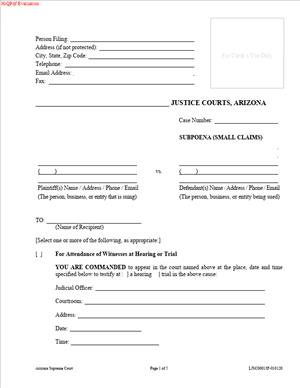
LJSC00013F – Subpoena (Small Claims)
Fill out nowJurisdiction: Country: United States | Province or State: Arizona
If you are involved in a small claims case and need evidence or testimony from someone who is not voluntarily participating, the LJSC00013F – Subpoena (Small Claims) is the document used to formally require their involvement. This form is part of the Arizona judicial branch process for small claims matters.
You use this form when a person has important information, records, or physical evidence relevant to your case. It allows the court to direct that person to appear at a hearing or produce documents.
Small claims court is designed to be simpler than other court divisions. Even so, you may still need formal tools to gather proof. A subpoena is one of those tools.
If you are representing yourself, this form can feel intimidating. Once you understand what it does and how it works, it becomes a practical step in preparing your case. The key is knowing what information belongs in each section and how the court expects it to be used.
What is LJSC00013F – Subpoena (Small Claims)?
Clear definition
The LJSC00013F – Subpoena (Small Claims) is a court document used to require a person to either appear in small claims court, produce documents, or both. It is issued in connection with an existing small claims case.
A subpoena is not a request. It is a formal order connected to the authority of the court. When properly issued and served, it directs the recipient to comply with its instructions.
In small claims cases, subpoenas are often used to obtain business records, contracts, payment histories, photographs, repair estimates, or testimony from someone who witnessed the events in dispute.
This form does not start a case. It supports a case that has already been filed.
Who typically uses this form?
This form is commonly used by plaintiffs and defendants in small claims court. If you filed the case, you might use it to require a witness to attend your hearing. If you are defending against a claim, you may use it to obtain records or testimony that support your position.
Self-represented individuals use this form frequently. Small claims court often limits or discourages attorney involvement, so the process is structured to allow non-lawyers to complete and submit the form.
In some situations, a business representative involved in the case may use the form to secure records from another company or to ensure a former employee appears at the hearing.
Court clerks and judges are involved in reviewing and issuing the subpoena, depending on local procedure. The subpoena becomes effective once properly issued and served.
Why might you need this form?
You might need this form if someone has information critical to proving your claim or defense but is unwilling to cooperate voluntarily.
For example, a bank may hold transaction records that show whether a payment was made. A repair shop may have invoices that support your damages. A third-party witness may have seen what happened during a dispute.
Without a subpoena, that person or business can simply decline your request. The subpoena gives legal weight to your request and connects it to the authority of the court.
In small claims cases, evidence often determines the outcome. If you cannot present the documents or testimony that support your version of events, the judge may only consider the information presented by the other side. A subpoena helps ensure the court has a fuller picture.
Typical real-life scenarios
- You sued a contractor for incomplete work. A building inspector evaluated the project and wrote a report. The inspector is not involved in your case and has not agreed to attend the hearing. You use the subpoena to require their appearance or to produce the inspection report.
- You are being sued for unpaid rent. You believe you made several payments that were not credited. Your bank has statements that show the transactions. You use the subpoena to require the bank to produce certified copies of your account records.
- You purchased a used car and claim the seller misrepresented its condition. A mechanic inspected the car shortly after purchase and documented serious issues. The mechanic is reluctant to testify. The subpoena compels the mechanic to appear or provide written records.
- You are defending a claim involving property damage. A security company has camera footage from the date of the incident. The company will not release the footage without a court order. The subpoena requires the production of that recording for use at your hearing.
When would you use LJSC00013F – Subpoena (Small Claims)?
You use this form after a small claims case has already been filed and assigned a case number. The subpoena is tied to that specific case.
Timing matters. You generally use it when preparing for a scheduled hearing, and you know you need outside evidence or testimony. It is not typically used before a case is formally underway.
Both plaintiffs and defendants may use the form. The party requesting the subpoena is sometimes called the “issuing party.” The person receiving it is often referred to as the “witness” or “custodian of records,” depending on what is requested.
In many small claims situations, you first try to obtain documents informally. If the person or business refuses or ignores your request, a subpoena becomes the formal method to obtain what you need.
You may also use the form if a witness agreed to attend but later became unresponsive. The subpoena provides a formal notice backed by the court’s authority, which may increase the likelihood of attendance.
In the Arizona small claims court, procedures are designed to be streamlined. Even so, evidence rules still apply. If you want the judge to consider certain documents or testimony, you are responsible for making sure they are available at the hearing. This form is one of the primary tools for doing that.
Legal characteristics of LJSC00013F – Subpoena (Small Claims)
A subpoena is effective when it is properly completed, issued, and served according to court procedures. All required fields must be filled in clearly and accurately. The case number, court information, and names of the parties must match the official court record.
The form must clearly state what is required. If it directs a person to appear, it must list the correct date, time, and location of the hearing. If it directs the production of documents, it must describe those documents with reasonable detail.
Vague or overly broad requests often create problems. For example, asking for “all records related to the business” without time limits or subject details may be challenged as unclear or burdensome.
Improper service is another common issue. A subpoena generally must be delivered to the recipient in a specific manner. If service is not completed correctly, the court may determine the subpoena is not enforceable.
There can be differences in procedure between court divisions or counties. Small claims court typically follows streamlined rules, but the subpoena still must meet the court’s basic requirements to be valid.
It is important to understand what this form does not do. It does not guarantee that the evidence will automatically be accepted. The judge still decides what is relevant and admissible. It also does not resolve your case or decide fault. It only compels appearance or production.
The form does not authorize you to personally enforce compliance. If someone fails to comply, the issue returns to the court for further action. The court decides what consequences, if any, apply.
Is it legally binding?
Yes, a properly issued and served subpoena is legally binding. It carries the authority of the court.
When a person receives a valid subpoena, they are legally required to comply with its terms. That may mean appearing in court at the scheduled time or providing the specified documents.
However, the binding nature depends on correct completion and service. If the form contains errors, lists the wrong hearing date, or was not served in an acceptable manner, its enforceability may be questioned.
There are also circumstances in which a recipient may object. For example, a person may claim the request is overly broad, seeks privileged information, or creates an unreasonable burden. In those situations, the court determines how to proceed.
The subpoena does not automatically override all privacy concerns. Certain records, such as medical or confidential financial information, may involve additional legal considerations. The court evaluates those concerns if raised.
When valid and uncontested, the subpoena functions as a court order. Ignoring it can lead to further court involvement.
How to fill out LJSC00013F – Subpoena (Small Claims)
Step 1 – Review your case information
Start by gathering your case details. You need the exact case number, the names of the plaintiff and defendant as they appear on the court record, and the court location handling your small claims case. Copy this information exactly as it appears in your official documents.
Accuracy at this stage prevents confusion later. Even small spelling errors in party names can create complications.
Step 2 – Enter the court information
At the top of the form, fill in the name of the court and its location. This identifies which court is issuing the subpoena. Use the same court name listed on your complaint or response.
Make sure the division and precinct information, if required, match your case file. This ensures the subpoena is properly linked to your specific proceeding.
Step 3 – Identify the parties
Enter the names of the plaintiff and defendant in the designated spaces. These must match the case caption exactly. Do not shorten names or add extra information unless the form specifically asks for it.
This section connects the subpoena directly to your small claims case.
Step 4 – Identify the person or entity receiving the subpoena
Provide the full legal name of the individual or business being subpoenaed. Include a complete address where the subpoena will be delivered.
If you are requesting documents from a business, you may need to identify a specific department or records custodian. Clear identification helps ensure the document reaches the correct recipient.
Step 5 – Specify what is required
Indicate whether the subpoena requires the person to appear at the hearing, produce documents, or both. The form may include checkboxes or designated sections for these options.
If appearance is required, confirm the hearing date, time, and location. These details must match the court’s scheduling notice.
If documents are requested, describe them clearly and specifically. Include relevant date ranges and subject matter. For example, you might request “invoices dated January 1 through March 31 related to repairs at [address].” Clarity reduces the chance of misunderstanding.
Step 6 – State the place and time for production
If documents are to be produced, the form may require you to list when and where they must be delivered. This could be the hearing date or another specified time.
Ensure that the time provided allows reasonable notice before the hearing. This gives you an opportunity to review the documents.
Consistency between this section and the court’s schedule is important.
Step 7 – Review for completeness and accuracy
Before submitting the form, read every line carefully. Confirm that all required fields are filled in and that names, dates, and addresses are correct.
Check that your document requests are understandable and limited to what is relevant to your case. Overly broad language can create delays.
If the form requires your contact information, ensure it is current and legible.
Step 8 – Sign the form if required
Some sections of the form may require your signature as the requesting party. Sign in the designated area only.
Your signature confirms that the information provided is accurate to the best of your knowledge and that the subpoena is connected to an active small claims case.
Do not sign in areas reserved for the clerk or judge.
Step 9 – Submit the form for issuance
Take or submit the completed form to the appropriate court office handling your small claims case. The court may review the form before it becomes effective.
Once issued according to court procedure, the subpoena can then be served on the person or business identified in the document.
Legal terms you might encounter in LJSC00013F – Subpoena (Small Claims)
- Subpoena: A subpoena is a court order that requires a person to do something specific. In small claims, it usually requires someone to appear at a hearing, bring documents, or both. When issued, it carries the authority of the court.
- Small Claims Division: This is the part of the court that handles lower-dollar civil disputes using simplified procedures. The form is designed specifically for cases filed in this division. It reflects the streamlined process and limited scope of small claims cases.
- Issuing Court: This refers to the specific court that has authority over your case. The name and location of the court must match your case exactly. The issuing court gives the subpoena its legal force.
- Case Number: This is the unique number assigned to your lawsuit. It links the subpoena to your specific case. If the number is wrong or missing, the court may reject the document, or the recipient may challenge it.
- Party: A party is either the plaintiff or the defendant in the small claims case. The subpoena is not typically directed at a party, but the parties’ names must still appear correctly on the form. This ensures clarity about which dispute the subpoena relates to.
- Witness: A witness is the person being ordered to appear and possibly testify. The subpoena identifies this person by name and address. The witness is legally required to comply once properly served.
- Custodian of Records: This is the person responsible for maintaining an organization’s documents. If you are requesting business records, you may direct the subpoena to the custodian of records. This avoids naming a specific employee who may not handle documents.
- Production of Documents: This phrase refers to the requirement that the recipient bring specific records or items. The form allows you to describe the documents in detail. Clear descriptions reduce confusion and objections.
- Service: Service means formally delivering the subpoena to the person named in it. Proper service is required before the subpoena becomes enforceable. The method of service must comply with court rules.
- Proof of Service: This is written confirmation that the subpoena was delivered correctly. It may be completed by the person who served the document. Courts often require proof of service before taking action if someone fails to comply.
FAQs
Do I need the judge to sign LJSC00013F – Subpoena (Small Claims) before I serve it?
In most small claims courts, the subpoena must be issued by the court before it has legal effect. That often means a clerk or judge signs or stamps it. Check the form carefully to see if there is a signature or seal section that must be completed before service. If you serve it without proper issuance, the witness may ignore it and the court may not enforce it.
What information must match my case exactly?
The court name, case number, and the names of the plaintiff and defendant must match your case file exactly. Even small spelling differences can cause confusion. Before submitting this document for issuance, compare it side by side with your complaint or previous court paperwork. Consistency helps the clerk process it without delay.
How specific do I need to be when listing documents to be produced?
You should describe documents clearly enough that the recipient understands what to bring. Instead of writing “all records,” list types of records, date ranges, and subjects. For example, you might request invoices between certain dates or photographs taken on a specific day. Vague requests can lead to objections or incomplete responses.
Can I subpoena a business instead of a person?
Yes, but you should direct the subpoena to the correct individual within the business. Often, this is the custodian of records. You must include a complete business name and service address. If you only list a company name without identifying who receives it, the service may be challenged.
What happens if the witness does not show up or bring the documents?
If a properly served subpoena is ignored, you can inform the court at your hearing. The judge may continue the case, issue further orders, or take other action. The court will usually want to see proof that service was completed correctly. Keep your documentation ready.
Do I have to pay witness fees when using this form?
Courts often require that you provide a statutory witness fee and possibly mileage at the time of service. The amount is set by court rules or statute. If you do not include the required payment, the witness may not be legally obligated to attend. Confirm the current fee before arranging service.
Can I change the date or time after LJSC00013F – Subpoena (Small Claims) has been issued?
Once issued, you should not alter the date or time by hand. If your hearing is rescheduled, you may need a new subpoena with the updated information. Serving an outdated or altered document can make it unenforceable. Always make sure the appearance date matches the court’s official schedule.
Does this form become part of the public court record?
When you file or submit this document to the court, it may become part of the case file. That means the names listed and the general description of requested materials could be visible in the court record. Be thoughtful and accurate when describing documents. Avoid including sensitive personal details unless necessary and permitted.
Checklist: Before, During, and After LJSC00013F – Subpoena (Small Claims)
Before
- Confirm your small claims case number and court location.
- Verify the full legal name and address of the witness or custodian of records.
- Decide whether you need testimony, documents, or both.
- Prepare a clear and limited description of the requested documents.
- Check the hearing date and time for accuracy.
- Confirm any required witness fees and mileage amounts.
- Review court rules about who can serve the subpoena.
- Make a draft copy to proofread before submitting for issuance.
During
- Complete every required field on the form in clear, legible print.
- Match party names exactly as they appear in your case.
- Double-check the date, time, and location of the appearance.
- Attach any additional pages if you need more space for document descriptions.
- Submit the form to the court clerk for issuance.
- Obtain the court’s signature, stamp, or seal if required.
- Arrange for proper service by an authorized person.
- Ensure witness fees are delivered at the time of service.
After
- Obtain and keep proof of service from the server.
- File proof of service with the court if required.
- Calendar the hearing date and confirm the witness has been served in time.
- Bring a copy of the subpoena and proof of service to court.
- Follow up respectfully with the witness if appropriate.
- Prepare questions or organize expected documents in advance.
- Be ready to explain to the judge why the subpoenaed evidence matters.
- Keep copies of all documents for your records.
Common mistakes to avoid with LJSC00013F – Subpoena (Small Claims)
- Mistake: Listing the wrong case number because you copied it from memory, which can cause the court to reject the form or link it to the wrong file, so do not forget to verify it directly from your official court paperwork.
- Mistake: Using a nickname or an incomplete business name for the witness, which happens when you rely on informal records and can make service invalid, so do not forget to confirm the exact legal name and address.
- Mistake: Requesting “all documents” without limits because you want to cover everything, which can lead to objections or noncompliance, so do not forget to narrow your request by subject and date range.
- Mistake: Serving the subpoena yourself when court rules require a neutral adult, which happens due to cost concerns and can invalidate service, so do not forget to check who is legally allowed to serve it.
- Mistake: Forgetting to include required witness fees at the time of service, which can relieve the witness of the duty to appear, so do not forget to confirm and provide the correct payment.
- Mistake: Altering the hearing date by hand after issuance because your schedule changed, which can make the document unenforceable, so do not forget to request a properly reissued subpoena if details change.
- Mistake: Waiting too close to the hearing date to serve the witness, which can prevent timely compliance and force a postponement, so do not forget to allow enough time for service and response.
- Mistake: Failing to bring proof of service to court because you assume it is already on file, which can limit the judge’s ability to enforce the subpoena, so do not forget to keep a stamped copy with you.
What to do after filling out LJSC00013F – Subpoena (Small Claims)
Once you complete the form, slow down and review it line by line. Small errors can delay your case. Make sure names, dates, and addresses are correct and readable.
- Step 1: Make at least two copies of the completed subpoena before submitting it for issuance.
- Step 2: Submit the original to the court clerk for issuance, following the court’s filing process.
- Step 3: Confirm that the subpoena has been signed, stamped, or sealed as required.
- Step 4: Arrange for proper service by someone authorized under court rules.
- Step 5: Provide required witness fees and mileage at the time of service.
- Step 6: Obtain written proof of service from the person who served it.
- Step 7: File the proof of service with the court if required, or bring it with you to the hearing.
- Step 8: Organize your case file so the subpoena, proof of service, and related notes are easy to access.
- Step 9: Prepare to explain to the judge why the witness or documents are relevant to your claim or defense.
- Step 10: Monitor your hearing date and confirm there are no schedule changes that would require a new subpoena.
Keep all copies in a safe place. Update your personal case checklist to show when the service was completed and when the proof was filed. If you receive documents before the hearing, review them carefully and organize them in the order you plan to discuss them. Being prepared shows the court you are serious and respectful of the process.
Disclaimer: This guide is provided for informational purposes only and is not intended as legal advice. You should consult a legal professional.