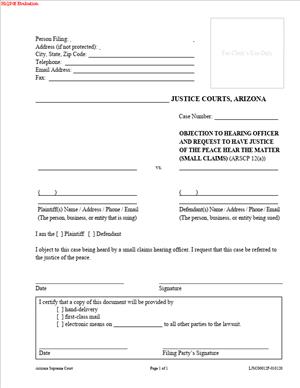
LJSC00012F – Objection to Hearing Officer and Request to Have Justice of the Peace Hear the Matter (Small Claims)
Fill out nowJurisdiction: Country: United States | Province or State: Arizona
If you are involved in a small claims case in Arizona, you may learn that your case is scheduled to be heard by a hearing officer instead of a justice of the peace. The LJSC00012F – Objection to Hearing Officer and Request to Have Justice of the Peace Hear the Matter (Small Claims) is the document you use to formally object to that assignment.
This form allows you to ask that your case be heard by a justice of the peace rather than a hearing officer. It is part of the small claims process in Arizona’s justice courts. You use it when you want a different judicial officer to decide your case.
Small claims cases are designed to be simple and accessible. Even so, the person who hears your case can matter to you. This form gives you a clear way to make your preference known through an official court filing.
If you are representing yourself, this document can feel technical at first. Once you understand its purpose and structure, it becomes straightforward. It is simply a written objection and request, filed within your small claims case.
What is LJSC00012F – Objection to Hearing Officer and Request to Have Justice of the Peace Hear the Matter (Small Claims)?
Clear definition
LJSC00012F – Objection to Hearing Officer and Request to Have Justice of the Peace Hear the Matter (Small Claims) is a court form used in Arizona justice courts. It allows a party in a small claims case to object to having the matter heard by a hearing officer and to request that a justice of the peace hear the case instead.
A hearing officer is authorized to hear and decide certain small claims matters. A justice of the peace is an elected judicial officer who also presides over cases in justice court. This form addresses which of those officials will handle your hearing.
The document becomes part of the court record once it is filed. It communicates your position formally, rather than informally telling court staff or mentioning it at the hearing.
Who typically uses this form?
This form is usually used by plaintiffs or defendants in small claims cases. Either side may decide they prefer a justice of the peace to hear the case.
Plaintiffs may file it after starting a small claims case and learning it has been assigned to a hearing officer. Defendants may file it after being served with a small claims complaint and reviewing the court paperwork.
Self-represented individuals most commonly use this form. Small claims court is designed for people without attorneys, so the language and layout are generally structured for non-lawyers.
Why might you need this form?
You may need this form if you disagree with having a hearing officer decide your case. The form provides a formal way to express that objection.
Some people are more comfortable having a justice of the peace hear their dispute. They may believe it affects how the case is handled or how the decision is issued.
In some situations, filing this document may change how the case proceeds. It can affect scheduling, procedures, or the level of formality at the hearing.
Without filing this form, your case may move forward before a hearing officer by default. This document ensures your objection is recorded in writing.
Typical real-life scenarios
- You file a small claims case over unpaid rent. The court notice states that a hearing officer will preside. After reviewing your paperwork, you decide you would prefer a justice of the peace to hear the matter. You complete and file the objection form within the time allowed.
- You are sued in small claims court over a disputed service contract. The court assigns the case to a hearing officer. After reading the instructions that came with your summons, you learn that you can object and request a justice of the peace instead.
- A business owner is involved in a small claims dispute over damaged property. The owner receives notice that the hearing will be conducted by a hearing officer. The owner chooses to submit a written objection using the official court form.
- Two neighbors are in a dispute about property damage. One party feels more comfortable having an elected judicial officer handle the hearing. That party files the objection document before the scheduled hearing date.
When would you use LJSC00012F – Objection to Hearing Officer and Request to Have Justice of the Peace Hear the Matter (Small Claims)?
You would use this form after a small claims case has been filed and assigned to a hearing officer. It is typically used before the hearing takes place. Timing matters because the court needs advance notice to adjust who will preside.
This form is used during the active phase of a small claims case. It is not part of starting a case or responding to a claim. Instead, it relates specifically to who will hear the case.
Both plaintiffs and defendants may use it. For example, a plaintiff who initiated the lawsuit may later decide to object. A defendant who has just been served may review the paperwork and decide to file the objection as part of preparing for the hearing.
You would not use this form in cases outside small claims. It applies to matters already designated as small claims within Arizona justice courts.
Legal characteristics of LJSC00012F – Objection to Hearing Officer and Request to Have Justice of the Peace Hear the Matter (Small Claims)
This document is procedural in nature. It does not address the merits of your dispute. Instead, it addresses which judicial officer will hear the case.
For the filing to be effective, it generally must be completed accurately and submitted within the required timeframe. Courts typically require that it include correct case information, such as the case number and names of the parties.
Common problems include missing case numbers, unsigned forms, or filing after the deadline. Clerical errors can delay processing. An incomplete submission may not result in the requested change.
This form does not present evidence. It does not explain why you are right in the dispute. It also does not request a change of venue or transfer to a different court. It is limited to objecting to a hearing officer and requesting a justice of the peace within the same court system.
Procedures may vary slightly between courts in how the objection is processed or scheduled. However, the core purpose of the form remains the same across Arizona justice courts.
Is it legally binding?
The form itself is not a contract between parties. It is a procedural request filed with the court. Its legal effect depends on proper filing and court rules.
Once properly submitted and accepted, the objection may require the court to assign the matter to a justice of the peace instead of a hearing officer. In that sense, it can change who presides over your case.
It does not bind the other party to any agreement. It also does not resolve the dispute. Its binding effect is limited to how the court manages the case moving forward.
How to fill out LJSC00012F – Objection to Hearing Officer and Request to Have Justice of the Peace Hear the Matter (Small Claims)
Step 1 – Review your case documents
Start by reviewing the notice you received from the court. Confirm that your small claims case has been assigned to a hearing officer. Locate your case number, the court name, and the names of all parties exactly as they appear on prior filings.
Having these details in front of you reduces the risk of errors. The information on this form must match the court’s records.
Step 2 – Complete the court caption
At the top of the form, fill in the court name, case number, and party names. This section is often called the caption.
Enter the plaintiff’s and defendant’s names exactly as listed in the original complaint or summons. Even small differences in spelling can cause confusion in court records.
Make sure the case number is accurate. The court uses this number to connect your filing to the correct case file.
Step 3 – Identify yourself in the case
Indicate whether you are the plaintiff or the defendant. The form typically includes a space to mark your role.
This tells the court who is making the objection. It also clarifies for the judge and the other party who filed the request.
Use your full legal name as it appears in the case. Consistency with prior filings helps avoid administrative issues.
Step 4 – State your objection and request
In the main section of the document, you formally object to the hearing officer and request that a justice of the peace hear the matter.
The language is usually provided in the form. Read it carefully before signing. By completing this section, you are asking the court to assign the case to a justice of the peace instead.
You do not need to argue the facts of your case here. The purpose is to make the procedural request, not to explain the underlying dispute.
Step 5 – Sign and date the form
Sign your name where indicated. Enter the date of your signature.
Your signature confirms that you are making the objection in your capacity as a party to the case. An unsigned form may not be processed.
If the form includes a section for printed name, address, or contact information, complete it clearly. This helps the court communicate with you about scheduling.
Step 6 – File the form with the court
Submit the completed document to the justice court handling your small claims case. This may involve filing it in person or through the court’s accepted filing method.
Ensure it is submitted within any stated deadline. Courts generally require that objections be filed within a specific timeframe after notice of assignment.
After filing, keep a copy for your records. You may need it for reference at the hearing or if questions arise about when the objection was made.
Step 7 – Confirm the updated hearing information
After the filing is processed, the court may issue updated information about who will hear the case and when. Review any new notice carefully.
Check the date, time, and courtroom or virtual instructions. Changes in the presiding officer can sometimes affect scheduling.
Keep all notices together with your copy of the filed form. Staying organized will make it easier to prepare for the next stage of your small claims case.
Legal terms you might encounter in LJSC00012F – Objection to Hearing Officer and Request to Have Justice of the Peace Hear the Matter (Small Claims)
- Hearing Officer: A court-appointed official who may conduct small claims hearings instead of a judge. The hearing officer can listen to testimony, review evidence, and make a decision in your case. This form allows you to object to having your case decided by a hearing officer.
- Justice of the Peace: An elected judicial officer who presides over justice court cases, including small claims. When you file this document, you are asking that a Justice of the Peace, rather than a hearing officer, hear and decide your case.
- Objection: A formal statement that you do not agree with something in the court process. In this context, you are objecting to the assignment of your case to a hearing officer. Your objection must be filed in writing using this specific form.
- Small Claims Division: A simplified court process within the justice court designed to resolve lower-dollar disputes quickly and informally. Procedures are streamlined. This document applies only to cases filed in the small claims division.
- Case Number: The unique number assigned to your case when it was filed. You must enter this exactly as it appears on your court papers. The clerk uses this number to match your objection to the correct file.
- Party: A person or business involved in the lawsuit. You are either the plaintiff (the person who filed the case) or the defendant (the person being sued). The form requires you to identify which party you are.
- Filing: The act of submitting a document to the court clerk for inclusion in the official record. Your objection is not effective until it is properly filed and accepted by the clerk.
- Certificate of Service: A statement showing that you provided a copy of your filed document to the other party. Some courts require you to confirm how and when you delivered the document to the opposing party.
- Court Record: The official file that contains all documents submitted in your case. Once accepted, this document becomes part of the permanent court record and shows that you requested a judge instead of a hearing officer.
FAQs
How do I know if this form applies to my case?
Check your notice from the court. If it states that your small claims case is assigned to a hearing officer, you can use this document to object. The LJSC00012F – Objection to Hearing Officer and Request to Have Justice of the Peace Hear the Matter (Small Claims) is specifically for small claims cases where a hearing officer has been assigned.
Is there a deadline to file this document?
Yes. The notice assigning the hearing officer usually explains how many days you have to object. Look closely at the date on the notice and count the allowed time. If you file late, the court may deny your request and keep the hearing officer assigned.
Do I need to explain why I want a Justice of the Peace instead?
Typically, no detailed explanation is required. This document is mainly a formal request stating that you prefer a Justice of the Peace to hear the matter. Focus on completing the caption, identifying yourself correctly, and clearly marking your objection rather than adding extra arguments.
What information must match exactly with my other court papers?
Your case number, the names of all parties, and the court location must match your original complaint or summons. Even small differences in spelling can delay processing. Before you file, compare this form line by line with your earlier documents.
Does filing this form change my hearing date?
It can. Once the court processes your objection, the case may be reassigned to a Justice of the Peace. The court may issue a new notice with an updated hearing date. Do not assume the original date still applies without checking the latest court notice.
Do I have to send a copy to the other party?
In most situations, yes. After filing this document, you should provide a copy to the opposing party according to court rules. Keep proof of when and how you delivered it, and complete any required certificate of service section.
What happens if both parties file an objection?
If both parties object, the court will typically assign the case to a Justice of the Peace. The clerk will update the court record to reflect the change. You should wait for written confirmation before assuming the reassignment is complete.
How will I know the court accepted my filing?
After you submit LJSC00012F – Objection to Hearing Officer and Request to Have Justice of the Peace Hear the Matter (Small Claims), the clerk will stamp it as filed or provide confirmation through the court’s filing system. Check that the filing date appears on your copy. If you do not receive confirmation, contact the clerk to verify that this form is in your case file.
Checklist: Before, During, and After LJSC00012F – Objection to Hearing Officer and Request to Have Justice of the Peace Hear the Matter (Small Claims)
Before
- Review the notice assigning your case to a hearing officer.
- Confirm the deadline for filing your objection.
- Locate your case number and full party names.
- Verify the correct justice court location.
- Read the entire form once before writing anything.
- Gather copies of prior court documents for reference.
- Check whether a certificate of service section is required.
During
- Enter the case number exactly as shown on your court papers.
- Print the names of all parties clearly and completely.
- Mark or state your objection as directed on the form.
- Identify yourself as plaintiff or defendant.
- Complete any required service information.
- Sign your full legal name where indicated.
- Date the form accurately.
- Review the completed form for missing fields.
After
- Make at least two copies of the signed document.
- File the original with the court clerk.
- Obtain a stamped copy for your records.
- Deliver a copy to the other party if required.
- Keep proof of delivery with your case file.
- Watch for a new hearing notice from the court.
- Update your calendar with any revised hearing date.
- Bring your filed copy to all future hearings.
Common mistakes to avoid with LJSC00012F – Objection to Hearing Officer and Request to Have Justice of the Peace Hear the Matter (Small Claims)
- Mistake: Missing the filing deadline because you did not carefully read the hearing officer assignment notice, which can result in your objection being rejected and your case staying with the hearing officer; do not forget to calculate and calendar the deadline immediately.
- Mistake: Writing the wrong case number due to copying from memory instead of checking the official documents, which can delay processing or place the form in the wrong file; do not forget to verify the number directly from your latest court paper.
- Mistake: Failing to sign and date the form because you focused only on the objection section, which can cause the clerk to refuse filing; do not forget that your signature makes the request valid.
- Mistake: Not providing a copy to the other party because you assumed the court would handle service, which can create procedural issues later; do not forget to complete any required certificate of service.
- Mistake: Adding long explanations or arguments on the form because you think you must justify your request, which can clutter the document and create confusion; do not forget that this form is mainly a simple written objection.
- Mistake: Assuming the hearing date automatically changes once you file, which can lead to missing your scheduled appearance; do not forget to confirm any new date in writing from the court.
- Mistake: Filing in the wrong court location because you did not check the courthouse listed on your case caption, which can result in rejection or delay; do not forget to match the court name exactly.
- Mistake: Keeping no personal copy because you believed the court keeps everything, which leaves you without proof of filing; do not forget to obtain and store a stamped copy for your records.
What to do after filling out LJSC00012F – Objection to Hearing Officer and Request to Have Justice of the Peace Hear the Matter (Small Claims)
Once you complete the document, shift your focus to proper filing and follow-up. Your request only takes effect after the court processes it. The organization now prevents confusion later.
- Step 1: Make at least two copies of the signed form—one for you and one for the other party.
- Step 2: File the original with the justice court clerk listed in your case caption, using the court’s accepted filing method.
- Step 3: Ask the clerk to stamp your copy “filed” or obtain electronic confirmation if filing digitally.
- Step 4: Review the filed stamp to confirm the correct date appears on your copy.
- Step 5: Deliver a copy to the opposing party if required, using an approved method.
- Step 6: Complete and retain proof of service if the rules require it.
- Step 7: Monitor your mail, email, or court portal for an updated hearing notice.
- Step 8: Compare any new notice to your calendar and update the date, time, and courtroom.
- Step 9: Place your stamped copy and proof of service in your case folder.
- Step 10: Bring your filed copy to the next court appearance in case there is any question about the reassignment.
Stay proactive. If you do not receive confirmation within a reasonable time, contact the clerk to verify that your objection appears in the court record. Keep all communications organized by date.
Finally, prepare for your hearing before the Justice of the Peace as you would for any small claims proceeding. Gather your evidence, organize your documents, and review your timeline. The reassignment does not change the substance of your case. It only changes who will hear it.
Disclaimer: This guide is provided for informational purposes only and is not intended as legal advice. You should consult a legal professional.