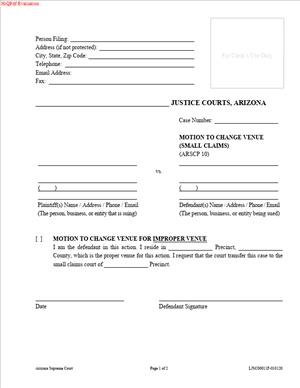
LJSC00011F – Motion to Change Venue
Fill out nowJurisdiction: Country: United States | Province or State: Arizona
If you believe your court case is filed in the wrong location, the LJSC00011F – Motion to Change Venue is the document used to ask the court to move it. It is a formal written request submitted to a judge. The request explains why the current court may not be the proper or most appropriate place to hear the case.
This form is part of the Arizona judicial branch court process. It is used in an active case. That means a case has already been filed, and you are asking to change where it will continue.
Venue refers to the specific court or county where a case is heard. It is different from jurisdiction, which deals with a court’s legal authority over a type of case. A motion to change venue focuses on location, not power.
Understanding this document matters because filing in the wrong court can delay your case. It may lead to extra costs, missed hearings, or dismissal. Knowing how this form works helps you understand what information the court expects and how your request will be reviewed.
What is LJSC00011F – Motion to Change Venue?
Clear definition
LJSC00011F – Motion to Change Venue is a written motion asking the court to transfer a case from one court location to another within the court system. It explains the legal and factual reasons for the requested transfer.
A motion is not a new lawsuit. It is a request made within an existing case. By filing this document, you are asking the judge to enter an order that changes where the case will be heard going forward.
The form typically includes the case caption, case number, names of the parties, and a detailed explanation of why the current venue is not proper or convenient. It may also include a proposed order for the judge to sign.
Who typically uses this form?
This form is often used by a party to a case who believes the lawsuit was filed in the wrong county. That could be a plaintiff, a defendant, or another party involved in the case.
Defendants commonly use a motion to change venue when they are sued in a county where they do not live and where the events did not occur. Plaintiffs may also use it if they later learn that another county is the legally correct venue.
Self-represented individuals frequently encounter this form when reviewing court procedures. Attorneys also use similar motions, but this specific document is designed for use within the Arizona court system.
Why might you need this form?
You might need this form if the case was filed in a county that does not meet venue rules. Venue rules often depend on where the parties live or where the events happened.
You may also use it if keeping the case in the current location would create serious inconvenience. For example, key witnesses may live in another county. Important evidence may be located elsewhere.
In some situations, venue rules are strict. If the case is filed in the wrong county and no one objects, it may still proceed. However, if a party formally raises the issue through a motion, the court must consider whether a transfer is required.
This document gives you a structured way to present your reasons clearly and in writing. The judge reviews the motion, any response from the other party, and then decides whether to grant or deny the request.
Typical real-life scenarios
- A person is sued in a county where they have never lived. The contract at issue was signed and performed in a different county. The defendant files a motion to change venue, explaining that the case should be heard where they reside or where the agreement was carried out.
- Two former business partners are in a dispute. The business operated in one county, but the lawsuit was filed in another county because one partner moved. A motion is filed arguing that the business location is the more appropriate venue.
- A family law matter is filed in a county where neither party currently lives. One party later relocates and believes the new county is more closely connected to the case. A motion is submitted asking the court to consider transferring the case for convenience and fairness.
- In a civil case involving property damage, the property is located in a specific county. The lawsuit is filed elsewhere. A party asks the court to move the case to the county where the property is located, explaining that witnesses and evidence are based there.
- In some cases, the issue arises early, shortly after service of the complaint. In others, it becomes clear only after reviewing documents or court rules more closely. The motion provides a formal way to raise the issue before the court proceeds further.
When would you use LJSC00011F – Motion to Change Venue?
You would use LJSC00011F – Motion to Change Venue after a case has already been filed and assigned a case number. It is not used to start a case. It is used during an existing proceeding.
Timing often matters. Many venue challenges are raised early in the case, often before or at the same time as a response to the complaint. This is because courts commonly expect objections to venue to be made promptly.
A defendant may use the form soon after being served with court papers. If the defendant believes the case is filed in the wrong county, the motion allows that issue to be addressed before the case moves forward.
A plaintiff might use the form if new facts come to light. For example, if the original filing location turns out not to meet venue requirements, the plaintiff may request a transfer instead of risking dismissal.
You might also use this document if both parties agree that another county is more convenient. Even when there is agreement, a formal motion and court order are generally required to transfer the case.
The form is relevant in civil matters handled by Arizona courts. The specific standards for granting a change of venue may vary depending on the type of case, such as contract disputes, personal injury claims, or other civil proceedings.
It is important to understand that this motion addresses location only. It does not change the type of case, the claims involved, or the legal standards that apply. It only asks the court to move the case to a different court location that is legally appropriate.
Legal characteristics of LJSC00011F – Motion to Change Venue
LJSC00011F – Motion to Change Venue is a procedural filing. Its effectiveness depends on compliance with court rules, proper service on the other party, and a legally recognized reason for transfer.
For the motion to be considered, it generally must include accurate case information, a clear statement of facts, and a legal basis for the request. Incomplete forms, missing case numbers, or vague explanations may cause delays or denial.
The motion must be filed in the court where the case is currently pending. After filing, the other party is usually given an opportunity to respond. The judge then reviews the written arguments and may decide the issue with or without a hearing, depending on court procedures.
Common problems include failing to explain why the current venue is improper, relying only on personal preference, or missing deadlines for raising the issue. Courts typically look for specific connections between the case and the requested county.
Venue rules can differ based on the type of case. For example, cases involving real property are often tied to the county where the property is located. Contract cases may be tied to where the contract was signed or performed. These differences affect how a judge evaluates the motion.
This document does not automatically move the case. Filing it alone does not change the venue. Only a court order signed by a judge can transfer the case to another location.
The motion also does not decide the merits of the dispute. It does not determine who wins or loses. It addresses only the question of where the case should be heard.
Is it legally binding?
The motion itself is a request, not a binding decision. It becomes legally significant once it is properly filed and served because it triggers the court’s review process.
If the judge grants the motion and signs an order transferring the case, that order is binding. The case file is then moved to the new court location, and future hearings take place there.
If the judge denies the motion, the case continues in the original venue. The denial does not resolve the underlying claims. It only confirms that the current court will keep the case.
The binding effect comes from the court’s order, not from the act of filing the motion. The form is the mechanism that allows the court to consider and rule on the issue.
How to fill out LJSC00011F – Motion to Change Venue
Step 1 – Complete the case caption
At the top of the form, enter the name of the court exactly as it appears on your existing case documents. Include the county and any division listed. Fill in the names of the parties in the same order shown in the original filing. Add the full case number without changes. This information must match the court record so the clerk can correctly place the motion in your file.
Step 2 – Identify yourself and your role in the case
State your name and indicate whether you are the plaintiff, defendant, or another party. Provide your contact information as required by the form. This section tells the court who is making the request and how to send notices about hearings or rulings.
Step 3 – State the current venue
Clearly identify the court and county where the case is currently pending. This confirms the existing location. It also frames the request by showing what venue you are asking the court to change.
Step 4 – Specify the requested new venue
Write the name of the court and county where you want the case transferred. Be precise. Include the full court title if required. The court needs to know exactly where you believe the case should proceed.
Step 5 – Explain the legal basis for the change
In the section provided, describe the reasons for the requested transfer. Focus on facts such as where the parties live, where events occurred, or where property is located. Connect those facts to recognized venue principles. Keep your explanation organized and fact-based.
Step 6 – Provide supporting details
Add any additional facts that help the judge understand your position. This may include information about witnesses, documents, or other practical considerations. If the form allows attachments, clearly label any extra pages and reference them in your explanation.
Step 7 – Sign and date the motion
Review the completed document for accuracy. Sign your name in the space provided and enter the date. Your signature confirms that the information is true to the best of your knowledge. Unsigned motions are generally not accepted for consideration.
Step 8 – Prepare any proposed order if required
Some courts require a proposed order for the judge to sign. If the form includes a section for an order, complete it as directed, leaving space for the judge’s signature. The proposed order should clearly state that the case is transferred to the specified court if granted.
Step 9 – File the motion with the court
Submit the completed motion to the clerk of the court where the case is currently pending. Ensure that the case number appears on all pages. The clerk will stamp the document and add it to the case file.
Step 10 – Serve the other party
Provide a copy of the filed motion to the other party or their attorney according to court rules. Complete any required proof of service section. This step ensures that all parties are informed and have an opportunity to respond before the judge makes a decision.
Legal terms you might encounter in LJSC00011F – Motion to Change Venue
- Venue: Venue refers to the specific court location where your case is being heard. In this form, you identify the current venue and the court you believe should handle the case instead. Venue is about the proper geographic location, not whether the court has power over the subject matter.
- Motion: A motion is a written request asking the court to make a decision or take a specific action. This document is a motion because you are formally asking the judge to move the case to another court location. The judge will review your written reasons before deciding.
- Case Caption: The case caption appears at the top of the first page. It includes the court name, case number, and the names of all parties. You must copy it exactly as it appears in your existing court paperwork so the clerk can match your motion to the correct case.
- Petitioner and Respondent: These terms identify the parties in the case. The petitioner is the person who started the case. The respondent is the person responding to it. On this form, you must clearly indicate which role you hold.
- Good Cause: Good cause means a legally sufficient reason to justify the requested change. In this document, you must explain specific facts that support why the current venue is improper or inconvenient under the rules. General complaints are not enough; you need concrete details.
- Affidavit or Declaration: An affidavit or declaration is a written statement of facts signed under oath or penalty of perjury. If the form requires or allows attachments, you may need to include one to support your request. It adds weight to your explanation by formally stating that your facts are true.
- Proposed Order: A proposed order is a draft decision for the judge to sign. Some courts require you to attach one when filing a motion. It states exactly how you want the court to rule, such as transferring the case to a specific court location.
- Service of Process: Service of process means delivering a copy of your filed motion to the other party. After you file, you must follow court rules to ensure the other side receives the document. Proof of service may need to be filed with the court.
- Hearing: A hearing is a scheduled court appearance where the judge may listen to both sides before deciding. When you file this motion, the court may set a hearing date. You are responsible for tracking any scheduled dates and appearing as required.
FAQs
What information must match exactly when I fill out this form?
You must copy the case caption exactly as it appears on your prior court documents. That includes the full court name, the case number, and the spelling of all party names. If even one letter or number is wrong, the clerk may not attach your motion to the correct case file.
Do I need to explain why the current court is wrong, or just say where I want the case moved?
You must do both. This document asks you to identify the current venue and clearly state the new venue you are requesting. You also need to explain the factual and legal reasons that support the transfer, such as where the parties live or where the events occurred.
What attachments should I include with the LJSC00011F – Motion to Change Venue?
You may need to attach a declaration or affidavit that provides detailed facts supporting your request. Some courts also require a proposed order for the judge to sign. Review the instructions carefully and confirm whether you must include proof of service or additional pages for your explanation.
When does the change of venue become effective?
The change does not take effect when you file the motion. It becomes effective only if the judge signs an order granting it. Once the order is entered, the case file is transferred according to court procedures.
Do I have to attend a hearing after filing?
Not always, but you must be prepared for one. The court may decide the motion based only on the written documents, or it may schedule a hearing. Check your mail and the court docket regularly so you do not miss any notice of a hearing date.
How do I prove that I sent a copy to the other party?
You must follow the court’s service rules. After delivering a copy by the approved method, complete a proof of service form if required. That document states when and how you served the other party and becomes part of the case record.
What happens if the other party disagrees with my request?
The other party can file a written response explaining why the case should stay in the current court. The judge will review both sides’ filings before making a decision. Make sure your explanation in the LJSC00011F – Motion to Change Venue is detailed and fact-based so it addresses possible objections.
Can I file this document after the case has already progressed?
Timing matters. Some rules limit when you can request a change of venue, especially if significant steps have already occurred. Before submitting the LJSC00011F – Motion to Change Venue, check whether any deadlines apply and confirm that your request is still allowed at this stage.
Checklist: Before, During, and After LJSC00011F – Motion to Change Venue
Before
- Review the procedural rules to confirm that a change of venue is permitted at your case stage.
- Gather your prior court documents to copy the case caption accurately.
- Verify the correct name and location of the court you are requesting.
- Collect facts that support your request, including addresses and relevant dates.
- Prepare any declaration or affidavit needed to support your statements.
- Draft a proposed order if required by local practice.
- Confirm filing fees or fee waiver status, if applicable.
During
- Type or print clearly and legibly.
- Complete every required field on the form without leaving blanks.
- Clearly state the current venue and the requested new venue.
- Provide specific facts, not general complaints.
- Attach all supporting documents in the correct order.
- Sign and date the motion where indicated.
- Make the required number of copies for filing and service.
- Double-check that the case number appears on every page.
After
- File the original motion with the court clerk using the approved method.
- Obtain a stamped copy for your records.
- Serve a copy on the other party according to court rules.
- File proof of service if required.
- Monitor the case docket for a hearing date or ruling.
- Attend any scheduled hearing on time and bring copies of all documents.
- Keep all transfer-related notices once the court issues a decision.
- Update your records with the new court information if the motion is granted.
Common mistakes to avoid with LJSC00011F – Motion to Change Venue
- Mistake: Using the wrong case number because you rely on memory instead of checking your paperwork, which can cause the clerk to reject or misfile your motion, so do not forget to copy the number exactly from an official document.
- Mistake: Giving vague reasons like “it’s inconvenient” without specific facts, which happens when you rush the explanation and can lead the judge to deny the request, so do not forget to include concrete details such as addresses and where events occurred.
- Mistake: Failing to serve the other party because you assume the court will notify them, which can delay your case or invalidate your motion, so do not forget to complete proper service and file proof if required.
- Mistake: Leaving sections blank because you think they do not apply, which may result in rejection by the clerk, so do not forget to write “not applicable” where appropriate instead of skipping lines.
- Mistake: Missing a deadline due to not checking procedural timing rules, which can cause the court to deny your motion automatically, so do not forget to confirm that your request is timely.
- Mistake: Forgetting to sign and date the document, which happens often with self-prepared forms and can lead to rejection, so do not forget to review the signature block before filing.
- Mistake: Not attaching a proposed order when required, which forces the court to request additional paperwork and delays the decision, so do not forget to verify attachment requirements.
- Mistake: Ignoring notices after filing because you assume the transfer is automatic, which can cause you to miss a hearing or response deadline, so do not forget to monitor mail and court updates closely.
What to do after filling out LJSC00011F – Motion to Change Venue
Once you complete the form, pause and review it line by line. Confirm that all names, dates, and court locations are accurate. Check that your explanation is clear and supported by specific facts. Make sure all attachments are labeled and in order.
- Step 1: Make at least two copies of the completed motion and all attachments.
- Step 2: File the original with the court clerk using the approved filing method.
- Step 3: Obtain a file-stamped copy showing the date of filing.
- Step 4: Serve a complete copy on the other party using an approved method.
- Step 5: Complete and file proof of service if the rules require it.
- Step 6: Calendar any response deadlines for the other party.
- Step 7: Check regularly for a notice of hearing or written ruling.
- Step 8: Prepare for a hearing by organizing your documents and outlining your key points.
- Step 9: Attend the hearing on time, dressed appropriately, and bring extra copies.
- Step 10: If the motion is granted, confirm the new court’s address and case handling procedures.
- Step 11: Update your personal records with the new venue information.
- Step 12: Continue following all future deadlines under the new court’s schedule.
Stay organized throughout the process. Keep a dedicated folder for all venue-related filings and correspondence. If the case is transferred, verify that future filings are sent to the correct court location. Clear recordkeeping will help you avoid confusion and missed deadlines as your case moves forward.
Disclaimer: This guide is provided for informational purposes only and is not intended as legal advice. You should consult a legal professional.