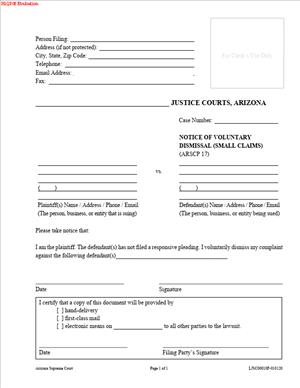
LJSC00010F – Notice of Voluntary Dismissal (Small Claims)
Fill out nowJurisdiction: Country: United States | Province or State: Arizona
If you filed a small claims case and no longer want to move forward, the LJSC00010F – Notice of Voluntary Dismissal (Small Claims) is the form used to formally end that case. It tells the court that you are choosing to withdraw your claim.
This document is commonly used by plaintiffs in the Arizona small claims court. It allows you to close your case without a trial or final judgment. Once filed and processed, the court treats the case as dismissed.
Filing this form matters because a small claims case does not automatically disappear if you change your mind. Until the court receives proper notice, the case remains active. Hearings may still be scheduled, and deadlines still apply.
Using the correct form helps ensure the court updates its records accurately. It also informs the other party that you are ending the claim, so they do not prepare for a hearing that will not take place.
Before you fill it out, it helps to understand what the form does, when it is appropriate, and how each section works. That clarity can prevent delays or rejected filings.
What is LJSC00010F – Notice of Voluntary Dismissal (Small Claims)?
Clear definition
LJSC00010F – Notice of Voluntary Dismissal (Small Claims) is a court document used in Arizona small claims cases to voluntarily withdraw a claim you previously filed. It is submitted to the same court where the small claims case is pending.
A voluntary dismissal means the person who started the case decides to end it. The court does not decide the outcome. Instead, the filing party asks the court to close the case without a ruling on the merits.
Once accepted by the court, the dismissal becomes part of the official case record. The case is then marked as dismissed, and no further action is taken unless a new case is filed later.
Who typically uses this form?
This form is most often used by the plaintiff. The plaintiff is the person or business that filed the small claims lawsuit.
In some situations, a plaintiff may reach a private agreement with the defendant and decide not to continue. In other cases, the plaintiff may realize the claim was filed in error or no longer wants to pursue it.
Small business owners sometimes use this form after receiving payment from the defendant. Individuals may use it after resolving a dispute informally.
Defendants do not typically use this specific form to dismiss a case they did not file. It is designed for the party that initiated the small claims action.
Why might you need this form?
You may need this form if your dispute has been resolved outside of court. For example, the other party may have paid the amount owed, returned property, or agreed to another solution.
You may also decide that continuing the case is not worth the time or effort. Small claims cases require preparation and attendance at hearings. If your circumstances change, you might prefer to withdraw.
Sometimes new information comes to light after filing. You may discover that the wrong party was named, the amount claimed was incorrect, or the issue cannot be handled in small claims court.
Using the proper dismissal form formally ends the case. Without it, the court will continue to treat the matter as active.
Typical real-life scenarios
- A tenant files a small claims case to recover a security deposit. Before the hearing, the landlord sends the full payment. The tenant then files a voluntary dismissal to close the case.
- A contractor sues a client for unpaid work. After discussing the dispute, both sides agree on a reduced payment plan. The contractor files the dismissal once payment is received.
- An individual files a claim for vehicle damage but later learns that insurance will cover the loss. The person decides not to proceed in small claims court and dismisses the case.
- A business owner files a claim against a customer but later realizes the amount exceeds small claims limits. The owner may dismiss the small claims case and consider filing in a different court.
- In each of these situations, the dismissal form is used to formally notify the court that the plaintiff no longer wishes to continue the lawsuit.
When would you use LJSC00010F – Notice of Voluntary Dismissal (Small Claims)?
You would use this form after a small claims case has already been filed and assigned a case number. It is not used to prevent a case from being filed. It is used to end one that is already open.
Timing can vary. Some people file the dismissal soon after starting the case. Others file it closer to the hearing date, after settlement discussions.
If a hearing has been scheduled, filing the dismissal informs the court that the hearing may no longer be necessary. This helps avoid unnecessary appearances.
In many small claims cases, the plaintiff is the one who files the dismissal. However, the context matters. For example, if both parties settle, the plaintiff usually completes the dismissal to close the case.
The form may also be used if you decide to refile later. Ending the current case first keeps the court record clear and organized.
The key point is that the case must already exist in the court system. The form references the case number and the names of the parties involved.
Legal characteristics of LJSC00010F – Notice of Voluntary Dismissal (Small Claims)
This form becomes effective when it is properly completed, signed, and accepted by the court. The court clerk typically reviews it to ensure that it matches the existing case information.
Accuracy is important. The case number, court name, and party names must match the original filing. Errors in these details can delay processing.
A common issue that causes problems is incomplete information. Leaving out a signature, date, or required identifying detail may result in rejection or a request for correction.
Another issue arises when a dismissal is filed after certain court actions have already occurred. In some situations, additional steps may be required depending on the stage of the case.
Court procedures can vary slightly depending on timing and whether the defendant has responded. While small claims courts are designed to be simpler than higher courts, they still follow formal processes.
The dismissal form does not automatically resolve payment arrangements or enforce agreements. It simply tells the court that the plaintiff is ending the lawsuit.
It also does not erase the history of the filing. The case remains on record as dismissed. The fact that a claim was filed and later withdrawn may still appear in court records.
The document does not determine fault or liability. It does not state that either side was right or wrong. It only closes the pending case.
Is it legally binding?
Once filed and accepted by the court, the dismissal generally becomes part of the official case record. The court recognizes that the plaintiff has chosen to withdraw the claim.
The binding effect relates to the closure of that specific case. The court will not proceed to a hearing or judgment in the dismissed matter.
Whether the dismissal prevents a future lawsuit can depend on how the dismissal is characterized. In many systems, a voluntary dismissal may be described as “with prejudice” or “without prejudice,” which affects whether the claim can be filed again. The specific wording used in the form and the court’s procedures influence this outcome.
If the dismissal is accepted without conditions, the case is treated as concluded. However, the document itself does not enforce any private settlement terms unless those terms are incorporated into a court order.
In practical terms, the form binds the court to stop processing the case. It does not create new obligations beyond closing the existing action.
How to fill out LJSC00010F – Notice of Voluntary Dismissal (Small Claims)
Step 1 – Identify the court
At the top of the form, enter the name of the court where your small claims case was filed. This must match the court listed on your original complaint. Include the court location if the form requests it.
Step 2 – Enter the case number
Locate the case number assigned to your small claims matter. This number appears on prior court documents. Write it exactly as shown, including any letters or formatting. An incorrect case number can delay processing.
Step 3 – List the parties
Fill in the names of the plaintiff and defendant as they appear in the original filing. Use the same spelling and order. Do not shorten or modify names unless the court previously approved a correction.
Step 4 – Indicate the type of dismissal
If the form includes options about how the case is being dismissed, review them carefully. You may need to indicate whether the dismissal applies to the entire case or specific claims. Mark or complete the section as directed by the form’s wording.
Step 5 – Provide any required details
Some versions of the form may ask for additional information, such as whether a hearing has been scheduled or whether the defendant has filed a response. Enter the requested details clearly and accurately.
Step 6 – Sign and date the form
Sign your name in the space provided. Print your name if required. Add the date of signing. Your signature confirms that you are voluntarily dismissing the case.
Step 7 – Include contact information
If the form requests your address, phone number, or email, provide current contact information. This allows the court to send confirmation or notices related to the dismissal.
Step 8 – Make copies
Before submitting the form, make copies for your records. Keep at least one copy that shows what you filed. If required by procedure, provide a copy to the other party.
Step 9 – File the form with the court
Submit the completed LJSC00010F – Notice of Voluntary Dismissal (Small Claims) to the same court that is handling your case. Filing methods may include in-person submission or other accepted delivery methods. After filing, monitor the case record to confirm that the dismissal has been entered.
Legal terms you might encounter in LJSC00010F – Notice of Voluntary Dismissal (Small Claims)
- Voluntary Dismissal: This means you are choosing to end your case on your own. You are not asking the judge to decide the dispute. On this form, you state clearly that you want the court to close the small claims case.
- Without Prejudice: This phrase means you may be able to file the case again later. If the form gives you an option to select this, it affects whether you can bring the same claim in the future. Read this carefully before you check any box.
- With Prejudice: This means the case is permanently closed. You cannot file the same claim again. If this option appears on the document, choosing it has long-term consequences.
- Case Number: This is the unique number assigned to your small claims case. You must enter it exactly as it appears on prior court documents. A wrong case number can delay processing or result in the dismissal being filed in the wrong file.
- Plaintiff: The plaintiff is the person or business who filed the small claims case. If you are the one dismissing the case, you are usually the plaintiff. Make sure your name matches what appears on the original complaint.
- Defendant: The defendant is the person or business being sued. Their name must also match the court record. Even small spelling differences can cause confusion in the court file.
- Court Clerk: The clerk processes your paperwork. The clerk does not give legal advice but ensures your document is entered into the case record. Filing is not complete until the clerk accepts and files the document.
- Signature: Your signature confirms that you are voluntarily dismissing the case. Some courts require a handwritten signature unless you file electronically. Do not forget to date your signature if the form asks for it.
- Proof of Service: This shows that you delivered a copy of the document to the other party. Some courts require you to notify the other side when you dismiss a case. If required, you must complete and file proof that you sent or delivered the document.
- Entry of Dismissal: This is the official action taken by the court after your form is accepted. It means the case status changes in the court system to closed. You may receive a stamped copy confirming this update.
FAQs
When does my case officially end after I file LJSC00010F – Notice of Voluntary Dismissal (Small Claims)?
Your case ends when the court accepts and files the document, not when you sign it. The effective date is usually the date the clerk stamps it as filed. Check the stamped copy or court record to confirm the exact filing date because that date becomes part of the official case history.
Do I need the other party’s permission to file this form?
In many small claims situations, you can dismiss your own claim without the other party’s approval, especially if there has been no trial. However, you must still ensure that the other party is properly identified in the document. If the case has progressed further, you should verify whether any additional steps are required before dismissal is entered.
What if I already had a hearing scheduled?
You should file this document as soon as you decide to dismiss. If a hearing is scheduled, the court calendar may still list your case until the dismissal is processed. Confirm that the hearing is removed from the schedule after filing so you do not accidentally miss an appearance requirement.
What happens to court fees after I dismiss my case?
Filing fees you already paid are usually not refunded. This document only closes the case; it does not automatically return money paid to the court. Check your receipt and keep it with your records so you know what was paid and when.
Can I reopen the case later if I change my mind?
That depends on how the dismissal is marked. If it is without prejudice, you may be able to file a new claim later. If it is with prejudice, the claim is permanently closed. Review the box you select before signing because the form controls how the case is recorded.
Do I need to notify the defendant after filing this document?
In some situations, you must send a copy to the defendant and complete proof of service. This ensures the court record shows the other side was informed. Keep a copy of whatever method you use to deliver the document, such as mail confirmation or a signed acknowledgment.
What if I made a mistake on LJSC00010F – Notice of Voluntary Dismissal (Small Claims) after filing it?
If you notice an error after filing, contact the clerk promptly to ask about correction procedures. You may need to file an amended or corrected document. Do not assume the mistake will be ignored, especially if it involves the case number, party names, or type of dismissal.
Will the dismissal show up in the public record?
Yes. Once accepted, the dismissal becomes part of the official court file. Anyone searching the case number will see that the claim was filed and later dismissed. The record will usually reflect the filing date and the type of dismissal entered.
Checklist: Before, During, and After LJSC00010F – Notice of Voluntary Dismissal (Small Claims)
Before
- Confirm you truly want to end the case and understand the difference between with and without prejudice.
- Locate your correct case number from prior court paperwork.
- Verify the exact spelling of all party names as shown on the complaint.
- Check whether a hearing is scheduled and note the date.
- Review whether you must provide proof of service.
- Gather copies of any settlement agreement, if one exists.
- Make sure you are the proper party authorized to sign.
During
- Write the full case number clearly and accurately.
- Enter the court name exactly as it appears on your prior documents.
- List all plaintiffs and defendants without abbreviations unless they match the original filing.
- Select the correct dismissal option, if choices are provided.
- Sign your full legal name as it appears in the case.
- Date the form on the day you sign it.
- Complete any certificate or proof of service section if required.
- Review the entire form once more before filing.
After
- Make at least two copies of the signed document.
- File the original with the court clerk using the accepted method.
- Request a stamped copy for your records.
- Send a copy to the other party if required.
- Confirm the hearing has been canceled, if one was scheduled.
- Check the case status online or with the clerk to confirm closure.
- Store the stamped copy with your case documents.
- Update any personal or business records to show the case was dismissed.
Common mistakes to avoid with LJSC00010F – Notice of Voluntary Dismissal (Small Claims)
- Mistake: Using the wrong case number because you copied it from memory; this can result in filing under the wrong case and delay closure, so always copy it directly from an official court document.
- Mistake: Misspelling a party’s name because you rely on informal versions; this may create confusion in the court record, so match the names exactly as originally filed.
- Mistake: Selecting with prejudice without understanding it is final; this happens when people rush, and it can permanently prevent refiling, so read each option carefully before checking a box.
- Mistake: Forgetting to sign and date the form; unsigned documents may be rejected by the clerk, so confirm your signature and date are present before submission.
- Mistake: Assuming the hearing is automatically canceled upon signing; the court must process the filing first, so verify that the calendar has been updated.
- Mistake: Failing to complete proof of service when required; this can delay acceptance of the dismissal, so do not forget to document how and when you notified the other party.
- Mistake: Not keeping a stamped copy because you think the court keeps everything; without proof of filing, you may struggle to confirm the dismissal later, so always retain your own copy.
- Mistake: Waiting until the last minute before a scheduled hearing; processing delays can occur, so file as early as possible to avoid unnecessary court appearances.
What to do after filling out LJSC00010F – Notice of Voluntary Dismissal (Small Claims)
Once you complete the form, focus on proper filing and documentation. Your goal is to ensure the court officially records the dismissal and that you have proof it was accepted.
- Step 1: Review the entire document one final time for accuracy, including names, case number, and your signature.
- Step 2: Make at least two clear copies before submitting the original.
- Step 3: File the original with the court clerk in person, by mail, or through any approved electronic system if available.
- Step 4: Request or download a stamped copy showing the filing date.
- Step 5: Confirm with the clerk or through the court’s case lookup system that the case status now reflects a dismissal.
- Step 6: If required, mail or deliver a copy to the other party and complete any proof of service.
- Step 7: Verify that any scheduled hearings are removed from the court calendar.
- Step 8: Organize your documents, including the original complaint, receipts, and the stamped dismissal.
- Step 9: If your case involved a settlement, store the dismissal with the signed settlement agreement.
- Step 10: Update your personal, financial, or business records to reflect that the dispute has been formally closed.
Keep your stamped copy in a secure place. If questions arise later about whether the claim was dismissed, that document is your confirmation. Clear records protect you from confusion and help you move forward with confidence.
Disclaimer: This guide is provided for informational purposes only and is not intended as legal advice. You should consult a legal professional.