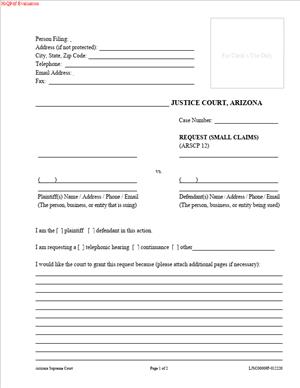
LJSC00009F – Request (Small Claims)
Fill out nowJurisdiction: Country: United States | Province or State: Arizona
If you are preparing to start or move forward with a small claims case, the LJSC00009F – Request (Small Claims) is the document that formally tells the court what you are asking for. This form is used in Arizona’s justice courts for small claims matters.
LJSC00009F – Request (Small Claims) begins the formal process of resolving a dispute in small claims court. It explains who is involved, what happened, and the amount of money or relief requested. Once filed, it becomes part of the official court record.
This form matters because it sets the scope of your case. The court and the other party will rely on what you write here. Clear and accurate information helps the process move forward without delays.
If you are representing yourself, this document is especially important. It is your first opportunity to present your side in a structured way. Understanding what it asks for will help you complete it with confidence.
What is LJSC00009F – Request (Small Claims)?
Clear definition
LJSC00009F – Request (Small Claims) is a court filing used to start a small claims case in an Arizona justice court. It identifies the parties, describes the dispute, and states the amount of money or other relief requested.
This form functions as a formal complaint within the small claims division. It notifies the court and the defendant that a claim has been made. After filing, the court assigns a case number and begins the scheduling process.
The document becomes part of the official court file. Everything written on it may be reviewed by a judge or hearing officer during the case.
Who typically uses this form?
Most often, this form is used by individuals who believe they are owed money. These individuals are called plaintiffs. They may be consumers, tenants, landlords, or small business owners.
Small business owners sometimes use the form to recover unpaid invoices. Tenants may use it to seek the return of a security deposit. Landlords may use it to pursue unpaid rent or property damage.
In some cases, companies file small claims actions against customers for unpaid services. Individuals may also file claims against businesses for defective goods or incomplete work.
The form is designed for people who may not have an attorney. Small claims court is generally intended to be more accessible and less formal than higher courts.
Why might you need this form?
You may need this form if you want the court’s help collecting money you believe you are owed. Small claims court handles disputes up to a specific dollar limit set by Arizona law.
If informal efforts have not resolved the issue, filing this document formally starts the legal process. It creates an official claim that the court can hear and decide.
The form is also necessary if you want a legally enforceable judgment. Without filing it, the court has no case to consider and cannot issue an order.
Submitting this form may also trigger deadlines for the other party. Once served, they must respond or appear at a scheduled hearing.
Typical real-life scenarios
- A common scenario involves unpaid loans between individuals. For example, you may have lent money to a friend or acquaintance who has not repaid it. If discussions have not led to payment, you may turn to small claims court.
- Another situation involves security deposits. A tenant who moves out may believe the landlord withheld the deposit unfairly. Filing a request allows the court to review the facts and determine whether the amount should be returned.
- Disputes over services are also frequent. You may have paid for home repairs that were never completed or were done improperly. If the contractor refuses to correct the work or issue a refund, this form starts the claim process.
- Property damage claims are another example. If someone damages your vehicle or personal property and refuses to pay for repairs, small claims court provides a forum to seek compensation.
- Unpaid invoices between small businesses and customers often lead to small claims filings. When written agreements or invoices are ignored, the court can determine whether payment is owed.
When would you use LJSC00009F – Request (Small Claims)?
You would use this form at the beginning of a small claims case. It is typically filed before any hearing is scheduled.
Timing often depends on the dispute. Some people file shortly after a payment becomes overdue. Others attempt informal resolution first, such as sending a written demand, before turning to the court process.
You might also use this form if negotiations have stalled. When communication breaks down, a formal filing can move the matter toward resolution.
In landlord-tenant disputes, this form may be used after a tenancy ends and money remains in dispute. In consumer matters, it may follow unsuccessful refund requests or warranty claims.
The form may also be used when the amount in controversy falls within the small claims limit but still requires formal enforcement. If the amount exceeds the small claims threshold, a different court process is typically required.
Both individuals and business entities can file, provided the claim fits within the small claims division rules. The person filing is identified as the plaintiff, and the person or entity being sued is identified as the defendant.
Legal characteristics of LJSC00009F – Request (Small Claims)
This document becomes legally effective once it is properly filed with the court and accepted. Filing usually involves submitting the completed form and paying a filing fee. The court then assigns a case number.
For the claim to move forward, the defendant must be formally notified. This process is commonly called service. Without proper service, the court may not proceed to a hearing or issue a judgment.
Accuracy is important. Incorrect names, wrong addresses, or unclear claims can delay the case. If the defendant’s legal name is wrong, enforcement of any judgment may become more difficult.
Clarity also matters. The court relies on the written description of your claim to understand the dispute. Vague statements can create confusion and may require clarification at the hearing.
Small claims procedures are generally simpler than other civil court processes. However, they still follow specific rules. Deadlines, service requirements, and limits on the amount claimed are set by court rules and state law.
This form does not automatically result in payment. It starts the case, but a hearing or other court action is usually required before a judgment is entered.
It also does not guarantee success. The judge or hearing officer evaluates the evidence presented by both sides before making a decision.
In some jurisdictions within Arizona, small claims hearings are less formal and may not allow attorneys to appear unless both parties agree. Procedures can vary slightly by court location.
Common reasons for rejection or delay include incomplete sections, missing signatures, incorrect court location, or failure to pay required fees. If information is missing, the clerk may return the form for correction.
Is it legally binding?
The form itself is not a judgment. Filing it does not create an immediate legal obligation for the defendant to pay. It initiates a legal process.
However, once properly filed and served, it creates an official court case. The defendant is required to respond or appear as directed by the court.
If the court later issues a judgment based on the claim, that judgment can be legally binding. A judgment may allow the prevailing party to pursue collection through lawful methods.
The statements made on the form also carry legal weight. By signing the document, you confirm that the information provided is true to the best of your knowledge. Providing false information in a court filing can lead to serious consequences.
In short, the form starts a binding court process. The binding effect comes from the court’s authority and any resulting orders, not from the form alone.
How to fill out LJSC00009F – Request (Small Claims)
Step 1 – Identify the court
Begin by confirming the correct justice court for your case. The form typically includes a space to write the name of the court and its location. Enter the full court name exactly as required. Using the correct court ensures your filing is processed in the proper jurisdiction.
Step 2 – Enter the plaintiff information
In the section for the plaintiff, write your full legal name. If you are filing on behalf of a business, use the registered business name. Provide your mailing address and contact information as requested. This information allows the court and the other party to communicate with you about the case.
Step 3 – Enter the defendant’s information
Next, complete the section for the defendant. Write the defendant’s full legal name. If the defendant is a business, include the correct legal entity name. Add a current address where the defendant can be served. Accurate details here are essential for proper notification.
Step 4 – State the amount of the claim
Indicate the total amount of money you are requesting. This should reflect the actual amount you believe is owed. Some forms include space to separate the main amount from court costs or other related amounts. Write clearly and ensure the total matches your explanation.
Step 5 – Describe the basis of your claim
Use the space provided to explain what happened. Keep your description factual and concise. Include key dates, the nature of the agreement or transaction, and how the dispute arose. Focus on facts rather than opinions.
Step 6 – Indicate any additional relief requested
If the form allows, specify whether you are requesting court costs or other allowable relief. Enter only what the form asks for. Do not add unrelated requests that fall outside small claims procedures.
Step 7 – Review for accuracy and completeness
Before signing, read the entire document carefully. Confirm that names are spelled correctly, addresses are complete, and the amount claimed is accurate. Check that all required sections are filled in.
Step 8 – Sign and date the form
Sign the form in the designated area. Print your name if required. Add the date of signing. Your signature confirms that the information provided is true to the best of your knowledge.
Step 9 – Prepare for filing and service
After completing and signing the form, make any required copies. The original is typically filed with the court, and copies are used for service and your records. Once filed, follow the court’s process for ensuring the defendant is formally notified of the case.
Legal terms you might encounter in LJSC00009F – Request (Small Claims)
- Plaintiff: The plaintiff is the person or business filing the claim. On this form, you are the plaintiff if you are asking the court for money or other relief. Your name must be written exactly as it appears on your identification or business registration documents.
- Defendant: The defendant is the person or business you are suing. This is the party you believe owes you money or caused your loss. You must list the defendant’s full legal name and accurate address so they can be properly served.
- Service of Process: This means officially delivering a copy of your filed claim to the defendant. The court requires proof that the defendant received notice of the case. Without proper service, your case cannot move forward.
- Cause of Action: This is the legal reason for your claim. In this document, you briefly explain what happened and why the defendant owes you money. Keep it factual and clear, focusing on dates, actions, and amounts.
- Damages: Damages are the amount of money you are asking the court to award you. This includes the main amount owed and may include court costs if allowed. You must clearly state the total amount you are requesting.
- Court Costs: These are the fees you pay to file your case and possibly to serve the defendant. You can request that the defendant reimburse you for these costs if you win. Be sure to include them if the form provides a space.
- Judgment: A judgment is the court’s final decision. If the judge agrees with you, the judgment will state how much the defendant must pay. The judgment becomes part of the official court record.
- Hearing Date: This is the date when you and the defendant appear before a judge. After filing, the court assigns this date. You must attend and bring your evidence.
- Default Judgment: If the defendant does not respond or appear at the hearing after being properly served, you may ask the court for a default judgment. This means you could win automatically, but you still must prove service.
- Venue: Venue refers to the correct court location where the case should be filed. It is usually based on where the defendant lives or where the dispute happened. Filing in the wrong venue can delay or dismiss your case.
FAQs
How do I know if LJSC00009F – Request (Small Claims) is the right form for my situation?
Check whether your dispute involves a limited amount of money and does not require complex legal remedies. This document is used to start a small claims case, not to request criminal charges or family law orders. Review the case type listed at the top of the form and confirm that your issue matches a money claim against a person or business.
What name should I use for the defendant if I am suing a business?
You must use the business’s full legal name, not just a trade name printed on a sign or receipt. Look at contracts, invoices, or official filings to confirm the correct entity name. If it is a corporation or limited liability company, list the registered name exactly as it appears in official records. An incorrect name can prevent proper service and delay your case.
Do I need to attach evidence when I file this form?
You usually do not need to attach all your evidence at the time of filing, but you must be ready to present it at the hearing. Keep copies of contracts, receipts, photos, messages, and repair estimates organized. If the form allows or requires attachments, clearly label them and reference them in your description of the claim.
What happens after I file LJSC00009F – Request (Small Claims)?
After filing, the court assigns a case number and a hearing date. You must arrange for the defendant to be served according to court rules. Keep proof of service because the judge will ask for confirmation that the defendant received notice. Without proof, the court may postpone your hearing.
Can I change the amount of my claim after filing this document?
You may be able to amend your claim, but you must follow the court’s procedure. If you discover additional damages, act quickly and file any required amendment forms. Do not simply show up at the hearing asking for a higher amount without updating the record.
What if I do not know the defendant’s current address?
You are responsible for providing a valid address for service. Check recent contracts, billing statements, public directories, or other reliable records. If service fails because the address is wrong, your case may be delayed until you locate a correct one.
Do I need a lawyer to complete this form?
Small claims court is designed for self-represented people. You can complete this document on your own if you carefully follow the instructions. Make sure every required field is filled in, and your statement of claim is clear and factual.
Will this form become part of the public record?
Yes. Once filed, the information you enter becomes part of the court file. That includes names, claim amounts, and the basic description of your dispute. Write clearly and professionally, knowing the judge and the defendant will review what you submit.
Checklist: Before, During, and After LJSC00009F – Request (Small Claims)
Before
- Confirm your claim qualifies for small claims court based on the amount and type of dispute.
- Verify the defendant’s full legal name and current service address.
- Gather contracts, receipts, invoices, photos, and written communications.
- Calculate the exact amount of money you are requesting.
- Check the correct court location for filing.
- Review filing fees and accepted payment methods.
- Make a draft summary of what happened in date order.
- Ensure you have accurate contact information for yourself.
During
- Write names exactly as they appear on official documents.
- Clearly state the total amount of damages requested.
- Describe what happened in short, factual sentences.
- Avoid emotional language or personal attacks.
- Double-check all numbers and dates for accuracy.
- Review every section to make sure nothing is left blank.
- Sign and date the form where required.
- Make copies before submitting the original.
After
- File the form with the court clerk and pay the required fee.
- Obtain your stamped copies with the case number.
- Arrange for proper service on the defendant.
- Keep proof of service for the hearing.
- Mark the hearing date on your calendar.
- Organize your evidence in a folder for court.
- Prepare a short outline of what you will say to the judge.
- Monitor mail or court notices for any updates.
- Keep all documents together in a secure place.
Common mistakes to avoid with LJSC00009F – Request (Small Claims)
- Mistake: Using a nickname or trade name for the defendant because it appears on a storefront, which happens when you rely only on a receipt; this can result in improper service and dismissal, so do not forget to confirm the full legal entity name.
- Mistake: Guessing the amount of damages without doing the math, often due to rushing; this can reduce your credibility with the judge, so do not forget to total your losses carefully and check your calculations.
- Mistake: Writing a long emotional story instead of clear facts, which happens when you feel frustrated; this can confuse the judge, so do not forget to focus on dates, actions, and amounts.
- Mistake: Leaving sections blank because you think they do not apply, which often occurs from uncertainty; this can delay processing, so do not forget to review every line and write “N/A” if appropriate.
- Mistake: Failing to arrange proper service after filing, often because you assume the court will notify the defendant; this can stop your case from moving forward, so do not forget that service is your responsibility.
- Mistake: Missing the hearing date due to poor calendar tracking, which happens when you rely on memory; this can lead to dismissal of your claim, so do not forget to record and confirm the date immediately.
- Mistake: Bringing original documents only and no copies, which happens when you overlook preparation; this can slow the hearing, so do not forget to bring organized copies for yourself and the defendant.
What to do after filling out LJSC00009F – Request (Small Claims)
Once you complete the form, pause and review it carefully. Read it out loud. Make sure your story is easy to follow, and your numbers match your documents.
- Step 1: Make at least two copies of the completed form—one for your records and one for service on the defendant.
- Step 2: File the original form with the appropriate court clerk, either in person or through any accepted submission method.
- Step 3: Pay the filing fee and obtain a stamped copy showing the case number and hearing date.
- Step 4: Confirm the method required for service of process in your case.
- Step 5: Arrange for proper service on the defendant using an approved method.
- Step 6: Obtain written proof that the service was completed and file that proof with the court if required.
- Step 7: Create a hearing folder with labeled sections for contracts, receipts, photos, and communication records.
- Step 8: Prepare a short timeline summarizing key events so you can present your case clearly.
- Step 9: Review the court notice to confirm the courtroom location and arrival time.
- Step 10: Attend the hearing early, dress neatly, and bring all documents and copies.
After the hearing, follow any instructions given by the judge. If you receive a judgment in your favor, keep a certified copy for your records. Track any payment deadlines set by the court. Maintain a complete file with your stamped claim, proof of service, and judgment documents in case you need them later.
Staying organized at every stage increases your confidence and helps the process move smoothly. Small claims court is designed to be straightforward, but preparation makes the difference.
Disclaimer: This guide is provided for informational purposes only and is not intended as legal advice. You should consult a legal professional.