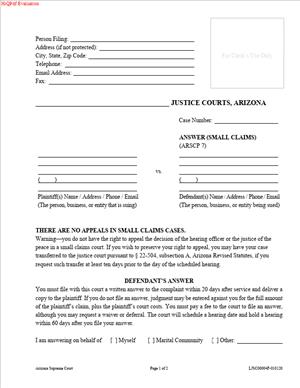
LJSC00004F – Answer (Small Claims)
Fill out nowJurisdiction: Country: United States | Province or State: Arizona
If you have been sued in small claims court in Arizona, the LJSC00004F – Answer (Small Claims) is the document you use to respond. It is your written reply to the claims made against you. This form gives you a structured way to tell the court your side of the story.
When someone files a small claims case, they become the plaintiff. You become the defendant. Filing this form allows you to admit, deny, or explain the allegations in the complaint. Without a written answer, the court may move forward without your input.
This document is part of the Arizona Judicial Branch’s small claims process. It helps the court understand what issues are actually in dispute. It also lets the plaintiff know how you plan to respond.
If you are representing yourself, this form matters. It shapes what will be discussed at the hearing. A clear and complete response can help the judge focus on the key facts.
You are not arguing your entire case on this form. Instead, you are formally responding to what was filed against you. Think of it as setting the stage for the hearing.
What is LJSC00004F – Answer (Small Claims)?
Clear definition
LJSC00004F – Answer (Small Claims) is a court form used by a defendant to respond to a small claims complaint. It is filed in the same court where the lawsuit was started.
The form allows you to state whether you agree with the plaintiff’s claims, disagree with them, or need more information. It may also give you space to explain your version of events or raise defenses.
In small claims court, procedures are simpler than in higher courts. This form reflects that simplicity. It is designed for people without lawyers and uses straightforward sections.
Once completed and submitted, the document becomes part of the official court record. The judge can review it before or during the hearing.
Who typically uses this form?
This form is used by defendants in small claims cases. A defendant can be an individual, a business owner, a tenant, a landlord, or anyone who has been served with a small claims complaint.
If you received a summons and complaint related to a money dispute within the small claims limit, you are likely the person who would use this form. It is common in disputes involving unpaid debts, property damage, contracts, or security deposits.
Small business owners also use this form when a customer or vendor files a claim against them. In that case, the business responds through an authorized representative.
The form is generally used by people representing themselves. Small claims courts often limit attorney participation, depending on the type of case and court rules.
Why might you need this form?
You need this form if you want to respond formally to a small claims lawsuit. Filing an answer tells the court that you are participating in the case.
Without an answer, the plaintiff may request a default judgment. A default judgment can result in the court awarding the plaintiff what they asked for, without hearing your side.
This form also gives you a chance to clarify misunderstandings. For example, you may agree that money is owed but disagree on the amount. The answer allows you to explain that distinction.
It can also be used to raise defenses. A defense might include payment already made, incorrect identity, or lack of agreement. The form helps you put those points in writing before the hearing.
Typical real-life scenarios
- A landlord sues a former tenant for unpaid rent and property damage. The tenant uses the form to deny the damage claim and explain that the rent was paid in full before moving out.
- A customer files a claim against a contractor, stating that work was not completed. The contractor files an answer explaining that the project was delayed due to agreed-upon changes and that partial payment remains unpaid.
- Two individuals enter into a written agreement for a personal loan. The lender claims the borrower never repaid it. The borrower responds using the form, stating that payments were made in cash and partially documented.
- A driver is sued for minor vehicle damage after a parking lot incident. The defendant files an answer stating that the damage existed before the incident and disputes responsibility.
- A former roommate files a claim over shared utility bills. The defendant uses the form to explain that the bills were divided according to a different arrangement than what the plaintiff alleges.
When would you use LJSC00004F – Answer (Small Claims)?
You would use LJSC00004F – Answer (Small Claims) after being formally served with a small claims complaint in Arizona. Service usually means you received official notice of the lawsuit.
The form is used before the scheduled hearing. It is part of the early stage of the case, after the plaintiff files the complaint but before the judge hears evidence.
Defendants use this form when they want to contest the claim in full or in part. It is also used when the defendant agrees with some facts but disagrees with the legal conclusions or the amount requested.
In some situations, a defendant may believe the wrong person was sued. The form can be used to state that you are not responsible for the alleged debt or incident.
Business entities named in small claims actions also use this form to respond. In those cases, an authorized person signs on behalf of the business.
If you are considering resolving the dispute outside of court, the answer may still be filed while discussions continue. Filing keeps the case active and signals your participation.
Legal characteristics of LJSC00004F – Answer (Small Claims)
This form becomes effective once it is properly completed, signed, and filed with the court. It must generally include accurate identifying information, such as the case number and party names.
A valid answer clearly responds to the claims in the complaint. Vague statements or leaving sections blank can create confusion. The court relies on the written content to understand your position.
Common issues that cause problems include missing signatures, incorrect case numbers, incomplete responses, or failure to file within required timeframes. Clerical errors can delay processing or result in rejection.
Small claims procedures are designed to be accessible. However, each court may have its own formatting or filing requirements. Some courts allow electronic submission, while others may require paper filing.
The form does not automatically dismiss the case. It does not guarantee a hearing outcome. It simply preserves your right to present your side before a judge.
The document also does not serve as evidence by itself. You may still need to bring supporting documents, photos, contracts, or witnesses to the hearing.
Is it legally binding?
Yes, once filed, your answer becomes part of the official court record. Statements you make on the form are considered representations to the court.
Because you sign the document, you are affirming that the information is true to the best of your knowledge. Providing false information can have legal consequences.
The binding nature of the form relates to procedure, not outcome. Filing the answer binds you to the position you state, but the judge will decide the final result after reviewing all the evidence.
In small claims court, hearings are often informal. Even so, the written answer can influence how the judge frames the issues. It sets boundaries on what is disputed and what is not.
The form does not create a contract between you and the plaintiff. It does not settle the dispute. Instead, it triggers the next stage of the court process.
How to fill out LJSC00004F – Answer (Small Claims)
Step 1 – Review the complaint and summons carefully
Start by reading the complaint line by line. Identify each claim the plaintiff is making. Pay attention to the amount requested and the reason given.
Note the case number and court location. You will need this information to complete the top section of the form.
Make sure you understand the deadline for filing your answer. This date is often included in the paperwork you received.
Step 2 – Complete the case caption
At the top of the form, fill in the court name, case number, and names of the parties exactly as they appear on the complaint.
Do not change the order of names. If the plaintiff is listed first on the complaint, keep that format.
Include your current contact information where requested. This allows the court to send you notices about the case.
Step 3 – State your response to the claims
Read each section that asks whether you agree or disagree with the plaintiff’s statements. Respond clearly and directly.
If you agree with certain facts but not others, indicate that distinction. Avoid broad statements if the form allows specific responses.
If the form includes space for explanation, use it to summarize your position. Focus on key facts rather than detailed arguments.
Step 4 – Describe any defenses or explanations
If there is a section for defenses, explain why you believe you are not responsible or why the amount is incorrect.
Keep your statements factual. Include dates, payments made, or agreements reached when relevant.
If you have documents that support your explanation, note them for your own records so you can bring them to the hearing.
Step 5 – Indicate any counterclaims if applicable
Some versions of the form may allow you to state a counterclaim. A counterclaim is when you assert that the plaintiff owes you money.
If you complete this section, clearly describe the amount and the reason. Keep it related to the dispute whenever possible.
Be sure to fill out all required information in this section if you choose to include it.
Step 6 – Review the form for accuracy and completeness
Before signing, read the entire document from top to bottom. Confirm that the case number, names, and contact details are correct.
Check that every required section has been completed. Look for missing answers or unclear statements.
Make sure your handwriting is legible if you are completing the form by hand.
Step 7 – Sign and date the form
Sign your full legal name where indicated. Add the date of signing.
Your signature confirms that the information provided is true to the best of your knowledge.
If you are signing on behalf of a business, include your title or role as required.
Step 8 – File the completed form with the court
Submit the completed LJSC00004F – Answer (Small Claims) to the court listed on the complaint.
Follow the court’s filing process, which may involve in-person delivery, mailing, or electronic submission.
After filing, keep a copy for your records. This copy helps you prepare for the hearing and confirms what you submitted.
Legal terms you might encounter in LJSC00004F – Answer (Small Claims)
- Plaintiff: The person or business that filed the lawsuit against you. On this form, the plaintiff’s name appears in the case caption at the top. You must use the exact same spelling as shown on the complaint so the court can match your answer to the correct case.
- Defendant: You, the person responding to the lawsuit. Your name must appear exactly as it does on the complaint and summons. If your name is misspelled, you can note the correct spelling in your response, but do not change the caption without explaining it.
- Case Number: A unique number assigned by the court when the plaintiff filed the claim. You will find it on the complaint and summons. You must enter this number accurately so your answer is filed in the right case file.
- Service: The formal delivery of court papers to you. The date you were served matters because it affects your deadline to respond. Keep the envelope or proof of service in case you need to confirm timing.
- Admission: A statement that you agree that a specific claim in the complaint is true. If you admit something, the court treats that fact as established. Only admit what you know is accurate.
- Denial: A statement that you disagree with a claim in the complaint. A denial tells the court that the plaintiff must prove that allegation. Be clear and direct when denying a claim.
- Affirmative Defense: A legal reason why you should not be held responsible, even if some of the facts are true. Examples include payment already made or the claim being filed too late. You must raise these defenses in your answer, or you may lose the right to use them later.
- Counterclaim: A claim you file against the plaintiff in the same case. If you believe the plaintiff owes you money related to the same dispute, you may include a counterclaim. You must clearly state what you are asking for and why.
- Judgment: The court’s final decision. If you do not file an answer on time, the court may enter a default judgment against you. Filing this form helps protect your right to present your side.
- Certificate of Service: A section where you confirm that you sent a copy of your answer to the plaintiff or their attorney. You must provide the date and method of delivery. This shows the court that the other side received your response.
FAQs
What deadline applies to filing this form?
Your deadline is tied to the date you were served with the complaint and summons. Look at the proof of service or recall when you received the papers. Count the days stated in the summons instructions. File this form before that deadline ends, not on the mailing date but by the court’s required filing date.
Do I have to respond to every paragraph in the complaint?
Yes. Go through the complaint line by line. For each numbered paragraph, state whether you admit, deny, or do not have enough information to admit or deny. If you skip a paragraph, the court may treat it as admitted, which can weaken your position.
What if some of the information in the complaint is partly true and partly wrong?
You can admit the true part and deny the rest. Be specific. For example, you might admit that a contract existed but deny the amount claimed. This keeps the record accurate and prevents accidental admissions.
Can I include documents with my answer?
You can attach copies of documents that support your response, such as receipts, contracts, or messages. Label each attachment clearly and refer to it in your written response. Keep the originals for yourself and bring them to any hearing.
What happens if I miss the deadline to file LJSC00004F – Answer (Small Claims)?
If you miss the deadline, the plaintiff can ask the court for a default judgment. That means the court may decide the case without hearing your side. You would then need to request that the judgment be set aside, which is harder than filing on time.
Do I need to send a copy of this document to the plaintiff?
Yes. After completing this document, you must provide a copy to the plaintiff or their attorney. Use the contact information listed on the complaint. Complete the certificate of service section to confirm when and how you sent it.
What if my contact information has changed since the complaint was filed?
Enter your current mailing address and phone number on the form where requested. This ensures you receive notices about hearings and court decisions. If your address changes later, notify the court in writing so the public record stays accurate.
Will filing this form schedule a court date automatically?
In small claims matters, a hearing date is often set when the case is filed. Check your summons for an existing date. Filing your answer confirms that you plan to appear and defend yourself at that scheduled hearing.
Checklist: Before, During, and After LJSC00004F – Answer (Small Claims)
Before
- Read the complaint and summons carefully from start to finish.
- Write down your response deadline based on the service date.
- Gather all contracts, receipts, photos, messages, and payment records.
- Highlight each numbered paragraph in the complaint to track your responses.
- Verify the correct spelling of all parties’ names.
- Confirm the case number exactly as shown on court documents.
- Outline any defenses or counterclaims you may want to raise.
- Check whether a hearing date is already listed on your summons.
During
- Fill in the case caption exactly as it appears on the complaint.
- Respond to each numbered allegation clearly and directly.
- State any affirmative defenses in separate, organized paragraphs.
- Describe any counterclaim with specific facts and amounts requested.
- Attach copies of supporting documents and label them clearly.
- Complete the certificate of service section fully.
- Review every page for blank spaces or missing information.
- Sign and date the form in the required signature area.
After
- Make at least two copies of the completed form and attachments.
- File the original with the court before your deadline.
- Deliver or mail a copy to the plaintiff or their attorney.
- Keep proof of filing, such as a stamped copy or receipt.
- Store your copy in a safe place with all related documents.
- Mark your calendar with any scheduled hearing date.
- Prepare a simple outline of what you will say at the hearing.
- Update your records if the court sends confirmation or notices.
Common mistakes to avoid with LJSC00004F – Answer (Small Claims)
- Mistake: Ignoring the deadline because you hope the dispute will resolve informally; this happens when parties talk about settlement, but the court can still enter default judgment, so do not forget to file on time even if discussions continue.
- Mistake: Leaving allegations unanswered because you feel they are minor; this often happens when a paragraph seems unimportant, but the court may treat it as admitted, so do not forget to respond to every numbered claim.
- Mistake: Changing the case caption format or correcting names without explanation; people do this trying to fix errors, but it can confuse filing staff, so do not forget to copy the caption exactly and note corrections clearly in the body.
- Mistake: Failing to include affirmative defenses because you assume you can explain them at the hearing; this occurs when defendants focus only on denials, but you may lose certain defenses if not raised early, so do not forget to list them in your written answer.
- Mistake: Not sending a copy to the plaintiff after filing; this happens when you think filing with the court is enough, but the other side must receive your response, so do not forget to complete and sign the certificate of service.
- Mistake: Attaching original documents instead of copies; this often occurs when trying to prove your case strongly, but originals can be lost in the file, so do not forget to keep originals and submit copies only.
- Mistake: Providing outdated contact information; this happens when you recently moved, but missing a hearing notice can harm your case, so do not forget to list your current address and update it if it changes.
- Mistake: Writing emotional arguments instead of clear facts; this occurs when you feel frustrated, but unclear statements weaken your credibility, so do not forget to state specific facts, dates, and amounts.
What to do after filling out LJSC00004F – Answer (Small Claims)
Once you complete the form, your next steps matter just as much as what you wrote. Filing properly protects your right to be heard. Good recordkeeping protects you later.
Start by reviewing the entire packet. Check that every page is complete, signed, and dated. Confirm that attachments are clearly labeled and referenced in your answer.
- Step 1: Make copies of the signed form and all attachments for your records.
- Step 2: File the original documents with the court clerk using the accepted filing method.
- Step 3: Obtain proof of filing, such as a stamped copy or confirmation notice.
- Step 4: Send a complete copy to the plaintiff or their attorney using the method you listed in the certificate of service.
- Step 5: Keep proof that you delivered or mailed the copy.
- Step 6: Calendar the hearing date listed on your summons or any notice you receive.
- Step 7: Organize your evidence in a folder in the order you plan to present it.
- Step 8: Prepare a short timeline of events with dates, amounts, and key facts.
- Step 9: Arrange for any witnesses to attend the hearing if needed.
- Step 10: Bring your filed copy, originals of documents, and notes to court on the hearing date.
After filing, watch your mail closely. The court may send updates, hearing reminders, or other instructions. Respond promptly to any new notice. Keep all case-related papers together in one place so you can access them quickly.
Taking these steps shows the court that you are organized and serious about your defense. It also reduces stress because you know you have met your obligations and prepared for what comes next.
Disclaimer: This guide is provided for informational purposes only and is not intended as legal advice. You should consult a legal professional.