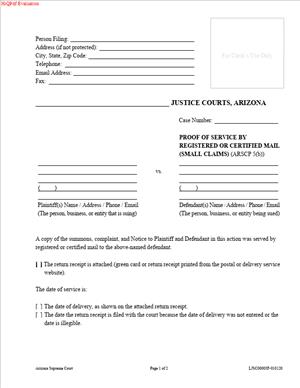
LJSC00003F – Proof of Service by Registered or Certified Mail (Small Claims)
Fill out nowJurisdiction: Country: United States | Province or State: Arizona
LJSC00003F – Proof of Service by Registered or Certified Mail (Small Claims) is a court form used to show that you properly mailed small claims documents to the other party. It creates a written record that the service was completed by registered or certified mail.
When you file a small claims case, the court expects the other side to receive notice. This form helps document that you sent the required paperwork in a way the court recognizes.
If you are representing yourself, this document is part of the process that keeps your case moving. Without proof of service, the court may not proceed with hearings or decisions.
This form does not start your case. It does not explain your claim. Its purpose is narrow but important: it shows how and when the other party was served by mail.
Understanding how this document works helps you avoid delays. Many small claims cases are slowed down because the service was incomplete or not properly documented.
What is LJSC00003F – Proof of Service by Registered or Certified Mail (Small Claims)?
Clear definition
LJSC00003F – Proof of Service by Registered or Certified Mail (Small Claims) is a filing that confirms you sent court papers to the opposing party using registered or certified mail. It is a written statement, usually signed under penalty of perjury, describing when and how the documents were mailed.
In small claims cases, “service” means delivering legal papers in a way that gives formal notice. This form focuses only on service by registered or certified mail, not personal delivery or other methods.
The document typically includes the case name, case number, the names of the parties served, the address used, and the mailing date. It may also reference the postal tracking or receipt information.
Who typically uses this form?
This form is commonly used by plaintiffs in small claims court. If you filed a complaint, you are often responsible for making sure the defendant receives notice.
In some situations, a defendant may also need to serve documents and use this form to prove mailing. That can happen when filing a counterclaim or other responsive papers that require service.
Self-represented individuals use this form frequently. Small claims court is designed for people without lawyers, and this document supports that process.
Court staff and judges rely on the information in this filing to confirm that notice requirements were met before proceeding with the case.
Why might you need this form?
You may need this form after you send the initial small claims complaint and summons to the defendant by registered or certified mail. The court must see proof that the mailing occurred.
Without proof of service, the court may not schedule a hearing or may postpone it. Proper documentation helps avoid unnecessary delays.
This form can also be important if the other party later claims they never received the documents. The mailing details and receipt information provide a record of what was sent and when.
Filing this proof shows that you followed the required mailing method. It supports the fairness of the process by confirming that both sides were given notice.
Typical real-life scenarios
- You file a small claims case to recover money for unpaid work. After filing, you mail the complaint and summons to the defendant using certified mail. You then complete this proof of service form to show the court that you mailed the documents.
- You are suing a former tenant for property damage. The court requires that the tenant be served. You choose registered mail, keep the mailing receipt, and file the completed proof form with the court.
- A business files a small claims action against a customer. An employee handles mailing the paperwork by certified mail. The employee completes and signs the proof of service to confirm the details.
- You are defending a case and filing a counterclaim. You mail your counterclaim documents to the plaintiff using registered mail. You use this form to confirm that the mailing took place.
When would you use LJSC00003F – Proof of Service by Registered or Certified Mail (Small Claims)?
You use this form after you have mailed the required court documents by registered or certified mail in a small claims case. It follows the mailing. It does not replace it.
This form is commonly used early in the case, soon after filing the initial claim. It may also be used later if additional documents require service by mail.
If you choose or are permitted to serve by registered or certified mail, this form provides the written confirmation the court expects. It connects the mailing to the specific case number.
In many small claims cases, the plaintiff handles service. However, any party responsible for mailing documents that require formal service may use this document to record that action.
Timing matters. The proof is usually filed after the mailing is completed and the receipt information is available. Filing too early, before service is actually made, may cause confusion or rejection.
This form is part of the procedural steps in a case. It supports the court’s ability to move forward, schedule hearings, and eventually issue a decision.
Legal characteristics of LJSC00003F – Proof of Service by Registered or Certified Mail (Small Claims)
This document is procedural. It does not argue your case. It does not provide evidence about the dispute itself. Its sole focus is notice and delivery.
For the form to be effective, it must accurately describe the mailing. That typically includes the full name of the person served, the address used, the date of mailing, and the method used. Incomplete or inconsistent information can create problems.
Courts often expect the address on the form to match the address used on the mailing receipt. If the information conflicts, the court may question whether proper service occurred.
Legibility matters. If the case number or party names are incorrect, the filing may not be associated with the right case. That can delay proceedings.
High-level differences can exist in how courts treat service by mail. Some courts may require a signed return receipt. Others may accept proof of mailing combined with tracking information. The specific requirements may vary, but the principle remains the same: the court needs reliable confirmation that notice was sent in an approved manner.
This form does not prove that the other party actually read the documents. It only shows that they were mailed using a recognized method. The legal effect relates to notice, not agreement or admission.
It also does not guarantee that the court will rule in your favor. Service is just one step in the process. Even perfect service does not decide the outcome of the dispute.
If the mailing is returned as undeliverable, that may affect whether service is considered complete. The form itself cannot correct a failed delivery. It simply records what was done.
Accuracy and honesty are critical. The person signing the form is generally declaring that the information is true. False statements can lead to serious consequences in a court setting.
Is it legally binding?
LJSC00003F – Proof of Service by Registered or Certified Mail (Small Claims) is legally significant because it is a sworn or affirmed statement filed with the court. Once signed and submitted, it becomes part of the official case record.
It is binding in the sense that the person who signs it is responsible for the truth of the information. Courts rely on this document when deciding whether proper service occurred.
However, it does not create a contract between the parties. It does not impose new obligations beyond confirming that service was completed in a particular way.
If the information on the form is challenged, the court may review mailing receipts, tracking records, or other supporting details. The form serves as the primary written declaration of service, but it may be examined alongside other evidence if questions arise.
How to fill out LJSC00003F – Proof of Service by Registered or Certified Mail (Small Claims)
Step 1 – Enter the court and case information
At the top of the form, fill in the court name and location exactly as shown on your other small claims documents. Enter the case number as it appears on your complaint or other filings. Write the full names of the plaintiff and defendant in the spaces provided so the proof matches the case record.
Step 2 – Identify the person served
Provide the full legal name of the person or business you mailed the documents to. Use the same name listed in the complaint. If you served a business, include the business name as written in the case caption.
Step 3 – Provide the mailing address
Enter the complete mailing address used for service. Include street address, apartment or suite number if applicable, city, state, and ZIP code. Make sure this address matches the one used on the registered or certified mail label.
Step 4 – Describe the documents mailed
List the specific documents you sent. This may include the complaint, summons, or other court papers. Use the full titles of the documents so there is no confusion about what was included in the mailing.
Step 5 – State the method of mailing
Indicate that the documents were sent by registered or certified mail, as required by the form. If there is space to include receipt or tracking details, enter that information carefully. Keep your mailing receipt for your records.
Step 6 – Enter the date of mailing
Write the exact date the documents were mailed. This should match the date shown on your postal receipt. Accuracy here is important because service deadlines are often calculated from this date.
Step 7 – Sign and date the form
Read the declaration section before signing. Sign your name where indicated and write the date of signing. By signing, you are confirming that the information provided is true and correct.
Step 8 – File the completed form with the court
After completing and signing the form, submit it to the court as part of your case record. Ensure the filing clearly shows the case number so it is properly associated with your small claims matter.
Legal terms you might encounter in LJSC00003F – Proof of Service by Registered or Certified Mail (Small Claims)
- Proof of Service: This is your written statement to the court that you delivered specific documents to the other party. On this form, you confirm that you mailed the papers by registered or certified mail. The court relies on this proof to decide whether the other side was properly notified.
- Registered Mail: A mailing method that provides tracking and a record of delivery. When you select registered mail on this form, you are confirming that you used that service to send the documents. You may need to attach or reference the mailing receipt.
- Certified Mail: A mailing option that provides proof that the item was mailed and delivered. This form asks you to state that you used certified mail. You should keep the mailing receipt and any delivery confirmation because they support what you state on the form.
- Return Receipt: A card or electronic confirmation showing who signed for the mail and when it was delivered. While the form itself records that you mailed the documents, the return receipt can show the exact date of delivery. This date can affect court deadlines.
- Party Served: The person or business that received the court papers. On this form, you must write the full legal name exactly as it appears in the case caption. Any mismatch can create confusion about whether the correct party was served.
- Case Number: The unique number assigned to your small claims case. You must include it on the form so the clerk can match your proof of service to the right file. A missing or incorrect case number can delay processing.
- Affirmation or Declaration: Your statement that the information on the form is true. When you sign, you are confirming under penalty that you actually mailed the documents as described. The court treats this as a serious statement.
- Date of Service: The date you mailed the documents, not the date they were delivered. This date is important because it often triggers response deadlines. Make sure it matches your mailing receipt.
- Service by Mail: A method of delivering court papers through the postal system instead of personal delivery. This form documents that you used this method in a small claims case. The court uses it to confirm that notice requirements were met.
- Clerk of Court: The court official who processes and files documents. After you complete this form, you submit it to the clerk. The clerk records it in the case file so the judge can see that service was completed.
FAQs
What exactly am I proving when I file LJSC00003F – Proof of Service by Registered or Certified Mail (Small Claims)?
You are proving that you mailed specific court documents to the other party using registered or certified mail. The form records who was served, what was mailed, where it was sent, and the date it was mailed. The court uses this information to confirm that the other party received proper notice of the case or a filing.
Do I need to attach the mailing receipt or return receipt to this form?
You should check whether the court requires you to attach proof of mailing or delivery. Even if it is not required, it is wise to keep the certified or registered mail receipt and any return receipt. The information on those documents should match what you entered on this form, including the address and mailing date.
What if the name on the mailing receipt is slightly different from the name on the case?
The name on this document should match the legal name listed in the case caption. If the mailing receipt shows an abbreviated or slightly different version, make sure the address and tracking number clearly connect to the correct party. Double-check that you listed the full and correct legal name on the form before filing.
What date do I enter as the date of service?
You enter the date you placed the documents in the mail using registered or certified mail. Do not use the date the other party signed for the mail unless the form specifically asks for the delivery date. Confirm that this date matches your mailing receipt.
Can someone else sign this form for me?
Generally, the person who actually mailed the documents should complete and sign the form. If someone else handled the mailing, that person may need to be the one who signs because they are the one affirming that the mailing occurred. The signature confirms personal knowledge of the mailing details.
What happens after I file this form with the court?
Once you file it, the clerk places it in your case file. The judge can then review it to determine whether service was properly completed. If the information is complete and consistent, the case can move forward according to the court’s schedule.
What if the mail is returned as undeliverable?
If the mail comes back marked undeliverable or unclaimed, service may not be considered complete. You may need to attempt service again using a corrected address or a different approved method. Do not ignore returned mail, and do not assume service was successful if the other party never received it.
Can I correct an error after filing this document?
If you notice a mistake, you may need to complete a new proof of service with the correct information and file it with the clerk. Make sure the corrected version clearly matches the mailing records. Do not alter a filed copy without following proper court procedures.
Checklist: Before, During, and After LJSC00003F – Proof of Service by Registered or Certified Mail (Small Claims)
Before
- Confirm the correct legal name of the person or business you are serving.
- Verify the complete and accurate mailing address.
- Make copies of all documents you plan to mail.
- Choose registered or certified mail as required.
- Review the case number and court information for accuracy.
- Check any court rules about deadlines for service.
- Prepare funds for mailing fees.
- Keep a folder ready for receipts and tracking information.
During
- Place the correct documents in the envelope.
- Address the envelope exactly as listed on the form.
- Select registered or certified mail at the mailing counter.
- Request a return receipt if needed.
- Obtain a dated mailing receipt.
- Write down the tracking number.
- Immediately complete the form while the details are fresh.
- Double-check the date of mailing before signing.
After
- Track the mailing to confirm delivery.
- Keep the mailing receipt and return receipt in a safe place.
- Make a copy of the completed form for your records.
- File the original form with the clerk.
- Confirm that the clerk accepted and filed it.
- Check the case docket to see that the filing appears.
- Calendar any response deadlines triggered by the service.
- Store all service-related documents together.
Common mistakes to avoid with LJSC00003F – Proof of Service by Registered or Certified Mail
- Mistake: Listing the wrong party name because you rely on memory instead of the case caption, which can create confusion in the court file and delay your case; do not forget to copy the exact legal name from the complaint or claim.
- Mistake: Using a different address on the envelope than on the form because you update one but not the other, which can lead to disputes about proper service; do not forget to make both match exactly.
- Mistake: Entering the delivery date instead of the mailing date because the return receipt seems more official, which can affect deadline calculations; do not forget that the form usually asks for the date you mailed the documents.
- Mistake: Forgetting to sign the form because you focus on the mailing details, which can cause the clerk to reject it; do not forget that your signature confirms the truth of the information.
- Mistake: Filing the form without keeping copies because you assume the court will provide them later, which can leave you without proof if questions arise; do not forget to make and store your own copy.
- Mistake: Ignoring returned or unclaimed mail because you believe mailing alone is enough, which may result in incomplete service and postponed hearings; do not forget to check tracking and address problems quickly.
- Mistake: Writing an incorrect case number due to copying it from another document in a different case, which can cause misfiling; do not forget to verify the case number before submitting.
- Mistake: Attaching the wrong supporting receipt because you mailed multiple items the same day, which can weaken your proof; do not forget to match the tracking number to the specific mailing in this case.
What to do after filling out LJSC00003F – Proof of Service by Registered or Certified Mail (Small Claims)
After you complete the form, pause and review every entry. Make sure the party’s name, address, case number, and mailing date are accurate and consistent with your receipts.
- Step 1: Make at least two copies of the signed form, one for your records and one for backup.
- Step 2: Attach copies of your mailing receipt and any return receipt, if required or helpful.
- Step 3: Organize your documents so the proof of service is placed behind the documents it relates to in your file.
- Step 4: Submit the original form to the clerk using the court’s accepted filing method.
- Step 5: Ask the clerk to confirm that the form has been filed and added to your case.
- Step 6: Check the case record after a few days to verify that the filing appears correctly.
- Step 7: Monitor the delivery status of your mail using the tracking number.
- Step 8: Record the date of delivery in your case notes for deadline tracking.
- Step 9: Calculate any response deadlines that begin after service and mark them on your calendar.
- Step 10: Keep all service-related documents together in a clearly labeled folder in case the judge asks for proof at a hearing.
Staying organized protects you. If the other party claims they were not served, you will have your completed form, mailing receipt, and delivery confirmation ready. Clear records help your case move forward without unnecessary delay.
Disclaimer: This guide is provided for informational purposes only and is not intended as legal advice. You should consult a legal professional.