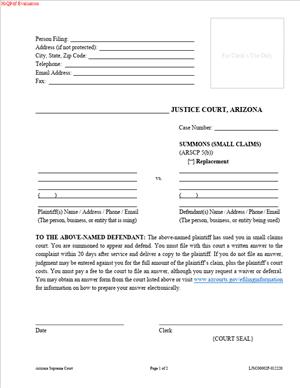
LJSC00002F – Summons (Small Claims)
Fill out nowJurisdiction: Country: United States | Province or State: Arizona
The LJSC00002F – Summons (Small Claims) is a court document used in Arizona small claims cases to officially notify someone that a lawsuit has been filed against them. If you are holding this form, you are either starting a small claims case or have received notice that someone is suing you. This document marks the formal beginning of the court process.
In small claims court, cases usually involve limited amounts of money and simpler procedures. Even so, the process is still part of the judicial system. That means proper notice is required before a judge can hear the case. The summons plays a key role in that notice.
If you are filing a claim, this form helps ensure the other party is informed about the case and their obligation to respond. If you received it, the document tells you who is suing you, what court is involved, and what deadlines apply. It is not just paperwork. It is the official communication from the court system.
Understanding what this form does will help you approach the process calmly and clearly. You do not need legal training to read it, but you do need to know what each part means and why it matters.
What is LJSC00002F – Summons (Small Claims)?
Clear definition
The LJSC00002F – Summons (Small Claims) is a formal court notice issued in connection with a small claims lawsuit. It informs the defendant that a plaintiff has filed a claim and that the court expects a response within a specific time frame.
The summons is separate from the complaint or claim itself. The complaint explains what the dispute is about. The summons tells the defendant that the complaint exists and provides instructions about what to do next. Without a properly issued summons, the court generally cannot move forward with the case.
This document typically includes the names of the parties, the court’s name and address, the case number, and instructions for responding. It may also outline the consequences of failing to respond, such as a default judgment.
Who typically uses this form?
This form is commonly used by individuals representing themselves in small claims court. Many small claims cases involve landlords and tenants, customers and service providers, neighbors, or individuals who lent money informally.
A plaintiff, the person starting the lawsuit, uses the summons as part of the filing process. After completing and filing the necessary documents with the court, the summons is issued so it can be formally delivered to the defendant.
Court clerks may also handle portions of the process, such as stamping or issuing the document after filing. Process servers or authorized individuals may be involved in delivering it to the defendant.
Defendants do not usually fill out the summons, but they receive it. For them, this document signals that legal action has begun and that attention is required.
Why might you need this form?
You might need this form if you are trying to recover money or resolve a dispute within the small claims limit set by Arizona courts. Filing a complaint alone is not enough. The other party must be officially notified, and this summons is part of that notification.
If you are the defendant, you need the summons because it tells you how and when to respond. It provides deadlines and basic instructions. Ignoring it can affect your ability to present your side of the story.
The form also creates a record that notice was given. Courts rely on proper service of the summons to confirm that the defendant had a fair opportunity to participate. Without that confirmation, the case may be delayed or dismissed.
In short, this document connects the filing of a claim to the participation of the other party.
Typical real-life scenarios
- A contractor completes work on a home and claims the homeowner did not pay the final invoice. After attempts to resolve the issue fail, the contractor files a small claims case. The summons is issued to notify the homeowner of the lawsuit and provide instructions for responding.
- A tenant believes a landlord wrongfully withheld a security deposit. The tenant files a claim in small claims court seeking repayment. The summons is used to formally inform the landlord that the case has been filed and that a response is required.
- Two individuals agree informally on a loan between friends. The borrower stops making payments and avoids communication. The lender files a small claims action to recover the remaining balance. The summons ensures the borrower receives official notice of the court proceeding.
- A customer pays for services that were never completed. After requesting a refund without success, the customer files a small claims case. The summons is issued, so the business owner is formally notified and given a chance to respond.
- In each of these situations, the dispute involves money and falls within the small claims process. The summons serves the same core function: to notify and require a response.
When would you use LJSC00002F – Summons (Small Claims)?
You use this form at the beginning of a small claims lawsuit, after preparing the claim documents and submitting them to the court. It is not used in the middle or at the end of a case. It is part of the initial filing stage.
If you are the plaintiff, the summons is typically prepared along with the complaint or claim form. Once the court accepts the filing, the summons is issued so it can be served on the defendant. Service means formally delivering the documents according to court rules.
If you are the defendant, you do not choose to use this form. You receive it because someone has filed a case against you. At that point, the summons outlines your time frame to respond and how to do so.
Small claims courts are designed to be more accessible than higher courts. Even so, they follow structured procedures. The summons is used whenever a new small claims case is initiated and requires proper notice to the other party.
In some situations, more than one defendant may be involved. In that case, separate summons documents may be issued for each defendant. Each person must be properly notified.
The timing matters. The summons must be served within the period allowed by court rules. If too much time passes, the plaintiff may need to request reissuance. The document is therefore tied closely to deadlines and procedural steps.
Legal characteristics of LJSC00002F – Summons (Small Claims)
The summons has legal force because it is issued under the authority of the court. It is not simply a letter from one person to another. Once issued, it carries the weight of formal judicial notice.
For the document to be effective, it must generally contain accurate information. This includes the correct names of the parties, the correct court location, and the correct case number. Errors in identifying the defendant or providing contact information can create delays.
Proper service is essential. Even a correctly completed summons may not be valid if it is not delivered in accordance with court rules. Courts usually require proof that service occurred, often through an affidavit or certificate of service. Without proof of service, the court may not proceed.
Common problems include incomplete fields, incorrect party names, or failure to meet service deadlines. These issues can result in the need to reissue the summons or reschedule hearings. In some cases, they may affect the outcome if a default judgment is requested.
Small claims procedures vary slightly between jurisdictions. While the overall purpose of a summons is consistent, details such as response deadlines, service methods, and formatting requirements can differ. Always review the instructions that accompany the form to understand how it functions in your court.
It is important to understand what this document does not do. The summons does not decide the case. It does not prove that the plaintiff’s claims are true. It does not require immediate payment. It only requires a response and participation in the court process.
Is it legally binding?
The summons itself is legally binding in the sense that it creates a legal obligation to respond within the time allowed. Once properly served, the defendant is officially on notice of the lawsuit.
Failing to respond can lead to a default judgment. A default judgment means the court may decide the case without hearing the defendant’s side. That result is based on non-response, not on a full review of both parties’ evidence.
For the summons to have a binding effect, it must be issued by the court and served properly. If the service does not meet court requirements, the defendant may challenge the validity of the notice. In those situations, the court may require corrective steps before moving forward.
The binding nature of the summons is procedural. It compels participation. It does not determine guilt, liability, or the amount owed. Those decisions are made later, after the court considers the evidence presented.
How to fill out LJSC00002F – Summons (Small Claims)
Step 1 – Identify the Court
Begin by entering the full name of the court where the small claims case is being filed. Include the specific location or precinct if required. This ensures the document is clearly connected to the correct court.
Step 2 – Enter the Case Number
If the court has already assigned a case number, write it exactly as provided. This number links the summons to the correct file. If you are preparing the document before filing, the case number may be added after submission.
Step 3 – List the Plaintiff Information
Provide the full legal name of the plaintiff, along with contact information as requested on the form. Use complete and accurate details. The name should match the name used in the complaint or claim document.
Step 4 – List the Defendant Information
Enter the full legal name of the defendant. Include the address where the defendant can be served. Accuracy here is critical. An incorrect name or outdated address can prevent proper service and delay the case.
Step 5 – Review the Response Instructions
The form typically contains preprinted language explaining how long the defendant has to respond and what may happen if no response is filed. Read this section carefully to confirm it is complete and legible. Do not alter standard court language unless instructed by the court.
Step 6 – Check Dates and Deadlines
Confirm that any hearing dates or response deadlines are clearly stated, if they are included on the form. Some courts schedule hearings after a response is filed, while others may set dates earlier. Make sure the information matches what the court clerk provides.
Step 7 – Sign Where Required
If the form requires a signature from the plaintiff or issuing authority, sign in the designated area. Use your full legal name. Some portions may be completed or signed by the court clerk after filing, depending on local procedure.
Step 8 – File the Form with the Court
Submit the completed summons along with the complaint or claim documents to the court clerk. The clerk may review the form for completeness and officially issue it. Once issued, it becomes ready for service.
Step 9 – Arrange for Service
After issuance, arrange for the summons and complaint to be delivered to the defendant according to court rules. This step is separate from filling out the document, but it is directly connected to its purpose. Ensure proof of service is completed and returned to the court as required.
Legal terms you might encounter in LJSC00002F – Summons (Small Claims)
- Summons: A summons is the official court notice that tells the defendant a lawsuit has been filed. This document, it directs the defendant to appear at a specific time and place or respond as instructed. It is the formal start of the court’s authority over the defendant.
- Plaintiff: The plaintiff is the person or business bringing the small claims case. Your name must appear exactly as it does on the original claim. If you are filing on behalf of a business, the business name must match its registered name.
- Defendant: The defendant is the person or business being sued. This form lists the defendant’s full legal name and address. Accuracy matters because service and enforcement depend on correct identification.
- Case Number: The case number is the unique identifier assigned by the court clerk when the claim is filed. It appears near the top of the summons. You must use this same number on every document filed in the case.
- Hearing Date: The hearing date is the scheduled court appearance when both sides present their side. The summons tells the defendant when and where to appear. Missing this date can lead to serious consequences.
- Service of Process: Service of process is the formal delivery of the summons and claim to the defendant. The court requires proof that the defendant received the documents in a legally acceptable way. Without proper service, the case cannot move forward.
- Proof of Service: Proof of service is the written confirmation that the summons was delivered correctly. It usually includes the date, time, place, and method of delivery. This document must be filed with the court.
- Default Judgment: A default judgment can be entered if the defendant does not appear or respond as required. The summons warns the defendant about this possibility. It is one reason the information on the form must be accurate.
- Court Clerk: The court clerk is the official who processes filings and maintains court records. The clerk may sign or stamp the summons to make it official. A summons is not valid until properly issued by the clerk.
- Jurisdiction: Jurisdiction refers to the court’s legal authority to hear the case. The summons identifies the court handling the dispute. Filing in the wrong court can delay or dismiss your case.
FAQs
What happens if the defendant ignores the LJSC00002F – Summons (Small Claims)?
If the defendant does not appear at the hearing listed on this form, you can ask the court for a default judgment. To do that, you must show that the summons and claim were properly served and that proof of service was filed. The judge will check the file to confirm the service date, method, and address used. If everything is correct, the court may award you the amount requested or another appropriate amount.
How do I know if the court has officially issued this form?
You should look for the clerk’s signature, stamp, or electronic certification on the document. An unsigned or unstamped summons is not considered issued. Before arranging service, confirm that the case number appears and that the hearing date is clearly printed. If any of those items are missing, contact the clerk’s office to confirm acceptance.
Can I correct a name or address after the summons is prepared?
Yes, but you must do it the right way. If the defendant’s name or address is wrong, do not serve the incorrect version. Ask the clerk about filing an amended document so the court record matches the correct legal name and location. Serving incorrect information can invalidate service and delay your hearing.
What if the hearing date listed does not work for me?
You cannot simply ignore the scheduled date. Check the document for instructions about requesting a change or continuance. Any request usually must be made in writing and filed before the hearing date. Until the court approves a change, you must treat the original date as active.
Does this form have to be served in a specific way?
Yes. This document must be delivered using a legally accepted method, such as personal service or another approved option. You cannot serve it yourself if the rules require a neutral third party. Make sure the person serving it understands they must complete and sign proof of service with the exact date and method used.
What information must match between the claim and this document?
The case number, court name, plaintiff name, and defendant name must be identical. Even small differences, like missing middle initials or business designations, can cause confusion. Before filing or serving, compare this document line by line with your original claim. Consistency helps prevent disputes about identity or notice.
What if the defendant has moved since I filed the claim?
You need the defendant’s current service address. If the address on this form is outdated, service may fail, and the hearing could be postponed. Confirm the most recent address before arranging delivery. If necessary, update the information with the court before service is attempted.
Will this document become part of the public record?
Yes. Once filed and issued, it becomes part of the court file. The names of the parties, case number, and hearing date are generally accessible through court records. Make sure all details are accurate because corrections after filing may require additional paperwork and time.
Checklist: Before, During, and After LJSC00002F – Summons (Small Claims)
Before
- Confirm the correct legal name of the defendant, including business status if applicable.
- Verify the defendant’s current physical address for service.
- Check that your claim has been filed and assigned a case number.
- Review the court location to ensure it has authority over the dispute.
- Gather any documents you plan to attach or reference.
- Confirm filing fees have been paid or waived.
- Prepare extra copies of the summons and claim for your records.
During
- Enter the case number exactly as assigned.
- Print all names clearly and consistently with the claim.
- Double-check the hearing date, time, and courtroom location.
- Ensure the clerk signs or stamps the document before service.
- Review response instructions printed on the form.
- Make sure no required fields are left blank.
- Keep one conformed copy for yourself before arranging service.
After
- Arrange for proper service using an approved method.
- Track the date and time the service was completed.
- File the completed proof of service with the court.
- Calendar the hearing date and any related deadlines.
- Organize your evidence in a folder for the hearing.
- Monitor the case docket for updates or changes.
- Prepare a short summary of your claim to present in court.
Common mistakes to avoid with LJSC00002F – Summons (Small Claims)
- Mistake: Listing a nickname or incomplete business name because it is commonly used; this happens when people rely on informal records, and it can result in ineffective service or an unenforceable judgment, so do not forget to verify the full legal name.
- Mistake: Serving the summons before it is officially issued by the clerk; this often happens due to urgency, and it can invalidate service and delay your case, so do not forget to check for the clerk’s stamp or signature.
- Mistake: Using an outdated address found online; this happens when quick searches replace verification, and it can lead to failed service and postponed hearings, so do not forget to confirm the current address.
- Mistake: Forgetting to file proof of service after delivery; this occurs when you assume service alone is enough, and the court may refuse to proceed without written proof, so do not forget to submit the completed proof form.
- Mistake: Missing the hearing date because you relied on memory instead of a calendar; this is common when juggling deadlines, and it can lead to dismissal or default, so do not forget to calendar the date immediately.
- Mistake: Leaving blank fields on the form because you think they are optional; this happens when instructions are skimmed, and incomplete forms may be rejected, so do not forget to review every section before filing.
- Mistake: Failing to keep copies of the issued summons and proof of service; this occurs when documents are handed off without duplication, and you may struggle to prove compliance later, so do not forget to store organized copies.
What to do after filling out LJSC00002F – Summons (Small Claims)
Once you complete the summons, slow down and review it line by line. Compare it with your filed claim. Make sure names, addresses, and the case number match exactly. Small errors now can create larger problems later.
- Step 1: Make at least three copies of the completed summons and the claim—one for you, one for service, and one backup.
- Step 2: Confirm the clerk has signed, stamped, or electronically issued the summons so it is officially valid.
- Step 3: Choose an approved method of service and arrange for delivery within the required timeframe.
- Step 4: Provide the server with clear instructions and accurate address details to avoid failed attempts.
- Step 5: After service, obtain the completed proof of service form with the exact date, time, and method listed.
- Step 6: File the proof of service with the court promptly and confirm it has been entered into the record.
- Step 7: Mark your calendar with the hearing date and set reminders several days in advance.
- Step 8: Organize your evidence, including contracts, receipts, photos, messages, and a summary timeline.
- Step 9: Prepare a short statement explaining what happened, what you are asking for, and how you calculated the amount.
- Step 10: Check the court docket a few days before the hearing to confirm no schedule changes have been made.
Keep all documents together in a single folder. Bring copies to court, including the issued summons and proof of service. If the defendant contacts you after receiving the summons, document the communication in writing and keep records of any settlement discussions.
Staying organized and proactive helps you move confidently toward your hearing date.
Disclaimer: This guide is provided for informational purposes only and is not intended as legal advice. You should consult a legal professional.