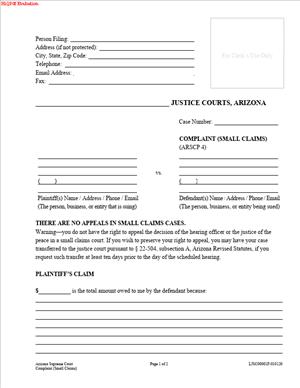
LJSC00001F – Complaint (Small Claims)
Fill out nowJurisdiction: Country: United States | Province or State: Arizona
The LJSC00001F – Complaint (Small Claims) is the document you file to start a small claims case in an Arizona justice court. It tells the court and the other party what happened, how much money you are asking for, and why you believe you are entitled to that amount.
If you are representing yourself, this form is often your first formal step in the legal process. It sets the tone for your case. Everything that follows, including the hearing, is based on what you include in this filing.
Small claims court is designed for simpler disputes involving limited dollar amounts. The process is more streamlined than other civil cases. Even so, the form must be completed carefully and accurately.
Understanding how this document works helps you avoid delays. Courts may reject or return incomplete forms. Clear, complete information makes the process smoother and reduces confusion later.
This guide walks you through what the form is, when it is used, and how to complete it in a practical, step-by-step way.
What is LJSC00001F – Complaint (Small Claims)?
Clear definition
LJSC00001F – Complaint (Small Claims) is the official document used to begin a small claims lawsuit in an Arizona justice court. By filing it, you are formally asking the court to resolve a dispute and award you money.
The form identifies you as the plaintiff and the other party as the defendant. It explains the basic facts of your claim and states the exact dollar amount you are requesting. It also provides contact information so the court can send notices about your case.
This document is not a full legal brief. It does not require detailed legal arguments. Instead, it focuses on a clear summary of what happened and what you are seeking.
Once filed and accepted, the court assigns a case number. The defendant is then served with the complaint and given an opportunity to respond.
Who typically uses this form?
You use this form if you believe someone owes you money and you want a court to decide the issue. Most plaintiffs in small claims court are individuals, not businesses.
Common users include tenants, landlords, consumers, contractors, and small business owners. For example, a tenant may file to recover a security deposit. A contractor may file to recover unpaid fees.
The defendant can be an individual, a business, or another legal entity. If you are suing a business, the name on the form must match the legal name of that business.
People who file this form often do not have an attorney. Small claims court is structured so individuals can represent themselves.
Why might you need this form?
You may need this form when informal efforts to resolve a dispute have not worked. That might include conversations, written demands, or payment requests.
If someone refuses to pay for services you provided, damages your property, or fails to return money owed, filing a complaint allows you to ask a judge to review the situation.
The form is also used when you want a clear, enforceable court decision. A judgment from the court can create legal consequences if the defendant does not pay voluntarily.
Filing this document also creates an official record of your claim. This can be important if the dispute continues or if you later need to show that you attempted to resolve the issue through the court system.
Typical real-life scenarios
- You paid a contractor for home repairs, but the work was never completed. After repeated requests for a refund, you received no response. You decide to file a complaint to recover the amount you paid.
- You loaned money to a friend with an agreement that it would be repaid within six months. The deadline passed, and repayment never happened. You file a small claims complaint to seek the unpaid balance.
- You moved out of a rental property and did not receive your security deposit back. You believe the deductions were improper or unsupported. You use the complaint form to request the return of the disputed amount.
- You sold a used vehicle, and the buyer paid with a check that later bounced. You attempted to resolve the issue directly but were unsuccessful. You file the form to request payment of the amount owed.
- You purchased goods that were defective, and the seller refused to issue a refund. After unsuccessful attempts to resolve the matter, you turn to the small claims court.
- In each of these examples, the dispute centers on money. The form allows you to explain what happened in clear terms and request a specific dollar amount.
When would you use LJSC00001F – Complaint (Small Claims)?
You use this form when your dispute falls within the monetary limits allowed for small claims in the Arizona justice court. Small claims cases generally involve claims for a limited amount of money rather than complex legal issues.
Timing matters. There are legal deadlines, often called statutes of limitation, that limit how long you have to file a case. If too much time has passed since the event, the court may dismiss the claim. The form itself does not calculate deadlines, so you need to be aware of the timing before filing.
This form is appropriate when you are seeking money only. Small claims courts typically do not handle requests for court orders that require someone to do or stop doing something, such as forcing repairs or transferring property. The focus is on financial compensation.
You may also use this form if you are comfortable with a simplified court process. Small claims procedures are designed to be faster and less formal than other civil cases. Rules of evidence and procedure may still apply, but the setting is usually more straightforward.
If your dispute involves complicated legal questions, large sums of money, or multiple parties with cross-claims, another type of court case may be more appropriate. The complaint form is intended for simpler, direct disputes.
You would not use this form if you are defending a case. In that situation, you would respond to a complaint rather than file one. This document is specifically for starting the case as the plaintiff.
Legal characteristics of LJSC00001F – Complaint (Small Claims)
This form becomes legally significant once it is filed with the court and properly served on the defendant. Filing alone is not enough. The defendant must receive formal notice of the case through an approved method of service.
For the complaint to be effective, it must clearly identify the parties. Names must be accurate and complete. Using a nickname, a misspelled name, or the wrong business entity can cause delays or problems with enforcement later.
The claim amount must be stated clearly. You cannot leave the amount blank or use vague language such as “to be determined.” The court needs a specific number to process the case.
You must also provide a short statement of why you believe the defendant owes you money. The explanation should connect the facts to the amount you are requesting. Incomplete or unclear descriptions can lead to confusion at the hearing.
Common reasons a court may reject or return the form include missing signatures, incomplete contact information, incorrect party names, or filing in the wrong court location. Court clerks review forms for completeness but do not evaluate the strength of your case.
The form does not prove your claim. It only starts the case. You still need to present evidence at the hearing, such as contracts, receipts, photographs, or witness testimony.
Small claims procedures can vary slightly by state and by court division. Filing fees, service requirements, and hearing procedures may differ. The structure of the complaint form reflects Arizona’s justice court process.
The document also does not guarantee payment. Even if you receive a judgment, collecting money may require additional steps if the defendant does not pay voluntarily.
Is it legally binding?
The complaint itself is not a binding decision. It is a formal request for the court to decide a dispute. Its legal force comes from the fact that it invokes the court’s authority and requires the defendant to respond.
Once the court accepts the filing and the defendant is properly served, the case is officially active. The defendant must respond or appear as required by the court’s procedures. Failure to respond can lead to a default judgment.
If the case proceeds to a hearing and the judge issues a judgment, that judgment is legally binding. It sets out who owes money and how much. The complaint is the document that begins that process, but it does not resolve the dispute on its own.
The accuracy of the information in the complaint matters. You typically sign the form under penalty of perjury. That means you are affirming that the statements are true to the best of your knowledge. Providing false information can have legal consequences.
How to fill out LJSC00001F – Complaint (Small Claims)
Step 1 – Identify the court
At the top of the form, you will see a space for the name of the justice court. Enter the correct court name and location. This is usually based on where the defendant lives, where the dispute occurred, or where a business operates. Make sure the court you choose has authority over the type and amount of your claim.
Step 2 – List the plaintiff’s information
In the section labeled for the plaintiff, enter your full legal name. Include your current address, phone number, and any other required contact details. This information allows the court to send you notices about hearings and other updates. If there is more than one plaintiff, list each person as directed on the form.
Step 3 – List the defendant’s information
Enter the full legal name of the person or business you are suing. Accuracy is critical. If the defendant is an individual, use their full legal name, not a nickname. If the defendant is a business, use the registered business name. Provide a complete address where the defendant can be served with the complaint.
Step 4 – State the amount of your claim
Locate the section that asks for the amount you are seeking. Write the total dollar amount clearly. This should reflect the actual loss you are claiming, such as unpaid invoices, repair costs, or returned checks. If the form allows, you may also include court costs or other permitted amounts, as described in the instructions on the document.
Step 5 – Explain why the defendant owes you money
In the space provided, write a clear and concise summary of what happened. Describe the agreement or event, what the defendant did or failed to do, and how that led to your financial loss. Keep your explanation focused on key facts, including dates and amounts. Avoid emotional language and stick to specific details.
Step 6 – Review for completeness and accuracy
Before signing, read the entire form carefully. Confirm that names are spelled correctly and that addresses are complete. Check that the amount claimed matches your explanation. Make sure all required sections are filled in and legible.
Step 7 – Sign and date the form
Sign your name in the designated area. By signing, you confirm that the information provided is true to the best of your knowledge. Add the date of signing. Some courts may require additional declarations or acknowledgments, so review the signature section closely.
Step 8 – Prepare for filing and service
After completing the form, follow the court’s filing process. This usually involves submitting the document to the clerk and paying a filing fee. Once filed, arrangements must be made for the defendant to be formally served. Keep copies of everything you submit for your records.
Legal terms you might encounter in LJSC00001F – Complaint (Small Claims)
- Plaintiff: This is you, the person or business filing the claim. On this form, you must provide your full legal name, mailing address, and contact information. If you are a business, you must list the exact registered business name, not a trade name, unless it is officially registered.
- Defendant: The person or business you are suing. The form requires the defendant’s correct legal name and address for service. If the name is wrong or incomplete, the court may not be able to move your case forward.
- Jurisdiction: This refers to the court’s authority to hear your case. In small claims, jurisdiction usually depends on where the defendant lives, where the dispute occurred, or where a contract was performed. You confirm this indirectly by filing in the correct court location.
- Cause of Action: This is the legal reason you are suing. On the form, you briefly explain what happened and why the defendant owes you money. You do not need complex legal terms, but you must clearly describe the event or agreement involved.
- Damages: The amount of money you are asking the court to award. The form asks you to state a specific dollar amount. This should match your actual financial loss and be supported by receipts, invoices, contracts, or other records.
- Service of Process: The official delivery of court documents to the defendant. After you file, the defendant must be properly served with a copy of the complaint and any required notices. Without service, the court cannot issue a judgment.
- Filing Fee: The amount you pay the court to open your case. The clerk will not process your complaint unless the correct fee is paid or a fee waiver is approved. Keep proof of payment for your records.
- Default Judgment: A court decision entered when the defendant does not respond or appear. If the defendant fails to act within the required time, you may request that the court enter judgment in your favor based on your complaint.
- Venue: The specific court location where your case is filed. Venue rules determine which courthouse is appropriate. Filing in the wrong venue can delay your case or require you to refile.
- Affidavit: A written statement made under oath. Some parts of the small claims process may require you to sign under penalty of perjury, confirming that the information you provided is true and correct.
FAQs
What exact name should I use for the defendant on this form?
Use the defendant’s full legal name. For an individual, that means their first and last name as it appears on official records. For a business, use the registered business name. If it is a corporation or limited liability company, include the full legal ending such as “Inc.” or “LLC.” Check contracts, invoices, or public business records to confirm spelling. If the name is wrong, the service may fail, and your case can be delayed.
Do I need to attach proof of what I am claiming?
You are not always required to attach evidence to the complaint itself, but you should have your proof ready. The court may ask you to bring copies to the hearing. Gather contracts, receipts, invoices, text messages, emails, photos, or repair estimates. Make sure the amounts listed in your documents match the amount you entered on this form.
What amount should I enter as damages?
Enter the total amount of money the defendant owes you at the time you file. Add up unpaid invoices, repair costs, or other financial losses. Do not guess. Use actual numbers supported by documents. If court costs are allowed, you typically request those separately or they may be added by the court later.
What happens after I file the LJSC00001F – Complaint (Small Claims)?
After filing, the clerk assigns a case number and sets a hearing date. The defendant must be formally served with the complaint and notice of hearing. The court cannot decide your case until service is completed and documented. Keep track of deadlines and confirm that proof of service is filed with the court.
How do I know if my complaint was accepted by the court?
When you submit this document, the clerk reviews it for completeness. If accepted, it will be stamped or marked as filed, and you will receive a case number. If something is missing, the clerk may return it for correction. Always check that the court’s file stamp appears on your copy.
Can I change information after filing this form?
Yes, but changes usually require an amended complaint or a formal request to the court. You cannot simply cross out information once it has been filed. If you discover an error in a name, amount, or address, act quickly. Updated information must also be properly served on the defendant.
Do I need to appear at the hearing even if the defendant does not respond?
Yes. Even if the defendant does not file a response, you are still expected to appear at the hearing unless the court tells you otherwise. The judge may ask you to explain your claim and show proof. If you do not appear, your case can be dismissed.
What does my signature mean on the LJSC00001F – Complaint (Small Claims)?
Your signature confirms that the information in the complaint is true to the best of your knowledge. You are declaring this under penalty of perjury. Before signing, review every section carefully. Make sure names, amounts, and dates are accurate because you are responsible for what the document states.
Checklist: Before, During, and After LJSC00001F – Complaint (Small Claims)
Before
- Confirm the correct legal name and address of the defendant.
- Gather contracts, invoices, receipts, and written communications.
- Calculate the exact total amount you are owed.
- Verify that your claim fits within the small claims monetary limit.
- Check that you are filing in the correct court location.
- Prepare your own contact information and mailing address.
- Review any deadlines related to your claim.
- Make copies of all supporting documents for your records.
During
- Print clearly or type all required information.
- Enter full legal names without abbreviations unless official.
- State the exact dollar amount of your claim.
- Provide a clear, short explanation of why the defendant owes you money.
- Double-check spelling of names and numbers.
- Review the form for blank sections.
- Sign and date the form where required.
- Prepare the correct filing fee or fee waiver request.
After
- File the complaint with the court clerk.
- Obtain a stamped copy showing the case number.
- Arrange for proper service of process on the defendant.
- File proof of service with the court.
- Calendar the hearing date and time.
- Organize your evidence in a logical order.
- Prepare a short summary of what you will say at the hearing.
- Keep all court documents in one secure folder.
Common mistakes to avoid with LJSC00001F – Complaint (Small Claims)
- Mistake: Suing under a nickname or trade name because it is familiar, which happens when you rely on informal documents; this can prevent proper service and delay judgment, so do not forget to confirm the exact legal name.
- Mistake: Guessing the amount owed because you are estimating quickly; this leads to inconsistencies with your evidence and may weaken your credibility, so do not forget to total your documents carefully.
- Mistake: Filing in the wrong court location because it is closer to you; this can result in dismissal or transfer, so do not forget to verify proper venue before submitting.
- Mistake: Leaving sections blank because you think they do not apply; incomplete forms may be rejected by the clerk, so do not forget to review every field before filing.
- Mistake: Failing to arrange proper service because you assume the court will handle it automatically; without service, the case cannot proceed, so do not forget to follow through and file proof of service.
- Mistake: Not appearing at the hearing because you think the paperwork is enough; the judge may dismiss your case for nonappearance, so do not forget to attend and bring your evidence.
- Mistake: Signing without reviewing details because you are in a hurry; errors become part of the court record, so do not forget that your signature confirms accuracy under oath.
- Mistake: Throwing away stamped copies or payment receipts because you think the court keeps everything; lost records make it harder to track your case, so do not forget to keep organized copies.
What to do after filling out LJSC00001F – Complaint (Small Claims)
Once your form is complete, your focus shifts from writing to process. The court system runs on deadlines and documentation. Staying organized now will save you stress later.
- Step 1: Make at least two copies of the completed complaint before filing. Keep one for your records and one for service.
- Step 2: File the original with the court clerk and pay the required filing fee or submit a fee waiver request if needed.
- Step 3: Obtain a stamped copy showing the case number and filing date. Confirm that all pages were accepted.
- Step 4: Review the notice of hearing issued by the court. Write down the date, time, and location immediately.
- Step 5: Arrange for proper service of the complaint and hearing notice on the defendant through an approved method.
- Step 6: Ensure proof of service is completed and filed with the court before the hearing date.
- Step 7: Organize your evidence in chronological order. Label each document so you can find it quickly during the hearing.
- Step 8: Prepare a short, clear statement summarizing what happened, how much you are owed, and how you calculated that amount.
- Step 9: Bring multiple copies of your evidence to the hearing, including one for the judge and one for the defendant.
- Step 10: After the hearing, review any judgment issued. If you win, follow the court’s process to collect the judgment. If you lose, note any deadlines for appeal or further action.
Keep a dedicated folder for everything related to your case. Include the filed complaint, proof of service, payment receipts, and all court notices. Update your personal records to reflect the pending claim, especially if it relates to business accounting or contractual disputes. Staying methodical helps you respond quickly to any court communication.
Disclaimer: This guide is provided for informational purposes only and is not intended as legal advice. You should consult a legal professional.