AOCAPC9F – Notice of Change of Address (Small Claims)
Fill out nowJurisdiction: Country: United States | Province or State: Arizona
If you are involved in a small claims case in Arizona and you move, the court needs your updated contact information. The AOCAPC9F – Notice of Change of Address (Small Claims) is the document used to report that change. It tells the court and the other party where you can now receive mail and case updates.
This form is short, but it plays an important role in your case. Courts send hearing notices, rulings, and other official documents by mail. If your address is outdated, you may miss critical information.
The AOCAPC9F – Notice of Change of Address (Small Claims) is typically filed after a case has already started. It does not open a case or respond to a claim. It simply updates your contact details in the court record.
If you are representing yourself, keeping your address current is part of managing your case. This document helps ensure that communication continues without interruption.
What is AOCAPC9F – Notice of Change of Address (Small Claims)?
Clear definition
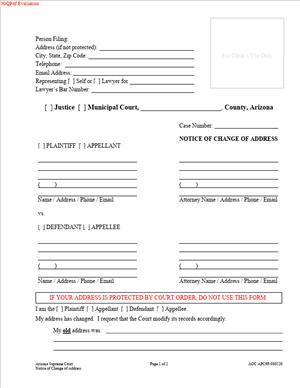
AOCAPC9F – Notice of Change of Address (Small Claims) is a court form used in Arizona small claims cases to notify the court and the other party that your mailing address has changed. It updates the official record in an existing case.
The form usually includes your name, the case number, your old address, and your new address. Once filed, the court updates its system so future notices are sent to the correct location.
This document does not change any claims, defenses, or court dates. Its sole purpose is to keep your contact information accurate.
Who typically uses this form?
This form is commonly used by plaintiffs and defendants in small claims cases. Either party may need it if they move while the case is pending.
It is also used by individuals who filed a claim and later relocated, or by defendants who were sued and changed residences before the case was resolved. In some situations, a party may update its address after judgment if post-judgment matters are still ongoing.
Self-represented individuals use this form most often. In small claims court, many people handle their cases without an attorney. That makes it especially important to keep personal contact details current.
Why might you need this form?
You may need this form if you move to a new home during your small claims case. Even a short-distance move within the same city can require an address update.
You may also need it if you change your mailing address but remain at the same physical location. For example, switching from a street address to a post office box affects where court mail is delivered.
Another reason is mail delivery issues. If you realize the court has an outdated or incorrect address for you, filing this document corrects the record.
Without an updated address on file, you risk missing notices about hearings, deadlines, or judgments. This form helps reduce that risk.
Typical real-life scenarios
- You file a small claims case to recover money for property damage. A few weeks later, you move to a new apartment. The court schedules a hearing and mails the notice to your old address. Filing a notice of change of address helps ensure that future mail goes to your new location.
- You are sued in small claims court and receive the claim at your previous residence. After being served, you relocate to another part of the county. You file a notice so the court and the plaintiff send all further documents to your new address.
- You win a small claims judgment and expect payment from the other party. During that time, you change your mailing address. Updating your address helps ensure that any mailed payments or court notices reach you.
- You are waiting for the court’s written decision after a hearing. Before the ruling is mailed, you move to a different city within Arizona. By filing the form promptly, you reduce the chance that the decision is sent to the wrong place.
When would you use AOCAPC9F – Notice of Change of Address (Small Claims)?
You would use AOCAPC9F – Notice of Change of Address (Small Claims) any time your mailing address changes while a small claims case is open. This includes the period after filing a claim, after being served as a defendant, or while waiting for a hearing.
It may also be used after a judgment has been entered if the case is still active in some way. For example, post-judgment collection activity or payment arrangements may continue for some time.
Both plaintiffs and defendants can file this form. In small claims court, the roles are straightforward. The plaintiff is the person who started the case. The defendant is the person or business being sued. Either role carries the responsibility of keeping contact information accurate.
Timing matters in practical terms. If a hearing is scheduled soon after your move, updating your address quickly helps reduce confusion. Courts rely heavily on mailed notices, and the system works best when records reflect current information.
You would not use this form to change your phone number only, unless the form specifically allows for additional contact details. Its primary function is to update your mailing address in the court file.
Legal characteristics of AOCAPC9F – Notice of Change of Address (Small Claims)
This form becomes effective once it is properly completed and filed with the appropriate court handling your small claims case. Filing places your new address into the official case record.
For the document to function as intended, it must clearly identify the case. That usually means including the correct case number and the names of the parties. If the case number is missing or incorrect, the court may not know which file to update.
Legibility is important. If the new address is hard to read, mail may still be misdirected. Using clear, complete address details helps avoid delivery problems.
In general, a notice of change of address does not require a hearing. It is an administrative update. However, filing procedures can vary slightly between courts within a state. Some courts may require multiple copies or proof that a copy was sent to the other party.
Common issues that cause problems include failing to sign the form, omitting the case number, or not providing a complete address. If the form is incomplete, the court may not process the update.
This document does not change any deadlines in your case. It does not extend time to respond, cancel hearings, or modify judgments. It only updates contact information.
It also does not automatically notify other agencies or courts. If you have other legal matters pending, each case may require a separate notice.
Is it legally binding?
A notice of change of address is not a contract between the parties. It is a formal statement to the court about your contact information.
Once filed, the court typically relies on the address you provided for future mailings. In that sense, it has legal effect within the case. The court treats the new address as your official address of record.
If you provide incorrect information, the consequences can be practical rather than contractual. Mail sent to the wrong address may still be considered properly delivered if it was sent to the address listed in the court file.
The form itself does not create rights or obligations between the parties. It supports the procedural process of keeping the court informed.
How to fill out AOCAPC9F – Notice of Change of Address (Small Claims)
Step 1 – Identify the court and case information
At the top of the form, enter the name of the court handling your small claims case. This may include the specific justice court and county. Then write the case number exactly as it appears on previous court documents. Accuracy here connects your address update to the correct file.
Step 2 – Enter your name and role in the case
Provide your full legal name as it appears in the case. Indicate whether you are the plaintiff or the defendant. This helps the court understand which party’s contact information is being updated.
Step 3 – Provide your previous address
Write the address currently listed in the court record, if requested on the form. This may include street address, apartment number, city, state, and ZIP code. Including the old address helps the court confirm what is being replaced.
Step 4 – Enter your new mailing address
Clearly print your new mailing address. Include all necessary details, such as unit numbers or post office box numbers. Make sure the information is complete and readable so future mail can reach you without delay.
Step 5 – Add additional contact information if requested
Some versions of the form may include space for a phone number or email address. If those fields are present, fill them in as directed in the document. This can assist the court in contacting you about scheduling or procedural matters.
Step 6 – Review the information for accuracy
Before signing, read through each section. Confirm that the case number is correct and that the new address is written exactly as intended. Small errors in numbers or spelling can cause delivery problems.
Step 7 – Sign and date the form
Sign your name in the designated signature area. Add the date you are completing the form. Your signature confirms that the information provided is accurate to the best of your knowledge.
Step 8 – Prepare copies for filing and service
Make the number of copies required for filing. Typically, one copy is kept by the court, and another is provided to the other party. Keeping a copy for your own records allows you to confirm what was submitted.
Step 9 – File the form with the court
Submit the completed document to the clerk of the court handling your case. Filing places your new address into the official court record. Once processed, future correspondence in your small claims case is generally sent to the updated address.
Legal terms you might encounter in AOCAPC9F – Notice of Change of Address (Small Claims)
- Case Number: This is the unique number assigned to your small claims case when it was filed. It appears on prior court documents and identifies your case in the court system. You must copy it exactly as it appears so the court updates the correct file.
- Party Name: This refers to your full legal name as it appears in the case, whether you are the plaintiff or defendant. The name on this form must match the court record. Even small differences, like missing a middle initial, can cause confusion.
- Mailing Address: This is the address where you receive mail, not necessarily where you physically live. The court will send all future notices, hearing dates, and judgments to this address. If it is incorrect, you may miss critical deadlines.
- Physical Address: This is where you actually reside. Some forms ask for both a physical and mailing address if they are different. Make sure you understand which one the court is requesting.
- Service: Service means formally delivering court documents to another party in the case. Even though this document updates your address, you may still need to provide notice to the other party, depending on court procedure.
- Certificate of Service: This section confirms that you sent a copy of the document to the other party. You usually state how and when you delivered it. Without this confirmation, the court may not process your filing.
- Self-Represented Litigant: This means you are representing yourself without a lawyer. If this applies to you, your contact information becomes even more important because the court communicates directly with you.
- Clerk of the Court: The clerk is the court official who receives, files, and maintains documents. When you submit this form, the clerk enters your new address into the court’s records.
- Notice: In court terms, a notice is an official communication that informs parties of a change, hearing, or decision. This document serves as a formal notice to the court and other parties that your contact information has changed.
- Judgment: A judgment is the court’s final decision in a case. If a judgment is mailed to an outdated address, you might miss your opportunity to respond or appeal. Keeping your address current helps protect your rights.
FAQs
Do I need to file AOCAPC9F – Notice of Change of Address (Small Claims) if I only moved temporarily?
Yes. If you want the court to send mail to a different address for any period of time, you should update your address. The court will use the address listed in the file until you officially change it. If you move back later, you will need to file another update so the record reflects your current mailing address.
When does my new address become effective in the court record?
Your new address becomes effective once the court accepts and files this document. Simply filling it out is not enough. The clerk must receive and process it before the court system updates your contact information.
Do I have to send a copy of this document to the other party?
Often, yes. If there is a certificate of service section, you must complete it to confirm that you delivered a copy to the other party. Check whether the form requires you to state the date and method of delivery, such as mail or hand delivery, and make sure you complete that section accurately.
What happens if I forget to update my address and miss a hearing notice?
The court will usually consider that notice properly sent if it was mailed to the address on file. Missing a hearing because you did not update your address can lead to a default judgment against you. This form helps prevent that problem by ensuring your contact information is current.
Can I update my phone number or email on this form?
If the document includes fields for phone number or email, you can update them at the same time. Make sure you write them clearly and double-check for typos. If those fields are not included, you may need to update them through a separate process with the court.
Do I need to explain why I moved?
No. This document only records your change of address. You do not need to provide a reason or additional details. Focus on entering your previous address and your new mailing address accurately.
What if my name on this document does not exactly match the court record?
You should use the same name that appears on previous filings in your case. If your legal name has changed, that is a separate issue and may require a different type of filing. This document is meant to update your address, not your identity in the case.
Will filing this form change anything else in my case besides my address?
No. Filing AOCAPC9F – Notice of Change of Address (Small Claims) only updates your contact information in the court’s records. It does not change hearing dates, deadlines, claims, defenses, or any judgment that has already been entered.
Checklist: Before, During, and After AOCAPC9F – Notice of Change of Address (Small Claims)
Before
- Locate your case number on a prior court document.
- Confirm the exact spelling of your name as it appears in the case.
- Write down your old address exactly as it appears in court records.
- Verify your full new mailing address, including apartment or unit number.
- Check whether your physical and mailing addresses are different.
- Gather envelopes or proof of your new address in case you need to verify it.
- Review whether you must send a copy to the other party.
- Make sure you know where to file the completed form.
During
- Print clearly in black or blue ink if completing by hand.
- Enter the case number without changing any digits.
- Identify your role in the case (plaintiff or defendant).
- List your previous address completely and accurately.
- Enter your new mailing address, including zip code.
- Fill in any optional contact fields, such as phone or email.
- Complete the certificate of service section if required.
- Sign and date the form in the designated space.
After
- Make at least two copies of the completed form.
- File the original with the clerk of the court.
- Deliver or mail a copy to the other party if required.
- Confirm the clerk has accepted and filed your document.
- Keep a stamped copy for your records.
- Update your personal file with the date you submitted the form.
- Monitor your mail at the new address for court notices.
- Follow up if you continue receiving court mail at your old address.
Common mistakes to avoid with AOCAPC9F – Notice of Change of Address (Small Claims)
- Mistake: Writing the wrong case number because you rely on memory, which can cause the clerk to place the form in the wrong file or reject it; do not forget to copy the number directly from an official court document.
- Mistake: Using a nickname or shortened version of your name, which happens when you sign quickly, and this can delay processing; do not forget to match the exact name listed in the case.
- Mistake: Leaving out an apartment or unit number, often overlooked during a move, which may result in missed mail; do not forget to include every part of your new address.
- Mistake: Failing to complete the certificate of service section because you assume the court will notify the other party, which can lead to filing issues; do not forget to state how and when you sent the copy.
- Mistake: Forgetting to sign and date the form, which commonly happens when assembling multiple documents and can cause rejection; do not forget that an unsigned form is usually not accepted.
- Mistake: Waiting too long to file after you move, which happens during busy transitions and can result in missed deadlines; do not forget to submit the update as soon as your address changes.
- Mistake: Submitting the form but not keeping a copy, which makes it harder to prove you updated your address if a dispute arises; do not forget to retain a stamped copy for your records.
- Mistake: Assuming the address change applies to other cases you have, which can cause confusion if you have multiple matters pending; do not forget to file a separate update in each case if needed.
What to do after filling out AOCAPC9F – Notice of Change of Address (Small Claims)
Once you complete the form, your next focus is proper filing and confirmation. Updating your address only works if the court records actually change.
Start by reviewing the entire document one more time. Look at your case number, your name, and your new mailing address. Make sure everything is accurate and legible.
- Step 1: Make at least two copies of the completed and signed form.
- Step 2: File the original with the clerk of the court handling your small claims case.
- Step 3: Ask the clerk to stamp your copies as “filed” for your records.
- Step 4: Deliver or mail a copy to the other party if the form requires service.
- Step 5: Complete and keep proof of service, such as a mailing receipt if applicable.
- Step 6: Check the court’s online docket or contact the clerk to confirm the address was updated.
- Step 7: Update your own case file with the date you filed the notice.
- Step 8: Monitor your mail carefully at your new address for any court communication.
- Step 9: If you do not receive expected notices, follow up promptly with the court.
- Step 10: If you move again, repeat the process without delay.
Keep your stamped copy in a safe place with your other court papers. If a question ever comes up about whether you informed the court of your new address, that copy is your proof.
Also, review any related documents you have submitted in your case. Make sure your new address appears on future filings. Consistency across all documents helps avoid confusion.
Staying organized after filing this notice protects your ability to respond to hearings, judgments, and deadlines. A simple address update can prevent serious procedural problems later.
Disclaimer: This guide is provided for informational purposes only and is not intended as legal advice. You should consult a legal professional.