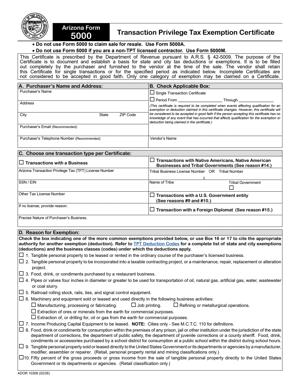
Form ADOR 10308 – Transaction Privilege Tax Exemption Certificate
Fill out nowJurisdiction: Country: United States | Province or State: Arizona
Form ADOR 10308 – Transaction Privilege Tax Exemption Certificate is a document used in Arizona to claim an exemption from transaction privilege tax on certain purchases. If you are about to complete this form, you are likely buying goods or services that qualify for a tax exemption under state law.
In Arizona, a transaction privilege tax is imposed on the seller for the privilege of doing business in the state. However, the seller may pass that cost on to the buyer. This certificate allows a buyer to state that a particular purchase qualifies for an exemption.
You complete this form to certify that the transaction meets specific exemption rules. The seller keeps the document in their records as proof of why the tax was not collected.
Understanding how this form works helps you avoid mistakes that could lead to tax being charged later, penalties, or disputes with the seller. It is important to complete it carefully and accurately.
What is Form ADOR 10308 – Transaction Privilege Tax Exemption Certificate?
Clear definition
Form ADOR 10308 – Transaction Privilege Tax Exemption Certificate is a written certification that a buyer provides to a seller to claim an exemption from Arizona transaction privilege tax on a specific purchase. It states the legal reason why tax does not apply.
The form identifies the buyer, the seller, and the type of exemption being claimed. It also requires the buyer to affirm that the information is true and correct. By signing it, you are declaring that the purchase qualifies under Arizona tax law.
This document does not eliminate tax automatically. Instead, it provides documentation that supports why the tax was not collected on the transaction.
Who typically uses this form?
Buyers who are purchasing goods for resale often use this form. Retailers, wholesalers, and distributors commonly complete it when buying inventory.
Businesses that qualify for specific statutory exemptions also use the form. This may include manufacturers purchasing certain machinery or equipment, or organizations claiming an exemption under a specific category allowed by law.
Government entities, qualifying nonprofit organizations, and certain contractors may also use the certificate in limited circumstances. The key factor is that the purchase must meet an exemption recognized under Arizona transaction privilege tax rules.
Sellers receive and retain the completed certificate. They rely on it to justify not charging tax on the transaction.
Why might you need this form?
You may need this form if a seller asks for documentation before agreeing not to charge tax. Sellers are responsible for correctly handling transaction privilege tax. Without proper documentation, they may choose to charge tax to protect themselves.
Providing the completed certificate gives the seller written support for treating the sale as exempt. It becomes part of their tax records.
You might also need this form if you regularly purchase goods that are resold in the normal course of business. In that case, you can provide the certificate once, and it may apply to future qualifying purchases from that seller.
If you are making a one-time purchase that qualifies for exemption, this form allows you to document the reason at the time of sale.
Typical real-life scenarios
- You operate a retail store in Arizona and buy inventory from a wholesale supplier. Because you plan to resell the merchandise to customers, you complete the exemption certificate so the supplier does not charge transaction privilege tax on your inventory purchase.
- You run a manufacturing business and purchase equipment that qualifies under a specific manufacturing exemption. The seller requests documentation before processing the sale without tax. You provide the completed certificate identifying the applicable exemption category.
- You are a contractor purchasing materials for incorporation into a project where a specific exemption applies. The seller requires written certification to treat the sale as exempt. You complete the form with the correct exemption reason.
- You represent a qualifying organization making a purchase that falls within a statutory exemption. The seller asks for proof before removing tax from the invoice. The exemption certificate provides that written confirmation.
- In each of these situations, the form serves as documentation for the seller and a declaration from the buyer.
When would you use Form ADOR 10308 – Transaction Privilege Tax Exemption Certificate?
You would use Form ADOR 10308 – Transaction Privilege Tax Exemption Certificate at the time of purchase, or before completing a transaction, when you intend to claim an exemption from Arizona transaction privilege tax.
The form is typically provided to the seller before or at the time the sale occurs. Some sellers require it before processing an order. Others may accept it shortly after the sale, depending on their internal policies.
If you have an ongoing relationship with a supplier, you may provide the certificate once to cover future qualifying purchases. In those cases, the seller keeps it on file and applies the exemption to later transactions that meet the stated criteria.
If your business activities change, or if you begin purchasing different types of items, you may need to submit a new certificate reflecting the correct exemption category.
Buyers are responsible for ensuring that the exemption applies to the specific transaction. Sellers rely on the information you provide when deciding whether to collect tax.
Legal characteristics of Form ADOR 10308 – Transaction Privilege Tax Exemption Certificate
This certificate functions as a written statement made by the buyer. It identifies the exemption being claimed and confirms that the purchase qualifies under Arizona law.
For the form to be effective, it generally must be complete and accurate. This includes providing the buyer’s legal name, address, and any required identification numbers, along with the specific exemption category. The form must be signed and dated.
Incomplete information is a common cause of rejection. If required fields are missing or if the exemption category is unclear, a seller may refuse to accept the certificate. Errors in registration numbers or business details can also create problems.
Another issue arises when the claimed exemption does not match the nature of the purchase. For example, claiming a resale exemption for items that will be used rather than resold can create tax exposure later. Sellers may later be assessed tax if the exemption was not valid.
The form does not replace any registration requirements. If a business must be registered with the Arizona Department of Revenue for transaction privilege tax purposes, this certificate does not serve as that registration.
It also does not determine eligibility by itself. The document is evidence of a claim. Whether the exemption applies depends on the facts of the transaction and the relevant tax rules.
Tax rules may change over time. Exemptions can be added, modified, or removed by legislation. The certificate reflects current exemption categories but does not guarantee that every purchase fits within them.
Is it legally binding?
Yes, in the sense that you are making a formal declaration. By signing the certificate, you are stating that the information is true and that the purchase qualifies for the claimed exemption.
The seller relies on your signed statement when deciding not to collect tax. If the information is false or incorrect, tax, interest, or penalties may be assessed later. The legal effect comes from your written certification and signature.
However, the form is not a contract between you and the state. It does not create new rights or obligations beyond those already established under Arizona tax law. It documents how an existing rule applies to a specific transaction.
The binding nature of the form relates to the accuracy of your statements. Signing it means you accept responsibility for the claim you are making about the tax treatment of the purchase.
How to fill out Form ADOR 10308 – Transaction Privilege Tax Exemption Certificate
Step 1 – Enter the buyer’s legal name and business information
Begin by writing the full legal name of the individual or business claiming the exemption. Use the exact name under which the business operates or is registered. Provide the business address, including street, city, state, and ZIP code. Make sure this information matches your official records.
Step 2 – Provide the buyer’s tax identification details
Enter any required transaction privilege tax license number or other identification number requested on the form. Double-check the number for accuracy. Errors in this field are a common reason for questions or rejection.
Step 3 – Identify the seller
Write the name and address of the seller from whom you are purchasing goods or services. This ensures the certificate is tied to a specific vendor. If the certificate is intended to apply to ongoing purchases, confirm that the seller’s information is complete and correct.
Step 4 – Select the type of exemption being claimed
Review the list of exemption categories provided on the form. Mark the box or line that matches the reason your purchase qualifies for exemption. Choose the category that most accurately describes the transaction. The exemption you select must align with how the goods or services will actually be used.
Step 5 – Describe the property or services being purchased
If the form includes a space to describe the items, provide a clear and specific description. For example, indicate whether the purchase consists of resale inventory, manufacturing equipment, or another qualifying category. Avoid vague terms. The description should support the exemption you selected.
Step 6 – Indicate whether the certificate is for a single transaction or blanket use
Some versions of the form allow you to state whether the certificate applies to one specific purchase or to ongoing purchases. Mark the appropriate option. If you choose blanket use, ensure that future purchases will consistently meet the exemption requirements.
Step 7 – Review the declaration statement carefully
Before signing, read the certification language near the signature line. This section confirms that the information is accurate and that the purchase qualifies for exemption. Make sure you understand what you are affirming. Confirm that all earlier sections are complete.
Step 8 – Sign and date the form
Sign your name in the designated area. If you are signing on behalf of a business, include your title or capacity if requested. Enter the date of signature. The date should reflect when you are making the certification, typically at or before the time of purchase.
Step 9 – Provide the completed certificate to the seller
Deliver the signed form to the seller according to their preferred method. Keep a copy for your records. The seller will retain the certificate as documentation supporting the tax-exempt treatment of the transaction.
Legal terms you might encounter in Form ADOR 10308 – Transaction Privilege Tax Exemption Certificate
- Transaction Privilege Tax (TPT): This is Arizona’s tax on the privilege of doing business in the state. It is imposed on the seller, not the buyer, but sellers often pass the cost on to customers. This form allows the seller to treat certain sales as exempt from TPT based on your certification.
- Exemption Certificate: A written statement from a buyer claiming that a purchase is not subject to tax. In this document, you certify that your purchase qualifies under a specific exemption category. The seller relies on this certificate to avoid charging tax.
- Gross Receipts: The total amount a business receives from sales before deducting expenses. TPT is calculated based on gross receipts. When you provide this certificate, the seller may exclude the exempt sale from taxable gross receipts.
- Blanket Certificate: A certificate that applies to multiple purchases over time. Instead of completing a new document for every transaction, you can indicate that the exemption covers all qualifying purchases until revoked. This increases your responsibility to ensure every purchase truly qualifies.
- Single Transaction Certificate: A certificate used for one specific sale. It applies only to the transaction described on the form. You would use this option if you rarely make exempt purchases from the seller.
- Resale Exemption: An exemption that applies when you purchase items for resale in the ordinary course of business. You are not the final consumer. You must intend to resell the items without using them personally or in your business operations.
- Qualifying Use: The specific legal reason that makes a purchase exempt. This could relate to resale, manufacturing, agriculture, or other statutory categories. You must accurately select and describe the qualifying use on the form.
- Good Faith Acceptance: A legal standard that protects the seller when they reasonably rely on your completed certificate. If the seller accepts the document in good faith, they may not be liable for uncollected tax. That puts pressure on you to provide accurate information.
- Tax Identification Number (TIN): A number used to identify your business for tax purposes. You may need to provide a TPT license number or another identifying number. This helps confirm that you are a legitimate business claiming the exemption.
- Audit: A review conducted by tax authorities to verify compliance. During an audit, this document may be examined to confirm that exempt purchases were properly documented. Incomplete or incorrect certificates can lead to tax assessments.
FAQs
What happens if I leave out my tax identification number?
If you omit your tax identification number, the seller may refuse to accept this document. The seller needs enough information to show they accepted it in good faith. Without your identifying number, the exemption claim may look incomplete, and the seller may charge tax or request a corrected form before processing the sale.
Do I send Form ADOR 10308 – Transaction Privilege Tax Exemption Certificate to the state?
No. You give this form directly to the seller. The seller keeps it in their records to justify not charging tax. You should not mail it to the tax agency unless specifically requested during an audit or review.
Can I use this document for both resale and another exemption at the same time?
You can only claim exemptions that truly apply to the purchase described. If a single purchase qualifies under more than one category, you must clearly indicate the correct reason and ensure your description matches the exemption selected. Mixing categories without explanation can cause confusion and rejection.
What if I realize after signing that I selected the wrong exemption type?
You should correct the error immediately. Contact the seller, explain the mistake, and provide a new, properly completed certificate. Do not rely on a verbal correction. The seller needs a clear written document in their files.
When does the exemption become effective?
The exemption is effective as of the date you sign the form, unless you specify otherwise and the seller agrees. It generally applies to purchases made on or after that date. It does not automatically apply retroactively to earlier sales unless the seller is willing and able to adjust prior invoices.
Who is allowed to sign this form?
An authorized person for the business must sign. This could be the owner, an officer, a manager, or someone with delegated authority. The signer confirms under penalty that the information is true, so it should not be signed by someone without knowledge of the purchase purpose.
What records should I keep after submitting the Form ADOR 10308 – Transaction Privilege Tax Exemption Certificate?
Keep a copy of the signed certificate and copies of related invoices. You should also maintain internal records showing how the purchased items were used or resold. These records help prove that your exemption claim was accurate if questioned later.
What if the seller refuses to accept this form?
A seller is not required to accept an incomplete or questionable certificate. If they believe the claim does not meet legal standards, they may charge tax. You can ask what information is missing and provide clarification or additional documentation to support your exemption claim.
Checklist: Before, During, and After Form ADOR 10308 – Transaction Privilege Tax Exemption Certificate
Before
- Confirm your business is properly registered and has a valid tax identification number.
- Verify that the purchase qualifies for a specific exemption category.
- Review your intended use of the items to ensure they are not for personal or internal business consumption.
- Gather accurate legal business name and address information.
- Determine whether you need a single transaction or a blanket certificate.
- Identify the authorized person who will sign the form.
- Check prior certificates on file with the seller to avoid duplication.
During
- Enter your legal business name exactly as registered.
- Provide the correct tax identification or license number.
- Clearly identify the seller’s name and address.
- Select the precise exemption category that applies.
- Describe the property or services in enough detail to match the exemption.
- Indicate whether the certificate covers one sale or multiple future sales.
- Review every field for accuracy and completeness.
- Sign and date the form with the authorized signature.
After
- Deliver the completed certificate directly to the seller.
- Request confirmation that the seller has accepted it.
- Keep a signed copy in your tax records.
- Attach related purchase orders and invoices to your copy.
- Monitor invoices to confirm tax is not being charged in error.
- Update your internal accounting system to reflect exempt purchases.
- Review the certificate periodically to ensure it remains accurate.
- Revoke or replace the certificate if your business activities change.
Common mistakes to avoid with Form ADOR 10308 – Transaction Privilege Tax Exemption Certificate
- Mistake: Claiming a resale exemption for items you actually use in your business, which happens when owners misunderstand “resale,” leading to back taxes and penalties, so do not forget to confirm the items will be resold without use.
- Mistake: Using a trade name instead of the registered legal name, which occurs due to branding habits, causing mismatches in records and possible rejection, so do not forget to match the name to your official registration.
- Mistake: Leaving required fields blank because they seem minor, resulting in seller refusal or audit exposure, so do not forget to complete every applicable line.
- Mistake: Selecting the wrong exemption category due to rushing through the form, which can invalidate the certificate, so do not forget to read each exemption description carefully.
- Mistake: Forgetting to indicate whether the certificate is single-use or blanket, creating confusion about its scope, so do not forget to clearly check or mark the correct option.
- Mistake: Allowing an unauthorized employee to sign, which may invalidate the document during review, so do not forget to ensure the signer has proper authority and knowledge.
- Mistake: Failing to update or revoke a blanket certificate after business activities change, which can lead to improper untaxed purchases, so do not forget to reassess your exemption status regularly.
- Mistake: Not keeping a copy of the signed certificate, which often happens during busy transactions and leaves you without proof during an audit, so do not forget to store organized copies.
What to do after filling out Form ADOR 10308 – Transaction Privilege Tax Exemption Certificate
Once you complete the form, your job is not finished. You need to manage the exemption properly going forward. The seller relies on your certification. You remain responsible for using it correctly.
Start by confirming delivery. Do not assume the seller received or processed it.
- Step 1: Make a clear copy of the signed form for your records before sending it.
- Step 2: Deliver the certificate to the seller using their preferred method, such as in person or by secure electronic transmission.
- Step 3: Ask the seller to confirm acceptance in writing or by updated invoice.
- Step 4: Review your next invoice to ensure tax was not charged if the exemption applies.
- Step 5: Attach the certificate copy to related contracts, purchase orders, and invoices in your records.
- Step 6: Update your accounting system to categorize these purchases as exempt.
- Step 7: Train staff responsible for purchasing so they understand when the exemption applies and when it does not.
- Step 8: Monitor your use of the purchased items to ensure they match the qualifying purpose stated on the form.
- Step 9: Schedule a periodic internal review of all blanket certificates you have issued.
- Step 10: Immediately issue a revised certificate if your business structure, tax ID, or exempt purpose changes.
You should also think ahead. If you stop qualifying for the exemption, notify the seller in writing. Do not continue using an outdated certificate. That can create tax exposure for both you and the seller.
Organized recordkeeping is your best protection. Keep certificates and supporting documents together, labeled by vendor. If an audit occurs, you want to quickly show that each exempt purchase was properly documented and used as certified.
Finally, treat this document as part of your overall tax compliance system. It is not just paperwork. It is a formal statement that affects how taxes are collected and reported. Careful handling now can prevent costly corrections later.
Disclaimer: This guide is provided for informational purposes only and is not intended as legal advice. You should consult a legal professional.