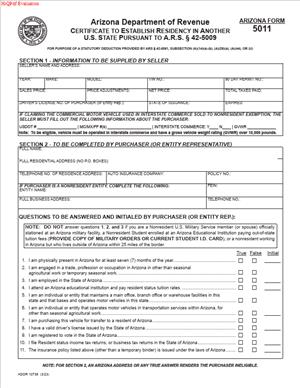
Form 511 – Certificate to Establish Residency in Another U.S. State Pursuant to A.R.S. § 42-5009
Fill out nowJurisdiction: Country: United States | Province or State: Arizona
Form 511 – Certificate to Establish Residency in Another U.S. State Pursuant to A.R.S. § 42-5009 is a document used to confirm that you have established residency outside Arizona. It is typically connected to tax matters. If you are moving or have already moved, this form helps document that change.
You may come across this form when you are updating your residency status for state tax purposes. It is often part of a larger process involving income reporting, vehicle registration, or business activity. The goal is to formally state that your primary residence is now in another state.
This document matters because residency affects how you are taxed. States generally tax residents on all income, even income earned elsewhere. If you are no longer an Arizona resident, you may need a way to show that your residency has changed.
If you are filling this out, you likely want clarity. You want to know what it does, what information it asks for, and how to complete it correctly. This guide walks you through the form in plain language so you understand what you are signing and why.
What is Form 511 – Certificate to Establish Residency in Another U.S. State Pursuant to A.R.S. § 42-5009?
Clear definition
Form 511 – Certificate to Establish Residency in Another U.S. State Pursuant to A.R.S. § 42-5009 is a written certification that you have established legal residency in a state other than Arizona. It is a formal statement made to the Arizona Department of Revenue.
By signing this document, you are declaring that your domicile, or permanent home, is now outside Arizona. Domicile generally refers to the place you intend to remain and return to. It is more than a temporary stay.
The form creates a record of your claimed change in residency. It is not just a casual notice. It is an official filing that may be used to evaluate your tax status.
Who typically uses this form?
This form is often used by individuals who previously lived in Arizona but have moved to another state. That can include retirees, employees who accepted a job elsewhere, military families relocating, or business owners shifting operations.
It may also be used by people who split time between states. If you maintain connections in Arizona but consider another state your primary residence, this form can help clarify your position.
In some cases, high-income earners or remote workers use this form when changing their domicile for tax reasons. The document supports their claim that they are no longer Arizona residents.
Why might you need this form?
You may need this form if Arizona questions your residency status. Residency affects whether the state can tax your full income. If the state believes you are still a resident, it may expect you to file and pay taxes as one.
Submitting this form can help show that you have taken concrete steps to establish residency elsewhere. It provides a written record tied to your identity and signature.
You might also use the form when filing part-year or nonresident tax returns. The document can support your position if your residency changed during the year.
In some situations, the form may be requested as part of a review or audit. It serves as part of the evidence showing that your permanent home is now outside Arizona.
Typical real-life scenarios
- You accept a job in another state and move there permanently. You sell your Arizona home, register your vehicle in the new state, and obtain a new driver’s license. To formalize your status, you complete this form.
- You retire and relocate to be closer to family. Although you still own property in Arizona, your main residence and daily life are now elsewhere. You use the form to document that change in domicile.
- You operate a business that relocates its headquarters to another state. You move your personal residence as well. The form helps reflect that both your personal and professional bases have shifted.
- You previously lived in Arizona but now spend most of your time in another state and intend to remain there. Even if you visit Arizona occasionally, you complete the form to confirm that your permanent home is no longer in Arizona.
When would you use Form 511 – Certificate to Establish Residency in Another U.S. State Pursuant to A.R.S. § 42-5009?
You would generally use Form 511 – Certificate to Establish Residency in Another U.S. State Pursuant to A.R.S. § 42-5009 when you have established a new domicile outside Arizona and need to formally state that fact. Timing often aligns with a move, a change in employment, or a significant life event.
This form is commonly used during a tax year in which your residency status changes. For example, you may have lived in Arizona for part of the year and then moved permanently. The filing can help explain that transition.
It may also be used if there is uncertainty about your residency. If you maintain ties to Arizona, such as property or business interests, but claim another state as your domicile, the form can clarify your intent.
Certain taxpayers with complex financial situations use the form when residency has tax implications. This can include individuals with investment income, remote work arrangements, or income sourced from multiple states.
The form is typically completed by the individual whose residency is at issue. In some cases, married couples may each need to consider their own residency status, depending on how their living arrangements and filings are structured.
Legal characteristics of Form 511 – Certificate to Establish Residency in Another U.S. State Pursuant to A.R.S. § 42-5009
This document is a formal certification. Its effectiveness depends on accuracy and truthfulness. You are making a declaration about your domicile, which is a legal concept tied to intent and physical presence.
For the form to be effective, it generally must be complete, signed, and submitted in the required manner. Missing information, inconsistent dates, or unsigned sections can delay processing or reduce its value as evidence.
Common problems arise when the information on the form conflicts with other records. For example, if you claim residency in another state but continue to hold an Arizona driver’s license or claim homeowner benefits in Arizona, those facts may raise questions.
Residency rules can differ from state to state. One state’s definition of domicile may not perfectly match another’s. The form reflects Arizona’s legal framework, but your new state may have its own requirements for establishing residency.
This form does not automatically change your residency by itself. It records your declaration. Your overall facts and circumstances typically determine whether a residency change is recognized.
Is it legally binding?
When you sign this form, you are making a formal statement to a state agency. In that sense, it carries legal weight. False or misleading statements on government filings can have consequences.
The form is binding as a certification of what you claim to be true at the time of signing. It can be used as evidence of your stated intent and residency status. However, it does not override factual realities.
If the underlying facts do not support your claim of residency in another state, the form alone may not control the outcome. Agencies often look at the total picture, including where you live, work, and maintain personal ties.
In practical terms, the document is an important part of establishing your position. Its strength depends on consistency with your actions and other records.
How to fill out Form 511 – Certificate to Establish Residency in Another U.S. State Pursuant to A.R.S. § 42-5009
Step 1 – Review the form and instructions
Start by reading the entire document before writing anything. Note what information is requested and how the certification is worded. Pay attention to any definitions included on the form, especially terms like domicile or residency.
This overview helps you understand what you are declaring. It also reduces the chance of errors or omissions.
Step 2 – Provide your identifying information
Enter your full legal name exactly as it appears on your tax records. Include any additional identifying details requested, such as your Social Security number or taxpayer identification number.
Make sure this information matches your other filings. Inconsistent names or numbers can cause delays or questions.
Step 3 – State your former Arizona address
List your last residential address in Arizona. This establishes the location you are leaving. Include the full street address, city, state, and ZIP code as requested.
Accuracy here is important because it ties your residency history to a specific property and timeframe.
Step 4 – Provide your new out-of-state address
Enter your current residential address in the new state. This should reflect your primary home. Use the complete address, including apartment or unit number if applicable.
The address supports your claim that you have established residency elsewhere. It should align with other records, such as your driver’s license or voter registration.
Step 5 – Indicate the date you established new residency
Specify the date you consider your residency in the new state to have begun. This is often the date you physically moved with the intent to remain there.
Choose the date carefully. It may affect how income is treated for the year and how your tax filings are structured.
Step 6 – Confirm your intent to establish domicile elsewhere
The form typically includes a certification statement about your intent to make the new state your permanent home. Read this language closely before signing.
By completing this section, you are affirming that you do not intend to maintain Arizona as your domicile. Ensure that this reflects your actual situation.
Step 7 – Review for consistency and completeness
Before signing, review every section. Check spelling, dates, and numbers. Confirm that the timeline makes sense and does not conflict with other documents.
Look at the form as a whole. Ask whether it clearly tells the story of your move and new residency.
Step 8 – Sign and date the certification
Sign the form in the space provided. Use your usual legal signature. Enter the date of signing.
Your signature finalizes the certification. Once signed, the document represents your formal declaration of residency outside Arizona.
Legal terms you might encounter in Form 511 – Certificate to Establish Residency in Another U.S. State Pursuant to A.R.S. § 42-5009
- Domicile: This is your true, fixed, and permanent home. It is the place you intend to return to after any temporary absences. On this form, you confirm that your domicile has changed from Arizona to another state.
- Residency: Residency refers to where you live for legal and tax purposes. You may have multiple residences, but only one domicile. This document records your claim that you are no longer an Arizona resident for tax purposes.
- Effective Date: This is the exact date you established residency in another state. The form requires you to state this clearly. That date affects how your tax obligations are calculated.
- A.R.S. § 42-5009: This is the Arizona statute that authorizes the certificate. It provides the legal framework for formally declaring that you established residency outside Arizona. The form references this statute to show it is grounded in state law.
- Certification: A certification is a written statement you declare to be true. When you sign this form, you certify under penalty that the information is accurate. False statements can lead to penalties.
- Perjury: Perjury means knowingly making a false statement under oath. The signature section may reference penalties similar to perjury. This reinforces that the information you provide must be truthful.
- Principal Residence: This is your main home. It is the address where you live most of the time and consider your primary dwelling. You will list your new principal residence outside Arizona.
- Tax Liability: Tax liability is the amount of tax you owe. Your residency status directly affects whether Arizona can tax your income. This document helps clarify when your Arizona tax liability may have ended.
- Declaration of Intent: This is your written statement that you intend to permanently reside in another state. Intent matters in residency determinations. The form captures that intent in clear language.
- Affirmation: An affirmation is a formal confirmation that what you state is true. It carries legal weight even if you are not physically in a courtroom. Your signature functions as an affirmation.
FAQs
Do I need to file Form 511 – Certificate to Establish Residency in Another U.S. State Pursuant to A.R.S. § 42-5009 if I already changed my driver’s license?
Changing your driver’s license helps show you moved, but it does not automatically update your tax residency record. This form serves as a formal declaration to the Arizona Department of Revenue. If you want a clear record of the date you established residency elsewhere, you should complete this document even if other agencies have already updated your information.
What date should I enter as my effective date of new residency?
You should enter the date you actually established your new domicile. That is usually the day you moved to your new principal residence with the intent to remain there. Use a specific calendar date, not just a month or year, and make sure it matches the timeline reflected in your tax return and other records.
Do I need to attach proof of my new address?
This document itself is a certification, so you are declaring the information as true. However, you should be prepared to support your statement if asked. Keep documents that show your new address, such as a lease, deed, or utility account, even if you are not required to attach them at the time of filing.
What happens after I submit this form?
After submission, the department reviews it and updates your residency status in its records. This affects how your tax account is viewed going forward. It does not automatically change prior tax filings, so you should make sure your tax returns reflect the same effective date you listed on this document.
Can I use this form if I am splitting time between two states?
This form is meant to establish that you have moved out of Arizona. If you maintain strong ties to Arizona and treat it as your permanent home, filing this document may not reflect your true situation. You should only complete it if you have clearly established a new primary residence in another state.
What if the name on this document does not match my most recent tax return?
Your name should match the name on your Arizona tax account. If your name changed due to marriage, divorce, or another legal reason, make sure the department has that update on record. Inconsistent names can delay processing or cause confusion about your identity.
Does filing this form automatically stop Arizona from taxing my income?
Filing Form 511 – Certificate to Establish Residency in Another U.S. State Pursuant to A.R.S. § 42-5009 does not by itself eliminate tax obligations. It documents the date you claim to have established residency elsewhere. Arizona may still tax income earned in the state after that date, so your tax return must accurately report Arizona-source income.
Can I correct this form if I realize I made a mistake?
If you discover an error after filing, act quickly. You may need to submit a corrected version of the document with a clear explanation. Make sure the corrected information aligns with your tax filings and any other official records to avoid inconsistencies.
Checklist: Before, During, and After Form 511 – Certificate to Establish Residency in Another U.S. State Pursuant to A.R.S. § 42-5009
Before
- Confirm the exact date you moved and established your new domicile.
- Gather your Arizona address and your new out-of-state address.
- Review your recent Arizona tax return for consistency.
- Check that your name and identifying number match your tax records.
- Make sure you truly intend your new state to be your permanent home.
- Collect documents that support your move, even if you will not attach them.
- Read the full form to understand the certification language.
During
- Print or type your full legal name clearly.
- Enter your Arizona address exactly as it appeared before your move.
- Provide your complete new address, including unit number if applicable.
- Write the specific effective date of your new residency.
- Review each statement carefully before signing.
- Ensure all required fields are filled in.
- Sign and date the form in the correct place.
- Double-check spelling and numbers for accuracy.
After
- Make a complete copy for your records.
- Store the copy with your tax documents.
- Submit the form using the accepted method.
- Monitor your mail for confirmation or follow-up requests.
- Verify that your next Arizona tax filing reflects the same effective date.
- Keep proof of mailing or submission.
- Update other agencies or institutions as needed.
- Maintain records showing your ongoing ties to your new state.
Common mistakes to avoid with Form 511 – Certificate to Establish Residency in Another U.S. State Pursuant to A.R.S. § 42-5009
- Mistake: Using the wrong effective date because you guessed or rounded to the first of the month; this happens when you do not check your moving records, and it can create inconsistencies with your tax return, so do not forget to confirm the exact date you established your new domicile.
- Mistake: Leaving sections blank because they seem unimportant; this often occurs when you rush, and it may delay processing or cause rejection, so do not forget to complete every required field.
- Mistake: Signing without reading the certification language; this happens when you assume it is routine, but you are making a legal declaration, so do not forget to review the statements carefully before signing.
- Mistake: Providing an address that is temporary rather than your principal residence; this can occur if you move in stages, and it may undermine your claim of permanent relocation, so do not forget to list your true primary home.
- Mistake: Failing to keep a copy; this happens when you submit the only signed version, and you may need proof later, so do not forget to retain a complete copy for your records.
- Mistake: Assuming this document automatically updates all government agencies; people often believe one filing covers everything, but it only updates the tax authority’s records, so do not forget to notify other agencies separately.
- Mistake: Using a nickname or shortened name; this can create mismatches with your tax account, so do not forget to use your full legal name as it appears on official records.
- Mistake: Ignoring follow-up correspondence; this happens when you think the matter is closed, and it can leave your status unresolved, so do not forget to respond promptly if additional information is requested.
What to do after filling out Form 511 – Certificate to Establish Residency in Another U.S. State Pursuant to A.R.S. § 42-5009
Once you complete the form, pause before sending it. Review every entry one more time. Make sure the effective date, your name, and both addresses are consistent with your tax records and other official documents.
You want a clean paper trail. Residency issues often come down to documentation. Clear, consistent records protect you if questions arise later.
- Step 1: Make at least one full copy of the signed form for your personal records.
- Step 2: Confirm the correct submission method, whether by mail or other accepted delivery option.
- Step 3: If mailing, use a method that provides proof of delivery.
- Step 4: Keep the mailing receipt or confirmation with your copy of the form.
- Step 5: Mark your calendar with the submission date.
- Step 6: Watch for written confirmation or any follow-up request for additional information.
- Step 7: Review your next Arizona tax return to ensure it reflects the same effective date of nonresidency.
- Step 8: Retain supporting documents that show your move, such as housing and utility records.
- Step 9: Update your address with financial institutions and other relevant entities to maintain consistency.
- Step 10: Store all related paperwork together in your permanent tax file.
Consistency is key. Your tax filings, addresses, and residency declaration should all tell the same story. If you later discover an inconsistency, address it promptly rather than waiting for a notice.
Keep your records long-term. Questions about residency can arise years later, especially if income was earned in multiple states. Having a complete file makes it easier to respond confidently and accurately.
Disclaimer: This guide is provided for informational purposes only and is not intended as legal advice. You should consult a legal professional.