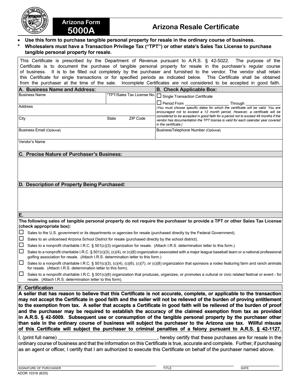
Form 5000A – Arizona Resale Certificate
Fill out nowJurisdiction: Country: United States | Province or State: Arizona
Form 5000A – Arizona Resale Certificate is a tax document used in Arizona when a business buys items for resale. It allows the buyer to purchase goods without paying transaction privilege tax at the time of purchase. Instead, the tax is collected later when the goods are sold to the final customer.
If you are filling out this form, you are likely buying products that you plan to resell in the ordinary course of your business. The form is given to your supplier, not filed with a court. It serves as written proof that your purchase qualifies as a resale transaction.
This document matters because it affects how taxes are handled. Without it, a seller may charge you tax. That increases your costs and can complicate your accounting.
Understanding what the form does and how to complete it correctly helps you avoid delays, rejected certificates, or tax disputes later.
What is Form 5000A – Arizona Resale Certificate?
Clear definition
Form 5000A – Arizona Resale Certificate is a written statement provided by a purchaser to a seller. In the document, the purchaser certifies that the goods being bought are intended for resale in the regular course of business.
Arizona uses a transaction privilege tax system. This form supports the seller’s claim that a sale is exempt from tax at the wholesale level. The seller keeps the certificate as part of their records.
The form typically includes the buyer’s business name, address, tax identification information, and a description of the property being purchased for resale.
Who typically uses this form?
Retailers commonly use this form when buying inventory from wholesalers. For example, a clothing store purchasing shirts from a distributor may provide the certificate to avoid paying tax on that wholesale purchase.
Wholesalers and manufacturers may also use it when buying component parts that will become part of products they sell. In some situations, contractors, dealers, or other businesses that resell tangible personal property may use it as well.
The seller is also an important party. Although the buyer completes the form, the seller relies on it to justify not charging tax on the transaction.
Why might you need this form?
You may need this form if you are buying goods strictly for resale. Without it, your supplier may treat the transaction as a taxable retail sale.
Using the certificate can prevent double taxation. Tax is generally meant to apply once, when the final consumer buys the item. The resale certificate helps ensure tax is collected at that final stage.
It also protects the seller. If the state later reviews the seller’s records, the certificate helps show why tax was not charged on a specific sale.
Typical real-life scenarios
- You operate a small electronics shop in Arizona. You order smartphones and accessories from a distributor. Because you plan to sell these items directly to customers, you provide a resale certificate so the distributor does not charge tax on the wholesale purchase.
- You run an online store based in Arizona and purchase inventory from a local supplier. Even though your customers may be located in different places, your purchase from the supplier qualifies as a resale transaction. The certificate documents that purpose.
- You own a furniture showroom. You buy sofas and tables from a manufacturer. Since you are not using the furniture in your business but instead reselling it, you give the manufacturer a completed resale certificate.
- You manage a business that assembles gift baskets. You buy packaged food items and small goods that will be included in baskets sold to customers. In many cases, you may provide a resale certificate for those component items because they are part of products you intend to sell.
When would you use Form 5000A – Arizona Resale Certificate?
You use Form 5000A – Arizona Resale Certificate at the time you purchase goods for resale. It is generally provided to the seller before or at the time of the transaction. Some sellers keep it on file for ongoing purchases, while others may require a new certificate for different types of goods.
This form is used in business-to-business transactions. It is not typically used by individual consumers buying items for personal use. The key factor is your intent to resell the property in the regular course of your business operations.
If you change how you use the items after the purchase, the tax treatment may also change. For example, if goods purchased for resale are later used by your business instead of being sold, that may affect how tax applies. The form is tied to your stated purpose at the time of purchase.
Businesses that frequently reorder the same type of inventory may provide a resale certificate once and have it apply to future purchases of similar property. In other situations, sellers may request updated information periodically to ensure the certificate remains accurate.
Legal characteristics of Form 5000A – Arizona Resale Certificate
This form functions as a certification. By signing it, you are declaring that the items purchased are intended for resale. The seller relies on your statement to treat the sale as exempt from transaction privilege tax at that stage.
For the certificate to be effective, it generally must be completed fully and accurately. Missing information, incorrect tax identification numbers, or vague descriptions of the property can cause problems. A seller may refuse to accept an incomplete form.
The form must be signed by an authorized person. This is usually an owner, officer, or other individual with authority to bind the business. An unsigned certificate typically does not provide protection to the seller.
If the information provided is false or misleading, the consequences may extend beyond a simple tax adjustment. The certification represents your business’s official position regarding the nature of the purchase.
While many states have resale certificates, each state has its own version and rules. Arizona’s form is specific to its transaction privilege tax system. A certificate from another state may not automatically apply to purchases made in Arizona.
It is also important to understand what the form does not do. It does not register your business. It does not replace a business license. It does not calculate or pay tax. It is simply documentation supporting the tax treatment of a specific type of transaction.
Is it legally binding?
Yes, the certification you make on this form is legally significant. When you sign it, you are making a formal statement about how the purchased goods will be used.
The seller may rely on your signed statement to avoid charging tax. If the statement is incorrect, tax liability may be reassessed later. The binding nature of the form comes from the representation you make and the seller’s reliance on it.
However, the form itself is not a contract in the traditional sense. It does not create an agreement about price, delivery, or warranties. Its legal effect relates to tax treatment and recordkeeping.
Its enforceability generally depends on accurate completion, proper signature, and use in a qualifying resale transaction. If those elements are missing, its protective value may be limited.
How to fill out Form 5000A – Arizona Resale Certificate
Step 1 – Enter the purchaser’s business information
Begin by providing your full legal business name. Use the name that matches your tax registration and official records. Include your business address, including street, city, state, and ZIP code.
If the form requests a transaction privilege tax number or similar identification number, enter it exactly as assigned. Double-check for accuracy. Errors in this section are a common cause of rejection.
Step 2 – Identify the seller
Write the name and address of the seller or vendor to whom you are giving the certificate. This ensures the document clearly applies to that specific supplier.
If you plan to use the certificate for ongoing purchases from the same seller, confirm that the seller allows a blanket certificate covering multiple transactions.
Step 3 – Describe the property being purchased for resale
Provide a clear description of the type of tangible personal property you are buying. The description should be specific enough to show that the goods are part of your resale inventory.
Avoid overly broad language. Instead of stating “various goods,” describe the category, such as “retail clothing inventory” or “electronic accessories for resale.” The goal is to match the description to your business activities.
Step 4 – Certify the resale purpose
Read the certification statement carefully. This section confirms that the property is being purchased for resale in the ordinary course of your business.
By completing this section, you are affirming your intent. Ensure that the intended use matches your actual business operations.
Step 5 – Sign and date the form
An authorized individual must sign the document. This may be the owner, a corporate officer, or another person with authority to act on behalf of the business.
Print the signer’s name and title if the form requests it. Add the date of signature. The date helps establish when the certification became effective.
After signing, provide the completed document to the seller. The seller typically keeps it in their records to support the tax treatment of your purchase.
Legal terms you might encounter in Form 5000A – Arizona Resale Certificate
- Resale: Resale means you are buying tangible personal property with the intent to sell it again in the ordinary course of your business. On this form, you certify that the items you are purchasing are not for your own use but for resale to your customers. The resale purpose is the core reason the seller does not charge transaction privilege tax on the sale to you.
- Tangible Personal Property: This refers to physical items you can see, touch, and move. The form applies to purchases of tangible goods, not services. You must ensure that what you are buying qualifies as tangible personal property intended for resale.
- Transaction Privilege Tax (TPT): Arizona imposes a transaction privilege tax on businesses for the privilege of doing business in the state. Although customers often think of it as sales tax, it is technically a tax on the seller. This document allows the seller to treat your purchase as a tax-exempt resale transaction.
- TPT License Number: This is the registration number issued to your business when you are authorized to collect and report transaction privilege tax. You will typically provide this number on the certificate to show that you are a registered business. The number links your resale claim to your tax account.
- Purchaser: The purchaser is your business if you are the one buying the goods for resale. You must list your legal business name, address, and registration details exactly as they appear in your official records. Any mismatch can cause the seller to reject the certificate.
- Seller: The seller is the vendor providing the goods to you. The form identifies the seller by name and sometimes address. This ensures the certificate applies to purchases from that specific business.
- Good Faith Acceptance: Sellers must accept the certificate in good faith. That means they rely on the information you provide as truthful and complete. If the seller has reason to believe the purchase is not for resale, they may refuse to accept the certificate.
- Blanket Certificate: A blanket certificate covers multiple purchases over time from the same seller, rather than a single transaction. If the form is used as a blanket certificate, it remains on file with the seller and applies to future qualifying purchases. You must ensure your resale status remains accurate for as long as it is used.
- Authorized Signature: The authorized signature is the signature of someone with authority to bind the business. This may be the owner, a partner, an officer, or a manager with proper authority. Signing confirms that the information is correct and that the goods are for resale.
- Misuse of Certificate: Misuse occurs when you claim resale exemption for items that you actually use in your business or personally. The form warns that improper use can result in tax liability, penalties, and interest. You are responsible for paying the tax if the purchase does not qualify for resale.
FAQs
Do I need a TPT license before completing this document?
Yes. You should have an active transaction privilege tax registration before you claim resale. When you fill out this document, you are usually required to enter your TPT license number. If you do not yet have that number, the seller may refuse to accept the certificate and charge tax on your purchase.
Can I use one Form 5000A – Arizona Resale Certificate for all future purchases from the same seller?
You can generally use it as a blanket certificate if the seller agrees to keep it on file. That means it will apply to multiple purchases over time, as long as each purchase qualifies for resale. You should confirm that your business details and tax registration stay current, because any change may require you to provide an updated certificate.
What if I occasionally use some of the items instead of reselling them?
If you remove items from resale inventory and use them in your own business, you may owe tax on those items. This document only covers purchases intended for resale. You should track inventory carefully so you can report and pay any tax due on items that are diverted to personal or business use.
Does the seller file this form with the state?
In most cases, the seller keeps the certificate in their records and does not send it to a state agency. The seller relies on the certificate to justify not charging tax on your purchase. If audited, the seller must be able to produce the completed document as support for the exempt sale.
What information must match my business records exactly?
Your legal business name, business address, and TPT license number should match your official registration. Even small differences, like using a trade name without listing the legal name, can create confusion. You should review your tax registration documents before completing this form to ensure consistency.
Who is allowed to sign this form?
The signer must have authority to bind the business. This usually includes an owner, corporate officer, partner, or authorized manager. By signing, that person confirms that the purchases are for resale and that the information provided is accurate.
Can I use this certificate for services I plan to resell?
This form is generally designed for tangible personal property. If you are purchasing services, you must confirm whether those services qualify and whether a different certificate applies. You should review the nature of the transaction before claiming resale treatment.
What happens if the information in this document is wrong?
Incorrect or incomplete information can cause the seller to reject it or later assess tax. If the error is discovered during an audit, you may be responsible for unpaid tax, interest, and possible penalties. It is better to correct mistakes immediately and provide an updated certificate to the seller.
Checklist: Before, During, and After Form 5000A – Arizona Resale Certificate
Before
- Confirm that your business has an active TPT license.
- Verify your exact legal business name and address from official records.
- Gather your TPT license number and any supporting registration documents.
- Identify the seller’s correct legal name.
- Confirm that the items you plan to purchase qualify as tangible personal property for resale.
- Decide whether the certificate will apply to a single purchase or serve as a blanket certificate.
- Review your internal inventory tracking process to ensure resale items are properly recorded.
During
- Enter your legal business name exactly as registered.
- Provide your complete and accurate business address.
- Insert your correct TPT license number without transposing digits.
- Clearly identify the seller to whom you are giving the certificate.
- Describe the type of property being purchased for resale, if required.
- Review the certification language before signing.
- Ensure the authorized person signs and dates the form.
- Double-check that all fields are complete and legible.
After
- Provide the completed certificate directly to the seller.
- Keep a copy in your tax and accounting records.
- Confirm that the seller has accepted it and will not charge tax on qualifying purchases.
- Monitor your purchases to ensure they remain consistent with resale intent.
- Update the certificate if your business name, address, or license number changes.
- Train staff who handle purchasing on when the certificate can and cannot be used.
- Periodically review seller accounts to ensure tax is handled correctly.
Common mistakes to avoid with Form 5000A – Arizona Resale Certificate
- Mistake: Claiming resale for items you actually use in your business because it seems easier at checkout, which can lead to tax assessments, penalties, and interest later; do not forget to separate resale inventory from business-use supplies.
- Mistake: Entering an incorrect or outdated TPT license number due to copying errors, which may cause the seller to reject the form or invalidate the exemption; do not forget to verify the number against your registration.
- Mistake: Using a trade name without listing the legal entity name, which creates record mismatches and audit issues; do not forget to match the name exactly as it appears on your tax registration.
- Mistake: Allowing an unauthorized employee to sign the certificate, which can raise questions about validity; do not forget to ensure the signer has the authority to bind the business.
- Mistake: Forgetting to update the certificate after changing your address or business structure, which may invalidate the seller’s reliance on it; do not forget to provide a revised document when key details change.
- Mistake: Assuming the certificate covers all purchases automatically, including services or non-qualifying items, which can result in unpaid tax liability; do not forget to confirm each type of purchase qualifies for resale treatment.
- Mistake: Failing to keep a copy for your own records because the seller keeps the original, which leaves you without proof during an audit; do not forget to store a complete copy in your tax files.
- Mistake: Leaving sections blank or writing illegibly in a rush, which may cause rejection or confusion later; do not forget to review the entire form carefully before submission.
What to do after filling out Form 5000A – Arizona Resale Certificate
Once you complete the certificate, your job is not finished. You need to make sure it is properly delivered, accepted, and supported by your internal records.
- Step 1: Make a clear copy of the signed certificate for your own files.
- Step 2: Provide the original or a clean copy to the seller, according to their preference.
- Step 3: Confirm with the seller that they have accepted it and applied resale status to your account.
- Step 4: Check your next invoice to ensure tax was not charged on qualifying resale items.
- Step 5: Store your copy with your tax registration and prior certificates in a secure, organized file.
- Step 6: Update your purchasing team so they know which vendors have a certificate on file.
- Step 7: Monitor your inventory system to track items purchased tax-free for resale.
- Step 8: Review your business information periodically to ensure your name, address, and license number remain accurate.
- Step 9: Issue an updated certificate promptly if your business structure, ownership, or registration details change.
- Step 10: Prepare to produce your copy if requested during a tax review or audit.
Keep your records organized. Maintain a simple log of which sellers have certificates on file and the date you provided them. This reduces confusion and prevents accidental tax charges or improper exemption claims.
If you stop reselling certain products, adjust your purchasing practices immediately. Do not continue using the certificate for items that no longer qualify. Clear internal communication helps prevent costly mistakes.
Finally, treat the certificate as an active compliance document. Review it as part of your regular tax and accounting checkups. A few minutes of review can prevent significant issues later.
Disclaimer: This guide is provided for informational purposes only and is not intended as legal advice. You should consult a legal professional.