Affidavit of Disclosure
Fill out nowJurisdiction: Country: United States | Province or State: Arizona
An Affidavit of Disclosure is a written statement recorded with the county that explains certain facts about real property. In Arizona, this document is commonly connected to the sale of land in unincorporated areas. It gives buyers key information before a transfer is finalized.
You usually see this form in private land sales. It is often prepared by a property owner who plans to sell five or fewer parcels of land in a year. The goal is transparency. The buyer receives important details about access, utilities, and legal status.
If you are filling out an Affidavit of Disclosure, you are likely involved in a land transaction. You may be the seller preparing the document. You may also be reviewing it as a buyer who wants to understand what you are signing.
This document matters because it creates a written record. Once recorded with the County Recorder’s Office in Arizona, it becomes part of the public record. That record can affect how the property is viewed, transferred, and financed in the future.
What is an Affidavit of Disclosure?
Clear definition
An Affidavit of Disclosure is a sworn statement about specific conditions affecting a parcel of land. It is signed under oath and recorded with the county. By signing, the person completing it confirms that the information provided is true to the best of their knowledge.
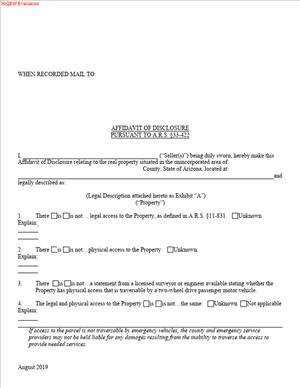
The form typically addresses whether the land has legal access, whether it complies with subdivision laws, and whether utilities and services are available. It may also state whether the property lies in an unincorporated area and whether there are any known issues affecting its use.
Because it is an affidavit, the information is given under penalty of perjury. That makes accuracy important. The document becomes part of the official land records once recorded.
Who typically uses this form?
This form is most often used by private property owners who are selling land. In Arizona, it is commonly required when someone sells five or fewer parcels of land in a calendar year, and the land is located in an unincorporated area.
Real estate professionals may prepare the document on behalf of a seller. However, the seller is usually the person who signs it. The buyer receives a copy and may sign to acknowledge receipt.
County recording offices handle the filing. Title companies and lenders may also review it during a transaction, since it can affect financing and insurability.
Why might you need this form?
You may need this form when transferring ownership of vacant land. It provides advance notice to the buyer about issues that could affect development or access. Without it, the transaction may not meet recording or statutory requirements.
The form also protects both sides by creating a written disclosure. The buyer receives information before closing. The seller documents what was disclosed at the time of sale.
In many cases, recording this document is part of completing the transfer process. If it is missing, the County Recorder’s Office may not accept the deed for recording, or the transaction may be delayed.
Typical real-life scenarios
- You own a rural parcel outside city limits and plan to sell it to a neighbor. The land has dirt road access and no utility hookups. Before transferring title, you complete and record the affidavit describing those conditions.
- You inherited several vacant lots in an unincorporated area. You decide to sell two of them in the same year. Because the parcels are not part of a formal subdivision, the disclosure form becomes part of the sale process.
- You are a buyer interested in purchasing desert land for a future home. The seller provides the recorded affidavit. You review it to confirm whether the property has legal access and whether utilities are available nearby.
- You are selling land that was divided years ago without going through a formal subdivision process. The affidavit explains the status of the land division and alerts the buyer to any limitations on building or improvements.
When would you use an Affidavit of Disclosure?
An Affidavit of Disclosure is used during the sale or transfer of certain parcels of land. It is typically prepared before or at the time the deed is signed and submitted for recording. The timing matters because the disclosure is meant to inform the buyer before ownership changes hands.
This form is often associated with private sales of vacant land in unincorporated areas. If the property is within city limits or part of a recorded subdivision, the situation may differ. In many transactions involving subdivided residential property, other disclosure forms are used instead.
Sellers are usually the ones who complete and sign the affidavit. Buyers may sign to confirm they received and reviewed it. In some cases, both parties sign the same document, and the completed form is recorded along with the deed.
You may also encounter this form if you are refinancing or researching the property’s history. Because it is recorded, it stays in the public file. Future buyers and lenders may look at it when evaluating the property.
Legal characteristics of Affidavit of Disclosure
The Affidavit of Disclosure is a sworn document. That means the person signing it declares the information is true under oath. A notary public usually verifies the signer’s identity and acknowledgment. Without proper notarization, the County Recorder’s Office may reject the submission.
For the document to be effective, it generally needs complete and accurate information. Missing parcel numbers, incomplete legal descriptions, or unsigned sections can cause delays. Recording offices may also reject forms that do not meet formatting requirements, such as margin size or legibility standards.
Because it is recorded, the affidavit becomes part of the chain of title. Anyone searching the property records can see it. This public nature increases the importance of clarity and precision in the statements made.
High-level requirements may vary depending on the type of land and the number of parcels involved. In Arizona, the use of this form is commonly tied to sales of five or fewer parcels in a calendar year in unincorporated areas. The details on the form are designed to address common risks in those transactions, such as access and subdivision compliance.
It is important to understand what the document does not do. It does not guarantee that the property is buildable. It does not replace inspections, surveys, or title searches. It does not create new property rights. Instead, it provides disclosures about existing conditions.
Is it legally binding?
Yes, an Affidavit of Disclosure is legally binding in the sense that it is a sworn statement recorded in the public record. By signing it, the person making the statements accepts responsibility for the accuracy of the information provided.
If the statements are knowingly false, there can be legal consequences because the document is signed under oath. In addition, a buyer may rely on the disclosures when deciding to proceed with the purchase.
However, the affidavit itself is not a purchase contract. It does not set the price, financing terms, or closing date. It works alongside the sales agreement. Its purpose is disclosure, not to create or enforce the full terms of the transaction.
How to fill out Affidavit of Disclosure
Step 1 – Identify the property
Begin by entering the full legal description of the property. This is not just the street address. Use the legal description from the deed, including section, township, range, and parcel number if required. Accuracy here is essential because the affidavit will be recorded and tied to this specific parcel.
Step 2 – Provide seller information
Enter the full legal name of each property owner who is transferring an interest. The names should match the current deed. Include mailing addresses where requested. If there are multiple owners, each may need to sign the form.
Step 3 – Disclose access details
State whether the property has legal access. This may include paved roads, dirt roads, or recorded easements. If access is through another private property, indicate whether there is a recorded easement or other legal right of access.
Step 4 – Disclose utility availability
Indicate whether utilities such as water, sewer, electricity, and natural gas are available to the property. If services are not currently connected, clarify whether they are nearby or would require installation. Provide factual information rather than assumptions.
Step 5 – Address subdivision status
Answer the questions about whether the land division complies with local subdivision laws. The form may ask whether the property was divided in accordance with applicable requirements. Provide truthful responses based on your knowledge and available records.
Step 6 – Review all statements carefully
Read each disclosure line by line before signing. Confirm that every answer reflects the current condition of the property to the best of your knowledge. Make corrections clearly if needed, and avoid leaving required sections blank.
Step 7 – Sign in the presence of a notary
Sign the affidavit where indicated. A notary public will verify your identity and complete the acknowledgment section. Do not sign the document in advance if notarization is required, since the notary must witness the signature.
Step 8 – Obtain buyer acknowledgment if required
If the form includes a section for the buyer to acknowledge receipt, have the buyer sign in the appropriate space. This shows that the disclosure was provided before or during the transfer process.
Step 9 – Submit for recording
After all required signatures and notarizations are complete, submit the document to the County Recorder’s Office in the county where the property is located. Pay any required recording fees. Once recorded, keep a copy for your records along with the related deed and transaction documents.
Legal terms you might encounter in Affidavit of Disclosure
- Affiant: This is the person who makes the sworn statements in the document. In this form, the affiant is usually the property seller. You are declaring that the information provided is true to the best of your knowledge.
- Notary Public: A notary is an official who verifies your identity and witnesses your signature. The notary confirms that you signed voluntarily. Your signature must be notarized before the document can be recorded.
- Legal Description: This is the formal description of the property as it appears in public records. It is not just the street address. You must copy it exactly as it appears on the deed or prior recorded documents.
- Parcel Number: Also called an assessor’s parcel number (APN), this is a unique number assigned to the property by the county. It helps identify the property for tax and recording purposes. Make sure the number matches county records.
- Unsubdivided Land: This refers to property that has not been divided into lots within a recorded subdivision. The document often requires you to confirm whether the land is part of a subdivision or not. This affects access and utility disclosures.
- Legal Access: Legal access means there is a lawful, recorded way to reach the property from a public road. You may need to confirm whether access is by a public road, private road, or easement. If access is limited, you must state that clearly.
- Easement: An easement is a legal right allowing someone to use part of the property for a specific purpose, such as access or utilities. If access is through an easement, you must disclose that. Easements are usually recorded in county records.
- Utilities Availability: This refers to whether services such as water, electricity, sewer, or gas are available to the property. You may need to indicate if utilities are connected, nearby, or not available. Be precise about what exists versus what is planned.
- Recording: Recording is the process of filing the signed and notarized document with the County Recorder’s Office. Once recorded, the document becomes part of the public record. This step makes the disclosure official and searchable.
- Acknowledgment: An acknowledgment is a statement, often signed by the buyer, confirming receipt of the disclosure. Some versions of the form include a section for the buyer’s signature. This proves the buyer was informed before closing.
FAQs
What information do I need in front of me before I start filling out this form?
You should have a copy of your deed, the full legal description of the property, and the parcel number from county records. You also need accurate details about road access, utility availability, and whether the land is part of a recorded subdivision. Keep any recorded easements or access agreements nearby so you can answer questions exactly as they appear in public records.
Do I use the property’s street address or the legal description?
You will usually include both, but the legal description is critical. The street address alone is not enough for recording purposes. Copy the legal description word for word from your deed or a prior recorded document to avoid rejection by the recorder.
When does this document become effective?
It becomes effective when it is signed, notarized, and recorded with the County Recorder’s Office. Signing it alone does not place it in the public record. Recording creates an official timestamp and makes the Affidavit of Disclosure part of the property’s file.
Do I need the buyer to sign this form?
Some versions include a buyer acknowledgment section. If that section appears, the buyer should sign to confirm receipt before closing. Even if buyer acknowledgment is not required for recording, having that signature helps show that you delivered the disclosure.
What if I realize I made a mistake after signing but before recording?
Do not alter a notarized document by hand. Prepare a new, corrected version of this form and sign it again in front of a notary. Recording a clean and accurate document prevents confusion in the public record.
Can I attach additional pages if I need more space?
Yes, you can attach additional pages if the provided space is not enough. Clearly label each attachment and reference it in the main document. Make sure every attachment is included when you submit the Affidavit of Disclosure for recording.
What happens if the recorder rejects my submission?
The recorder may reject this document for missing notary acknowledgment, incorrect margins, incomplete legal description, or unpaid fees. You will need to correct the issue and resubmit. Review all required fields and formatting rules before filing to avoid delays.
Will this document change ownership of the property?
No. This form does not transfer ownership. It places required disclosures into the public record. Ownership changes only when a properly executed and recorded deed is filed.
Checklist: Before, During, and After Affidavit of Disclosure
Before
- Obtain a copy of your current deed with the full legal description.
- Confirm the parcel number from the county tax records.
- Review any recorded easements affecting access.
- Verify how the property is accessed from a public road.
- Check availability and connection status of utilities.
- Determine whether the property is part of a recorded subdivision.
- Gather government-issued identification for notarization.
During
- Enter the property’s legal description exactly as recorded.
- Double-check the parcel number for accuracy.
- Answer every disclosure question completely and clearly.
- Avoid leaving blanks; write “N/A” if a section does not apply.
- Review all statements for accuracy before signing.
- Sign only in the presence of a notary.
- Ensure the notary completes all acknowledgment fields.
After
- Make at least one copy for your records.
- Provide a copy to the buyer.
- Confirm recording fees and accepted payment methods.
- Submit the original notarized document to the County Recorder’s Office.
- Obtain confirmation of recording or a receipt.
- Keep the recorded copy with your closing documents.
- Store digital and paper copies in a secure place.
Common mistakes to avoid with Affidavit of Disclosure
- Mistake: Using only the street address instead of the full legal description, which happens because it seems simpler, but it can lead to recording rejection; do not forget to copy the legal description exactly from your deed.
- Mistake: Leaving sections blank because you are unsure of the answer, which often occurs when sellers lack documents, but unanswered questions can create disputes; do not forget to verify facts or write “N/A” when appropriate.
- Mistake: Signing before meeting with a notary, which people do for convenience, but it invalidates the notarization; do not forget to sign only in the notary’s presence.
- Mistake: Guessing about legal access or utilities, which happens when records are unclear, but inaccurate disclosures can cause legal and financial consequences; do not forget to confirm details through recorded documents.
- Mistake: Forgetting to attach additional pages referenced in the form, which can occur during assembly, but missing attachments may lead to rejection or confusion; do not forget to include and label every attachment.
- Mistake: Failing to submit the document for recording after notarization, which happens when parties assume closing agents will handle it, but without recording it is not part of the public record; do not forget to confirm that it has been officially recorded.
What to do after filling out the Affidavit of Disclosure
Once you complete and notarize the document, your job is not finished. You must make sure it is properly recorded and stored. Taking a few extra steps now prevents larger problems later.
Start by reviewing the notarized original one more time. Confirm that the notary seal is clear and that all pages are included. Check that names are spelled consistently throughout the document.
- Step 1: Make at least two copies of the signed and notarized document—one for you and one for the buyer.
- Step 2: Confirm the current recording fee and acceptable payment method with the County Recorder’s Office.
- Step 3: Submit the original document for recording, either in person or by mail, following the recorder’s formatting and margin requirements.
- Step 4: Request a receipt or confirmation showing the document was accepted for recording.
- Step 5: Wait for the recorded copy with the official recording stamp and document number.
- Step 6: Review the recorded copy to ensure the stamp, date, and document number are visible and correct.
- Step 7: Provide a copy of the recorded document to the buyer if they do not already have one.
- Step 8: Store the recorded copy with your deed, settlement statement, and other closing documents.
- Step 9: Update your personal records to reflect the date the disclosure was recorded.
- Step 10: Keep both digital and paper versions in a secure location in case questions arise later.
Recording creates a public record that may be referenced years later. Keeping organized copies protects you if there is ever a dispute about what was disclosed and when. Treat the recorded document as a permanent part of the property’s history.
Disclaimer: This guide is provided for informational purposes only and is not intended as legal advice. You should consult a legal professional.