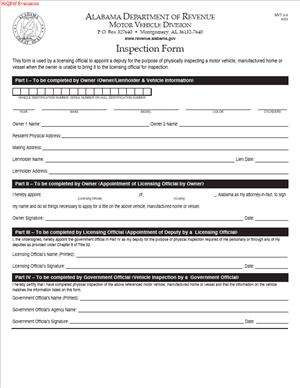
MVT-5-9 – Inspection Form
Fill out nowJurisdiction: Country: United States | Province or State: Alabama
If you are preparing paperwork related to a vehicle in Alabama, you may come across the MVT-5-9 – Inspection Form. This document is used to confirm that a vehicle has been physically inspected and that certain identifying information is accurate.
The MVT-5-9 – Inspection Form is often required when standard ownership documents are missing, incomplete, or need verification. It helps the state confirm that a specific vehicle matches the details listed in an application or record.
You may encounter this form during a title correction, a bonded title process, or when registering a vehicle that has unusual circumstances. The inspection adds a layer of verification before the state updates its records.
If you are filling this out yourself, your main focus is accuracy. The form centers on the vehicle’s identification details and the inspector’s confirmation. Understanding what the document does will make the completion process much smoother.
What is MVT-5-9 – Inspection Form?
Clear definition
The MVT-5-9 – Inspection Form is an official Alabama Department of Revenue document used to record the results of a physical inspection of a motor vehicle. It documents key identifying information such as the vehicle identification number (VIN), make, model, and other relevant details.
The purpose of the form is to verify that the physical vehicle matches the information being submitted in a related filing. It creates a written record that an authorized person has examined the vehicle and confirmed its identity.
This form does not transfer ownership by itself. It supports other title or registration documents by confirming that the vehicle exists and that its identifying numbers are accurate.
Who typically uses this form?
Vehicle owners most often encounter this form when they are applying for a title under special circumstances. This may include situations where the original title is unavailable or when there is a discrepancy in vehicle records.
Law enforcement officers or other authorized inspectors typically complete the inspection portion. Their role is to physically examine the vehicle and record the required information.
Clerks or administrative staff may also handle this form as part of a larger submission packet. However, the vehicle owner is usually responsible for arranging the inspection and ensuring the form is included with the correct filing.
Why might you need this form?
You may need this form if your vehicle’s ownership documents are incomplete or if there is uncertainty about the VIN. The inspection provides confirmation that the vehicle matches the information provided in your application.
It is often used when applying for a bonded title. In those cases, the state may require a physical inspection to reduce the risk of fraud or error before issuing a new title.
You might also need this form if a vehicle has been rebuilt, reconstructed, or significantly altered. The inspection helps verify that the identifying numbers are present and legible.
In some cases, the form is required when a vehicle is coming into Alabama from another state and documentation is not sufficient on its own. The inspection serves as an additional layer of verification.
Typical real-life scenarios
- You purchase an older vehicle from a private seller, but the seller cannot locate the original title. When you attempt to apply for a new title, you are told that a physical inspection is required. The inspection form becomes part of your submission.
- You inherit a vehicle from a family member, but the paperwork contains inconsistencies in the VIN. Before corrections can be processed, an inspection is conducted and documented to confirm the correct number.
- You buy a vehicle that was previously declared salvage and later rebuilt. During the title process, an inspection is required to verify the VIN and confirm the vehicle matches its records.
- You bring a vehicle into Alabama from another state, and the existing documentation raises questions about its identifying details. An inspection is requested to ensure the vehicle’s VIN and other characteristics are properly recorded.
When would you use MVT-5-9 – Inspection Form?
You would use this form when a physical verification of a vehicle is required as part of a larger title or registration process. It is not typically a standalone filing. Instead, it supports another application already in progress.
This often occurs during a bonded title application. In that process, the state may require extra documentation to protect against competing ownership claims. The inspection confirms the vehicle’s identity before a bond is issued or accepted.
You may also use the form when correcting errors on an existing title. If the VIN or other key information does not match the vehicle, the state may require an inspection before approving the correction.
Law enforcement officers or designated officials commonly complete the inspection section. As the vehicle owner, you are usually responsible for presenting the vehicle for examination and ensuring the document is properly included in your submission.
In general, this form comes into play when the standard documentation is not enough by itself. The inspection provides additional assurance that the vehicle being titled or registered is the same one described in the paperwork.
Legal characteristics of MVT-5-9 – Inspection Form
This form becomes effective when it is properly completed and signed by an authorized inspector. The inspector’s signature confirms that the vehicle was physically examined and that the listed details match what was observed.
Accuracy is critical. If the VIN is recorded incorrectly, even by one character, the submission may be delayed or rejected. Illegible writing, missing signatures, or incomplete sections can also cause problems.
The form is part of an administrative process. It does not create ownership rights on its own. Instead, it supports another filing that may lead to a title being issued or corrected.
Requirements for who may perform the inspection can vary depending on the circumstances. In many cases, a law enforcement officer performs the inspection. In other situations, another authorized official may be permitted. The key factor is that the inspector must have authority to complete the document.
Common issues that lead to rejection include altered or unreadable VIN plates, inconsistencies between the inspection form and the title application, or missing required signatures. Ensuring that all related documents match is essential for smooth processing.
Is it legally binding?
The inspection form is legally significant as an official record of what was observed during the vehicle inspection. When signed by an authorized official, it becomes part of the state’s vehicle record system.
However, it is not a contract between private parties. It does not transfer ownership, create a lien, or establish financial obligations. Its legal effect is limited to documenting the inspection results.
If the information on the form is false or inaccurate, it can lead to delays or potential legal consequences, particularly if the inaccuracies involve misrepresentation of the vehicle’s identity. The form’s binding nature relates to the truthfulness and official nature of the recorded inspection, not to ownership rights by itself.
How to fill out MVT-5-9 – Inspection Form
Step 1 – Review the purpose of your filing
Before completing the form, confirm why it is required in your situation. This document usually supports another title or registration application. Make sure you have that related paperwork ready so the vehicle details match exactly.
Check the vehicle’s existing documents for the correct VIN, year, make, and model. Having this information in front of you helps prevent inconsistencies between forms.
Step 2 – Arrange for an authorized inspection
The inspection section must be completed by an authorized individual. Contact the appropriate office or official to schedule a time for the vehicle to be examined.
Bring the vehicle to the inspection location, or arrange for the inspector to view it if that option is available. Ensure the VIN plate and other identifying numbers are clean and visible before the inspection begins.
Step 3 – Provide vehicle identification details
During the inspection, the inspector will locate and verify the VIN on the vehicle. This number must match the one listed on your related application documents.
The inspector may also record the year, make, model, body style, and color. Review these entries for accuracy before the form is finalized. Even small errors can delay processing.
Step 4 – Confirm odometer or condition details if required
Depending on the version of the form and the purpose of the inspection, additional details may be recorded. This can include information about the vehicle’s condition or other identifying marks.
Make sure the information written on the form reflects what is actually present on the vehicle. If something appears incorrect, address it before the inspector signs the document.
Step 5 – Inspector signature and certification
After completing the inspection and filling in the required fields, the authorized inspector will sign and date the form. This signature certifies that the vehicle was physically examined and that the information recorded is accurate to the best of the inspector’s knowledge.
Check that the signature, printed name, title, and any required identification number for the inspector are clearly written. Missing signature details are a common reason for rejection.
Step 6 – Review the completed form before submission
Once the inspection is complete, read through the entire document carefully. Confirm that the VIN matches exactly across all paperwork in your filing packet.
Verify that no sections are left blank if they are required. Ensure the writing is legible and that all dates are correct.
After reviewing the form, include it with the rest of your title or registration submission. Keep a copy for your records so you have proof of the completed inspection if questions arise later.
Legal terms you might encounter in MVT-5-9 – Inspection Form
- Vehicle Identification Number (VIN): The VIN is the unique 17-character code assigned to a vehicle by the manufacturer. On this form, the VIN is one of the most critical pieces of information. The inspector compares the VIN on the vehicle to the VIN listed on your title or application to confirm they match exactly.
- Authorized Inspector: This refers to the person legally permitted to perform and certify the vehicle inspection. The form requires this person’s printed name, signature, and often their title or badge number. If someone who is not authorized signs the document, it may be rejected.
- Certification Statement: This is the section where the inspector confirms that they physically examined the vehicle and that the information listed is accurate. It usually appears near the signature line. By signing, the inspector is formally attesting to the truth of the details recorded.
- Odometer Reading: This is the mileage displayed on the vehicle at the time of inspection. Some versions of the form require the inspector to record the current reading. This helps document the vehicle’s condition and can be relevant for title processing.
- Make, Model, and Year: These fields identify the basic characteristics of the vehicle. The inspector verifies that these details match the VIN and any supporting documents. Errors in these fields can delay processing.
- Body Style: This term refers to the vehicle’s design type, such as sedan, coupe, truck, or SUV. The form may include a specific space to record this. It helps confirm that the physical vehicle matches the title description.
- Applicant/Owner Information: This section captures the name and address of the person seeking title or registration action. The information must match the related title or application documents. Mismatched names are a common cause of delays.
- Jurisdiction of Inspection: This indicates where the inspection took place. It may include the county or agency conducting the inspection. This detail matters because only certain officials are authorized to complete the form.
- Physical Inspection: This means an in-person examination of the vehicle, not a review of paperwork alone. The inspector must physically check identifying marks, such as the VIN plate. The form confirms that this step occurred.
FAQs
Do I need to bring the vehicle in person for this form?
Yes. This document is based on a physical inspection. The inspector must see the vehicle and verify identifying details such as the VIN. You cannot complete this process using photos or copies of documents alone.
What happens if the VIN on the vehicle does not match my paperwork?
If the VIN does not match exactly, the inspector will note the discrepancy. The MVT-5-9 – Inspection Form may not be certified until the issue is resolved. You may need to correct your title application or investigate whether there was a clerical error or a problem with the vehicle’s documentation.
Who is allowed to sign this document?
Only an authorized inspector can sign and certify it. That usually means a law enforcement officer or another official designated to perform vehicle inspections. You cannot sign on behalf of the inspector, even if you own the vehicle.
What information should I double-check before the inspection?
Make sure the VIN on your title or application matches the VIN on the vehicle. Confirm the spelling of your name, your address, and the vehicle’s year, make, and model. Errors in these details can cause the MVT-5-9 – Inspection Form to be rejected or require correction.
Does this form transfer ownership of the vehicle?
No. This form does not transfer ownership. It documents that the vehicle was inspected and that identifying details were verified. Ownership changes happen through title transfer documents, not through this inspection record.
What if the inspector makes a mistake while filling it out?
If the mistake is minor, the inspector may need to correct it according to standard procedures, which often require initialing changes. If the error is significant, you may need a new form completed. Do not submit a form with visible errors unless properly corrected.
Will this document become part of the public record?
Inspection information can become part of the vehicle’s official file once submitted. This means the verified VIN and vehicle details may be recorded in state records. Make sure all information is accurate before submission.
How do I know if my inspection was accepted?
After submission, the agency processing your title or registration will review this form along with your other documents. If accepted, your title or registration action will move forward. If there is a problem, you will typically be notified that additional information or a corrected document is needed.
Checklist: Before, During, and After MVT-5-9 – Inspection Form
Before
- Confirm why you need the inspection and what transaction it supports.
- Gather your title, bill of sale, or application documents.
- Verify that the VIN on your paperwork matches the VIN on the vehicle.
- Make sure your name and address are correct on all related forms.
- Locate the VIN on the vehicle so you can easily show it to the inspector.
- Ensure the vehicle is accessible and not blocked or locked in a way that prevents inspection.
- Check that the VIN plate is legible and not damaged.
During
- Present your identification and vehicle documents to the inspector.
- Allow the inspector full access to the VIN plate and other identifying features.
- Watch as the inspector records the VIN, year, make, and model.
- Confirm that the odometer reading is recorded accurately, if required.
- Review the spelling of your name and vehicle details before the inspector signs.
- Ensure the inspector prints and signs their name clearly.
- Ask questions immediately if you notice any incorrect information.
After
- Review the completed form for legibility and completeness.
- Make a copy for your personal records.
- Attach the inspection form to your title or registration application.
- Submit all documents together as required.
- Keep proof of submission if you file in person or by mail.
- Follow up if you do not receive confirmation within a reasonable time.
- Store your copy in a safe place with your vehicle records.
Common mistakes to avoid with MVT-5-9 – Inspection Form
- Mistake: Bringing paperwork with a VIN that does not match the vehicle, which often happens due to typing errors or swapped digits, leading to rejection of the form and delays, so do not forget to compare every character before the inspection.
- Mistake: Allowing someone who is not an authorized inspector to complete or sign the form, usually because of confusion about who qualifies, resulting in an invalid certification. Do not forget to confirm the inspector’s authority.
- Mistake: Submitting the form with blank fields, which happens when sections are overlooked during a rushed inspection, causing processing delays. Do not forget to review every line before leaving.
- Mistake: Failing to check for legibility, often due to handwritten entries that are unclear, which can cause administrative rejection, so do not forget to ensure all writing is readable.
- Mistake: Separating the inspection form from the related title application, which can occur when documents are mailed separately, leading to incomplete processing, so do not forget to submit all required documents together.
- Mistake: Ignoring minor errors such as misspelled names or incorrect body style descriptions, which seem small but can conflict with official records and create delays, so do not forget to correct errors immediately.
- Mistake: Waiting too long to submit the completed form, which may cause issues if other documents expire or transaction deadlines pass, so do not forget to file promptly after inspection.
- Mistake: Failing to keep a personal copy, often because you assume the agency will retain records, which leaves you without proof if questions arise later, so do not forget to make and store a copy.
What to do after filling out MVT-5-9 – Inspection Form
Once the inspection is complete and the form is signed, your next steps matter. This document usually supports a larger transaction, such as applying for a title or correcting vehicle records. Treat it as one piece of a complete filing package.
First, review the entire document carefully. Check every character of the VIN. Confirm the year, make, model, and body style. Make sure your name is spelled correctly and matches your identification and title paperwork. Small inconsistencies can slow down processing.
- Step 1: Make at least one clear copy of the completed form for your records.
- Step 2: Attach the original inspection form to your title or registration application.
- Step 3: Confirm that all supporting documents are included in the same packet.
- Step 4: Submit the full set of documents through the appropriate filing method.
- Step 5: Obtain proof of submission, such as a receipt or stamped copy.
- Step 6: Track the status of your title or registration request.
- Step 7: Respond promptly to any notice requesting corrections or additional documents.
- Step 8: Store your copy of the inspection form with your permanent vehicle records.
- Step 9: Update your personal files to reflect the completed inspection.
- Step 10: Verify that your updated title or registration reflects the correct VIN and vehicle details once issued.
If you submit in person, ask whether your packet is complete before leaving. A quick review by a clerk can prevent weeks of delay. If you submit by mail, organize documents in a logical order and keep copies of everything you send.
After submission, monitor your mail or account notifications for updates. If there is an issue, address it quickly. Delays often happen when people overlook follow-up requests.
Finally, keep the inspection form with your long-term records. Even after your title is issued, you may need proof that the vehicle was properly inspected, especially if questions arise in the future about VIN verification or prior ownership documentation.
Disclaimer: This guide is provided for informational purposes only and is not intended as legal advice. You should consult a legal professional.