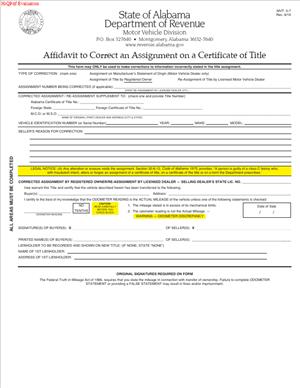
MVT-5-7 – Affidavit to Correct an Assignment on a Certificate of Title
Fill out nowJurisdiction: Country: United States | Province or State: Alabama
The MVT-5-7 – Affidavit to Correct an Assignment on a Certificate of Title is a document used in Alabama to fix mistakes made when transferring ownership of a motor vehicle. If you are about to complete this form, you are likely dealing with an error on a vehicle title that is preventing a clean transfer.
This form matters because vehicle titles are legal proof of ownership. Even a small mistake in the assignment section can delay registration, financing, or resale. The correction must be documented properly so the title record reflects the correct information.
You might be a buyer, a seller, or another party involved in the transfer. If the title assignment was filled out incorrectly, crossed out, or contains inconsistent information, this form helps clarify what actually happened.
Understanding how this document works can save you time. It helps you avoid rejected filings and repeated trips to a title office. The key is knowing what the form is designed to fix and what it cannot change.
What is MVT-5-7 – Affidavit to Correct an Assignment on a Certificate of Title?
Clear definition
The MVT-5-7 – Affidavit to Correct an Assignment on a Certificate of Title is a sworn statement used to correct errors in the assignment section of a vehicle certificate of title. The assignment section is where ownership is transferred from the seller to the buyer.
An affidavit is a written statement made under oath. By signing this document, the person completing it confirms that the information provided is true and accurate to the best of their knowledge.
This form does not create a new transfer. It clarifies or corrects information that was previously written incorrectly on an existing title.
Who typically uses this form?
This form is often used by vehicle sellers who made a mistake when signing over a title. For example, they may have written the wrong buyer name or made a numbering error in the odometer section.
Buyers also use this form when they discover that the title they received contains an error. Without correction, they may not be able to register the vehicle in their name.
In some cases, dealers or other intermediaries involved in vehicle transfers may complete the form when a clerical mistake occurred during the assignment process.
Anyone whose name appears in the incorrect assignment may need to participate. The correction usually requires clear identification of the parties involved in the original transfer.
Why might you need this form?
You may need this form if the assignment area of the title contains incorrect information. Common errors include misspelled names, wrong dates, incorrect mileage entries, or incomplete buyer or seller signatures.
Title offices generally cannot accept altered or heavily crossed-out assignments. If the correction cannot be handled directly on the title, a separate affidavit may be required to explain the error.
Without this correction, the transfer of ownership may be delayed. Registration, tag issuance, or title reissuance may not move forward until the mistake is formally addressed.
This form provides a structured way to explain what went wrong and what the correct information should be.
Typical real-life scenarios
- A seller signs the title but accidentally writes the wrong buyer’s name. The vehicle was sold to one person, but a different name appears in the assignment. The buyer cannot register the vehicle until the discrepancy is resolved.
- A buyer fills in their information but makes a spelling mistake in their own name. The error does not match their identification documents. A correction is needed to align the title with official records.
- The odometer reading is written incorrectly at the time of sale. The number may be transposed or missing a digit. Because odometer disclosures are sensitive, a correction affidavit may be required to clarify the accurate mileage at the time of transfer.
- A date of sale is entered incorrectly. This can affect tax calculation or compliance with time limits for registration. The affidavit explains the correct date of transfer.
- In another situation, a seller signs in the wrong space on the title. The assignment area may appear incomplete or improperly executed. The affidavit helps clarify who signed and in what capacity.
When would you use MVT-5-7 – Affidavit to Correct an Assignment on a Certificate of Title?
You would use this form when an error in the title assignment prevents the transfer from being processed smoothly. The issue usually appears when the buyer attempts to register the vehicle or apply for a new title.
If the title shows alterations, crossed-out entries, or inconsistent information, the processing office may require additional documentation. This affidavit provides a formal explanation.
The form is commonly used after a sale between private individuals. In these transactions, the seller and buyer complete the title by hand. Mistakes are more likely without structured systems.
It may also be used when a vehicle passes through more than one party before being properly titled. If the chain of assignment contains errors, a sworn correction may be necessary.
You would not typically use this form to change ownership after a completed and valid transfer. It is intended to correct mistakes, not to reverse or create a new transaction.
Legal characteristics of MVT-5-7 – Affidavit to Correct an Assignment on a Certificate of Title
This document is an affidavit, which means it is made under oath. The person signing it is declaring that the facts stated are true. False statements on an affidavit can carry legal consequences.
For the form to be effective, it generally must be completed clearly and signed by the appropriate party. The information must match the vehicle and title details exactly, including the vehicle identification number and current title number.
Common reasons for rejection include incomplete fields, missing signatures, or mismatched information between the affidavit and the title. Illegible handwriting can also cause delays.
Another common issue is when the wrong person signs the correction. The individual who made the original error or whose name appears in the incorrect assignment often needs to provide a sworn statement.
The form does not replace the certificate of title. It supports the existing title by clarifying specific errors in the assignment section. It also does not settle disputes about ownership. If there is a disagreement between buyer and seller, this affidavit alone does not resolve that conflict.
Requirements may vary slightly depending on how the title was issued or whether the vehicle was previously titled in another state. Processing practices can differ based on administrative procedures.
Is it legally binding?
Yes, this affidavit is legally binding in the sense that it is a sworn statement. By signing it, you are formally affirming that the information provided is accurate.
Because it is sworn, it carries legal weight. Providing false information can expose the signer to penalties associated with making a false statement.
However, being legally binding does not mean it guarantees acceptance. The document must still meet all formatting and completion requirements. It must also align with the information on the title and any related documents.
The affidavit binds the person making the statement to the truth of the correction. It does not automatically validate an otherwise improper transfer if other legal requirements were not met.
How to fill out MVT-5-7 – Affidavit to Correct an Assignment on a Certificate of Title
Step 1 – Identify the vehicle
Begin by entering the complete vehicle information exactly as it appears on the certificate of title. This typically includes the vehicle identification number, year, make, and model. Accuracy here is critical because the correction must match the specific vehicle record.
Step 2 – Provide current title details
Enter the title number and any other identifying information requested about the existing certificate of title. Double-check these numbers against the physical title to avoid additional errors.
Step 3 – Identify the parties involved
List the names of the seller and buyer as they appear on the original, incorrect assignment. Then provide the correct names as they should have been written. Be consistent with full legal names and spelling.
Step 4 – Describe the error clearly
Explain what was written incorrectly on the title. Keep the explanation factual and specific. For example, state that the buyer’s name was misspelled or that the wrong date of sale was entered.
Avoid vague language. The goal is to show exactly what the mistake was and what the correct information should be.
Step 5 – Provide the correct information
State the accurate information that replaces the incorrect entry. This may include the correct buyer name, accurate date of sale, or proper odometer reading at the time of transfer.
Ensure that the corrected information matches any supporting documents you may be submitting with the title.
Step 6 – Review for consistency
Before signing, compare the affidavit to the certificate of title and any related paperwork. Check that the vehicle identification number, names, and dates are consistent across all documents.
Small inconsistencies can result in processing delays. Careful review at this stage helps prevent further corrections.
Step 7 – Sign the affidavit
The person making the correction must sign the affidavit in the designated signature area. Because this is a sworn statement, it is typically signed in the presence of a notarial officer or other authorized official, if required.
Sign your name exactly as it appears in the statement portion of the form. Do not use initials or abbreviations unless they match the name listed.
Step 8 – Complete any required acknowledgment
If the form includes a notary section, ensure that it is fully completed at the time of signing. The notarial acknowledgment must include the date and required certification details.
An incomplete acknowledgment can result in rejection of the filing.
Step 9 – Attach the affidavit to the title
Once completed, the affidavit is submitted together with the original certificate of title and any other required documents. Keep the documents together so the correction can be reviewed alongside the existing assignment.
Ensure that all pages are legible and properly organized before submission.
Legal terms you might encounter in MVT-5-7 – Affidavit to Correct an Assignment on a Certificate of Title
- Affidavit: A written statement made under oath. When you sign this form, you are declaring that the correction you describe is true. Providing false information can carry legal consequences because you are swearing to the accuracy of your statements.
- Assignment: The section on a certificate of title where ownership is transferred from one party to another. An error in this area—such as a misspelled name or incorrect date—often triggers the need for this document. The affidavit explains what was written incorrectly and what the correct information should be.
- Certificate of Title: The official document that proves vehicle ownership. The assignment appears on this certificate. This affidavit does not replace the title; it supports it by clarifying a mistake in the ownership transfer section.
- Transferor: The person or entity that is transferring ownership of the vehicle. This is usually the seller. If the error appears in the seller’s information or signature, that person may need to be involved in completing or signing the affidavit.
- Transferee: The person or entity receiving ownership of the vehicle. This is usually the buyer. If the mistake involves the buyer’s name, address, or signature, the transferee’s accurate details must be clearly stated in the correction.
- Vehicle Identification Number (VIN): A unique 17-character code assigned to the vehicle. This number must match exactly across the title and this affidavit. Even one incorrect digit can cause processing delays or rejection.
- Notarization: The process of having a notary public witness the signature on the affidavit. The notary verifies the identity of the signer and confirms that the signature was made voluntarily. Many title correction affidavits require notarization to be accepted.
- Material Error: A significant mistake that affects the validity of the ownership transfer. Examples include wrong legal names, missing signatures, or incorrect odometer disclosures. Minor spelling issues may still need correction if they affect how ownership is recorded.
- Odometer Disclosure: A statement of the vehicle’s mileage at the time of transfer. If the mileage was recorded incorrectly in the assignment section, this affidavit may clarify the correct reading, depending on how the error occurred.
- Lienholder: A lender or other party with a financial interest in the vehicle. If a lien is listed on the title and the assignment error affects lien information, the correction must not conflict with the lienholder’s recorded interest.
FAQs
Do I need to complete MVT-5-7 – Affidavit to Correct an Assignment on a Certificate of Title for a small spelling mistake?
If the spelling error changes how the name appears in official records, you should correct it. Compare the name on the title assignment with the person’s government-issued identification. If the two do not match exactly, this document helps align the record with the correct legal name so the transfer can be processed without delay.
Who must sign this document?
You need the signature of the person whose information is being corrected. If the error relates to the seller’s section, the seller typically signs. If it relates to the buyer’s information, the buyer may need to sign. Check the signature block carefully and confirm whether notarization is required before signing.
Can I use this form to change the sale price of the vehicle?
This document is intended to correct mistakes, not renegotiate or change agreed terms. If the sale price was written incorrectly by accident, you must clearly explain the error and state the correct amount. Make sure the corrected amount matches any supporting paperwork you submit with the title.
What if the Vehicle Identification Number was written incorrectly on the assignment?
You must compare the VIN on the vehicle, the title, and this document. Enter the full 17-character VIN exactly as it appears on the vehicle and title. Do not guess or shorten it. An incorrect Vehicle Identification Number can prevent the ownership transfer from being recorded.
Does this affidavit change the ownership date?
This form clarifies what the correct information should have been at the time of transfer. It does not create a new sale date unless the original date was written incorrectly. If you are correcting the date, explain that the original entry was a mistake and provide the accurate transfer date.
Do I need to attach the original title?
Yes, this document supports the original certificate of title. Submit it together with the title that contains the incorrect assignment. The correction is reviewed alongside the original document so the record can be updated properly.
What happens if the person who made the mistake is unavailable?
If the individual whose information is incorrect cannot be reached, the correction may be more complicated. You may need additional documentation to support the change. The key is to ensure that the correction is clearly explained and supported by consistent identifying information.
How do I know if the correction was accepted?
After submission, the updated title record should reflect the corrected information. Review the new or updated certificate of title carefully. Check names, dates, Vehicle Identification Number, and any lien information to confirm the record now matches the accurate details.
Checklist: Before, During, and After MVT-5-7 – Affidavit to Correct an Assignment on a Certificate of Title
Before
- Review the certificate of title and highlight the exact error in the assignment section.
- Confirm the correct legal names using government-issued identification.
- Verify the full 17-character VIN directly from the vehicle and the title.
- Gather any supporting documents that show the correct information.
- Check whether notarization will be required.
- Confirm which party must sign based on where the error appears.
- Make sure there are no additional errors beyond the one you plan to correct.
During
- Print clearly in black or blue ink.
- Enter the Vehicle Identification Number exactly as it appears on the vehicle and title.
- Identify the transferor and transferee accurately and completely.
- Describe the error in a clear, factual sentence.
- State the corrected information precisely as it should appear.
- Review dates for consistency with the original transfer.
- Sign only after reviewing the entire document.
- Complete notarization if required.
After
- Make a complete copy of the signed affidavit for your records.
- Attach the affidavit securely to the original title.
- Submit the documents through the appropriate filing method.
- Track submission if a receipt or tracking option is available.
- Review any updated title issued for accuracy.
- Store copies with your vehicle purchase records.
- Update your personal records to reflect the corrected information.
Common mistakes to avoid with MVT-5-7 – Affidavit to Correct an Assignment on a Certificate of Title
- Mistake: Writing a vague explanation of the error, which happens when you assume the reviewer will understand the issue; this can lead to rejection because the correction is unclear, so do not forget to state exactly what was wrong and what the correct information is.
- Mistake: Entering a partial or incorrect VIN because you copied it from memory; this causes processing delays or denial, so do not forget to verify all 17 characters directly from the vehicle and title.
- Mistake: Forgetting to have the correct party sign, often due to confusion about who made the error; this can invalidate the affidavit, so do not forget to confirm whose information is being corrected before signing.
- Mistake: Using nicknames instead of legal names, which happens out of habit; this creates mismatched records, so do not forget to match the name exactly to official identification.
- Mistake: Signing before reviewing the entire form, which can lock in additional errors; this may require another correction document, so do not forget to double-check every entry before signing.
- Mistake: Submitting the affidavit without the original title, often due to a misunderstanding of the process; this prevents the correction from being applied, so do not forget to attach it to the certificate of title.
What to do after filling out MVT-5-7 – Affidavit to Correct an Assignment on a Certificate of Title
Once you complete the affidavit, your next steps matter. A correction only becomes effective when it is properly submitted and accepted with the title record.
- Step 1: Make at least one clear copy of the signed and notarized affidavit for your personal records. Keep it with your vehicle documents.
- Step 2: Attach the original certificate of title that contains the incorrect assignment. Do not separate them.
- Step 3: Review both documents together one final time. Confirm that the VIN, names, and dates are consistent across all pages.
- Step 4: Submit the documents using the accepted filing method. This may involve delivering them in person or sending them through an approved submission process.
- Step 5: If you submit in person, request confirmation that the documents were received and appear complete.
- Step 6: If you submit by mail or another delivery method, use a trackable option when possible and keep proof of delivery.
- Step 7: Monitor the status of your title update. Processing times can vary, so plan ahead if you need the corrected title for registration or sale.
- Step 8: When you receive the updated or reissued certificate of title, inspect it immediately. Confirm that the corrected assignment information now appears accurately.
- Step 9: Store the new title in a secure location. Do not keep it in the vehicle.
- Step 10: Update any related records you maintain, such as bills of sale, insurance files, or loan documentation, so all documents reflect the corrected ownership information.
Taking these steps helps ensure the correction is properly recorded and prevents future problems if you sell, register, or refinance the vehicle.
Disclaimer: This guide is provided for informational purposes only and is not intended as legal advice. You should consult a legal professional.