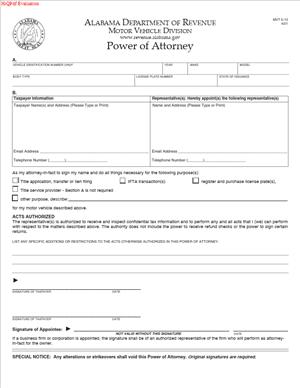
MVT-5-13 – Power of Attorney
Fill out nowJurisdiction: Country: United States | Province or State: Alabama
The MVT-5-13 – Power of Attorney is a form used in Alabama to let someone act on your behalf in certain motor vehicle matters. It is commonly connected to vehicle title and registration transactions handled through the Alabama Department of Revenue.
If you are about to fill out the MVT-5-13 – Power of Attorney, you are likely trying to authorize another person to sign or complete vehicle paperwork for you. This often happens during a sale, transfer, or title correction.
This form matters because vehicle records are official state records. The person signing those records must either be the legal owner or someone properly authorized to act for the owner. Without proper authorization, the transaction may be delayed or rejected.
You may be using this document because you cannot be present in person, or because a dealer, family member, or business partner is handling the paperwork. The form creates a clear written record of who has authority and what they are allowed to do.
Before you start filling it out, it helps to understand what the form does, when it is used, and how to complete it accurately. Small mistakes can slow down your vehicle transaction.
What is MVT-5-13 – Power of Attorney?
Clear definition
The MVT-5-13 – Power of Attorney is a written authorization that allows one person, called the principal, to appoint another person, called the agent or attorney-in-fact, to act on their behalf in motor vehicle matters.
This form is typically limited in scope. It does not give broad financial or medical authority. Instead, it focuses on vehicle-related actions, such as signing title documents, applying for a certificate of title, or completing registration paperwork.
In practical terms, it allows the agent to step into your place for specific vehicle transactions. The agent’s authority is defined by the language in the form and by the type of transaction it is used for.
Because vehicle ownership records affect legal ownership and liability, the state requires clear documentation when someone other than the owner signs. This form serves as that documentation.
Who typically uses this form?
Individual vehicle owners often use this form when they cannot attend a title transfer in person. For example, you might be out of state, deployed, or unable to travel.
Car dealerships frequently use this type of power of attorney during vehicle sales. When you buy or trade in a vehicle, you may authorize the dealership to complete title and registration paperwork for you.
Business entities, such as corporations or limited liability companies, may use it when a designated employee handles vehicle paperwork. The form clarifies who has the authority to sign on behalf of the business.
Family members also use this form when helping an elderly or unavailable relative transfer or register a vehicle. It provides a clear legal basis for the helper to act.
In short, anyone involved in transferring, correcting, or applying for a vehicle title in Alabama may encounter this document.
Why might you need this form?
You might need this form if you are selling a vehicle but cannot be present to sign the title at the time of transfer. By completing the form, you allow another person to sign the necessary documents for you.
You may also need it if there is an error on a vehicle title that must be corrected. An agent can sign the correction paperwork on your behalf if properly authorized.
If you are purchasing a vehicle from a dealer, you may be asked to sign a power of attorney so the dealer can submit the title application and registration documents for you. This streamlines the transaction and avoids multiple trips.
In some cases, vehicle paperwork must be completed quickly to meet state deadlines. If you are unavailable, appointing an agent helps prevent delays or penalties.
The form can also be useful when a vehicle is owned by multiple people, and one owner cannot be present to sign. An authorized agent can sign for that owner if the form is properly completed.
Typical real-life scenarios
- You sell your car to a private buyer, but move to another city before the title transfer is finalized. Instead of traveling back, you sign the power of attorney so a trusted person can complete the transfer on your behalf.
- You purchase a vehicle from a dealership on a busy workday. The dealer asks you to sign a power of attorney so they can submit the title application to the state after you leave. This allows them to handle the filing without requiring your return.
- You discover that your vehicle title contains a misspelled name. Correcting the error requires submitting paperwork and signing forms. You authorize someone else to handle the correction because you are out of town.
- A family member is hospitalized and needs to transfer ownership of a vehicle. With proper authorization through the form, another trusted person can sign the title documents to complete the transfer.
- A business owns several vehicles and designates one employee to manage all vehicle registrations and title updates. The form documents the employee’s authority to act for the company.
- In each of these situations, the key issue is presence and signature. The state needs a valid signature from the owner or someone legally authorized to sign in the owner’s place.
When would you use MVT-5-13 – Power of Attorney?
You would use this form when a vehicle-related transaction requires a signature from the owner, and the owner cannot or does not want to sign the documents personally.
Common situations include transferring a title after a sale, applying for a new title, correcting information on an existing title, or completing registration paperwork. If the transaction involves official state records, proper authorization becomes important.
This form is often used during vehicle sales handled by dealerships. The buyer or seller may authorize the dealer to sign specific documents needed to process the transaction with the Alabama Department of Revenue.
It can also be used when an owner is physically unavailable due to travel, illness, military service, or work commitments. Instead of postponing the transaction, the owner appoints an agent to act in their place.
For business-owned vehicles, the form may be used to confirm which employee or officer has authority to sign motor vehicle documents. This prevents confusion about who is allowed to act for the company.
In multi-owner situations, one co-owner may authorize another person to handle paperwork if they cannot attend in person. This helps avoid delays in transferring or updating ownership records.
The key factor is the need for a legally recognized signature on motor vehicle documents. If you cannot provide that signature yourself, this form creates a pathway for someone else to do so in a legally recognized way.
Legal characteristics of MVT-5-13 – Power of Attorney
The MVT-5-13 – Power of Attorney is generally considered a limited power of attorney. It grants authority only for specific motor vehicle matters described in the document. It does not automatically extend to banking, real estate, or personal financial decisions.
For the form to be effective, it typically must be completed accurately and signed by the principal. In many cases, signatures on motor vehicle power of attorney forms are required to be notarized. Notarization helps confirm the identity of the person granting authority.
The form must clearly identify the principal and the agent. It also usually requires details about the vehicle, such as the vehicle identification number (VIN), make, model, or year. Incomplete or incorrect vehicle information can cause problems during processing.
Common reasons for rejection include missing signatures, incorrect VIN numbers, mismatched names, or alterations that are not properly initialed. Even small errors can delay a title transfer.
In general, a power of attorney remains effective until it is revoked, expires, or the specific transaction is completed. Some forms are written for a single transaction, while others may be broader but still limited to motor vehicle matters.
This form does not change vehicle ownership by itself. It only authorizes someone to sign and act. The actual transfer of ownership occurs through proper completion and submission of title and related documents.
It also does not remove the principal’s responsibility for the vehicle. Granting authority to an agent does not eliminate potential legal or financial obligations tied to ownership.
Rules about notarization, witness requirements, and formatting can vary by state. In Alabama, motor vehicle power of attorney forms are typically structured to meet state administrative requirements. Using the correct version of the form helps avoid processing issues.
Is it legally binding?
When properly completed and signed, the MVT-5-13 – Power of Attorney is generally legally binding for the limited purposes described in the document.
It becomes effective once the principal signs it in accordance with any required formalities, such as notarization. At that point, the agent has the authority to act within the scope defined in the form.
The agent’s actions, when taken within that authority, are usually treated as if the principal performed them. For example, if the agent signs a title application under valid authority, the signature is typically accepted as legally effective.
However, the form is only binding to the extent it is properly executed and used. If the form is incomplete, forged, or used beyond its stated authority, its validity can be challenged.
The agent must act within the limits set by the document. If the form authorizes signing for a specific vehicle, it does not automatically cover other vehicles.
A power of attorney can often be revoked by the principal. Revocation typically requires clear communication and may require written notice. Once revoked, the agent no longer has authority.
The binding nature of the form depends on accurate completion, proper signing, and compliance with state requirements. Careful attention to detail supports its effectiveness.
How to fill out MVT-5-13 – Power of Attorney
Step 1 – Review the entire form before writing anything
Start by reading the entire MVT-5-13 – Power of Attorney from top to bottom. This helps you understand what information is required and where signatures are needed. Look for sections that ask for vehicle details, personal information, and notarization. Reviewing first reduces the risk of mistakes.
Step 2 – Enter the principal’s full legal name and address
Write your full legal name exactly as it appears on the vehicle title. Include your current address as requested. If the vehicle is jointly owned, ensure the correct owner information is entered based on how the title is issued. Consistency with existing records helps prevent processing delays.
Step 3 – Identify the appointed agent clearly
Enter the full legal name of the person you are appointing as your agent. Provide any additional identifying information the form requests, such as address. Make sure the name is spelled correctly. The agent should be someone you trust to handle the vehicle transaction accurately.
Step 4 – Provide complete vehicle information
Fill in the required vehicle details, including the vehicle identification number, year, make, and model. Copy this information directly from the title or registration to avoid errors. Even a single incorrect digit in the VIN can cause the document to be rejected.
Step 5 – Specify the scope of authority if required
Some versions of the form may include language describing what the agent is allowed to do. Read this section carefully. If the form allows or requires you to describe the transaction, ensure the description matches the intended vehicle action, such as title transfer or application.
Step 6 – Review all information for accuracy
Before signing, check every entry. Confirm names match official documents. Verify the VIN and vehicle details. Look for blank spaces that may need completion. Correcting errors after signing can require starting over with a new form.
Step 7 – Sign the form in the required manner
Sign your name exactly as it appears on the title or as required by the form. If notarization is required, do not sign until you are in the presence of a notary. The notary will confirm your identity and complete their section of the form.
Step 8 – Ensure notarization is completed properly
If the form includes a notary section, confirm that the notary fills in all required details, including their signature, seal, and commission information. An incomplete notary section can invalidate the document for processing purposes.
Step 9 – Provide the completed form to the agent or submitting party
After signing and notarization, give the original form to the agent or to the party handling the vehicle transaction. Keep a copy for your records. The original is usually required when submitting vehicle paperwork to the appropriate state office.
Step 10 – Confirm submission with related vehicle documents
The power of attorney is typically submitted along with title applications or transfer documents. Ensure it accompanies the correct paperwork for the specific vehicle transaction. Proper pairing with related documents supports smooth processing.
Legal terms you might encounter in MVT-5-13 – Power of Attorney
- Principal: The principal is you, the person who owns the vehicle and is giving authority to someone else. Your full legal name must match the name shown on the vehicle title and registration records. If there is more than one owner listed on the title, each owner may need to sign, depending on how ownership is recorded.
- Agent: The agent is the person you appoint to act on your behalf. This person can sign documents, submit applications, and complete title or registration transactions for the vehicle listed on the form. The agent’s name should be written exactly as it appears on their identification to avoid delays.
- Attorney-in-Fact: This is another term for the agent. It does not mean the person is a lawyer. It simply means they have legal authority to act for you in the limited ways described in this document.
- Vehicle Identification Number (VIN): The VIN is the unique 17-character code assigned to your vehicle. It appears on your title, registration, and on the vehicle itself. The VIN must be entered accurately because it identifies the exact vehicle covered by this power of attorney.
- Odometer Disclosure: This refers to the recorded mileage of the vehicle at the time of sale or transfer. In some transactions, your agent may be authorized to complete or sign an odometer disclosure statement. The mileage must be accurate because false statements can lead to serious penalties.
- Assignment of Title: This is the section on a vehicle title where ownership is transferred from seller to buyer. Your agent may sign the assignment section on your behalf if you authorize them to handle the sale or transfer. The information must match the details on the title exactly.
- Notarization: Notarization means a notary public verifies your identity and witnesses your signature. The notary adds a seal or stamp to confirm the signature was properly made. Without proper notarization, the document may be rejected.
- Scope of Authority: This describes what your agent is allowed to do. In this document, the authority is typically limited to specific vehicle-related transactions. The agent cannot act outside the powers clearly granted.
- Revocation: Revocation means canceling the authority you previously gave. If you change your mind, you may need to complete a separate written revocation and notify the relevant office. Simply telling the agent verbally may not be enough to prevent future use.
FAQs
Does this form give my agent control over all my property?
No. This document is limited to specific vehicle-related matters listed in it. It does not give your agent authority over your bank accounts, real estate, or other assets. Always read the description of powers carefully so you understand exactly what authority you are granting.
When does the MVT-5-13 – Power of Attorney become effective?
It generally becomes effective once you sign it and it is properly notarized. There is usually no delayed effective date written into this form. The agent can act as soon as the completed document is presented with the required vehicle paperwork.
Can I limit what my agent is allowed to do?
Yes, if the form allows space for limitations or if the authority is already narrowly defined. Review the wording closely to confirm what actions are included. If you only want the agent to complete a specific transaction, make sure the document clearly reflects that and does not grant broader authority than you intend.
Do I need to list the vehicle information exactly as it appears on my title?
Yes. The VIN, year, make, and model should match the title and registration records exactly. Even a small typo in the VIN can cause rejection or delays. Double-check every character before signing.
What if the name on my identification is slightly different from the name on the title?
The names must match the public record tied to the vehicle. If there is a difference due to marriage, divorce, or a legal name change, you may need supporting documents to explain the change. Make sure the name you enter on this form matches the title record to avoid processing issues.
Does my agent need to sign this document?
In most cases, only you, as the principal, are required to sign in front of a notary. However, your agent must sign any vehicle documents they complete on your behalf. When signing for you, they should indicate they are acting as attorney-in-fact so the record clearly shows they are not the owner.
What happens if I make a mistake while filling it out?
If you notice an error before notarization, complete a new, clean copy. If the mistake is discovered after notarization, it is usually safer to complete a new MVT-5-13 – Power of Attorney rather than crossing out information. Corrections can raise questions about authenticity and may lead to rejection.
Will this document change the ownership listed on my vehicle title?
No. This form only authorizes someone to act for you. Ownership changes only when a properly completed title assignment and related documents are processed and accepted. The public record changes after the underlying transaction is approved, not simply because this document exists.
Checklist: Before, During, and After MVT-5-13 – Power of Attorney
Before
- Confirm the vehicle’s title is in your name and matches your current legal name.
- Locate the correct VIN, year, make, and model from the title or registration.
- Decide exactly what transaction your agent will handle.
- Choose an agent you trust to manage legal paperwork accurately.
- Verify whether all titled owners must sign.
- Gather valid photo identification for notarization.
- Review the form to understand the scope of authority granted.
During
- Print clearly in black or blue ink if completing by hand.
- Enter your full legal name exactly as it appears on the title.
- Enter the agent’s full legal name without abbreviations.
- Carefully copy the VIN character by character.
- Fill in all required vehicle details without leaving blanks.
- Do not sign until you are in front of the notary.
- Check that the notary completes every required section, including the seal and date.
After
- Make a clear copy of the signed and notarized document for your records.
- Provide the original to your agent for submission with vehicle paperwork.
- Confirm the agent understands the limits of their authority.
- Track the status of the vehicle transaction.
- Keep proof of submission or acceptance if available.
- Store your copy with your important vehicle documents.
- If needed, prepare a written revocation once the transaction is complete.
Common mistakes to avoid with MVT-5-13 – Power of Attorney
- Mistake: Entering the wrong VIN because you copied it from memory instead of the title, which can lead to rejection of the paperwork and delays; do not forget to verify every character directly from the official document.
- Mistake: Signing before meeting with a notary because you wanted to save time, which can invalidate the notarization and require starting over; do not forget to wait and sign in the notary’s presence.
- Mistake: Using nicknames or shortened names for yourself or your agent, which may not match the vehicle record and cause processing issues; do not forget to use full legal names exactly as recorded.
- Mistake: Leaving blanks in required sections because you assumed they were optional, which can result in refusal to accept the document; do not forget to review every line and complete all mandatory fields.
- Mistake: Making handwritten corrections after notarization because you noticed a small typo, which can raise concerns about authenticity and lead to rejection; do not forget to complete a new form if changes are needed.
- Mistake: Giving broad authority without understanding the scope, often because the form language was not carefully read, which can allow actions you did not intend; do not forget to read the entire document before signing.
- Mistake: Failing to confirm that all titled owners signed when required, which can stop the transaction entirely; do not forget to check how ownership is listed on the title.
- Mistake: Not keeping a copy for your records because you trusted the agent to handle everything, which leaves you without proof of what authority was granted; do not forget to retain a complete copy.
What to do after filling out MVT-5-13 – Power of Attorney
Once the document is signed and notarized, your focus shifts to proper handling and follow-through. This form only works if it is submitted with the correct supporting paperwork and accepted for processing.
Start by organizing everything connected to the vehicle transaction. That may include the original title, bill of sale, odometer disclosure statement, registration application, or lien release. Your agent will likely need several of these at the same time.
- Step 1: Make at least one clear photocopy or scanned copy of the fully executed document for your records.
- Step 2: Attach the original signed and notarized form to the vehicle documents your agent will submit.
- Step 3: Confirm your agent understands how to sign on your behalf, typically by writing your name followed by their signature as attorney-in-fact.
- Step 4: Ensure all related documents are complete before submission to avoid multiple trips or rejections.
- Step 5: Have your agent submit the paperwork through the appropriate filing channel.
- Step 6: Request confirmation that the documents were accepted for processing.
- Step 7: Monitor the status of the title transfer, registration update, or other requested action.
- Step 8: Once the transaction is complete, verify that the public record reflects the correct ownership or updated information.
- Step 9: Store your copy of the power of attorney with your permanent vehicle records.
- Step 10: If the authority is no longer needed, prepare and deliver a written revocation to prevent unintended future use.
You remain responsible for understanding what authority you granted. Stay informed about the outcome of the transaction. Keep documentation that shows when the authority was used and for what purpose. Clear records protect you if questions arise later.
Disclaimer: This guide is provided for informational purposes only and is not intended as legal advice. You should consult a legal professional.