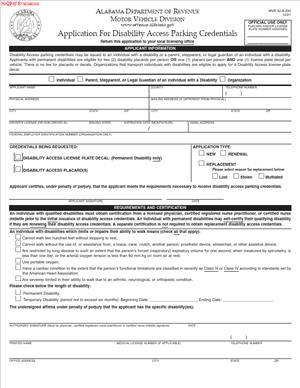
MVR-32-6-230 – Application for Disability Access Parking Credentials
Fill out nowJurisdiction: Country: United States | Province or State: Alabama
The MVR-32-6-230 – Application for Disability Access Parking Credentials is the form used in Alabama to request authorized disability parking credentials. These credentials allow eligible individuals to park in designated accessible spaces.
If you are preparing to complete this form, you likely need a disability parking placard or plate for yourself or someone in your care. The document connects your medical condition with official parking authorization issued by the state.
This form matters because accessible parking spaces are legally restricted. You cannot use them without approved credentials. Completing the form correctly is how you request that authorization.
The application requires personal details and medical certification. It also involves signatures from both you and a licensed medical provider. Each section plays a role in determining eligibility.
Understanding what the form asks for before you begin can help you avoid delays or rejection.
What is MVR-32-6-230 – Application for Disability Access Parking Credentials?
Clear definition
The MVR-32-6-230 – Application for Disability Access Parking Credentials is an official Alabama Department of Revenue document used to request disability access parking placards or license plates. It gathers identifying information, confirms eligibility through medical certification, and records the type of credential requested.
The form functions as a formal request. It does not automatically grant parking privileges. Approval and issuance come after review and processing by the appropriate state office.
This document typically includes sections for applicant information, type of credential, disability certification, and signatures. Some versions also address replacement or renewal requests.
Who typically uses this form?
You would use this form if you have a qualifying physical condition that limits mobility. This commonly includes conditions affecting walking ability, lung capacity, cardiac function, or the need for assistive devices.
Caregivers or legal representatives may complete the form on behalf of a minor or an adult who cannot complete it independently. In those cases, the applicant’s information is still required, along with the representative’s details if requested.
Licensed medical professionals also use part of this form. They complete the certification section that confirms whether the applicant meets the criteria for disability parking credentials.
Organizations that transport individuals with disabilities may use a related version of this form when applying for placards for vehicles they operate.
Why might you need this form?
You need this form if you want lawful access to designated disability parking spaces in Alabama. Without official credentials, parking in these spaces can result in fines or other penalties.
You may also need the form if your existing placard has expired and you are seeking renewal. Expired credentials are typically not valid, even if your condition remains unchanged.
If your placard was lost, stolen, or damaged, the form may be required to request a replacement. The replacement process often involves confirming prior issuance.
Some individuals use the form when transitioning from a temporary placard to a permanent one. This may occur when a medical condition changes from short-term to long-term.
Typical real-life scenarios
- You recently had knee replacement surgery and cannot walk long distances. Your doctor expects recovery to take several months. You apply for a temporary placard to park closer to entrances during that period.
- You live with a chronic heart condition that significantly limits your ability to walk without rest. Your medical provider confirms that your condition meets eligibility requirements. You apply for a permanent placard.
- You are the parent of a child with a mobility impairment. You transport your child to medical appointments and school. You complete the application to obtain a placard that can be used when your child is in the vehicle.
- Your previous placard expired, and you did not notice until you received a warning citation. You submit a new application to renew your credentials and avoid further issues.
- You operate a nonprofit organization that transports individuals with disabilities to community programs. You apply for authorized placards for specific vehicles used for that purpose.
When would you use MVR-32-6-230 – Application for Disability Access Parking Credentials?
You would use the MVR-32-6-230 – Application for Disability Access Parking Credentials any time you need to request new disability parking credentials in Alabama. This includes first-time applications, renewals in many cases, and certain replacements.
If your medical condition significantly limits your ability to walk 200 feet without stopping to rest, or requires the use of a wheelchair, brace, crutch, prosthetic device, or another assistive device, this is often when the form becomes relevant. A licensed medical provider must confirm that your condition meets established standards.
Temporary conditions also trigger the use of this form. After surgery or injury, if your mobility is limited for a defined period, a medical professional may certify a temporary disability. The form distinguishes between temporary and permanent requests.
You might also use the form when switching from a placard to a disability license plate. Some applicants prefer a plate attached to a specific vehicle rather than a portable placard.
If your placard was lost or stolen, you may use the form to document the loss and request a replacement. This helps the state track issued credentials and prevent misuse.
Medical professionals use the certification portion when patients request disability parking authorization. They confirm the nature and expected duration of the condition.
Organizations that transport individuals with disabilities use the form when applying for placards tied to specific vehicles. The eligibility criteria and documentation requirements may differ slightly from individual applications.
Legal characteristics of MVR-32-6-230 – Application for Disability Access Parking Credentials
The MVR-32-6-230 – Application for Disability Access Parking Credentials is an administrative form. Its effectiveness depends on accurate completion, proper medical certification, and submission to the appropriate state authority.
For the form to be processed, required fields must be completed. Missing signatures, incomplete medical information, or unclear disability descriptions can delay review. In some cases, the application may be rejected until corrected.
The medical certification section is central to validity. A licensed medical provider must confirm that the applicant meets qualifying standards. If the certification is outdated, unsigned, or completed by someone not authorized to certify disabilities, the application may not be accepted.
Different states have similar forms but may define qualifying disabilities differently. Alabama has its own standards and processes. Using the correct state form matters because out-of-state forms are generally not interchangeable.
This document does not, by itself, grant parking privileges. Approval and issuance of a placard or plate are separate administrative steps. You receive the legal right to use accessible spaces only after credentials are issued.
The form also does not change your disability status for other legal purposes. It applies only to parking access credentials. It does not establish eligibility for other programs or benefits.
Improper use of issued credentials, such as using a placard when the eligible person is not present, can result in penalties. The form includes certifications that the information provided is true and accurate, which may carry legal consequences if false information is submitted.
Is it legally binding?
The MVR-32-6-230 – Application for Disability Access Parking Credentials is legally significant because it involves sworn statements and official certification. When you sign the form, you affirm that the information you provided is accurate to the best of your knowledge.
The medical provider also signs under certification. That signature confirms professional judgment regarding the applicant’s condition. Providing false information can have legal implications under general laws governing false statements to government agencies.
However, the form is not a contract between private parties. It is a request submitted to a government agency. Its legal effect depends on review and approval by that agency.
Once approved and credentials are issued, those credentials carry enforceable legal rights and responsibilities. The application itself is part of the administrative record supporting that issuance.
How to fill out MVR-32-6-230 – Application for Disability Access Parking Credentials
Step 1 – Review the Form Type and Instructions
Start by reading the entire form before writing anything. Identify whether you are applying for a permanent placard, a temporary placard, disability license plate, or a replacement. Make sure you are using the current version of the document.
Step 2 – Enter Applicant Information
Fill in the applicant’s full legal name as it appears on official identification. Provide your residential address, including city, state, and ZIP code. Enter your date of birth and any requested identification numbers, such as a driver’s license number or state ID number.
Ensure that all personal details are accurate and legible. Inconsistent information can delay processing.
Step 3 – Select the Type of Credential Requested
Indicate whether you are requesting a permanent placard, temporary placard, or disability license plate. If the form includes checkboxes, mark the one that matches your situation.
If you are requesting a replacement, complete any additional section that asks for details about the lost, stolen, or damaged credential.
Step 4 – Complete Vehicle Information if Required
If you are applying for a disability license plate, provide vehicle information as requested. This may include the vehicle identification number, license plate number if already assigned, and registration details.
For placards, vehicle information is often not required because placards are portable and can be used in different vehicles when the eligible person is present.
Step 5 – Obtain Medical Certification
Take the form to a licensed medical professional authorized to certify disabilities. The provider will complete the medical certification section.
This section typically requires the provider to describe the qualifying condition and indicate whether it is temporary or permanent. The provider must sign and date the certification. Some forms require a license number or professional identification.
Ensure that the certification is complete before leaving the medical office. Missing details can result in rejection.
Step 6 – Review Applicant Certification and Sign
Read the applicant certification statement carefully. By signing, you confirm that the information provided is true and that you understand the rules for using disability parking credentials.
Sign and date the form in the designated space. If the applicant cannot sign, follow the form’s instructions for a legal representative or guardian signature.
Step 7 – Submit the Completed Form
Submit the completed form to the appropriate local office as indicated on the document. This may involve delivering it in person or mailing it, depending on the instructions provided with the form.
Include any required fees if applicable. Some types of placards may not require a fee, while license plates or replacements may involve standard registration costs.
After submission, retain a copy of the completed form for your records. Processing times vary. Once approved, you will receive your disability access parking credential according to the state’s procedures.
Legal terms you might encounter in MVR-32-6-230 – Application for Disability Access Parking Credentials
- Disability Access Parking Credentials: This refers to the placard or license plate that allows you to park in designated accessible parking spaces. In this document, you select whether you are applying for a temporary placard, a permanent placard, or a disability access license plate. Each option has different eligibility and duration rules.
- Permanent Placard: A permanent placard is issued to individuals with long-term or lifelong qualifying disabilities. It typically has a longer validity period than a temporary placard. On this form, you indicate if your condition is considered permanent by your medical provider.
- Temporary Placard: A temporary placard is issued for short-term medical conditions. It usually has an expiration date based on your provider’s certification. You must pay attention to the start and end dates listed in the medical section.
- Medical Certification: This is the portion of the document completed by a licensed healthcare provider. The provider confirms that you meet the medical criteria for accessible parking. Without this certification, your application will not be processed.
- Qualifying Disability: A qualifying disability is a physical or medical condition that meets the legal standards for accessible parking. The form may list examples, such as limited mobility or use of assistive devices. Your provider must confirm that your condition meets these standards.
- Applicant Certification: This is your signed statement confirming that the information you provided is true and correct. By signing, you acknowledge that misuse of the placard or plate may result in penalties. Your signature makes the submission complete.
- Authorized Agent: An authorized agent is someone who submits the form on your behalf. This might be a family member or caregiver. If someone else signs or submits for you, their relationship and authority may need to be indicated.
- Vehicle Registration Information: If you are applying for a disability access license plate instead of a placard, you must provide vehicle details. This includes the vehicle identification number and current registration information. The name on the registration usually must match the applicant’s name.
- Expiration Date: The expiration date is the date when the placard or credential is no longer valid. For temporary credentials, this is based on medical certification. For permanent credentials, the expiration may be tied to a renewal cycle set by the issuing agency.
FAQs
Do I need a doctor to complete part of this document?
Yes. A licensed healthcare provider must complete and sign the medical certification section. The issuing agency relies on that certification to confirm you qualify. If this section is incomplete or missing a signature, your application will likely be rejected.
Can I apply for both a placard and a license plate at the same time?
You may request different types of credentials, but you must clearly mark your selection on the MVR-32-6-230 – Application for Disability Access Parking Credentials. If you apply for a license plate, you will need to provide vehicle registration details. Make sure the vehicle is properly registered in your name or as otherwise required.
What happens if my name on this form does not match my ID?
The name you enter should match your government-issued identification and, if applicable, your vehicle registration. If there is a mismatch, processing may be delayed. You may be asked to provide documentation explaining a name change or correcting an error.
When does my placard become valid?
Your credential generally becomes valid once it is issued, not when you sign the document. The effective date is usually printed on the placard itself. Do not use accessible parking spaces until you receive and properly display the issued credential.
Can someone else submit this document for me?
Yes, another person can submit it for you. However, you are still responsible for ensuring the information is accurate and complete. If an authorized agent is involved, make sure their details are clearly stated where required.
What if my condition improves before the expiration date?
If your condition improves and you no longer meet eligibility standards, you are expected to stop using the credential. This document is based on medical needs. Continuing to use a placard when you no longer qualify can lead to penalties.
Do I need to return an expired or unused placard?
In many cases, expired or unused credentials should not be used and may need to be surrendered. Review the instructions that come with your issued placard. Keep a record of what you received and whether you were instructed to return old credentials.
How do I renew a permanent credential issued through the MVR-32-6-230 – Application for Disability Access Parking Credentials?
Renewal usually requires submitting updated information before the expiration date. Some renewals may not require a new medical certification, while others do. Check the renewal notice you receive and confirm whether you must complete a new version of this form.
Checklist: Before, During, and After MVR-32-6-230 – Application for Disability Access Parking Credentials
Before
- Confirm that your medical condition meets the listed qualifying criteria.
- Schedule an appointment with a licensed healthcare provider if certification is required.
- Gather your government-issued identification.
- Locate your current vehicle registration if applying for a plate.
- Review the full form instructions carefully.
- Check whether there are any fees associated with your request.
- Make sure your mailing address is current and accurate.
During
- Print clearly or type your full legal name as it appears on your ID.
- Enter your current residential and mailing address.
- Select the correct type of credential (temporary, permanent, or plate).
- Double-check vehicle details for accuracy if applicable.
- Ensure your healthcare provider completes every required field in the medical section.
- Review all dates entered by you and your provider.
- Sign and date the applicant certification section.
After
- Make a complete copy of the signed form for your records.
- Confirm that all required signatures are present.
- Submit the form using the approved submission method.
- Keep proof of submission, such as a receipt or confirmation.
- Monitor your mail for approval or requests for additional information.
- Review the issued placard or plate for correct spelling and dates.
- Safely store any documentation related to your application.
Common mistakes to avoid with MVR-32-6-230 – Application for Disability Access Parking Credentials
- Mistake: Leaving the medical certification section incomplete because you assume your diagnosis is obvious, which happens when applicants rush the process; this leads to rejection, so do not forget to confirm your provider filled in, signed, and dated every required field.
- Mistake: Selecting the wrong type of credential due to confusion between temporary and permanent options, which can result in receiving a credential that expires sooner than expected; do not forget to verify the duration that matches your condition.
- Mistake: Providing a nickname or outdated address, often because you use it informally, which may delay processing or cause mailing issues; do not forget to match your legal name and current address exactly to your identification.
- Mistake: Submitting the form without your signature, which happens when someone else helps complete it; this can invalidate the application, so do not forget to sign and date the applicant certification section.
- Mistake: Forgetting to include vehicle information when applying for a disability plate, often because applicants focus only on the medical portion; this may prevent issuance of the plate, so do not forget to complete all vehicle-related fields.
- Mistake: Using the placard before it is officially issued, usually because you expect approval, which can result in fines; do not forget that you must wait until you physically receive and display the valid credential.
- Mistake: Ignoring the expiration date after approval, which happens when you assume permanent means lifelong; this can cause unintentional misuse, so do not forget to note the renewal deadline on your calendar.
- Mistake: Failing to keep a copy of your submission, often because you think it is unnecessary, which makes it harder to resolve disputes; do not forget to retain a full copy for your records.
What to do after filling out MVR-32-6-230 – Application for Disability Access Parking Credentials
Once you complete the form, pause before submitting it. Review every section slowly. Small errors can delay approval.
Make a full copy of the signed document. Keep both a paper and digital version if possible. This helps if the original is lost or if questions arise later.
- Step 1: Confirm that all required signatures are present, including your healthcare provider’s signature and date.
- Step 2: Attach any required supporting documents, such as identification or vehicle registration details if you are requesting a plate.
- Step 3: Verify that your contact information is accurate so you can receive approval or follow-up notices.
- Step 4: Submit the form using the accepted submission method, whether in person or by mail, as instructed on the document.
- Step 5: If submitting in person, request a receipt or stamped copy as proof of delivery.
- Step 6: If submitting by mail, consider using a method that provides delivery confirmation.
- Step 7: Mark your calendar with an estimated processing timeframe so you know when to follow up.
- Step 8: Check your mail regularly for your placard, plate, or any request for additional information.
- Step 9: When you receive your credential, review it immediately to confirm your name and expiration date are correct.
- Step 10: Place the placard in your vehicle only when you are driving or being transported, and store it safely when not in use.
Keep your credentials in good condition. Do not alter it. If it becomes damaged or unreadable, you may need to request a replacement.
Finally, set a reminder well before the expiration date. Renewal often takes time. Acting early helps you avoid gaps in valid access to designated parking spaces.
Disclaimer: This guide is provided for informational purposes only and is not intended as legal advice. You should consult a legal professional.