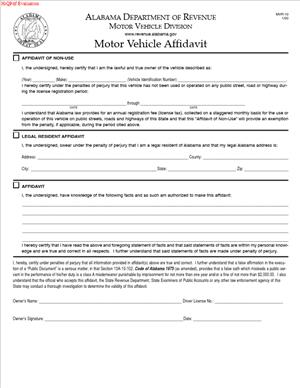
MVR-10 – Motor Vehicle Affidavit
Fill out nowJurisdiction: Country: United States | Province or State: Alabama
The MVR-10 – Motor Vehicle Affidavit is a sworn statement used in connection with motor vehicle matters in Alabama. It allows you to formally declare certain facts about a vehicle when standard documentation is missing, incomplete, or needs clarification.
If you are filling out this form, you are likely dealing with a title issue, ownership question, or correction related to a vehicle record. The form gives you a structured way to explain the situation in writing.
An affidavit is not just a casual statement. When you sign this document, you are confirming that the information is true to the best of your knowledge. That makes accuracy important.
This form is often used by vehicle owners, buyers, sellers, or others involved in a vehicle transfer. It may also be used when a state agency needs additional clarification before processing a title or registration.
Understanding what this document does helps you complete it with confidence. The goal is to clearly state the facts so the motor vehicle record can be updated or processed correctly.
What is MVR-10 – Motor Vehicle Affidavit?
Clear definition
The MVR-10 – Motor Vehicle Affidavit is a written, sworn statement used in motor vehicle transactions in Alabama. It allows a person to certify specific facts about a vehicle under oath.
An affidavit is a formal declaration. By signing it, you confirm that the information provided is true. The form becomes part of the official record connected to the vehicle.
This document is typically used when other paperwork does not fully explain a situation. Instead of submitting informal notes or verbal explanations, you provide a structured written statement.
It does not replace a title, bill of sale, or registration form. Instead, it supports those documents by clarifying facts that may affect ownership or record accuracy.
Who typically uses this form?
Vehicle owners commonly use this form when there is a discrepancy in records. For example, a name may be misspelled on a title, or there may be a missing assignment.
Buyers may use it when a seller cannot provide certain documents. The affidavit helps explain how the buyer came into possession of the vehicle.
Sellers sometimes complete the form to confirm details about a transfer. This may include correcting errors or confirming the circumstances of a sale.
In some cases, heirs or representatives of an estate may use the form to state facts about a deceased owner’s vehicle. The affidavit can help explain the chain of ownership.
Lienholders or other parties with a financial interest in the vehicle may also complete the form if clarification is needed for title processing.
Why might you need this form?
You might need this form when required information is missing from the vehicle’s title history. Instead of delaying the process, the affidavit provides an explanation.
It can be used when correcting clerical errors. For example, if the vehicle identification number was recorded incorrectly, an affidavit may help clarify the correct information.
You may also need it when the circumstances of ownership are unusual. If a vehicle was transferred without a standard bill of sale, the affidavit can document how the transfer occurred.
Another reason is when a signature is unavailable. If one party cannot sign due to specific circumstances, the affidavit may explain why.
In general, this form is used when the state motor vehicle agency needs a sworn explanation before moving forward with a title or registration action.
Typical real-life scenarios
- A common situation involves a title with an error in the owner’s name. The owner completes the affidavit to confirm the correct spelling and explain the mistake.
- Another example is when a buyer purchased a vehicle but never received a properly assigned title. The buyer may use the affidavit to describe the transaction and provide supporting details.
- You might also see this form used when a vehicle was inherited. If the previous owner passed away and certain documents are unavailable, the affidavit can help explain the transfer.
- In some cases, a vehicle identification number may not match prior records due to a typographical error. The affidavit can clarify which number is correct.
- It may also be used when a vehicle was abandoned, gifted, or transferred under unusual conditions. The affidavit allows the person involved to state the facts in a formal way.
When would you use MVR-10 – Motor Vehicle Affidavit?
You would use this form when a motor vehicle record requires clarification. This usually happens during a title transfer, title correction, or registration process.
For example, if you are applying for a new title and the supporting documents do not fully explain the ownership history, you may be asked to complete an affidavit. The form gives context to the transaction.
If you discover an error after submitting paperwork, the affidavit can serve as a written explanation. This may occur when dates, names, or vehicle details do not match existing records.
The form may also be used during a dispute over ownership. In those cases, each party might provide a sworn statement describing their understanding of the facts.
You may encounter this form if you are acting in a representative capacity. For instance, an executor handling a deceased person’s estate might use it to clarify how a vehicle is being transferred.
Dealers, individuals, and private sellers may all use this document when a straightforward transaction becomes complicated by missing or inconsistent paperwork.
In practical terms, you use this form when the standard forms alone are not enough to explain the situation.
Legal characteristics of MVR-10 – Motor Vehicle Affidavit
This document is an affidavit, which means it is a sworn statement of fact. When you sign it, you are declaring that the information is true.
For the form to be effective, it generally must be completed fully and accurately. Missing information, unclear statements, or inconsistencies with other documents can cause delays or rejection.
The affidavit often requires your signature to be notarized. Notarization confirms your identity and that you signed the document voluntarily. Without proper notarization, the submission may not be accepted.
The information provided must match the vehicle’s identifying details. This includes the vehicle identification number, make, model, and year. Even small discrepancies can create processing issues.
High-level procedural requirements may vary depending on the type of transaction involved. For example, a title correction may involve different supporting documents than an ownership transfer. The affidavit supports the process but does not replace the required primary forms.
It is important to understand what this document does not do. It does not automatically grant ownership. It does not override a properly issued title. It does not resolve legal disputes by itself. Instead, it provides sworn information that the motor vehicle agency considers when reviewing a filing.
Is it legally binding?
Yes, an affidavit is generally legally binding in the sense that you are swearing that the information is true. By signing, you are making a formal declaration.
Because it is sworn, providing false information can carry legal consequences. The seriousness of an affidavit is what gives it weight in administrative processes.
However, the form itself does not create ownership rights. It supports a claim or explanation, but the final decision about title or registration depends on the reviewing authority and the total set of documents submitted.
In short, the affidavit binds you to the truth of your statement. It does not, by itself, settle disputes or guarantee a specific outcome.
How to fill out MVR-10 – Motor Vehicle Affidavit
Step 1 – Identify the vehicle
Begin by entering the complete vehicle information exactly as it appears on existing records. This usually includes the vehicle identification number, year, make, and model. Double-check each character of the identification number to avoid errors.
Step 2 – Provide your personal information
Fill in your full legal name and contact details as requested on the form. Use the same name format that appears on your identification and related vehicle documents. If you are acting on behalf of someone else, indicate your capacity clearly.
Step 3 – State the facts clearly
In the main body of the form, describe the situation in plain, direct language. Explain what happened, when it happened, and why the affidavit is necessary. Keep your statement factual and focused on relevant details.
Step 4 – Reference supporting documents
If the form allows space to mention attachments, note any documents that support your statement. This might include copies of titles, bills of sale, or other related paperwork. Make sure the information in your affidavit matches these documents.
Step 5 – Review for accuracy
Read the entire form carefully before signing. Confirm that names, dates, and vehicle details are consistent throughout. Small inconsistencies can slow down processing.
Step 6 – Sign in the required manner
Sign the form exactly as your name appears in the document. If notarization is required, wait to sign until you are in the presence of a notary. The notary will verify your identity and complete the acknowledgment section.
Step 7 – Prepare the form for submission
After signing and notarization, make a copy for your records. Ensure the original document is complete and legible. Submit it along with any required supporting paperwork as part of your motor vehicle filing.
Legal terms you might encounter in MVR-10 – Motor Vehicle Affidavit
- Affiant: The affiant is the person making the sworn statement. On this form, that is you or the individual signing the affidavit. By signing, you confirm that the information you provide is true to the best of your knowledge.
- Notary Public: A notary public is an official who verifies your identity and witnesses your signature. If the form requires notarization, you must sign in front of the notary, not beforehand. The notary then completes their section and applies their seal.
- Sworn Statement: A sworn statement is a written declaration made under oath. When you complete this affidavit, you are legally affirming that the facts are accurate. False statements can lead to penalties because you are swearing to the truth.
- Vehicle Identification Number (VIN): The VIN is the unique 17-character number assigned to a specific vehicle. You must enter it exactly as it appears on the vehicle or title documents. Even one incorrect digit can cause processing delays or rejection.
- Odometer Reading: This is the vehicle’s recorded mileage at a specific point in time. If the form asks for it, you must write the number exactly as shown on the dashboard. Do not round up or estimate.
- Transfer of Ownership: This refers to the legal change of a vehicle’s owner. Your affidavit may support or clarify a transfer when standard documents are missing or contain errors. The statement helps establish who owns the vehicle and why.
- Lienholder: A lienholder is a person or entity with a financial interest in the vehicle, usually due to a loan. If a lien exists, you may need to disclose it in your affidavit. Omitting a lien can create title complications.
- Material Misrepresentation: This means providing false or misleading information that affects the outcome of the record. In an affidavit, any significant inaccuracy can be considered material. You are responsible for ensuring your statements are truthful and complete.
- Effective Date: The effective date is the date the facts in your statement apply or take effect. Some sections may ask when a transfer, correction, or event occurred. Make sure this date matches your supporting documents.
- Supporting Documentation: These are the records you attach to back up your statements. Examples include a bill of sale, title copy, or identification. Clear copies strengthen your affidavit and reduce questions during review.
FAQs
Do I need to sign the MVR-10 – Motor Vehicle Affidavit in front of a notary?
If the document includes a notary section or states that it must be sworn, you must sign it in the presence of a notary public. Do not sign it ahead of time. Bring valid photo identification so the notary can verify your identity and complete their portion.
What information must exactly match my title or registration?
Your full legal name, the vehicle identification number, and the vehicle year, make, and model must match your title or registration record. Even small differences, such as a missing middle initial or a transposed VIN digit, can cause the document to be rejected. Double-check these entries before signing.
What date should I enter as the effective date?
Use the actual date the event occurred, such as the date of sale, transfer, correction, or discovery of an error. Do not use the date you are filling out the form unless that is also the date of the event. The date should align with any attached documents.
What attachments should I include with this form?
Attach clear copies of any documents that support your statement. This may include a bill of sale, a copy of the title, identification, or proof of payment. Only include documents that directly relate to the facts you are swearing to in this document.
What happens after I submit the MVR-10 – Motor Vehicle Affidavit?
The reviewing office examines your statement and attachments to decide whether the requested change or clarification can be processed. If something is missing or inconsistent, you may be contacted for corrections. Keep copies so you can quickly respond if needed.
Can someone else sign this document on my behalf?
Only the person with legal authority over the vehicle or the transaction should sign. If someone signs for another person, they must have proper authority, such as a power of attorney. The name and capacity of the signer must be clearly stated.
Will this form change the public vehicle record immediately?
Changes are not automatic. The information you provide is reviewed before any update is made to the official record. Processing time can vary, and incomplete or unclear information may delay updates.
What if I realize I made a mistake after submitting this form?
Act quickly. Prepare a corrected affidavit or written explanation that clearly identifies the error and provides accurate information. Reference the original submission details so the office can connect the correction to your initial filing.
Checklist: Before, During, and After MVR-10 – Motor Vehicle Affidavit
Before
- Gather your vehicle title, registration, and any related documents.
- Confirm the full legal names of all parties involved.
- Verify the VIN directly from the vehicle or official paperwork.
- Check whether notarization is required.
- Collect valid photo identification.
- Make copies of any supporting documents you plan to attach.
- Review the reason you are completing the affidavit and write down key facts.
- Confirm the correct spelling of addresses and contact information.
During
- Print clearly in black or blue ink if completing by hand.
- Enter the VIN carefully, character by character.
- State facts in chronological order.
- Use exact dates, not estimates.
- Avoid abbreviations unless they are part of official names.
- Review each field before moving to the next.
- Attach supporting documents securely.
- Sign only when all information is complete.
- If required, sign in front of a notary and confirm that the notary fills out their section fully.
After
- Make a complete copy of the signed affidavit and attachments.
- Submit the form through the proper channel.
- Note the date and method of submission for your records.
- Keep proof of delivery if mailing.
- Monitor for any communication about missing information.
- Respond promptly to requests for clarification.
- Store your copy with your vehicle records.
- Update your personal records if ownership or details have changed.
Common mistakes to avoid with MVR-10 – Motor Vehicle Affidavit
- Mistake: Entering an incorrect VIN because you copied it from memory, which happens often and can lead to rejection; always copy it directly from the vehicle or official document and double-check each character.
- Mistake: Signing before meeting with a notary, which occurs when people rush and results in an invalid notarization; do not forget to wait and sign in the notary’s presence.
- Mistake: Leaving sections blank because they seem unimportant, which can delay processing; do not forget to complete every applicable field or clearly mark it if not applicable.
- Mistake: Providing inconsistent dates that do not match attachments, often due to guesswork, which can trigger follow-up questions; do not forget to align all dates with your supporting documents.
- Mistake: Using nicknames or shortened names, which happens out of habit and may not match official records; do not forget to use your full legal name exactly as shown on your identification.
- Mistake: Failing to attach supporting documents because you assume the affidavit alone is enough, which can result in denial; do not forget to include clear copies of relevant paperwork.
- Mistake: Writing vague explanations, which occurs when you try to keep it brief, and can cause confusion; do not forget to state specific facts, including who, what, and when.
- Mistake: Not keeping a copy of the completed form, which is common when filing in person, and leaves you without proof; do not forget to make and store a full copy for your records.
What to do after filling out MVR-10 – Motor Vehicle Affidavit
Once you complete and sign the affidavit, your job is not finished. You need to make sure it is properly submitted and documented.
Start by reviewing the entire packet one more time. Confirm that every page is signed where required and that all attachments are included. Check that the notary section, if applicable, is fully completed with signature, seal, and date.
- Step 1: Make at least one complete copy of the signed affidavit and all attachments.
- Step 2: Organize the original and copies so you can easily reference them.
- Step 3: Submit the original affidavit through the appropriate filing method.
- Step 4: If mailing, use a method that provides confirmation of delivery.
- Step 5: If delivering in person, request a stamped or dated receipt if available.
- Step 6: Record the date of submission in your personal records.
- Step 7: Monitor your mail, email, or phone messages for any response.
- Step 8: Respond promptly if additional documents or corrections are requested.
- Step 9: Once processed, verify that the vehicle record reflects the intended change.
- Step 10: Store your copy with other important vehicle documents.
If the affidavit supports a change in ownership, correction of an error, or clarification of facts, confirm that any related documents, such as updated titles or registration records, are issued correctly. Review them carefully for accuracy. If something is still incorrect, address it quickly while your original submission is recent and easy to reference.
Keep your paperwork in a secure location. Vehicle records can affect taxes, registration, insurance, and future sales. Having a clear paper trail protects you if questions arise later. Staying organized now saves time and stress down the road.
Disclaimer: This guide is provided for informational purposes only and is not intended as legal advice. You should consult a legal professional.