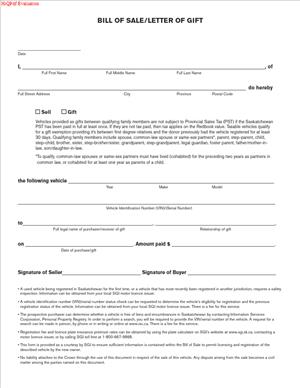
Bill of Sale or Letter of Gift
Fill out nowJurisdiction: Country: Canada | Province or State: Saskatchewan
A Bill of Sale or Letter of Gift is a written record that confirms a vehicle has been transferred from one person to another. In Saskatchewan, this document is commonly used when a vehicle changes ownership through a sale or as a gift.
If you are buying, selling, or receiving a vehicle, the Bill of Sale or Letter of Gift helps show who transferred the vehicle, who received it, and under what terms. It creates a clear paper trail for registration and licensing purposes.
This document matters because vehicle ownership is tied to registration records. Without written proof of the transfer, it can be difficult to complete the registration process or resolve disputes about ownership.
You may be filling out this form because you are selling a car privately, transferring a vehicle to a family member, or giving a vehicle away. In each case, the document confirms the details of the transfer in writing.
Understanding what goes into the Bill of Sale or Letter of Gift will help you complete it accurately and avoid delays when you submit your registration documents.
What is the Bill of Sale or Letter of Gift?
Clear definition
A Bill of Sale or Letter of Gift is a written document that records the transfer of ownership of a vehicle from one person to another. It identifies the parties involved, describes the vehicle, and sets out the terms of the transfer.
When used as a bill of sale, it states that the vehicle was sold and usually includes the purchase price. When used as a letter of gift, it confirms that the vehicle was given without payment.
In both cases, the document serves as evidence that ownership has changed hands. It supports the vehicle registration process by showing how and when the transfer occurred.
Who typically uses this form?
Private sellers and buyers commonly use this document when a vehicle is sold outside of a dealership. It is typical in person-to-person transactions involving cars, trucks, motorcycles, trailers, or other registered vehicles.
Family members often use a gift letter when transferring a vehicle between relatives. For example, a parent may give a vehicle to a child, or a spouse may transfer a vehicle to the other spouse.
Anyone receiving a vehicle as part of a personal arrangement, rather than through a commercial sale, may need this document to show how they obtained the vehicle.
Why might you need this form?
You may need a Bill of Sale or Letter of Gift to complete a vehicle registration or transfer process. Registration authorities generally require proof of ownership before updating their records.
This document also protects both parties. For the seller or donor, it shows the date the vehicle was transferred. For the buyer or recipient, it confirms the right to claim ownership.
If questions arise about the purchase price, the date of transfer, or the condition of the vehicle at the time of sale, this written record can help clarify what was agreed.
Without a properly completed document, the transfer process may be delayed. Missing information can lead to requests for corrections or additional paperwork.
Typical real-life scenarios
- You sell your used car to a neighbour. You agree on a price, exchange payment, and hand over the keys. A bill of sale records the details of that transaction so the buyer can register the vehicle in their name.
- You give your old truck to your adult child who has just moved to a new city. A letter of gift confirms that the vehicle was transferred without payment and identifies both of you as the parties to the transfer.
- You and your spouse separate your property, and one of you takes ownership of a jointly used vehicle. A written document helps show the transfer from one registered owner to another.
- You purchase a used motorcycle from a private seller through an online listing. The bill of sale confirms the agreed price, the vehicle identification number, and the date of transfer.
- An elderly relative decides to stop driving and transfers their vehicle to a grandchild. A letter of gift helps formalize that transfer so the grandchild can register and insure the vehicle.
When would you use the Bill of Sale or Letter of Gift?
You would use this document whenever a registered vehicle changes ownership in a private transaction. It is most common in situations where no dealership is involved.
If you are the seller, you use the bill of sale at the time of transfer. It records the key details of the transaction on the same day you give up possession of the vehicle.
If you are giving a vehicle as a gift, you use the letter of gift to clearly state that no money was exchanged. This distinction can be important during the registration process.
You might also use this document when transferring a vehicle between related parties, such as between spouses, parents and children, or other family members. Even when no money changes hands, written confirmation supports the administrative process.
In some cases, multiple owners may be listed on a vehicle registration. When one owner transfers their interest to another person, a written record helps document that change.
The form may also be used when settling personal arrangements, such as dividing property or restructuring ownership of a family vehicle.
Legal characteristics of Bill of Sale or Letter of Gift
A Bill of Sale or Letter of Gift is generally effective when it clearly identifies the parties, accurately describes the vehicle, and states the terms of the transfer. Key details often include the full legal names of the parties, their addresses, the vehicle identification number, make, model, and year.
The document typically includes the date of transfer. This date can be important for determining when responsibility for the vehicle changes from one person to another.
Signatures are a central feature. Both parties commonly sign the document to confirm that the information is accurate and that the transfer occurred as stated. Incomplete or missing signatures can create problems during submission.
Common issues that lead to delays include incorrect vehicle identification numbers, mismatched names compared to identification documents, or unclear statements about whether the vehicle was sold or gifted.
A Bill of Sale or Letter of Gift does not, by itself, complete the registration process. It is one part of the overall transfer. You may need to submit additional forms or documents when updating vehicle registration records.
This document also does not automatically guarantee the condition of the vehicle unless specific statements are included. Many private sales are completed on an “as is” basis, meaning no promises are made about future performance.
Different jurisdictions may have varying administrative requirements, such as whether the document must be witnessed or include specific wording. While the core purpose remains the same, small formatting or content differences can affect acceptance.
Is it legally binding?
A properly completed Bill of Sale or Letter of Gift is generally considered a legally binding record of the transfer between the parties. It reflects an agreement that ownership moved from one person to another on a specific date and under stated terms.
When used as a bill of sale, the document shows that a sale occurred in exchange for payment. When used as a letter of gift, it shows that the transfer was made voluntarily and without payment. In both cases, the written agreement helps establish the intention of the parties.
The binding effect usually depends on clear terms and proper execution. If key details are missing, incorrect, or ambiguous, it may be harder to rely on the document as proof of the transfer.
While the document can serve as evidence of ownership transfer, it does not replace official registration. Legal ownership, in practical terms, is often tied to registration records, which must be updated through the appropriate process.
How to fill out the Bill of Sale or Letter of Gift
Step 1 – Title
At the top of the document, clearly indicate whether it is a bill of sale or a letter of gift. The title should match the nature of the transfer. This helps avoid confusion about whether money was exchanged.
Step 2 – Date of transfer
Enter the full date when the vehicle changes hands. Use a clear format that includes the day, month, and year. This date should reflect when possession and control of the vehicle were transferred.
Step 3 – Seller or donor information
Write the full legal name of the person transferring the vehicle. Include their current address as it appears on identification or registration records. Ensure the spelling matches official documents.
Step 4 – Buyer or recipient information
Provide the full legal name of the person receiving the vehicle. Include their complete address. Double-check that the information is accurate and legible to prevent processing issues.
Step 5 – Vehicle description
Enter the vehicle’s details exactly as they appear on the registration. This typically includes the year, make, model, and vehicle identification number. Accuracy is critical, especially for the identification number.
Step 6 – Purchase price or statement of gift
If the vehicle was sold, state the agreed purchase price in clear numerical form. If the vehicle was given as a gift, include a clear statement that it was transferred without payment. Avoid vague wording.
Step 7 – Additional terms, if any
If there are specific conditions agreed between the parties, such as included accessories or timing of payment, record them clearly. Keep the language simple and direct so the terms are easy to understand.
Step 8 – Signatures
Both parties sign the document in the spaces provided. Sign using your usual legal signature. The signatures confirm that the information is correct and that the transfer occurred as described.
Step 9 – Keep copies
After signing, ensure that each party has a complete copy of the signed document. Copies serve as records in case questions arise later during registration or about the transfer itself.
Legal terms you might encounter in the Bill of Sale or Letter of Gift
- Transferor: This is the person who is giving or selling the vehicle. In this document, the transferor must match the name shown on the current vehicle registration. If the name does not match exactly, the transfer may be delayed or rejected when you try to register the vehicle.
- Transferee: This is the person receiving the vehicle, either by purchase or as a gift. The transferee’s full legal name must be written clearly. The name should match the identification the person will use when registering the vehicle.
- Vehicle Identification Number (VIN): The VIN is a unique 17-character code assigned to the vehicle. You must copy it exactly as it appears on the vehicle and registration documents. Even one incorrect character can cause problems when transferring ownership.
- Consideration: Consideration means the amount of money paid for the vehicle. If the vehicle is sold, you must state the purchase price. If it is a gift, you will usually write that no consideration was paid and that the vehicle is transferred as a gift.
- Odometer Reading: This is the number of kilometres shown on the vehicle’s odometer at the time of transfer. Recording it creates a record of the vehicle’s usage. An inaccurate or missing odometer reading can raise questions about the vehicle’s history.
- As Is: This term means the buyer accepts the vehicle in its current condition. If the document states “as is,” the seller is not promising that the vehicle is free from defects. You should understand this before signing.
- Lien: A lien is a legal claim against the vehicle, usually because of an unpaid loan. If a lien exists, the vehicle cannot be freely transferred until it is cleared. The presence of a lien can prevent registration in the new owner’s name.
- Date of Transfer: This is the exact date when ownership changes hands. It is important because it affects insurance, registration deadlines, and responsibility for tickets or accidents. You must ensure this date is accurate and agreed upon by both parties.
- Signature: A signature confirms that the information on the document is true and that both parties agree to the transfer. Some forms may require printed names along with signatures. Unsigned documents are not valid proof of transfer.
FAQs
Do I need to use the exact legal names on the Bill of Sale or Letter of Gift?
Yes. You should write the full legal names exactly as they appear on government-issued identification and the current vehicle registration. If the seller’s name on this document does not match the registered owner, the transfer may be refused. Check spelling, middle initials, and hyphenated names before signing.
What date should I enter as the date of transfer?
You should enter the actual calendar date when the vehicle changes hands. This is usually the day the buyer pays and takes possession, or the day the gift is given. Do not backdate or postdate the document. The date you write affects registration timelines and may determine who is responsible for the vehicle on that day.
What if I make a mistake while filling out this form?
Avoid crossing out or using correction fluid if possible. If you make a significant mistake, it is usually better to complete a new copy. Changes that are not initialed by both parties can create doubts about accuracy. Make sure both parties review the final version before signing.
Do I need to record the odometer reading even if the vehicle is a gift?
Yes. The odometer reading should reflect the vehicle’s mileage at the time of transfer, whether it is sold or gifted. This information helps create an accurate vehicle history record. Write the number exactly as it appears on the dashboard.
What happens if there is a lien on the vehicle?
If a lien is registered against the vehicle, it must generally be cleared before ownership can be fully transferred. You should confirm whether any money is still owed. Transferring a vehicle with an active lien can delay or block registration in the new owner’s name.
Do both parties need to sign this document?
Yes. Both the seller or donor and the buyer or recipient must sign to confirm the transfer. Unsigned forms are not valid proof of ownership change. Make sure signatures are added after all details are completed.
Is a separate document required if the vehicle is being gifted to a family member?
If you are using a Bill of Sale or Letter of Gift, you should clearly state that the vehicle is transferred as a gift and that no payment was made. Some situations may require additional proof of relationship or declarations, so confirm what information must accompany this form before attending a registration office.
What should I bring when registering the vehicle after completing this form?
Bring the completed and signed document, valid identification, and the current vehicle registration. You may also need proof of insurance and payment for applicable fees. Make sure all information on your identification matches what appears on this form to avoid processing delays.
Checklist: Before, During, and After Bill of Sale or Letter of Gift
Before
- Confirm the seller is the registered owner of the vehicle.
- Check that there are no outstanding liens or loans on the vehicle.
- Inspect the vehicle and verify that the VIN on the vehicle matches the registration.
- Agree on the purchase price or confirm that the transfer is a gift.
- Gather the required identification for both parties.
- Review any registration or insurance requirements for the transfer.
- Prepare a clean, blank copy of the document to avoid corrections.
During
- Write the full legal names of both parties clearly and accurately.
- Enter the complete and correct VIN without errors.
- Record the exact odometer reading at the time of transfer.
- State the purchase price or clearly indicate that it is a gift.
- Insert the correct date of transfer.
- Review all information together before signing.
- Ensure both parties sign and print their names where required.
After
- Make copies of the signed document for both parties.
- Provide the buyer or recipient with the original signed copy if required for registration.
- Remove licence plates if required before handing over the vehicle.
- Cancel or update insurance coverage as appropriate.
- Notify the registration authority if required.
- Keep your copy in a safe place for your records.
- Confirm that the new owner completes registration within the required time.
Common mistakes to avoid with the Bill of Sale or Letter of Gift
- Mistake: Writing nicknames instead of full legal names because it feels informal, which can cause registration delays or rejection; do not forget to match names exactly to identification and registration documents.
- Mistake: Entering an incorrect VIN due to copying it quickly, which can invalidate the transfer record; do not forget to double-check every character against the vehicle and paperwork.
- Mistake: Leaving the purchase price blank when the vehicle is sold because payment was made in cash, which can create tax and registration issues; do not forget to clearly state the agreed amount.
- Mistake: Failing to record the odometer reading because it seems unimportant, which can raise concerns about vehicle history; do not forget to write the exact mileage at transfer.
- Mistake: Forgetting to check for liens because you assume the vehicle is paid off, which can prevent ownership transfer; do not forget to confirm the vehicle is free of financial claims.
- Mistake: Signing the document before all information is filled in because you trust the other party, which can allow changes later; do not forget to review the completed form before adding your signature.
- Mistake: Using correction fluid or heavy cross-outs after making errors, which can make the document look altered and suspicious; do not forget to start a fresh copy if major corrections are needed.
- Mistake: Delaying registration after signing because you think the document alone transfers ownership automatically, which can lead to penalties or liability issues; do not forget to complete the registration process promptly.
What to do after filling out the Bill of Sale or Letter of Gift
Once the document is fully completed and signed, your job is not over. You must take practical steps to protect yourself and ensure the ownership transfer is properly recorded.
Start by organizing your paperwork. Make at least two clear copies of the signed document. Each party should keep one copy. If possible, scan a digital version and store it securely.
- Step 1: Give the appropriate copy to the buyer or recipient so they can register the vehicle.
- Step 2: Remove your licence plates from the vehicle if required before it leaves your possession.
- Step 3: Cancel or update your vehicle insurance coverage effective on the date of transfer.
- Step 4: Confirm that the buyer or recipient obtains insurance before driving the vehicle.
- Step 5: Submit or present the signed document to the vehicle registration authority when applying for ownership transfer.
- Step 6: Bring matching identification and any supporting documents required for registration.
- Step 7: Pay any applicable fees or taxes at the time of registration.
- Step 8: Obtain confirmation that the ownership has been successfully updated in the official records.
- Step 9: Store your copy of the document with other important records, such as past registrations and insurance confirmations.
After registration is processed, check that the new registration document reflects the correct name, vehicle details, and date. Errors should be corrected immediately to avoid future complications.
If you were the seller or donor, monitor your records for a short period to ensure you are no longer associated with the vehicle in official systems. This reduces the risk of being contacted about future tickets, tolls, or incidents.
Finally, update your personal records. Remove the vehicle from any asset lists, financial statements, or internal logs you maintain. Keeping your records current helps prevent confusion later.
By taking these steps promptly, you protect yourself and ensure that the transfer of ownership is clear, documented, and properly recorded.
Disclaimer: This guide is provided for informational purposes only and is not intended as legal advice. You should consult a legal professional.