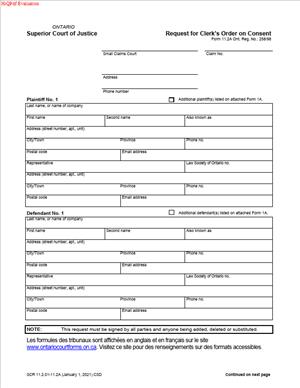
Form 11.2A – Request for Clerk’s Order on Consent
Fill out nowJurisdiction: Country: Canada | Province or State: Ontario
Form 11.2A – Request for Clerk’s Order on Consent is a court document used when everyone involved agrees on the terms of an order and wants the court to issue it without a judge hearing the matter. It is designed for situations where there is no dispute about the outcome.
This form matters because it turns an agreement into a formal court order. An agreement on its own is often not enforceable in the same way as an order. This document bridges that gap.
People often encounter this form when they are already partway through a court case. The issues have narrowed, discussions have happened, and consensus has been reached.
If you are about to fill out this form, you are likely looking for clarity. You want to understand what information the court expects and how the document functions in the process.
This overview focuses on how the form works in practice. It explains the purpose, common uses, and the structure you will see when completing it.
What is Form 11.2A – Request for Clerk’s Order on Consent?
Clear definition
Form 11.2A – Request for Clerk’s Order on Consent is a written request asking a court clerk to issue an order based on the parties’ shared consent. The clerk issues the order administratively, without a judge reviewing contested evidence.
The form reflects that all required parties agree to the exact wording of the order. The clerk relies on that confirmation when issuing the order.
This document is part of the Superior Court of Justice process in Ontario. It is used within an existing court file.
The form does not decide new issues. It records and formalizes an outcome everyone has already accepted.
Who typically uses this form/document?
This form is commonly used by people who are already named in a court case. That includes applicants, respondents, plaintiffs, defendants, or other parties, depending on the type of proceeding.
Self-represented individuals often use this document after reaching an agreement through discussion, negotiation, or informal settlement. Lawyers also use it, but the form is structured so non-lawyers can complete it.
It is typically used when all parties have legal capacity to consent. The court relies on that shared consent rather than adjudicating disagreements.
The form may also be used by parties who want to finalize procedural steps, such as timelines or document exchanges, when there is no disagreement.
Why you might need this form/document
You might need this form when you want the court record to reflect what everyone has agreed to. An informal agreement may not be enough to move the case forward.
A clerk’s order can create clarity. It sets out obligations, deadlines, or outcomes in a formal way that the court recognizes.
This form is often used to avoid unnecessary court appearances. When there is nothing to argue about, a hearing may not be needed.
Using this document can also help close part of a case. It can narrow the remaining issues or finalize a specific aspect of the proceeding.
Typical real-life scenarios
- Two parties in a civil case agree on an extension of time to exchange documents. Rather than attend court, they document their agreement and request a clerk’s order to make the new timeline official.
- In a family-related matter, the parties agree on a procedural change, such as the adjournment of a motion. They use the form to record that consent so the court file reflects the change.
- In an ongoing dispute, the parties settle one issue but not others. They use this form to turn the settled issue into an enforceable order while the rest of the case continues.
- After negotiations, parties agree on costs or another limited issue. The form is used to request that the clerk issue an order reflecting that agreement.
When would you use Form 11.2A – Request for Clerk’s Order on Consent?
This form is used when there is full agreement on the content of the order being requested. There is no dispute left for the court to resolve on that specific issue.
It is commonly used during an active case, not at the very beginning. There is usually already a court file number and defined parties.
The form is often used after discussions between parties have concluded. Those discussions may happen directly, through correspondence, or with professional assistance.
Typical roles involved include the parties themselves and, indirectly, the court clerk. A judge is usually not involved at this stage because the request is based on consent.
This document is not limited to one type of case. It appears in different kinds of proceedings where the rules allow clerks to issue orders on consent.
Legal characteristics of Form 11.2A – Request for Clerk’s Order on Consent
This form is effective because it communicates consent clearly and in writing. The court relies on that clarity to issue an order without further inquiry.
Accuracy matters. Clerks typically rely on the information exactly as written. Missing details, inconsistent terms, or unclear wording can delay issuance.
Common problems include incomplete party information, mismatched file numbers, or consent that is not properly indicated. These issues can prevent the clerk from issuing the order.
The form operates within specific procedural rules. While the general concept is similar across jurisdictions, the authority of a clerk and acceptable content may vary.
This document does not replace a settlement agreement between the parties. It also does not resolve disputes that still exist. It only covers what is clearly agreed.
Is it legally binding?
Once the clerk issues the order, it carries the same legal effect as other court orders within the same proceeding. The binding nature comes from the court’s authority, not from the form itself.
The order reflects the consent given at the time of signing. If consent was not genuine or complete, that can raise issues later, but the form assumes valid consent.
Before issuance, the document is a request. After issuance, the resulting order becomes part of the court record and can be relied on as such.
How to fill out Form 11.2A – Request for Clerk’s Order on Consent
Step 1 – Court information and file details
This step captures where the case is being heard and how it is identified. It usually includes the court name, location, and the existing court file number. This information connects the request to the correct proceeding.
Accuracy here helps ensure the request is routed properly. Clerks use these details to locate the correct file and confirm they have authority to issue the order.
Step 2 – Party names and roles
This section lists the parties involved in the case and their roles, as they appear in the court file. The names must match the existing record.
Clear identification matters because the order will apply only to the parties listed. The clerk relies on this section to confirm who is bound by the consent.
Step 3 – Statement of consent
This part of the form indicates that all required parties agree to the order being requested. It communicates that there is no dispute about the terms.
The language in this section is typically brief and direct. Its purpose is to confirm shared agreement, not to explain negotiations or background.
Step 4 – Terms of the proposed order
This step sets out the exact wording of the order the clerk is being asked to issue. Precision matters because the issued order will mirror this language.
The terms usually describe actions, timelines, or outcomes that the parties have already accepted. Ambiguity here can cause delays or confusion later.
Step 5 – Signatures confirming consent
This section records the signatures of the parties or their authorized representatives. Signatures show that consent is current and intentional.
The clerk relies on these signatures to confirm that the request reflects a shared position at the time of submission.
Step 6 – Date and administrative details
The final step includes dates and any additional administrative information required by the form. This helps situate the request within the timeline of the case.
Once this information is complete, the form presents a full picture for the clerk to review and, where appropriate, issue the order based on consent.
Legal terms you might encounter in Form 11.2A – Request for Clerk’s Order on Consent
- Clerk’s Order: This is an order issued by a court clerk rather than a judge. In this document, you are asking the clerk to sign an order because all parties agree to the terms. The clerk relies entirely on what you submit, so accuracy and completeness matter.
- Consent: Consent means that every party affected by the order agrees to it. In this form, consent must be clear, current, and given by someone with authority to bind the party. The clerk does not resolve disagreements, so consent must already exist.
- Proposed Order: This is the draft order you want the clerk to issue. The form usually refers to it as an attachment or schedule. The clerk signs this document if it matches the request and shows proper consent.
- Moving Party: This is the party asking the court to make the order. Even though the order is on consent, one party usually takes responsibility for preparing and submitting the paperwork. Your role affects how you list yourself on the form.
- Responding Party: This is any other party that must consent to the order. Their names must match the court file exactly. If a responding party is missing or misnamed, the clerk may refuse to issue the order.
- Court File Number: This number identifies your case in the court system. It must be written exactly as it appears on prior documents. The clerk uses this number to place the order into the correct file.
- Effective Date: This is the date the order takes effect. Sometimes it is the date the clerk signs it. Sometimes the order specifies a different date, which must be clearly stated in the proposed order.
- Authority to Sign: This refers to the legal ability of a person to sign on behalf of a party. In this document, the clerk assumes the signer has authority. If that assumption is wrong, the order may later be challenged.
- Schedule or Attachment: These are extra pages attached to the form, often including the proposed order itself. They are considered part of what the clerk reviews. Missing or inconsistent attachments can stop the process.
FAQs
What does Form 11.2A – Request for Clerk’s Order on Consent actually ask the court to do?
This form asks the court clerk to issue an order without a judge because everyone agrees. You are not asking for a decision. You are asking for confirmation of an agreement in the form of a court order.
Where do I show that everyone agrees in this document?
You show agreement through signatures and clear wording. Each party, or their authorized representative, signs to confirm consent. The clerk looks for matching names and signatures before issuing the order.
What names should I use if a party’s name has changed since the case started?
You must use the name exactly as it appears on the court file. If someone has a different name now, that change needs to be addressed elsewhere, not corrected informally in this document.
Do I need to attach anything when submitting this form?
Yes. The clerk expects to see the proposed order attached. If the form refers to schedules or attachments, they must be included and clearly labeled so the clerk knows what to sign.
How do I choose the effective date of the order?
Look at the wording in the proposed order. If it says the order is effective on signing, no extra date is needed. If it is meant to take effect earlier or later, that date must be written clearly and consistently.
Who is allowed to sign on behalf of a party?
The signer must have authority to bind the party. This could be the party itself or an authorized representative. The clerk does not investigate authority, so you must be confident the signer is entitled to sign.
What happens if the clerk does not accept this form?
If the clerk finds a problem, the order is not issued. You may receive a notice explaining what is missing or unclear. You then correct the issue and resubmit this document.
Will this form change what appears in the public court record?
Yes. Once accepted, the signed order becomes part of the court file. Anyone reviewing the file will see the order and rely on it as an official record of what was agreed.
Checklist: Before, During, and After Form 11.2A – Request for Clerk’s Order on Consent
Before
- Confirm all parties fully agree to the exact wording of the proposed order.
- Check the court file number against earlier documents.
- Verify every party’s name matches the court record exactly.
- Prepare the proposed order in final form with no blanks.
- Confirm who will sign for each party and their authority.
- Review the form for any required attachments or schedules.
- Decide on the effective date and confirm everyone agrees.
- Make clean copies of everything for your records.
During
- Enter the court name and file number carefully.
- List parties in the same order used in the case.
- Clearly indicate that the request is made on consent.
- Attach the proposed order and label it clearly.
- Obtain all required signatures before submission.
- Check that dates are consistent across all pages.
- Review the completed package as if you were the clerk.
After
- Submit the form and attachments using the accepted filing method.
- Keep proof of submission or filing confirmation.
- Monitor for acceptance or rejection by the clerk.
- Save a copy of the signed order once issued.
- Share the issued order with all parties.
- Update your own records and calendars based on the order.
- Follow any next steps required by the terms of the order.
Common mistakes to avoid with Form 11.2A – Request for Clerk’s Order on Consent
- Mistake: Using a shortened or updated party name, because it feels accurate, which leads to a mismatch with the court file and delays issuance, so do not forget to copy names exactly as they appear.
- Mistake: Attaching a draft order that does not match the request, because changes were made late, which can cause rejection, so do not forget to confirm the final version is attached.
- Mistake: Missing a required signature, because you assumed verbal agreement was enough, which prevents consent from being proven, so do not forget to collect all signatures first.
- Mistake: Leaving dates blank or inconsistent, because you planned to fill them in later, which creates uncertainty, so do not forget to finalize dates before filing.
- Mistake: Assuming the clerk will correct small errors, because they seem obvious, which can stop the order from being issued, so do not forget that the clerk only signs what you submit.
- Mistake: Submitting without reviewing attachments, because the form looks complete, which can separate the request from the order, so do not forget to check the full package.
- Mistake: Filing under the wrong case number, because you have multiple matters, which misfiles the order, so do not forget to verify the file number.
- Mistake: Forgetting to keep copies, because you expect online access later, which makes follow-up harder, so do not forget to save your own records.
What to do after filling out Form 11.2A – Request for Clerk’s Order on Consent
Once you have completed the form and attached the proposed order, your focus shifts to submission, confirmation, and follow-through. This is where many self-represented people lose momentum. Treat this phase as part of the same task, not an afterthought. You want a clear record showing what you submitted, when you submitted it, and what the court did with it.
Start by organizing your documents into one complete package. This includes the form, the proposed order, and any schedules. Make sure the pages are in a logical order and easy to read. A clean package helps the clerk process it without questions.
- Step 1: Make at least one complete copy of everything for yourself.
- Step 2: Submit the package using the filing method accepted for your case.
- Step 3: Note the date and method of submission in your own records.
- Step 4: Watch for confirmation that the clerk has accepted or issued the order.
- Step 5: If the order is issued, obtain a copy showing the clerk’s signature.
- Step 6: Review the issued order to confirm it matches what you requested.
- Step 7: Share the issued order with all other parties promptly.
- Step 8: Update any personal files, calendars, or obligations affected by the order.
- Step 9: If the clerk raises an issue, correct it carefully and resubmit.
- Step 10: Keep all versions and correspondence together for future reference.
Staying organized after submission protects you if questions arise later. The issued order is not just paperwork. It is a record that others may rely on, including you. Treat it as a final, important document in your case file.
Disclaimer: This guide is provided for informational purposes only and is not intended as legal advice. You should consult a legal professional.