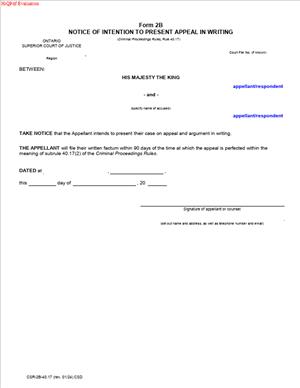
Form 2B – CSR-2B-40.17- Notice of Intention to Present Appeal in Writing
Fill out nowJurisdiction: Country: Canada | Province or State: Ontario
The Form 2B – CSR-2B-40.17- Notice of Intention to Present Appeal in Writing is a court document used in criminal matters before the Ontario Superior Court of Justice. It tells the court that you plan to present your appeal in writing rather than through an in-person oral hearing.
If you are representing yourself, this form can feel technical at first glance. Its purpose is straightforward. You are formally notifying the court and the other party that you want your appeal decided based on written materials.
This document does not explain your full argument. Instead, it confirms how you intend to proceed with the appeal. It helps the court organize the process and schedule.
Understanding this form matters because appeal procedures follow strict rules. Filing the wrong document, or filing it late, can delay your case or affect how your appeal is handled.
When you fill it out carefully and submit it properly, you make your intentions clear and keep your appeal moving in an orderly way.
What is Form 2B – CSR-2B-40.17- Notice of Intention to Present Appeal in Writing?
Clear definition
Form 2B – CSR-2B-40.17- Notice of Intention to Present Appeal in Writing is a procedural notice used in criminal appeal matters before the Ontario Superior Court of Justice. It informs the court that the person appealing, or in some cases the respondent, intends to rely on written submissions instead of appearing to argue the case orally.
In simple terms, it is a communication to the court about format. You are not arguing your case in this form. You are stating how you want the appeal to be considered.
The form becomes part of the official court file. Once submitted, it signals that the appeal may be decided based on written materials, subject to the court’s rules and any directions from a judge.
Who typically uses this form?
This form is commonly used by appellants in criminal matters. The appellant is the person who is challenging a conviction, sentence, or other decision from a lower court.
In some situations, the respondent, often the Crown, may also use a similar notice to confirm that they agree to proceed in writing. Self-represented individuals frequently encounter this form because written appeals are often used where the issues are narrow or primarily legal.
People who are in custody may use written appeals because transportation and scheduling for oral hearings can be complex. Others may choose written submissions because they believe their arguments are clearer on paper.
Why might you need this form?
You may need this form if you have already filed a notice of appeal and now must tell the court how you plan to present it. Court rules often require formal notice if you choose to proceed without an oral hearing.
This form helps manage court time. Written appeals can be reviewed by a judge without setting aside time for in-court arguments.
You might also use it if the issues on appeal involve interpreting legal principles rather than disputing facts. Written submissions allow you to set out your reasoning in detail.
Filing this notice ensures transparency. The other party is informed that the matter may be decided based solely on written arguments and filed materials.
Typical real-life scenarios
- You were convicted in a provincial offences court and believe the judge made a legal error. You filed a notice of appeal and now decide that your grounds are clear in writing. You submit this form to confirm you will not be attending for oral argument.
- You are appealing a sentence and believe the transcript and written submissions are enough for the judge to review. Instead of requesting a hearing date, you notify the court of your intention to proceed in writing.
- You are self-represented and live far from the courthouse. Travel is difficult. You choose to present your arguments in written form and file this notice to reflect that choice.
- The Crown and the appellant agree that the legal issue is straightforward. Both sides indicate their intention to rely on written submissions, reducing the need for a courtroom appearance.
- In each of these situations, the form does not decide the appeal. It simply shapes the process by which the judge will review it.
When would you use Form 2B – CSR-2B-40.17- Notice of Intention to Present Appeal in Writing?
You would use this form after an appeal has been started but before the appeal is heard. It comes into play when the court needs to know whether the matter will proceed by oral hearing or written argument.
Timing is important. Appeals follow structured steps, including filing transcripts, preparing appeal books, and serving documents on the other party. This notice fits into that sequence once you are ready to confirm the format of your hearing.
Appellants most often use it, but respondents may also be involved in confirming agreement with written proceedings. In many cases, court rules set deadlines for advising the court of your intention.
This form is not used to start an appeal. That requires a different document, often called a notice of appeal. Instead, it follows that earlier filing and builds on it.
You may also encounter situations where a judge directs the parties to advise whether they wish to proceed in writing. In that case, this notice formalizes your response.
Legal characteristics of Form 2B – CSR-2B-40.17- Notice of Intention to Present Appeal in Writing
This form is procedural. Its legal effect comes from court rules that require parties to notify the court about how they intend to present their appeal.
For it to be effective, it generally must be completed accurately, signed where required, and filed within any applicable deadline. It must also be served on the other party if the rules require service.
Common problems include missing file numbers, incorrect party names, or failing to sign the document. Another frequent issue is filing it after the deadline set by the rules or by court direction.
If the form is incomplete or inconsistent with earlier filings, the court may request corrections. In some cases, the court may still require an oral hearing, even if you file this notice.
Procedural requirements can vary slightly depending on the type of criminal appeal and the level of court involved. While the core purpose remains the same, filing methods and timelines may differ depending on the specific circumstances.
It is also important to understand what this form does not do. It does not set out your grounds of appeal. It does not replace written submissions. It does not extend deadlines automatically. It simply communicates your intention about the format of the appeal.
Is it legally binding?
The Form 2B – CSR-2B-40.17- Notice of Intention to Present Appeal in Writing is not a contract between parties. It is a formal notice to the court. Its effect is procedural rather than contractual.
Once filed, it reflects your stated intention. The court may rely on it when scheduling and reviewing the appeal. However, the court retains control over its own process.
In some situations, a judge may decide that an oral hearing is necessary, even if a notice to proceed in writing has been filed. In other cases, the court may accept the written format without further appearance.
So while the form does not bind the court in the same way an agreement binds parties, it does carry weight in managing how your appeal proceeds.
How to fill out Form 2B – CSR-2B-40.17- Notice of Intention to Present Appeal in Writing
Step 1 – Identify the court and file number
At the top of the form, enter the full name of the court as it appears on your appeal documents. Include the court file number exactly as assigned. This number links your notice to the correct appeal file.
Step 2 – List the parties
Write the full legal names of the appellant and the respondent as shown on the notice of appeal. Make sure the spelling and order match the existing court record. Consistency avoids confusion or rejection.
Step 3 – State your intention clearly
In the main body of the form, indicate that you intend to present the appeal in writing. The wording is usually structured, so you complete or confirm the statement provided. Read it carefully before signing.
Step 4 – Provide contact information
Enter your current mailing address and any other required contact details. If you are self-represented, this information tells the court where to send notices and decisions. Ensure it matches what is already on file, or update it if it has changed.
Step 5 – Sign and date the form
Sign your name in the space provided. Print your name if required. Add the date you are signing. The signature confirms that the information is accurate to the best of your knowledge.
Step 6 – Arrange for service if required
If the rules require that the other party receive a copy, prepare to serve the completed form according to accepted methods. Keep proof of service if the procedure calls for it, as this may need to be filed with the court.
Step 7 – File the form with the court
Submit the completed document to the appropriate court office. This may be done in person or through another accepted filing method. Make sure it is filed within any deadline that applies to your appeal process.
Step 8 – Keep copies for your records
After filing, keep a copy of the signed and filed form for yourself. Store it with your other appeal documents. Having a complete record helps you track the progress of your case and respond to any future court communication.
Legal terms you might encounter in Form 2B – CSR-2B-40.17- Notice of Intention to Present Appeal in Writing
- Appellant: The appellant is the person who filed the appeal. If you are challenging a criminal decision from a lower court, you are the appellant. Your name must appear exactly as it does in the original court record.
- Respondent: The respondent is the other party in the appeal. In a criminal case, this is usually the Crown. You must correctly identify the respondent because this affects who must be served with your notice.
- Appeal Record: The appeal record is the collection of documents from the lower court that the appeal court will review. This can include transcripts, exhibits, and written reasons. Your decision to proceed in writing does not replace the need for a proper record.
- Written Submissions: Written submissions are your legal arguments set out in writing. By filing this notice, you are telling the court you want your appeal decided based on written material rather than oral argument.
- Oral Hearing: An oral hearing is when parties appear before a judge to argue the appeal in person or by video. This form confirms that you do not intend to attend an oral hearing and instead want the appeal decided in writing.
- Service: Service means formally delivering a copy of the document to the other party. You must follow proper service rules so the respondent knows you intend to proceed in writing.
- Filing: Filing means submitting the completed form to the court office so it becomes part of the official court record. The court only acts on documents that are properly filed.
- Court File Number: This is the unique number assigned to your case. It connects your notice to the correct appeal. If you enter the wrong number, the court may not attach the form to your file.
- Judgment Under Appeal: This refers to the specific decision you are challenging. You must ensure your notice relates to the correct judgment and date so there is no confusion about what is being reviewed.
FAQs
Do I need to file Form 2B – CSR-2B-40.17- Notice of Intention to Present Appeal in Writing if I already filed my notice of appeal?
Yes. Your original notice of appeal starts the appeal process. This form serves a different purpose. It tells the court how you want the appeal decided. If you want the judge to decide based only on written materials, you must clearly state that intention in this document.
What exactly am I telling the court by submitting this document?
You are confirming that you do not want to appear for an oral hearing. You are asking the court to decide the appeal based on written submissions and the existing record. Make sure you understand that the judge may not hear additional spoken arguments from you.
Do I need to attach my written arguments when I file this form?
This form only gives notice of your intention. It does not replace your written submissions. Check whether your written arguments are due at the same time or later. If you attach them, make sure they are clearly labeled and match the court file number exactly.
How do I make sure my name matches the court record?
Look at your original court documents or the filed notice of appeal. Copy your name exactly as it appears there, including middle names or initials. If the name does not match, the court may question whether the document belongs in your file.
What happens if the other party wants an oral hearing?
The court makes the final decision about how the appeal will proceed. Even if you file this document, the judge may direct an oral hearing if it is necessary. Watch for further instructions from the court after filing.
Is there a deadline to file this notice?
Appeal timelines are strict. This document is usually filed within a set period after starting the appeal or after receiving scheduling directions. Check the timeline in your appeal materials and confirm you are filing within the required time frame so your appeal is not delayed.
Will filing this form change the public court record?
Yes. Once accepted, it becomes part of your appeal file. It shows that you chose to proceed in writing. Anyone reviewing the file will see that the appeal was intended to be decided without oral argument unless the court orders otherwise.
How do I know the court accepted my Form 2B – CSR-2B-40.17- Notice of Intention to Present Appeal in Writing?
After filing, you should receive confirmation that the document was accepted. This may be a stamped copy or an electronic confirmation. Keep that proof. If you do not receive confirmation, contact the court office to ensure your document is properly on file.
Checklist: Before, During, and After Form 2B – CSR-2B-40.17- Notice of Intention to Present Appeal in Writing
Before
- Confirm you have already filed a valid notice of appeal.
- Review the appeal timelines and ensure you are within the required period.
- Locate your correct court file number from existing documents.
- Confirm the full legal names of all parties as they appear on the record.
- Decide whether you fully understand the impact of proceeding without an oral hearing.
- Review any court directions about written hearings.
- Prepare a draft of your written submissions if required.
- Check how many copies the court requires for filing and service.
During
- Enter the court file number exactly as shown on prior documents.
- Write your name and the respondent’s name exactly as they appear in the appeal.
- Clearly state your intention to have the appeal decided in writing.
- Double-check dates related to the judgment under appeal.
- Provide your current mailing address and contact details.
- Sign and date the form where required.
- Review the form line by line for spelling or number errors.
- Make the required number of copies before filing.
After
- File the original document with the court using the accepted method.
- Serve a copy on the respondent according to court rules.
- Obtain proof of service if required.
- Keep a stamped or confirmed copy for your records.
- Note any deadlines for filing written submissions.
- Monitor your mail or email for further court instructions.
- Update your personal calendar with any response dates.
- Store all appeal documents together in one organized file.
Common mistakes to avoid with Form 2B – CSR-2B-40.17- Notice of Intention to Present Appeal in Writing
- Mistake: Using the wrong court file number because you rely on memory instead of checking documents, which can cause misfiling and delay, so always verify the exact number from the official record.
- Mistake: Misspelling a party’s name because you type it from memory, which may create confusion about the correct file, so copy names directly from prior court documents.
- Mistake: Forgetting to sign and date the form because you focus only on the content, which can result in rejection by the court, so confirm your signature appears in the proper place.
- Mistake: Assuming this form replaces written submissions because the title mentions presenting the appeal in writing, which may leave you without arguments on file, so do not forget to prepare and file your submissions separately if required.
- Mistake: Failing to serve the respondent because you think filing with the court is enough, which can breach procedural rules, so make sure service is completed properly and documented.
- Mistake: Filing after the deadline because you misunderstood the appeal timeline, which can jeopardize your appeal, so double-check all time limits before submitting.
- Mistake: Providing outdated contact information because you recently moved, which may cause you to miss court notices, so confirm your current address and contact details are accurate.
- Mistake: Ignoring follow-up communication from the court because you believe the written process requires no further action, which may result in missed instructions, so continue monitoring your case after filing.
What to do after filling out Form 2B – CSR-2B-40.17- Notice of Intention to Present Appeal in Writing
Once you complete the form, your next steps matter just as much as the content itself. The court only recognizes documents that are properly filed and, where required, properly served.
Start by reviewing the completed form one more time. Look for small errors. Check spelling, numbers, and dates. Confirm the court file number matches your appeal exactly.
- Step 1: Make at least two copies of the signed form, one for your records and one for service on the respondent.
- Step 2: File the original form with the court using the approved filing method for criminal appeals.
- Step 3: Confirm that the court has accepted the filing and that it appears in your case record.
- Step 4: Serve a copy on the respondent in accordance with procedural rules.
- Step 5: Complete and keep proof of service if required by the rules.
- Step 6: Calendar any deadlines for written submissions or responding materials.
- Step 7: Organize your appeal record, transcripts, and draft written arguments in a single folder.
- Step 8: Begin preparing or finalizing your written submissions if they are not already filed.
- Step 9: Monitor communications from the court for scheduling updates or directions.
- Step 10: Update your contact information with the court immediately if anything changes.
Keep all confirmation receipts, stamped copies, and correspondence together. Appeals move on written timelines. Missing a deadline can affect how your case is handled.
Proceeding in writing means your written argument carries full weight. Take the time to review your submissions carefully. Clear organization, correct references to the record, and focused arguments will help the judge understand your position without needing oral clarification.
Finally, stay engaged. Even if you requested a written process, the court may issue further directions. Read every notice carefully and respond within the required time frame.
Disclaimer: This guide is provided for informational purposes only and is not intended as legal advice. You should consult a legal professional.