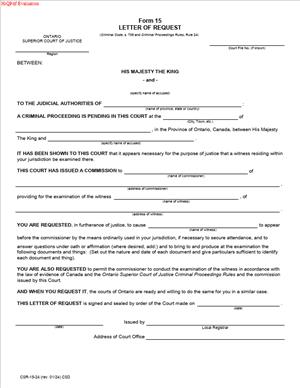
Form 15 (CSR-15-24) – Letter of Request
Fill out nowJurisdiction: Country: Canada | Province or State: Ontario
What is a Form 15 (CSR-15-24) – Letter of Request?
Form 15 (CSR-15-24) is the standard court form used in Ontario criminal proceedings to ask a court in another jurisdiction to help you gather evidence. It is often called a “letter of request” or “letters rogatory.” You use it when a witness or records you need are outside Ontario and cannot be compelled by an Ontario subpoena alone. The form is issued by a judge of the Superior Court of Justice. It is addressed to the court in the place where the witness or records are located. That court then decides whether to make an order in its own jurisdiction to obtain the evidence.
You will typically use this form in a criminal case before the Ontario Superior Court of Justice. It is used by the Crown or by defence counsel. Self-represented accused can also use it, but practical support is often needed. The form is part of the Criminal Proceedings Rules of the Superior Court of Justice, and it follows the format that foreign courts expect to see in a formal judicial request.
You need this form when you cannot secure critical evidence within Ontario’s reach. Common examples include a witness who returned home to another province or country, a social media platform based outside Canada, or bank records kept in a foreign branch. An Ontario subpoena does not have force beyond Ontario. The letter of request asks the foreign court to use its powers to compel the testimony or production of documents you need for your trial or motion.
In practice, you use Form 15 in two broad situations. First, to examine a witness outside Ontario and preserve their evidence for your trial. Second, to obtain documents or data held outside Ontario, often by businesses or institutions with no presence here. The form sets out what you need, why it matters, and how the foreign court can help. The judge signs and seals it, so the foreign court knows the request comes from a court, not a private party.
Here is what the form does not do. It does not replace rules in the other jurisdiction. It does not force any person outside Ontario on its own. It is a respectful court-to-court request. The foreign court decides whether to grant it and on what terms. That is why your form must be accurate, specific, and proportional. It should show why the request is necessary for a fair trial and how it will be carried out.
Typical usage scenarios include time-sensitive trial evidence, international fraud cases, out-of-province medical or phone records, and witnesses who will not return to Ontario for trial. You may also use it to arrange a video-link examination if local rules allow that approach. The form can cover both testimony and document production. You can attach a schedule listing questions or topics, and a schedule listing records with clear date ranges.
The Superior Court uses this format to support comity between courts. It is a well-understood mechanism that respects local laws where the evidence is located. When completed well, the form speeds up cooperation, reduces uncertainty, and helps you keep your trial on track.
When Would You Use a Form 15 (CSR-15-24) – Letter of Request?
You use this form when you need evidence from outside Ontario in a criminal case and cannot get it any other way. Imagine a tourist who witnessed a key event and returned to another country. Your Ontario subpoena cannot compel them. You use Form 15 to ask that country’s court to order the witness to attend an examination, under oath, with a transcript returned for your trial. You can ask to be examined by video link if local rules permit. If not, you may request an in-person examination before an officer of that court.
Another common example is electronic records held outside Canada. You may need account activity from a platform with servers outside Ontario. Or you need subscriber data from a provider based abroad. The foreign court may only act if it receives a judge-signed letter of request that shows necessity, relevance, and defined scope. Form 15 gives the foreign court what it needs to consider your request.
You may also need out-of-province records inside Canada. Many records in national chains are stored outside Ontario. If the custodian is in another province and cannot be reached with the Ontario process, you may request that province’s court to compel production. In some cases, other tools may be available for interprovincial subpoenas. But when those do not fit the need, a letter of request can still be the practical route. It allows the receiving court to act under its own procedures.
Defence counsel use the form to secure third-party records abroad that are vital to the theory of the case. Crown counsel use it to secure evidence such as foreign business records, expert data, or chain-of-custody documents. A self-represented accused can request it for witness testimony outside Ontario when cross-examination at trial would otherwise be impossible. In each case, the Court will expect clear reasons why the evidence is necessary and why there is no realistic local alternative.
Timing matters. You use this form well before trial whenever possible. Foreign courts have their own timelines. Some require local counsel to present the request. Others require translation or certified copies. If your trial is close, the Court may ask for a detailed plan that shows you can get the evidence back in time. If you wait too long, the request may still be granted, but scheduling risk increases.
You may also use Form 15 to regularize an agreed process with a foreign custodian. A business outside Ontario may be willing to produce records, but its counsel may insist on a court-to-court request to protect privacy and ensure a lawful basis. In that case, you narrow the scope to only what is necessary and build in confidentiality. That makes it easier for the foreign court to say yes.
Legal Characteristics of the Form 15 (CSR-15-24) – Letter of Request
Form 15 becomes a formal judicial request once it is issued by a judge of the Superior Court of Justice and sealed by the court. It is not a private letter. It is a court document that speaks from judge to judge. Because it is issued within a criminal proceeding, it carries the authority of the Court and the duty to promote a fair trial. That status is essential for the receiving court to consider it.
The form itself is not self-executing. It does not bind anyone outside Ontario until a court in the receiving jurisdiction grants relief. Its force comes from the foreign court’s order made in response to the request. That court applies its own law. The receiving court may grant the request as drafted, modify the terms, or refuse it. Careful drafting improves the chance of success and reduces delays.
Enforceability rests on a few core elements. First, the request must be authorized and signed by a judge. Second, it must clearly identify the case, the parties, and the stage of the proceeding. Third, it must be specific and necessary. It should outline the evidence sought and explain why it matters to the issues at trial. Fourth, it should propose a lawful and practical method for obtaining the evidence. That may include an examination under oath, a defined list of records, or both. Fifth, it should respect limits such as privilege, privacy, and undue burden. A narrow, reasoned scope is more likely to be enforced.
Courts expect proportionality. Broad fishing expeditions reduce the chance of success. You should show how the evidence is material to key issues. Provide dates, topics, and search terms. If you seek records, describe the custodian and the exact record types. If you seek testimony, describe the topics and attach a list of proposed questions or themes. The foreign court will not know your case. Clear facts and relevance help the judge understand why the request is justified.
Confidentiality and use limits are common. The request should confirm that the evidence will be used only in the Ontario criminal proceeding. Protective terms may restrict public disclosure, especially for sensitive records. If you need to file the records under seal in Ontario, your request should say so. The receiving court may condition its order on those protections.
Finally, respect the receiving court’s process. Some jurisdictions require that the letter of request be sent court-to-court rather than by counsel. Others allow counsel to file it directly. Some require translation. Some require an officer to supervise the examination. Your form should be flexible enough to meet those needs, while still securing fair access to the evidence.
How to Fill Out a Form 15 (CSR-15-24) – Letter of Request
1) Confirm that a letter of request is necessary
Start by confirming that the witness or records are outside Ontario and not compellable by Ontario process alone. Identify why the evidence is material. Decide whether you seek testimony, records, or both. Clarify timing and how the evidence will be used at trial.
2) Use the current version of Form 15
Obtain the current Form 15 (CSR-15-24). Ensure you understand each section. Plan your schedules for witness details, questions or topics, and document lists. Draft in clear, plain language. Avoid overbroad requests.
3) Complete the court heading
At the top, set out “Ontario Superior Court of Justice.” Add the court file number, the region, and the style of cause (for example, R. v. [Accused]). If there are co-accused, list them. Include counsel names and contact details in the footer or a schedule.
4) Identify the receiving court and jurisdiction
Insert the full name and address of the court you are asking for help. Name the country, state or province, and city. If you know the specific department that handles such requests, include that. Use the formal court name. Accuracy matters for filing abroad.
5) Describe the nature of the case and stage
In a short paragraph, explain the charge and the procedural stage. State the trial date or hearing date, if set. Identify the presiding judge if known. Note any pressing timelines. Keep the tone factual and restrained. The receiving court needs context, not argument.
6) State the assistance requested
Set out exactly what you ask the foreign court to do. If you seek testimony, request an order that the named witness attend and be examined under oath on specified topics. If you seek document production, request an order that the custodian produce the defined records. If you seek both, state both, and explain which should occur first if that matters. Ask that the evidence be recorded and certified for return to Ontario.
7) Identify the witness or custodian with precision
Provide the full legal name, position or role, and last known address. Add contact details if available. For corporate custodians, name the entity and the relevant department or officer. Include any identification numbers that help locate the person or records. If there is a risk to safety, consider placing sensitive details in a confidential schedule.
8) Explain relevance and necessity
Include a concise statement of why the evidence matters. Tie it to specific issues such as identity, intent, timing, or alibi. Avoid hyperbole. If you seek records, explain how they will be authenticated and used. If you seek testimony, explain why a live appearance in Ontario is impractical and why an examination abroad is necessary.
9) Define the scope of examination or records
Attach a Schedule A for topics or questions. Keep topics focused and ordered. Avoid compound and argumentative questions. For records, attach a Schedule B that lists each category with date ranges, keywords, and formats. For example: “Subscriber information for account [identifier], from [date] to [date], including IP logs and login metadata.” Limit the request to what you truly need.
10) Set procedure and safeguards
Propose how the examination or production will occur. For testimony, request administration of an oath, recording by a certified reporter, and use of video conferencing if permitted. For documents, request certified true copies, business records certifications where available, and chain-of-custody details for any media. Address translation needs if the witness does not speak English or French. Include privacy and privilege safeguards. Confirm you do not seek privileged communications.
11) Address attendance, representation, and cross-examination
Ask that counsel for both sides may attend and examine or cross-examine, as allowed by the receiving court. If you anticipate remote attendance, request that as an option. If the foreign court requires a commissioner or officer to supervise, acknowledge that and consent to reasonable terms.
12) Set timelines and return method
Propose practical timelines that align with your trial date. Request that the transcript, exhibits, and certifications be sent under seal to the Registrar of the Ontario Superior Court of Justice, with a copy to counsel. Provide the exact return address for the court. If secure electronic transmission is acceptable, state that as an alternative. Ensure you include contact details for coordination.
13) Costs and logistics
State who will pay costs. That is usually the requesting party. Ask the foreign court to set reasonable fees, and confirm you will arrange payment. If travel or room bookings are needed, state that you will coordinate. If the foreign court prefers to deal only with court staff, confirm you will follow that process.
14) Add undertakings and confidentiality
Include an undertaking that the evidence will be used only in the identified proceeding. Add any confidentiality or sealing terms needed to protect sensitive information. If youth records, medical records, or other protected data are involved, propose protective orders. That shows respect for privacy laws in the receiving jurisdiction.
15) Judge’s authorization and seal
Provide the signature block for the Ontario judge, with space for date and place of issue. Include a line for the court seal. The court must sign and seal the request to make it official. Without that, the foreign court is unlikely to act. Ensure the Registrar can attach the seal cleanly and that your copies are clear.
16) Attach supporting materials as schedules
Include copies of relevant parts of the indictment or information, scheduling endorsements, and any prior orders that explain urgency or context. Add an affidavit or short statement summarizing facts that show necessity and materiality. Do not overload the package. Include only what helps the foreign court decide.
17) Review for clarity, proportionality, and accuracy
Check names, dates, addresses, and file numbers. Ensure your scope is narrow and justified. Remove vague phrases like “any and all documents” unless they are truly necessary, and you explain why. Keep the language plain. Foreign judges appreciate clarity.
18) File, issue, and obtain sealed copies
File the completed form with the court office as directed. Arrange for the judge to review and, if satisfied, sign and seal it. Ask for certified copies if needed. Confirm whether the request must be sent from court to court or whether counsel can transmit it. Follow the required route.
19) Transmit the request to the receiving court
Send the letter of request according to the receiving court’s rules. Some require local counsel to file. Others accept direct filing from Ontario counsel. Ensure any translation, notarization, or certification requirements are met. Do not assume. Confirm before sending to avoid delay.
20) Coordinate and follow up
Once the foreign court accepts the request, coordinate scheduling and logistics. Confirm who will attend, how the examination will run, and how records will be delivered. Ensure transcripts are certified. Track the return of the sealed packet to the Ontario court. Build time for corrections if needed.
21) File the returned evidence in Ontario and serve parties
When the evidence arrives, file it with the Ontario court as required. Serve copies on other parties in line with procedural fairness. If protective orders apply, follow them. Update the trial judge on any scheduling impacts. Be ready to address admissibility and any objections.
22) Plan for contingencies
If the foreign court modifies the request, adjust your plan. If the witness refuses to attend, consider whether the foreign court can compel attendance. If production is incomplete, request directions. Keep the Ontario court informed if trial fairness is at risk.
Practical tips help you avoid delay. Stay specific. Align your request with the foreign court’s likely process. Respect privacy and privilege. Show why your request is needed for a fair trial. And give the receiving court a clear, workable plan to get the evidence and return it on time.
Legal Terms You Might Encounter
- A Letter of Request is the formal document that the Ontario Superior Court of Justice signs to ask a court in another jurisdiction to help obtain evidence or take a specific step. In this form, you set out exactly what you want the other court to do, such as compel a witness to testify or produce records.
- The Issuing Court is the Ontario court handling your criminal matter. It is the court that reviews your draft Form 15 (CSR-15-24) and, if satisfied, signs the letter. Make sure the case title, court file number, and judge’s details in your form match the issuing court record.
- The Receiving Court is the court in the other jurisdiction that you are asking to act. That court decides how to carry out the request under its own local rules. You must address the letter correctly and follow any format or procedural preferences known for that court.
- Jurisdiction means a court’s legal power over people, places, or things. You use this form when the Ontario court needs help because the target witness or records are outside its jurisdiction. Your request should explain why the Ontario court cannot act on its own.
- Comity refers to the respect courts extend to each other across borders. The receiving court is not bound to comply, but clear reasons, a narrow scope, and respectful language improve the chance of cooperation. Your form should reflect this tone.
- Evidence Sought describes the testimony or documents you want. In Form 15 (CSR-15-24), you should identify the witness, the specific records, the relevant dates, and any limits that prevent a fishing expedition. Your clarity helps the receiving court understand what to order.
- Terms and Directions are the conditions the Ontario court asks the receiving court to apply. Examples include administering an oath, permitting videoconference testimony, creating a transcript, handling exhibits, and sealing sensitive materials. In your form, include only what you truly need.
- Supporting Affidavit is the sworn evidence that often accompanies the form to explain necessity, relevance, and proportionality. While the form is the letter itself, your affidavit (or other supporting record) gives the judge the facts to decide whether to sign.
- Service and Notice are the steps you take to inform the other parties in your Ontario case. For Form 15 (CSR-15-24), you usually serve the draft and your supporting materials on all parties and file proof. If you seek to proceed without notice, you must explain why.
- Execution of the Request is the work the receiving court does after signing any local order. Your form should explain how to send questions, how to package exhibits, who pays costs, and where to return certified materials so they arrive correctly in the Ontario proceeding.
- Return Date and Timelines are the deadlines you propose for the receiving court to act and send back results. Set realistic time frames. The other court may have scheduling constraints that affect timing.
- Sealing Order refers to court directions to restrict public access to sensitive information if you need the receiving court to seal materials; state that clearly in Form 15 (CSR-15-24) and explain why the protection is necessary.
- Certified Copy is an official copy of a document or transcript verified as authentic. Your form should ask for certified copies of any documents or transcripts returned, so the Ontario court can rely on them without additional proof.
- Translation is a certified translation of the letter and any exhibits for a court that operates in another language. If the receiving court requires it, include a translation request and provide translated materials with your package.
FAQs
Do you use Form 15 (CSR-15-24) to compel an out‑of‑province witness to testify?
Yes. This form is commonly used to ask another court to require a witness outside Ontario to testify or produce records. You should name the witness, explain why their evidence matters, and request the method of testimony, such as video or in-person, if appropriate.
Do you need the other party’s consent before filing the form?
Not always. You usually give notice to all parties and file proof of service. If you seek to proceed without notice, explain clearly why notice would cause harm or is impractical. The judge decides whether to proceed without notice.
Do you use this form for evidence from outside Canada?
Sometimes, but cross-border evidence can be more complex. Some countries use different processes or require government-to-government requests. If you plan to send the letter outside Canada, confirm that a court-to-court request is accepted and whether translations are needed.
Who signs the Letter of Request?
A judge of the Ontario Superior Court of Justice signs it. You prepare the form, attach supporting materials, and request a time to have it reviewed. The judge may make edits, limit the scope, or attach conditions before signing.
How detailed should your request be?
Be specific but not overbroad. Identify the exact topics for testimony, the precise documents, and the time period. Avoid asking for “all documents” without limits. Clear, focused requests show necessity and respect the receiving court’s processes.
How long does it take to get results back?
Expect weeks to months. Timing depends on the receiving court’s calendar, the need for translation, how quickly you serve materials, and whether the witness cooperates. Set realistic return dates and build in buffer time for unforeseen delays.
Do you need to cover costs for the request?
Often, yes. Courts may require cost coverage for transcripts, interpreters, witness fees, or service costs. Your form can include an undertaking to pay reasonable expenses and identify who should be contacted for payment arrangements.
What happens if the receiving court declines your request?
The court may refuse if the request is unclear, overly broad, contrary to local law, or burdensome. You can revise the scope, provide more detail, adjust timelines, or explore other evidence-gathering routes. Document any refusal and next steps for the Ontario court record.
Checklist: Before, During, and After the Form 15 (CSR-15-24) – Letter of Request
Before signing
Case details:
- Current case title and court file number.
- Correct level of court (Superior Court of Justice).
- Names and roles of all parties.
Purpose and scope:
- Clear description of evidence sought.
- Witness’s full name, role, and location.
- Specific documents with date ranges.
- Preferred method of testimony (video or in-person).
Addressing and routing:
- Proper name and address of the receiving court.
- Any known procedural requirements in that jurisdiction?
- Language requirements and certified translations, if needed.
Supporting materials:
- Draft affidavit setting out necessity and relevance.
- Any exhibits that help identify records or topics.
- Proposed questions or topics for examination (if applicable).
Timelines and logistics:
- Realistic return date and scheduling constraints.
- Plan for transcript, interpretation, and recording.
- Instructions for returning exhibits and certified copies.
Costs and undertakings:
- Undertaking to pay reasonable costs.
- Contact for invoicing and fee deposits, if required.
Notice:
- Service on all parties and proof of service.
- Draft endorsement or order if the judge prefers a separate order.
Confidentiality:
- Request for sealing, if needed, with reasons.
- Redacted versions for service where appropriate.
During signing
Party and case identifiers:
- Confirm spelling of names, charges, and file number.
- Verify the correct judge and courthouse information.
Receiving court details:
- Check the exact court name and address.
- Confirm whether a liaison office or clerk must be named.
Scope accuracy:
- Ensure questions and document lists match your supporting affidavit.
- Remove vague or unnecessary requests.
Directions:
- Include oath/affirmation, transcript requirements, and exhibit labeling.
- Confirm instructions for video testimony and time zone.
Timelines:
- Set feasible deadlines for execution and return.
- Add buffer time if translation or travel is involved.
Returns:
- Specify certified copies, sealing, and chain-of-custody handling.
- Provide the return address and contact person in Ontario.
Costs:
- Include your undertaking and payment method.
- Clarify who arranges interpreters and who pays.
Signatures and seal:
- Confirm the judge’s signature block is correct.
- Ensure the court seal area is present if needed by the receiving court.
Attachments:
- Check that all exhibits are numbered and referenced in the letter.
- Include any required translations and certificates.
After signing
Filing:
- File the signed letter with the Ontario court registry as directed.
- Obtain certified copies if the receiving court requires originals and copies.
Transmission:
- Send the package to the receiving court following its preferred method.
- Include a cover letter with contact details and a checklist of contents.
Service:
- Serve the signed letter and attachments to all parties.
- File updated proof of service in Ontario.
Tracking:
- Diarize the expected execution date and follow-up milestones.
- Note any hearing dates the receiving court sets.
Costs:
- Pay requested deposits quickly to avoid scheduling delays.
- Keep receipts and create a cost log for the court record.
Confidentiality:
- Store sealed materials securely and follow labeling protocols.
- Use redacted copies for distribution where necessary.
Follow-up:
- Confirm receipt with the receiving court clerk.
- Address any deficiencies, such as missing translations or unclear instructions.
Return handling:
- Log all returned materials.
- File transcripts and exhibits with the Ontario court.
- Notify all parties that the materials have been received.
Common Mistakes to Avoid Form 15 (CSR-15-24) – Letter of Request
- Don’t forget to limit your scope. Overbroad requests slow everything down and risk refusal. Narrow your topics and list specific documents with clear date ranges.
- Don’t misname the receiving court. A wrong court name or address can cause rejection or misdirection. Verify the court’s official name and preferred contact before sending.
- Don’t skip translations where required. If the receiving court operates in another language, an untranslated package may stall. Arrange certified translations and include them in your materials.
- Don’t ignore timelines. Unrealistic deadlines frustrate scheduling and harm your credibility. Set practical return dates and build in time for service, travel, and transcription.
- Don’t overlook costs. Many courts require fee deposits or witness expenses. If you fail to provide an undertaking or pay promptly, the request may not proceed.
- Don’t leave return instructions vague. If you omit how to package and return exhibits or transcripts, items may be delayed or mishandled. Provide clear return addresses and chain-of-custody steps.
What to Do After Filling Out the Form 15 (CSR-15-24) – Letter of Request
- File the signed letter with the Ontario court record and get the copies you need. Confirm whether the receiving court needs an original, a certified copy, or both. Prepare a complete package with the signed letter, supporting affidavit, exhibits, translations, and a cover letter.
- Serve all parties in your Ontario case and file proof of service. Include any endorsements or schedules the judge added. If the judge limited scope or added conditions, update your cover letter and checklist to reflect those changes.
- Transmit the request to the receiving court using its preferred method. Some clerks accept couriered sealed packages. Others ask for both physical and electronic copies. Include a clear point of contact for scheduling and costs. Attach your undertaking to pay reasonable expenses.
- Coordinate logistics early. If the letter requests a videoconference examination, propose dates, time zone conversions, and platform options. If an interpreter is required, confirm who retains and pays the interpreter. If a local officer must serve the witness, ask for the process timeline and any fees.
- Monitor progress and follow up respectfully. Ask for written confirmation that the request was received and is being scheduled. Keep a log of all communications, payments, and dates. Share updates with the other parties to avoid disputes about timing.
- Handle amendments if needed. If the receiving court says a part of your request is not permitted or needs clarification, prepare a narrow amendment. Seek quick direction from the Ontario court if a revised letter or order is required. Serve any amendments on all parties and re-send the corrected materials.
- Prepare for returns. Give clear instructions for sealing sensitive exhibits and for certifying transcripts. Provide prepaid return courier materials if helpful. When materials arrive, check the package against your checklist. Confirm certifications and seals are intact.
- File and distribute returned materials. File transcripts and exhibits with the Ontario court as appropriate. Notify the other parties and provide copies or access, subject to any sealing orders. If a sealing order applies, circulate a redacted version and store the unredacted version securely.
- Address refusals or partial compliance. If the receiving court declines, document the reasons. Consider revising the scope, offering to cover additional costs, or proposing a different method of evidence (such as written questions). If a witness refuses to comply, ask the receiving court or the Ontario court for guidance on the next steps available within the rules.
- Close the loop. After you receive all materials, file a brief confirmation or endorsement if required, noting completion of the request. Update your internal timeline so the evidence is integrated into your next hearing or trial dates. Keep your cost log and proof of payment in case the court asks for them.
Disclaimer: This guide is provided for informational purposes only and is not intended as legal advice. You should consult a legal professional.