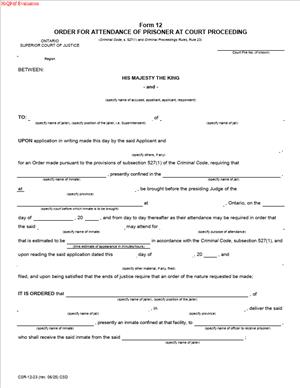
Form 13 (CSR-12-23) – Order for Attendance of Prisoner at Court Proceeding
Fill out nowJurisdiction: Country: Canada | Province or State: Ontario
What is a Form 13 (CSR-12-23) – Order for Attendance of Prisoner at Court Proceeding?
Form 13 is a court order that directs a correctional institution to bring an incarcerated person to a Superior Court of Justice proceeding and return them afterward. It ensures the person appears in person for a scheduled hearing. The order also authorizes the sheriff or designated officers to hold the person in custody while they are in court.
This is a prescribed form under the Criminal Proceedings Rules of the Superior Court of Justice. The court issues it on motion or with the judge’s direction. The form records the core details needed for transport and custody. Those details include the person’s identity, the institution that holds them, the date and time of the proceeding, and the courtroom location.
Who typically uses this form?
Lawyers for the accused often prepare the draft order and bring it to court for the judge to sign. Crown counsel also prepares it in some cases, such as where the person in custody is a witness. Self‑represented accused may prepare it when the court requires in‑person attendance. Court staff issue and seal the signed order. The sheriff and the officer in charge of the institution receive the order and carry it out.
You may need this form if you have a Superior Court proceeding that requires the attendance of a person who is currently in custody. This could be the accused in your case. It could also be a witness held on another matter. The form compels the institution to produce the person on the required date at the required place. Without it, transport may not occur, and your proceedings could be delayed.
Typical usage scenarios include a trial (jury or judge‑alone), a pre‑trial motion that requires the accused’s presence, a plea and sentencing hearing, or an evidentiary hearing where a witness is in custody. The form is also used to secure the presence of a person in custody at jury selection, at verdict, or at a continuation of a trial where the court needs the accused in person. You might also use it for a witness who is serving a sentence but has relevant evidence for your case. In each scenario, the order coordinates transportation, arrival, custody during the court day, and return to the institution.
Form 13 is not a subpoena or a summons. A subpoena compels a civilian witness to attend. It does not direct an institution to transport a prisoner. Form 13 addresses the special logistics of moving a person who is already in custody. It is also not a bench warrant. A bench warrant authorizes arrest. Form 13 authorizes production for the court, and the person remains in continuous custody throughout.
When Would You Use a Form 13 (CSR-12-23) – Order for Attendance of Prisoner at Court Proceeding?
You use Form 13 any time the court requires in‑person attendance of someone who is in custody, and your proceeding is in the Superior Court of Justice. For example, you have a multi‑day jury trial starting next month. Your client is on remand at a provincial jail in a different region. You prepare a Form 13 to direct the officer in charge to produce your client at the opening of the trial. You may include a schedule listing each trial day to avoid repeating the application.
You would also use it for a scheduled plea and sentencing where the judge wants the accused present in person. Many sentencing can occur by video. Some cannot, or the judge may require in‑person attendance. The form makes sure the correctional institution transports your client to the courthouse for the hearing.
Another common situation involves an inmate witness. Suppose a key witness is serving a sentence at a different institution. They have material evidence for a voir dire or for the trial proper. A Form 13 directs the institution to bring that witness to court on the set date and return them afterward. The order can include directions to keep the witness separate from the accused, if needed.
You might also need the form for a complex pre‑trial motion with evidentiary issues. The judge may require the accused in person to hear evidence or give instructions. You would complete a Form 13 with the motion date and courtroom details. If the motion spans multiple days, you can list each day.
If your case is a continuation, you can use a Form 13 to cover the next appearance as well. For example, the jury returns at 10:00 a.m. for a verdict. You ensure a fresh order is issued for that day and time. The order guarantees the accused arrives before the jury returns.
Typical users include defence counsel, Crown counsel, and self‑represented accused. A complainant’s counsel may request the order if a protected witness is in custody and needs to testify. Trial coordinators and court staff do not request the order for you. They will, however, process it once the judge signs it and ensure it is issued and sealed.
If the court will proceed by video, you may not need Form 13. Always confirm the mode of appearance with the court before you prepare the order, if the court requires in‑person attendance, file and serve the order with enough lead time so transport can be arranged.
Legal Characteristics of the Form 13 (CSR-12-23) – Order for Attendance of Prisoner at Court Proceeding
Form 13 is a binding court order. It is enforceable because the Criminal Proceedings Rules authorize the court to order the production of a person in custody for a proceeding. The order is made by a judge of the Superior Court of Justice. Once issued and sealed, it directs the officer in charge of the named institution and the sheriff to take specific actions. Those actions include producing the named person at a set place and time, keeping them in lawful custody while they attend, and returning them after the hearing.
Enforceability comes from several features built into the form. It identifies the court file, the style of cause, and the presiding court. It names the person to be produced with enough detail to avoid any doubt. It identifies the institution that has custody, so the order can be obeyed. It states the date, time, and location of the hearing. It authorizes transport and custody through the sheriff or designated officers. It includes the judge’s signature and the court seal. Those elements make the order clear, specific, and executable by the receiving agencies.
General legal considerations apply. The person remains in custody throughout the process. The order does not grant any release. It authorizes production only for court attendance and for the times set out in the order. The sheriff or designated officers control transport, security, and holding. If the order lists more than one date, production covers each listed date. If a date changes, you need an amending order or a new order. If the person’s institution changes, you should update the order so the correct facility receives it. Where separate‑keeping directions are needed, include them to protect trial integrity and safety.
The order must be properly served on the officer in charge of the institution and the sheriff. Service makes the order known to those who must act. Without service, the order may not reach the right people in time. Keep proof of service. If the institution cannot meet the order due to security or medical reasons, it will notify the sheriff and the court. The judge will decide the next steps. Do not attempt to modify the order on your own. Only the court can vary it.
Finally, the form is not optional if the court requires the in‑person attendance of a person in custody. A letter or email to the institution is not a substitute. The order is the legal authorization for transport and for custody at the courthouse. Correctional and policing partners rely on it to move people safely and lawfully.
How to Fill Out a Form 13 (CSR-12-23) – Order for Attendance of Prisoner at Court Proceeding
Follow these steps to prepare, file, and serve the form.
1) Confirm you need the order
- Ask the court whether the attendance must be in person. If the judge requires in‑person, use Form 13.
- Clarify who will prepare the draft. Defence usually prepares it for an accused. The Crown may prepare it for a witness.
2) Gather accurate identifying details
- Court file number and region.
- Full legal name of the person in custody. Include any known aliases.
- Date of birth and, if available, a correctional identifier.
- Exact name and address of the institution that holds the person.
- Hearing type, date(s), time(s), courtroom, and courthouse address.
- Name of the presiding judge, if already assigned.
3) Complete the court caption
- At the top, enter “Superior Court of Justice.”
- Add the court location (judicial region and courthouse city).
- Insert the court file number exactly as it appears on the record.
- Enter the style of cause. For criminal cases, use “R. v. [Accused’s full name].”
- If there are multiple accused, ensure the style of the cause matches the file.
4) Title of the document
- Use the prescribed title: “Order for Attendance of Prisoner at Court Proceeding.”
- Confirm the form number and version match the court’s current Form 13.
5) Identify the person to be produced
- Write the full legal name as it appears in custody records.
- Add the date of birth to reduce the risk of misidentification.
- Include any relevant identification number used by the institution, if known.
- State the full name of the institution (for example, the specific correctional centre).
- Add the institution’s municipal address.
6) Describe the proceeding requiring attendance
- State the hearing type: trial, jury selection, pre‑trial motion, plea, sentencing, or other application.
- Include the exact date and start time.
- Provide the courtroom number and courthouse address.
- If the proceeding spans several dates, include each date and start time. You can attach a schedule if there are many dates. Label it “Schedule A – Production Dates” and list each date and time clearly.
7) Direct production, custody, and return
- Use clear, standard language. For example: “The officer in charge of [Institution] shall produce [Name] at the Superior Court of Justice, [address], on [date] at [time], and thereafter as directed by the court, and shall return [Name] to the institution at the conclusion of the attendance.”
- Authorize custody while at court. For example: “The sheriff or designate shall have lawful custody of [Name] during the attendance.”
- If the order covers multiple days, direct daily return unless the court instructs otherwise. If overnight holding at a local facility is needed, identify it.
8) Add any special directions needed for safety or fairness
- Separation orders. If the person must be kept separate from the co‑accused or a witness, state the names or file numbers.
- Medical or accommodation needs, if the court has made such directions. Keep the language necessary and neutral.
- Lawyer‑client access. If counsel needs private access during breaks, note that access is subject to security protocols.
9) Include authority for the transporting agency
- State that the sheriff or designee may transport and maintain custody. This covers the local sheriff or a designated police service, depending on the region.
- You do not instruct on restraints. That is an operational decision. Do not add operational details unless the judge directs it.
10) Date, signature, and court seal
- Insert the date the judge makes the order.
- Leave the signature line for the judge. Do not sign on their behalf.
- The registrar will affix the court seal when issuing the order. Ensure space for the seal.
11) Add contact information for the preparing party
- Include your name, firm (if any), address, phone, and email. This allows the institution and the sheriff to contact you if needed.
- If you are self‑represented, provide a reliable phone and email.
12) File the draft and obtain the signed order
- File the draft order with the court as directed by local practice. This may occur at a motion, a pre‑trial, or by filing for issuance, where the judge has already ordered production.
- Bring an extra copy for the judge and for the registrar.
- Once the judge signs, obtain the issued and sealed copies from the registrar.
13) Serve the issued order promptly
- Serve the officer in charge of the named institution. Confirm the correct fax or email for legal orders and the time window for receipt.
- Serve the local sheriff’s office responsible for transport for that courthouse.
- Serve the other parties, including Crown counsel and any other affected counsel.
- Keep proof of service. Note date, time, method, and recipient details.
14) Confirm logistics before the hearing
- Contact the sheriff’s office a few days before the hearing. Confirm they received the order and have scheduled transport.
- Confirm the institution has the order and the production time. Share any courtroom changes with them immediately.
- If the hearing is rescheduled, prepare an amending order or a new order. Serve it right away.
15) Plan for multi‑day trials or motions
- If you included a schedule of dates, check that it covers every day.
- If an extra day is added, seek a supplementary order as soon as the court sets it.
- If the court wants overnight holding at a local facility, include that direction in the order. Coordinate with the sheriff on where the person will be held.
16) On the day of attendance
- Arrive early and confirm with the sheriff that the person has arrived.
- Check that the courtroom staff know the person is in custody and in holding.
- If the case is stood down, ensure the person remains available for recall.
17) After the proceeding
- Confirm that the order’s return direction is followed.
- If the case is adjourned to a new date that also requires in‑person attendance, prepare a new Form 13 right away.
18) Common mistakes to avoid
- Incorrect institution. Verify where the person is actually housed, especially if transfers occur.
- Missing or wrong court file number. That can delay issuance and transport.
- No time or vague timing. Give a specific start time and courtroom location.
- Not naming the sheriff or designee for custody. The order must authorize custody at court.
- Forgetting multiple trial dates. Use a schedule to cover them all.
- Failing to serve the institution or the sheriff. Without service, the order may not be executed.
- Changing the order by hand after issuance. Never alter an issued order. Seek an amending order.
19) Using schedules and attachments
- Use Schedule A to list multiple dates and times. Number each date and include the start time and courtroom.
- If the court directs specific separation or medical notes, use Schedule B for those directions to keep the main order clear and concise.
- Refer to each schedule in the body of the order so it forms part of the order.
20) Timeline and lead time
- Serve the order with enough time for the institution and the sheriff to arrange transport. Earlier is better, especially for out‑of‑region transfers.
- If an urgent hearing arises, alert the sheriff and institution by phone and email after service. Provide the issued order right away.
By following these steps, you will give the court and custodial agencies the clear, specific directions they need. A precise Form 13 helps prevent late arrivals and adjournments. It also protects custody and safety while ensuring the person appears when the court requires it.
Legal Terms You Might Encounter
- Order. This is the signed direction from a judge that compels action. For this form, the order instructs officials to bring a specific prisoner to a court event and return them after. The order must be clear, complete, and signed. Without a signed order, the institution will not move the prisoner.
- Custody. Custody means who legally holds the person at each stage. Your form should specify transfer of custody to the sheriff or another official for the court date. It also states that custody returns to the institution afterward. Clear custody wording helps avoid gaps or disputes.
- Superintendent. This is the head of the correctional institution that holds the person. Your order often directs the superintendent to produce the prisoner. Include the facility’s full name. This ensures the right official receives the command and can act on it.
- Sheriff. The sheriff handles prisoner transport and courtroom custody for many Superior Court matters. Your order may direct the sheriff to take the prisoner to court and back. If the sheriff needs details to plan transport, add them. Provide date, time, courtroom, and any special security notes.
- Remand. Remand means the person is held in custody before the case finishes. Many people subject to this order will be on remand. If the person is sentenced and is in a different facility, note that. Transport can differ for remand versus sentenced inmates.
- Video appearance. Some appearances can happen by video instead of in-person attendance. This order is for physical attendance. If the video is acceptable, you may not need Form 13. Confirm the court’s preference before you draft. If in-person is required, use the form to compel production.
- Production. In this context, production means physically bringing the person to the courtroom. It is not about records. The order tells officials to produce the person at a set date, time, and place. It also directs their return to custody after the appearance.
- Court file number. This is the unique number assigned to the case. It links the person’s attendance to the right matter. If the court file number is wrong or missing, transport can fail. Always confirm it from the latest court endorsement or notice.
- Return. Return describes the step after the court concludes. Your order should instruct the sheriff to return the person to a named institution. If the person should be returned to a different facility than the one listed at the start, state that clearly.
- Service. Service means delivering the signed order to the people who must act on it; for this form, that includes the correctional facility, the sheriff, and court security. Keep proof of when and how you served it. Timely service avoids delays and missed appointments.
FAQs
Do you need a judge to sign Form 13 (CSR-12-23)?
Yes. This document becomes effective only when a judge signs it. You can draft the order and present it to the court in the proper way for your case. Once a judge signs, you must distribute the signed order to the sheriff, the correctional institution, and any other required recipients. Unsigned drafts are not enforceable, and facilities will not act on them.
Do you have to use this form if video appearances are allowed?
Not always. If the court allows a video appearance for the specific event, you may not need an order to transport the person in custody. Confirm the court’s direction before you proceed. If the court requires in-person attendance or a witness must testify in person, then you need this form to compel production and return.
Do you need consent from the other side to get the order?
Consent helps but may not be required. If everyone agrees, you can present a draft order that reflects the consent. If there is no consent, you may need to bring a motion or seek the order at a scheduled appearance. The key is to give the court enough information to see why the person must attend and that the logistics are workable.
Do you have to specify the exact facility holding the person?
Yes. Identify the facility by its full name, and include the inmate or offender number if available. People in custody are sometimes moved. Verify the current location before you finalize the order. If the person moves after you serve the order, notify the sheriff and the court immediately so transport plans can adjust.
Do you need to list the precise date, time, and courtroom?
Yes. The order should include the exact date, start time, and court location. If the start time is tentative, state a reasonable window and the earliest arrival time needed. Vague language causes confusion for transport teams and can lead to late arrivals. Clear details help the sheriff plan routes and security.
Do you have to arrange security yourself?
No, but you must provide the key details that security needs. The sheriff and correctional services manage the escort. Your job is to ensure the order gives them what they need: who, where, when, how long, the purpose of attendance, and whether the person is an accused or a witness. If there are security concerns, flag them early.
Do you need to serve the order on the facility and the sheriff?
Yes. Serving both is routine and expected. The facility needs the judge’s signed order to release the person to the sheriff. The sheriff needs it to plan the pickup and escort. Serve with enough lead time. Confirm delivery and get the names of contacts who received and acknowledged it.
Do you need a new order if the date or courtroom changes?
Usually, yes. If the order lists a specific date or place, and that changes, prepare a revised order or seek a variation. Small timing shifts on the same morning may not require a new order if the sheriff is already in motion. Larger changes do. Do not rely on informal updates. Align the paperwork with the actual logistics.
Checklist: Before, During, and After the Form 13 (CSR-12-23)
Before signing: information and documents you need
- Full name of the person in custody, as it appears on court records.
- Inmate/offender number, if available.
- Exact correctional facility name and address.
- Court file number and case caption.
- Role of the person (accused, co-accused, or witness).
- Purpose of attendance (plea, motion, trial date, testimony).
- Date, start time, and courtroom number.
- Estimated duration of attendance.
- Return destination after court (same or different facility).
- Any special needs (medical, mobility, interpreter).
- Security considerations known to counsel or the court.
- Contact details for the sheriff’s office and facility liaison.
- Confirmation that the court requires in-person attendance.
- Draft order language for transfer of custody to the sheriff and return.
- Any related endorsements or directions from a prior appearance.
- Knowledge of any facility lockdowns, distance, and travel time.
- Backup date/time window if the court often runs late.
- Proof of the person’s current location (recent check with the facility).
During signing: sections to verify carefully
- Correct spelling of the person’s name and any aliases.
- Accurate court file number and court location.
- Full and correct facility name and, if needed, the superintendent’s title.
- Clear direction to the sheriff for pickup, attendance, and return.
- Exact date, start time, and courtroom for the proceeding.
- A precise purpose of attendance to justify production.
- Whether the person must be present for the full day or for a time block.
- Proper custody wording during transit and in court.
- Return destination and timing after the hearing ends.
- Any special conditions (medical, restraints, separation from co-accused).
- Legible judge’s name, signature line, and date of order.
- No blanks or conflicting times that create ambiguity.
- Consistency between the order and any attached schedule.
After signing: filing, notifying, and storing instructions
- Obtain certified copies from the court office, if available.
- Serve the signed order at the correctional facility promptly.
- Serve the signed order on the sheriff and court security.
- Notify opposing counsel and any affected parties.
- Confirm receipt with named contacts at the facility and the sheriff’s office.
- Verify pickup time, route, and arrival time for the day of court.
- Provide updates if the court’s start time changes.
- Add the order to your materials list for the hearing day.
- Prepare a contact sheet for day-of coordination (sheriff, facility, court).
- Schedule a reminder to check the transport status in the morning.
- Keep proof of service and the signed order in your file.
- If the matter adjourns, plan next steps for a revised order.
Common Mistakes to Avoid
- Don’t forget to confirm the current facility. People are moved between institutions. If you name the wrong facility, transport can fail. The person may not appear. Your hearing could be delayed.
- Don’t leave the time and place vague. “Morning court” is not enough. The sheriff needs a firm schedule. Vague orders lead to late arrivals, missed connection windows, and adjournments.
- Don’t omit the return direction. The order should say where the person goes after court. Missing return language causes confusion about custody. It can trigger security issues and delays.
- Don’t assume video is the default. Some events require in-person attendance. If you expect video and the court requires attendance, you will lose time. Confirm the format early.
- Don’t serve the order at the last minute. Facilities and sheriffs need lead time to plan. Late service risks no transport and a wasted court day. Build in buffer days.
What to Do After Filling Out the Form
- Get the judge’s signature. Present the draft at the proper time in court or as directed. The order only takes effect once signed.
- Make certified copies. Ask the court office if certification is available. Certified copies reduce disputes about authenticity.
- Serve the facility and the sheriff. Deliver the signed order promptly. Include the court date, time, and courtroom in your cover note. Confirm that both recipients have it and are acting on it.
- Coordinate logistics. Call the facility and the sheriff to confirm pickup time, arrival window, and holding arrangements at court. Share any access or parking instructions for secure transport.
- Brief the court staff. Let court security and the trial coordinator know to expect a prisoner arrival. Share the time and courtroom. This helps with dock availability and holding cells.
- Prepare for the day of court. Bring a copy of the signed order and proof of service. Arrive early. Touch base with the sheriff and court security when you get there.
- Manage schedule changes. If the court time or courtroom shifts, inform the sheriff and facility immediately. If the date changes, prepare a revised order or seek a variation without delay.
- Ensure return to custody. After the appearance, confirm that the sheriff returns the person as the order states. If the matter continues another day, plan ahead for the next order.
- Update your file. Save the executed order, service confirmations, and any email or call notes. Record the names of contacts who handled transport and security.
- Plan for future dates. If more appearances are likely, set timelines to prepare the next order. Carry forward lessons about timing, routes, and any special needs.
Disclaimer: This guide is provided for informational purposes only and is not intended as legal advice. You should consult a legal professional.