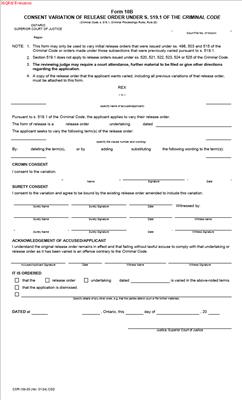
Form 10B (CSR-10B-20)- Consent Variation of Release Order under s. 519.1 of the Criminal Code
Fill out nowJurisdiction: Canada | Province or State: Ontario
What is a Form 10B (CSR-10B-20)- Consent Variation of Release Order under s. 519.1 of the Criminal Code?
Form 10B is the Ontario Superior Court of Justice form you use to ask a judge or justice to change the terms of a criminal release order (bail) when both you and the Crown agree. It is a consent-based process under section 519.1 of the Criminal Code. Instead of scheduling a bail review or bringing a contested motion, you and the Crown document your agreement in this form and submit it for judicial approval. If the judicial officer is satisfied that the new terms remain appropriate and lawful, they sign the form, and it becomes the operative release order.
Who typically uses this form?
- Accused persons seeking practical changes to their release conditions.
- Defence counsel acting on instructions from the accused.
- Crown counsel who agree that a change is justified or necessary.
- Sureties, where a surety’s obligations are being added, changed, or removed.
Why would you need this form?
You use Form 10B when your life circumstances have changed or when the original release terms no longer fit your situation, and the Crown agrees. It is the fast, paperwork-based way to update conditions without a contested hearing. By putting the agreement into Form 10B, you ask a judge or justice to replace or modify parts of your existing order. Until it is signed, your current conditions still apply.
Typical usage scenarios
- Your work schedule changes, and you need your curfew adjusted so you can work evening shifts.
- You move homes and need to update your residence condition or the jurisdiction where you must remain.
- You enroll in a treatment program and want to add a condition allowing you to attend or to replace a broader restriction with a treatment-focused term.
- A named surety can no longer supervise you, and you have a new proposed surety ready to sign on.
- You and the Crown agree that a no-contact condition can be narrowed (for example, contact permitted through counsel or for family law purposes) or removed entirely if it is no longer required.
- Reporting tothe police or probation can be reduced because you have demonstrated compliance.
- You need a short-term exception, like travel for a funeral, that requires adjusting a geographic or curfew condition for specific dates.
Form 10B does not change a detention order. It only varies an existing release order. If you are detained, you would need a bail review or a fresh bail hearing, not this form. If the Crown does not consent, Form 10B is not the right tool; you will need to bring a contested application or review under the appropriate provisions.
When Would You Use a Form 10B (CSR-10B-20)- Consent Variation of Release Order under s. 519.1 of the Criminal Code?
You use Form 10B when you and the Crown have reached clear agreement on the changes to your release conditions and you want the court to approve those changes in writing. This typically happens after you have been on release for some time and have complied with your conditions, or when a practical issue arises that neither side wants to litigate.
For example, you may start a new job with hours that conflict with your curfew. Instead of bringing a contested motion, your lawyer works with the Crown to draft an agreed change that tightens other safeguards (like increased reporting) while relaxing the curfew hours to match your shifts. You both sign Form 10B and submit it for judicial endorsement. Once signed, your curfew condition reads as updated, and employers can rely on it for scheduling.
Another common situation is a change of address. If your lease ends, or you move to live with a family member who can support you, your release order must reflect your new residence. You and the Crown confirm the new address and that your surety (if you have one) approves the change. The variation sets out the new address and any related conditions. Once the judge or justice signs, the police can update their records.
You may also use Form 10B to adjust non-communication or non-attendance conditions. If there is a family law case requiring communication about parenting, or if the alleged victim consents to mediated, structured contact through counsel, the Crown may agree to narrow the condition. The variation will specify the approved mode and scope of contact to avoid ambiguity. The same approach applies to no-go zones: you might need a surgical exception to enter a restricted area to work, attend medical appointments, or appear in court on another matter.
If a surety can no longer supervise—due to health, relocation, or conflict—you can replace the surety by consent. The new surety must be vetted and prepared to sign. The variation will remove the old surety and add the new one, with any collateral or cash deposit terms clearly stated.
Typical users include accused persons and defence lawyers, Crown attorneys, and sureties. Police services and court staff are not “users” of the form, but they rely on the signed variation to update enforcement databases and ensure the conditions they enforce are current.
In short, you use Form 10B when everyone agrees on the fix, and you want it formalized quickly, cleanly, and enforceably, without returning to court for a contested hearing.
Legal Characteristics of the Form 10B (CSR-10B-20)- Consent Variation of Release Order under s. 519.1 of the Criminal Code
Form 10B becomes legally binding when a judge or justice signs it. Your consent and the Crown’s consent are necessary but not sufficient. The court must be satisfied that the proposed changes meet the legal standards for release under the Criminal Code, including the primary, secondary, and tertiary grounds for bail (attendance in court, public protection and safety, and maintaining confidence in the administration of justice). The judicial officer acts as a gatekeeper to ensure the updated conditions are reasonable, necessary, and proportionate to the risks in your case.
What ensures enforceability is the court’s endorsement. Once signed, the Form 10B functions as a formal variation to your existing release order. It either replaces specific conditions or adds new ones. The varied terms are enforceable like any other release condition. A breach of the new terms is a breach of your release order, exposing you to arrest and potential new charges.
Key legal considerations
- Scope: Form 10B is for varying existing release orders, not detention orders. If you are detained, you cannot use this form to obtain release.
- Consent: The variation must reflect genuine consent by both the Crown and you (or your lawyer on instructions). While the process is “on consent,” the court is not a rubber stamp. The judicial officer can decline to sign or can require clarifications to ensure the conditions are lawful and workable.
- Clarity: Conditions must be clear and specific. Vague or contradictory conditions risk being unenforceable or leading to breaches you did not intend. Times, locations, and exceptions should be precise.
- Proportionality: Conditions should be the least onerous necessary to address the statutory bail concerns. A variation that lowers risk (for example, by adding treatment or clarifying supervision) can justify relaxing other constraints.
- Sureties: If you add, remove, or replace a surety, the surety’s consent and acknowledgment of obligations are required. The court must be satisfied the surety is appropriate and understands the role.
- Continuity: The variation does not erase your entire release order unless it expressly replaces it. Any condition not changed remains as originally ordered. Read the final endorsed form carefully to confirm exactly what changed.
- Records: Once the variation is signed, court staff or the Crown should ensure the police database is updated. You should carry a copy of the endorsed variation until you confirm the update is reflected in enforcement records.
Because the court must endorse the change, the process protects you and the public. Your consent avoids the need for a full hearing, but it does not bypass legal safeguards. If the court declines to sign the variation, your original conditions remain in effect.
How to Fill Out a Form 10B (CSR-10B-20)- Consent Variation of Release Order under s. 519.1 of the Criminal Code
What follows is a practical, step-by-step guide to completing the form so you can get it signed and enforceable as efficiently as possible. The exact layout can vary slightly, but the core components are consistent across the Superior Court of Justice.
1) Identify the correct file and court
- Court level: Confirm whether your matter is in the Superior Court of Justice. If your case is still in the Ontario Court of Justice, you can still seek a 519.1 consent variation, but ensure you are using the correct court caption and filing at the correct courthouse. Ask the Crown or the criminal counter if unsure.
- File numbers: Gather all file identifiers. Include the Superior Court file number (if assigned), any Ontario Court of Justice information number, the police occurrence number, and the Crown brief number if available. Accurate identifiers avoid delays in updating records.
2) Complete the style of the caption.
- Accused name: Use your full legal name exactly as it appears on your existing release order and on the indictment/information.
- Court location: Enter the name of the courthouse where the matter is pending or where the original release order was made.
- Date: Use the date you are preparing the form. The judicial signature date will be added when approved.
3) Describe the existing release order
- Date and type: State the date of the original release order and who made it (police undertaking, justice, or judge). If there have been previous variations, list the most recent one and its date.
- Charges: List the charges currently outstanding. You do not need full particulars, but include the section numbers and brief descriptors (for example, “assault causing bodily harm, s. 267(b)”).
- Current conditions summary: If the form asks, provide a concise snapshot of the current key conditions, especially those you plan to change (curfew, non-communication, residence, surety, reporting, travel).
4) Set out the proposed variations clearly
- Use exact wording: Quote the current condition (for example, “Condition 5: Curfew 10 p.m. to 6 a.m.”) and then write the replacement text (“Replace Condition 5 with: Curfew 12 a.m. to 6 a.m. daily.”).
- Additions and deletions: If adding a new condition, label it “Add Condition [number]” and write the full text. If deleting a condition, say “Delete Condition [number] in its entirety.”
- Dates and times: Be precise. If the change is temporary (for example, a weekend travel exception), include exact dates and times, and write what happens after the exception ends (“After March 18, 2025, the original curfew resumes: 10 p.m. to 6 a.m.”).
- Places and boundaries: If adjusting geographic restrictions, define areas using clear boundaries (street names or municipal borders). Avoid ambiguous terms like “downtown.”
- Communication exceptions: For no-contact changes, specify permitted modes (for example, “through legal counsel only,” “by text for parenting exchanges only,” or “through a third-party agreed in writing by counsel”) and identify the protected person(s) by name.
- Reporting: If reporting frequency changes, state the new day(s), time window, and location. Confirm whether phone reporting is permitted if that is part of the agreement.
- Identification documents: If dealing with passports or travel documents, state where they will be surrendered or held and by whom.
- Substance conditions: If conditions relate to alcohol or drugs, define exceptions for prescribed medications and name the program or treatment you will attend if relevant.
5) Handle surety changes properly
- Removing a surety: State that the named surety is released from obligations as of the date the variation is signed.
- Adding or replacing a surety: Provide the new surety’s full legal name, address, phone/email, occupation, and relationship to you. State any cash deposit or pledge amount. If the form provides a separate surety acknowledgment, ensure the surety signs it. If the surety must attend in person, plan for that; some courts accept remote signatures with verification, but confirm with the criminal court.
- Conditions tied to surety: If the surety must supervise residence or curfew, write those obligations clearly so police and the court understand what the surety has agreed to enforce.
6) Confirm the basis for consent
- Defence consent: You (or your lawyer on your instructions) sign the “Accused’s consent” section. If counsel signs, they should confirm they have instructions.
- Crown consent: The assigned Crown attorney signs the “Prosecutor’s consent” section. Ensure the name is legible and the contact details are included if the form provides a field.
- Optional explanatory note: If the form allows or court practice suggests, include a short reason for the variation (for example, “Employment schedule change verified by letter dated [date],” or “Surety replaced due to health issues”). Keep it factual and brief.
7) Complete the judicial endorsement section
- Leave space for the judge/justice: There will be a section for the judicial officer to sign, date, and indicate whether the variation is granted. Do not write in this area.
- Proposed order language: Draft clean, court-ready language in the variation section so the judicial officer can adopt it without editing. The clearer your drafting, the faster the approval.
8) Attach any schedules
- Schedule of conditions: If the variation is extensive, attach a Schedule A that lists all current conditions as they will read after the variation. This avoids confusion about which language controls.
- Supporting letters: If the court in your region expects proof for certain changes (employment letter, program acceptance), attach them to the form. Do not attach unnecessary material.
9) Signatures and dating
- Sequence: Get all non-judicial signatures first (you/your counsel, the Crown, any surety). Date each signature. Use ink or approved electronic signatures as accepted by the courthouse. Consistent dates help the court verify consent.
- Names in print: Print names under signatures legibly.
10) Filing and delivery
- Where to file: Submit the signed form to the criminal counter of the courthouse handling your matter, or as directed by local practice. Some locations accept e-filing via the criminal office; others require in-person filing.
- Copies: File the original and bring at least two extra copies. Keep a stamped copy for your records. Provide a copy to your surety and to the police reporting office if applicable.
- Follow-up: Ask when the form will go before a judge or justice. Follow up to confirm when the signed variation is ready for pickup or electronic release.
11) After approval: confirm enforcement readiness
- Carry proof: Keep a copy of the signed variation with you until you confirm that police databases reflect the change.
- Inform stakeholders: Provide a copy to your employer, treatment provider, or family law counsel if the variation affects them. If reporting conditions changed, inform the reporting office immediately.
- Calendar changes: Update your calendar with new curfew times, reporting dates, and any temporary exceptions’ expiry times. Set reminders to avoid accidental breaches.
Practical drafting tips
- Keep it necessary and proportionate: Propose only the changes you need. If one exception solves the problem, use the narrowest language that works.
- Avoid contradictions: If you add an exception to a non-attendance condition (for example, to go to a specific address for work), confirm it does not conflict with a curfew or other restriction. If it does, write the exception to cover both conditions for the same dates and times.
- Use specific addresses: For residence and employment, write full civic addresses. Police need precision to enforce conditions correctly.
- Time zones and holidays: Use local time. If a reporting day falls on a holiday and the office is closed, specify the contingency (“If the reporting office is closed due to a statutory holiday, report the next business day between 9 a.m. and 4 p.m.”).
- Temporary vs. permanent changes: If you need a short-term exception, write it as a time-limited carve‑out and confirm the original term resumes automatically when it expires. If you need a lasting change, write it as a replacement condition.
Common mistakes to avoid
- Incomplete file information: Missing court file numbers or incorrect names cause delays and risk misapplied changes.
- Vague conditions: “Late curfew for work” is not enforceable. “Curfew extended to 12 a.m. for shifts ending at 11:00 p.m., Monday to Friday, with direct travel between work and residence” is.
- Forgetting surety sign-off: If a surety’s obligations change, you must obtain the surety’s consent and signature where required.
- Not aligning with program rules: If you add a treatment condition, confirm the program’s schedule and location so the condition supports attendance rather than creating conflicts.
- Assuming verbal consent is enough: Verbal agreement with the Crown is not enforceable. The court must sign the written form.
If the court declines to approve the consent variation
- The original release order remains in force.
- You can revise the wording to address the court’s concern and resubmit on consent.
- If consensus breaks down, you may bring a formal application or a bail review, depending on the stage of your case and the nature of the change you seek.
By approaching Form 10B methodically—accurate file details, precise language, proper signatures, and timely filing—you give the court what it needs to approve your agreed changes quickly. The end goal is simple: conditions that fit your real life, keep you compliant, and maintain the legal safeguards the court requires.
Legal Terms You Might Encounter
- A release order is the court’s document that sets your bail terms. Form 10B asks the court to change those terms. You use it when you want changes, and both sides agree.
- A condition is any rule in your release order. Examples include curfew or no-contact terms. Form 10B lists the conditions you want to change.
- A consent variation means the accused and the prosecutor both agree. You confirm that agreement in Form 10B. The judge or justice still needs to approve it.
- A surety is a person who supervises and pledges money to the court. They promise to help you follow your release conditions. If a surety is added, removed, or changed, Form 10B must reflect it.
- An undertaking is a written promise to follow rules. It can exist on its own or with a release order. If your promise changes, Form 10B records those changes.
- A breach is a failure to follow a release condition. Breaches can bring charges and detention risk. Use Form 10B to fix unrealistic conditions before a breach happens.
- Material change means a significant shift in your situation. Examples include new work hours or a move. State that change to justify the variation.
- Endorsement is the court’s signed approval of your request. Without endorsement, nothing changes. Form 10B helps the court see the full agreement and sign off.
- File or information number is your case identification. You must enter it correctly on Form 10B. Wrong numbers can delay or block your variation.
- Venue is the court location handling your case. File Form 10B in the proper venue. Using the wrong venue causes delays or rejection.
FAQs
Do you need a lawyer to file Form 10B?
No, you can complete and file it yourself. That said, the form must be accurate. A lawyer can help draft precise conditions. Clear drafting reduces the risk of rejection.
Do both sides need to agree before you file?
Yes. This is a consent variation form. The accused and the prosecutor must agree. If there is no agreement, you need a different process. Ask for a contested variation instead.
Do you need a hearing if both sides consent?
Often, the court can approve it on the paperwork. Sometimes the court may still ask for a brief appearance. That can happen if terms are complex or unusual. Check after filing to see if a date was set.
Can you use Form 10B to add, remove, or replace a surety?
Yes, if both sides consent. Include the new surety’s full details and confirm their consent. The court may require the surety to sign or attend. Provide clear contact information for follow-up.
Can you change a no-contact or residential condition with this form?
Yes, if both sides consent and the court approves. Explain the reason for the change in simple terms. Propose specific, enforceable wording. Vague language can cause rejection or confusion.
Do you need to file in the same court that issued your release order?
Yes, file in your case venue. Use the exact file number and court location. This keeps your record consistent. It also speeds up review and endorsement.
How long does a consent variation take to process?
It varies by court volume and complexity. Simple changes with complete information can move fast. Complex changes may take longer. Ask the filing office about current timelines.
What if the court does not approve the consent variation?
Your current order stays in effect. You can try a revised proposal with clearer terms. Or set a contested hearing for a different process. Do not change your behavior until the court signs.
Checklist: Before, During, and After the Form 10B
Before signing
- Get your exact case file or information number.
- Confirm the court location handling your case.
- Gather your original release order and any amendments.
- List the specific conditions you want to vary.
- Write clear reasons for each requested change.
- Confirm the prosecutor agrees to each change.
- Confirm that any surety agrees to changes affecting them.
- Collect surety contact details and identification information.
- Check your mailing address, phone, and email.
- Confirm any required language or interpreter needs.
- Draft precise wording for each new condition.
- Ensure all names match the case record.
During signing
- Verify your full legal name and date of birth.
- Check the file number and court location for accuracy.
- Confirm the charge list matches your case.
- Identify each condition to be removed, added, or changed.
- Use clear, enforceable language for all new terms.
- Confirm curfew times and addresses, if included.
- For no-contact changes, list names and exceptions precisely.
- For work or school changes, state hours and locations.
- Confirm surety names, addresses, and phone numbers.
- Ensure all consent signatures appear where required.
- Date and sign in the correct signature fields.
- Review for blanks, cross-outs, or inconsistencies.
After signing
- File the form with the correct court office.
- Ask how you will receive the endorsed result.
- Track your filing with a receipt or stamp.
- Keep checking for a hearing date, if required.
- Do not change behavior until approval is signed.
- Once endorsed, get certified or stamped copies.
- Give a copy to your surety, if named.
- Provide a copy to any supervision program, if applicable.
- Keep a copy with you until the system update.
- Store the final endorsed order in a secure place.
- Calendar review dates in case conditions may change again.
- Confirm all agencies have updated the conditions.
Common Mistakes to Avoid
Don’t forget to confirm mutual consent.
- If both sides do not agree, this form won’t work. Filing without consent wastes time. Use a contested process instead.
Don’t use vague or unenforceable terms.
- Conditions must be specific, measurable, and clear. Vague terms cause confusion and enforcement issues. The court may reject unclear wording.
Don’t ignore surety involvement.
- You need the surety’s agreement for changes that affect them. Lacking their consent can block approval. It can also strain supervision and compliance.
Don’t file with the wrong case details.
- Wrong file numbers or court locations cause delays or rejection. Always check those details before filing. Align your names and dates with the record.
Don’t change behavior before endorsement.
- Your current order stays in place until the court signs. Acting early risks a breach. Wait for the endorsed variation.
What to Do After Filling Out the Form 10B
- File the completed Form 10B at the correct court office. Include all signatures and dates. Ask about processing timelines.
- Confirm if a hearing is needed. If yes, note the date and time. Bring copies of your original order and Form 10B.
- Wait for court endorsement. Do not act on proposed changes until you see the signed approval.
- Get certified or stamped copies of the endorsed variation. Ask how to obtain extra copies if needed.
- Distribute copies to all necessary parties. That includes the prosecutor, defence counsel if any, and your surety.
- Provide a copy to any supervision program you report to. This ensures consistent compliance checks.
- Keep a copy with you for a period after approval. This helps during any enforcement checks.
- Verify that all agencies updated your conditions. If there is a mismatch, show the endorsed variation.
- Follow the new conditions exactly as endorsed. If anything seems unclear, seek clarification right away.
- If the court refuses the consent variation, review the reasons. You can revise the terms and refile. Or schedule a contested hearing.
- If your situation changes again, consider another variation. Document new facts and seek consent early.
- Store the endorsed order securely. Keep digital and paper copies back up in a safe place.
Disclaimer: This guide is provided for informational purposes only and is not intended as legal advice. You should consult a legal professional.