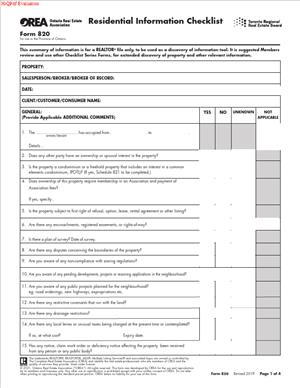
OREA Form 820 – Residential Information Checklist
Fill out nowJurisdiction: Country: Canada | Province or State: Ontario
If you are preparing to list a home for sale, the OREA Form 820 – Residential Information Checklist is designed to help you organize the property details that buyers often ask about. It is a working document used in residential real estate transactions in Ontario.
The OREA Form 820 – Residential Information Checklist gathers key facts about a property in one place. It helps reduce confusion, missed details, and last-minute questions during a sale. For many sellers, it becomes the foundation for listing information and marketing materials.
You are likely to see this form early in the selling process. It is commonly completed before or at the time you sign a listing agreement with a real estate brokerage. The information you provide can shape how your property is described to potential buyers.
This checklist matters because accuracy is critical in real estate. Small errors can create delays, disputes, or lost trust. By working through the form carefully, you create a clearer picture of your property and help avoid misunderstandings later.
What is OREA Form 820 – Residential Information Checklist?
Clear definition
The OREA Form 820 – Residential Information Checklist is a structured document used to collect detailed information about a residential property. It covers physical features, systems, improvements, and other facts that may influence a buyer’s decision.
It is called a checklist because it prompts you to review many aspects of your home. Instead of relying on memory during conversations or negotiations, you provide written responses in an organized format.
The form does not transfer ownership. It does not set a price or create a purchase contract. Its purpose is to gather and confirm information that may later be shared in listings, offers, or disclosure documents.
Who typically uses this form?
Homeowners who plan to sell a house, townhouse, or condominium in Ontario commonly complete this form. It is usually prepared with the assistance of a real estate professional.
Real estate sales representatives and brokers rely on the information in the checklist to draft marketing materials and respond to buyer inquiries. It supports their due diligence and record-keeping.
In some situations, estate representatives, power of attorney holders, or other authorized individuals may complete the form on behalf of an owner. The key requirement is that the person filling it out has reliable knowledge of the property.
Why might you need this form?
You may need this form to ensure that important property details are recorded accurately before your home goes on the market. Buyers often ask about age, upgrades, heating systems, roofing, and past repairs. This checklist helps you prepare those answers in advance.
It can also reduce the risk of inconsistent information. When details are written down clearly at the start, it becomes easier to maintain accuracy across listings, showings, and negotiations.
In addition, the form can serve as a reference point if questions arise later. Having a dated document that outlines what was known at the time of listing can help clarify what was disclosed and when.
Typical real-life scenarios
- You are selling a detached home that you have lived in for many years. Over time, you replaced the furnace, updated the kitchen, and repaired the roof. The checklist helps you document those improvements, including approximate dates and any available warranties.
- You inherited a property and are preparing it for sale. You may not know every detail about past renovations. The form prompts you to confirm what you do know and identify areas where information is limited or unavailable.
- You are selling a condominium unit. The checklist can include information about the unit itself, such as appliances and flooring, as well as details that relate to shared elements or parking arrangements.
- You recently completed major upgrades before listing your property. The checklist allows you to clearly outline those improvements so they can be reflected accurately in marketing materials and buyer communications.
When would you use OREA Form 820 – Residential Information Checklist?
You typically use this form at the beginning of the selling process. It is often completed before the property is formally listed on the market. This timing allows your real estate representative to rely on accurate information from the start.
If you are meeting with a brokerage to discuss listing your home, the form may be introduced during that meeting. It helps guide the discussion about the property’s features and history.
The document can also be useful if your home was previously listed and is being re-listed. Updating the checklist ensures that any new repairs, changes, or corrections are captured before marketing resumes.
In situations where there has been a conditional offer and the transaction did not close, the checklist may still be relevant. It can be reviewed and updated before the property is shown again to new buyers.
Sellers who prefer to be organized often complete the form in advance of listing consultations. This can make discussions more efficient and reduce the chance of overlooking important information.
Legal characteristics of OREA Form 820 – Residential Information Checklist
The checklist is primarily an information-gathering tool. Its effectiveness depends on the accuracy and completeness of the information provided. It is typically signed and dated, which shows when the information was confirmed.
For a document like this to be reliable, it usually needs clear identification of the property and the person completing it. Ambiguous descriptions or missing details can reduce its usefulness.
Common problems arise when information is guessed or left incomplete without explanation. Inconsistent dates, unclear descriptions of renovations, or failure to mention known issues can create confusion later in the transaction process.
In Ontario, real estate transactions are shaped by both contract law and general principles around disclosure and misrepresentation. While this checklist is not itself a purchase agreement, the information recorded may be relied upon by professionals and buyers when forming decisions.
The document does not replace inspection reports, warranties, or official property records. It does not guarantee the condition of the property. It also does not eliminate a buyer’s right to conduct their own investigations.
Is it legally binding?
The OREA Form 820 – Residential Information Checklist is generally not a contract for sale. It does not create an agreement to buy or sell property. Instead, it records information provided by the seller.
However, once signed, it can become an important record of what was stated about the property at a particular time. If information in the form is later shown to be inaccurate, it may raise questions about how the property was described during the transaction process.
Its impact often depends on how the information is used. If details from the checklist are incorporated into a listing, marketing materials, or an agreement of purchase and sale, those statements may carry more weight.
For that reason, many sellers treat the completion of this document seriously. It is not legally binding in the way a sale contract is, but it can influence the legal and practical outcome of a real estate transaction.
How to fill out OREA Form 820 – Residential Information Checklist
Step 1 – Confirm the property details
Begin by reviewing the section that identifies the property. Enter the full municipal address, including unit number if applicable. Check that the spelling, postal code, and legal description are accurate. This ensures the information clearly applies to the correct property.
Step 2 – Provide ownership and occupancy information
Complete the portion that asks about ownership and who currently occupies the property. Indicate whether you are the registered owner and whether the property is owner-occupied, tenanted, or vacant. Make sure the information reflects the current situation as of the date you sign the form.
Step 3 – Describe the structure and layout
Fill in details about the type of dwelling, number of storeys, and approximate square footage if known. Include information about bedrooms, bathrooms, and finished areas such as basements or lofts. Use clear descriptions rather than informal terms.
Step 4 – Outline major systems and utilities
Provide information about heating, cooling, plumbing, electrical service, and water supply. If you know the age of systems such as the furnace or air conditioner, include approximate installation dates. If certain services are rented rather than owned, note that clearly.
Step 5 – Record renovations and improvements
List significant upgrades or repairs completed during your ownership. Include approximate dates and a brief description of the work performed. If warranties exist, indicate whether they may be transferable.
Step 6 – Identify known issues or past problems
Answer questions about past water damage, structural concerns, or other material issues honestly and clearly. If a problem was repaired, describe the repair rather than simply stating that the issue existed. Avoid speculation and stick to facts you can confirm.
Step 7 – Review appliances and included items
Indicate which appliances or fixtures are included with the property. Confirm whether they are owned or subject to rental or lease agreements. Ensure that the information matches what you plan to include in the eventual listing or sale discussions.
Step 8 – Double-check accuracy and completeness
Before signing, read through the entire document from start to finish. Look for missing answers, unclear handwriting, or inconsistent dates. Correct any errors neatly and make sure changes are initialed if required by the form layout.
Step 9 – Sign and date the form
Once you are satisfied that the information is accurate to the best of your knowledge, sign and date the checklist where indicated. Keep a copy for your records. Provide the completed form to your real estate representative so it can be used in preparing the listing and related documents.
Legal terms you might encounter in OREA Form 820 – Residential Information Checklist
- Chattels: These are movable items included in the sale, such as appliances, window coverings, or light fixtures not permanently attached. In this form, you may be asked to confirm which chattels are present or typically included with the property. Buyers often rely on this information when preparing offers.
- Fixtures: Fixtures are items permanently attached to the property, like built-in cabinets, plumbing, or hardwired lighting. This document helps clarify what is considered part of the structure. Misunderstanding fixtures can lead to disputes about what stays with the home.
- Encumbrance: An encumbrance is a claim or liability attached to the property, such as a mortgage, lien, or easement. While this checklist is not a title search, it may prompt you to disclose known encumbrances that affect use or ownership.
- Easement: An easement gives someone else the legal right to use part of your property for a specific purpose, such as utility access. If you know about registered easements, you should reflect that in your responses where relevant.
- Zoning: Zoning refers to municipal rules about how the property can be used. This form may ask about the current use of the property, which should align with local zoning rules. If the property has a non-conforming use, that is important information.
- Material Defect: A material defect is a significant issue that could affect the property’s value or safety, such as foundation problems or water damage. This document encourages you to identify known issues so that buyers have a clear picture.
- Rental Items: Rental items are equipment or systems not owned outright by the homeowner, such as a rented water heater. The checklist may ask you to confirm whether certain systems are owned or rented.
- Representation: A representation is a statement of fact made to another party. Information you provide in this form can become part of the overall transaction record. Accuracy matters because others may rely on what you state.
- Occupancy: Occupancy refers to who currently lives in the property and under what arrangement. You may need to confirm whether the property is owner-occupied, tenanted, or vacant.
- Survey: A survey is a document showing property boundaries and structures. While you may not attach a survey to this checklist, you may be asked whether one exists and whether it is available.
FAQs
Do I have to complete every section of OREA Form 820 – Residential Information Checklist?
Yes. You should review and respond to each section, even if the answer is “not applicable” or “unknown.” Leaving blanks can create confusion about whether you overlooked the question or intentionally skipped it. If you genuinely do not know the answer, state that clearly instead of guessing.
What if I do not know the age of the roof or furnace?
Check your records first. Look for invoices, warranties, or service documents. If you still cannot confirm the age, indicate that the exact age is unknown and provide an estimate only if you have a reasonable basis. Do not invent dates. If you later find accurate information, update your disclosure promptly.
Can I update this document after I have signed it?
Yes. If you discover new information or realize something was inaccurate, you should correct it in writing as soon as possible. Provide the revised details clearly and make sure all parties receive the updated version. Keeping outdated information in circulation can cause problems later in the transaction.
Is this form the same as a seller property disclosure statement?
No. This document functions as an information checklist rather than a formal warranty. It gathers detailed background facts about the property. A separate disclosure statement, if used, may contain specific representations about conditions and defects. Read both carefully so your answers are consistent.
Who should sign this document?
Each registered owner of the property should review and sign it. If someone is signing on behalf of an owner, confirm they have proper authority, such as under a power of attorney. The names on this form should match the names on the title and the agreement of purchase and sale.
Does the information in OREA Form 820 – Residential Information Checklist become part of the offer?
It can. Buyers and their representatives may rely on the details when drafting conditions or clauses. In some cases, information from this form is referenced in the agreement. That is why your answers in OREA Form 820 – Residential Information Checklist must be consistent with any representations in the offer documents.
What attachments should I provide with this form?
Attach copies of relevant documents you already have, such as surveys, renovation permits, warranty certificates, or rental contracts for equipment. Make sure each attachment is clearly labeled. Keep a copy of everything you provide so you can verify what was shared.
What happens if the information here conflicts with the purchase agreement?
The purchase agreement usually governs the transaction terms. If you notice a conflict, raise it immediately and clarify the correct information in writing. Do not assume the inconsistency will resolve itself. Clear, consistent documentation reduces the risk of disputes before closing.
Checklist: Before, During, and After OREA Form 820 – Residential Information Checklist
Before
- Gather property tax bills, utility records, and recent invoices for repairs or upgrades.
- Review your agreement of purchase and sale to ensure consistency in names and property details.
- Confirm the legal description of the property from your deed or title documents.
- Locate warranties, manuals, and rental contracts for major systems and appliances.
- Check whether you have a current survey and know where it is stored.
- Speak with co-owners to confirm shared knowledge about past issues or renovations.
- Make a list of known defects, repairs, and improvements with approximate dates.
During
- Read each question slowly and answer based on actual knowledge, not assumptions.
- Use clear, specific language when describing systems, renovations, or problems.
- Indicate “unknown” where appropriate instead of leaving blanks.
- Double-check spelling of names and accuracy of property details.
- Confirm whether items are owned or rented before listing them.
- Review your answers for consistency with other transaction documents.
- Ensure every registered owner reviews the completed form before signing.
- Date the document accurately on the day it is signed.
After
- Make a complete copy of the signed form and all attachments for your records.
- Provide the document to the appropriate party as agreed in the transaction process.
- Store digital and paper copies in a safe, organized location.
- Monitor for new developments, such as system failures or new damage.
- Issue written updates if material information changes before closing.
- Keep proof of delivery or confirmation that the document was received.
- Retain the form with your transaction file even after closing.
Common mistakes to avoid with OREA Form 820 – Residential Information Checklist
- Mistake: Leaving sections blank because you are unsure, which often happens when you rush, leading others to assume you avoided the question, so do not forget to write “unknown” or “not applicable” clearly.
- Mistake: Guessing dates for renovations or system replacements, usually due to missing paperwork, which can undermine credibility later, so do not forget to check invoices or state that the date is approximate.
- Mistake: Failing to disclose past water damage because it was repaired, often out of fear it will affect value, which can create disputes if discovered, so do not forget to mention both the issue and the repair.
- Mistake: Listing rented equipment as owned because you overlooked the contract, which can affect closing adjustments, so do not forget to confirm the status of each major system.
- Mistake: Using inconsistent names or property descriptions compared to the purchase agreement, often from copying old documents, which can delay processing, so do not forget to match the legal details exactly.
- Mistake: Not updating the form after discovering new information, usually because you think it is minor, which can expose you to claims of misrepresentation, so do not forget to issue written corrections promptly.
- Mistake: Forgetting to attach supporting documents you referenced, which happens when documents are stored separately, causing confusion about proof, so do not forget to label and include all attachments.
- Mistake: Allowing only one co-owner to complete it without confirming shared knowledge, which can result in incomplete answers, so do not forget that every owner should review and sign.
What to do after filling out OREA Form 820 – Residential Information Checklist
Once you complete the form, pause before sending it out. Review every page carefully. Look for missing answers, unclear wording, or inconsistencies with your other transaction documents. Small corrections now can prevent larger issues later.
Make sure all required signatures are in place. If there are multiple owners, confirm that each person has reviewed the final version. The date beside each signature should reflect when that person actually signed.
- Step 1: Create a complete copy of the signed form, including all attachments.
- Step 2: Save a digital scan in a secure folder labeled with the property address and date.
- Step 3: Deliver the document to the appropriate party using the agreed method, such as email or secure document sharing.
- Step 4: Request confirmation that it was received and is readable.
- Step 5: File the original paper version in your transaction binder or records folder.
- Step 6: Cross-check the information against the agreement of purchase and sale one more time.
- Step 7: Notify the other party in writing if you discover any new material information before closing.
- Step 8: Keep records of any follow-up questions and your written responses.
- Step 9: Retain the document after closing as part of your permanent property records.
- Step 10: Update your internal records to reflect what was disclosed, especially if you are purchasing another property and need a reference.
Staying organized after completion is just as important as filling out the form itself. Clear records protect you if questions arise months or even years later. Treat this document as part of your permanent transaction history, not just a one-time checklist.
Disclaimer: This guide is provided for informational purposes only and is not intended as legal advice. You should consult a legal professional.