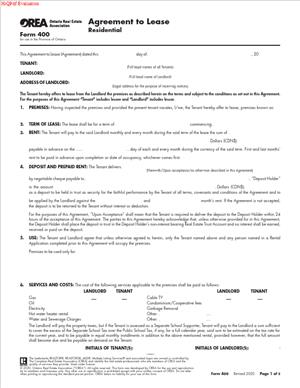
OREA Form 400 – Agreement to Lease – Residential
Fill out nowJurisdiction: Country: Canada | Province or State: Ontario
The OREA Form 400 – Agreement to Lease – Residential is a standard document used to record the main terms of a proposed residential tenancy. You usually encounter it right before a formal lease is prepared and signed.
If you are about to complete this form, it helps to understand what it does and what it does not do. The details you enter often shape the final lease and the relationship that follows.
This document matters because it captures key expectations in writing. Rent, timing, and conditions are usually set out here, before anyone moves in.
What is an OREA Form 400 – Agreement to Lease – Residential?
Clear definition
The OREA Form 400 – Agreement to Lease – Residential is a written agreement that outlines the essential terms for renting a residential property. It is often used as an initial agreement before a longer lease document is prepared.
The form typically records the parties involved, the property being rented, the rent amount, and important dates. It may also include conditions that must be met before the tenancy begins.
This document is commonly treated as a serious commitment. Once signed, it often reflects an intention to enter into a residential lease on the stated terms.
Who typically uses this form/document?
This form is commonly used by property owners or landlords and prospective tenants. It is also often used when a real estate professional is involved in arranging a residential rental.
You may see it used for houses, apartments, condominiums, or other residential units. It is generally used when both sides want written confirmation of agreed-upon terms before finalizing a lease.
Why you might need this form/document
You might need this form when you and the other party have agreed on the main rental terms but are not yet signing a full lease. It provides a written snapshot of what was agreed.
The document can help avoid misunderstandings. It puts key points in one place so both sides can review them before moving forward.
For many people, it acts as a bridge between verbal discussions and a formal tenancy agreement.
Typical real-life scenarios
- A common scenario is when a tenant’s offer to rent a unit has been accepted, subject to certain conditions. The form records those terms while the conditions are addressed.
- Another situation is when a future move-in date is planned. The form may set out the rent and start date even though the tenant has not yet taken possession.
- It is also used when parties want clarity before investing more time or money, such as arranging movers or giving notice at a current residence.
When would you use an OREA Form 400 – Agreement to Lease – Residential?
This form is used at the point where negotiations have become concrete,e and both parties have aligned on the essential terms of the rental. It fits situations where the property has been identified, the rent has been agreed upon, and there is a shared intention to move forward, but a full lease is not yet ready to be signed.
It is particularly appropriate when there is a timing gap between agreement and possession. This can happen when the unit will only become available at a future date, when renovations or cleaning are still underway, or when a current tenant has not yet vacated. In these cases, the form provides reassurance that the key terms are settled while practical steps are completed.
The form is also commonly used when the agreement depends on one or more conditions. Examples include confirmation of employment, credit approval, or other requirements that must be satisfied before the tenancy begins. Writing these conditions down helps both sides understand what must happen next and what the consequences are if those steps are not completed.
Legal characteristics of the OREA Form 400 – Agreement to Lease – Residential
The OREA Form 400 – Agreement to Lease – Residential is commonly treated as a binding agreement once properly completed and signed. Whether it is enforceable can depend on factors such as clarity, completeness, and mutual agreement.
Validity is often affected by whether essential terms are included. These usually involve the parties, the property, rent, and timing. Missing or unclear terms can affect how the document is interpreted.
In Ontario, residential tenancies are influenced by specific legislation. This can affect how certain clauses are treated, even if they appear in the form. Practices may differ in other jurisdictions.
This form does not replace a full residential lease. It usually does not contain all the terms required for an ongoing tenancy. It is also not a guarantee that every future detail has been settled.
How to fill out an OREA Form 400 – Agreement to Lease – Residential
Step 1 – Identify the parties and property
You start by entering the full legal names of the landlord and the tenant. Accuracy matters because these names identify who is bound by the agreement.
You also describe the rental property. This usually includes the address and the specific unit, if applicable. Clear identification helps avoid confusion later.
Step 2 – Set out the rent and payment terms
This step records the agreed rent amount. It often includes how often rent is paid and the method of payment.
You may also see space for deposits or other amounts connected to the tenancy. These details are typically written exactly as agreed during discussions.
Step 3 – Specify the tenancy start and length
Here, you note the date the tenancy is expected to begin. This sets expectations for both move-in timing and rent obligations.
The form may also ask for the term of the tenancy, such as a fixed period or another arrangement. This information frames how long the initial commitment lasts.
Step 4 – Include conditions and contingencies
This section is often used to record conditions that must be met before the tenancy begins. Examples may include approvals or confirmations.
Conditions are usually written clearly and with timelines. This helps both sides understand what needs to happen next.
Step 5 – Address included items and services
You may list what is included with the rental, such as utilities, parking, or appliances. These details help define the value and scope of the rental.
Writing this information clearly reduces the risk of later disagreements about what was part of the deal.
Step 6 – Review additional terms
Some forms include space for additional terms or schedules. This is where unique arrangements are often recorded.
Any added terms are usually read carefully by both sides to ensure they match what was discussed.
Step 7 – Signatures and dates
The final step is signing and dating the document. Signatures show agreement to the recorded terms.
Dates help establish when the agreement was made. Once signed, the document typically reflects a shared understanding at that point in time.
Legal terms you might encounter in OREA Form 400 – Agreement to Lease – Residential
Agreement to Lease
An agreement to lease is a document that sets out the intention of the parties to enter into a formal lease in the future. In this context, it captures the core rental terms before a full residential lease is signed.
Landlord
The landlord is the person or entity offering the residential property for rent. This term identifies who will be granting the right to occupy the property under the future lease.
Tenant
The tenant is the individual or individuals who intend to rent and occupy the property. Their legal names are important because they define who will be responsible for the obligations described in the agreement.
Rent
Rent refers to the amount of money the tenant agrees to pay for the right to occupy the property. The form usually specifies the amount, frequency, and timing of these payments.
Commencement Date
The commencement date is the date the tenancy is intended to begin. This date often determines when rent becomes payable and when possession is expected.
Conditions
Conditions are requirements that must be satisfied before the agreement proceeds to a full lease. If conditions are not met as written, the agreement may not move forward as planned.
Deposit
A deposit is an amount of money provided in connection with the rental, often tied to future rent obligations. How it is treated can be influenced by residential tenancy rules.
Binding Agreement
A binding agreement is one that can be enforced once properly completed and signed. This document reflects the parties’ intention to be legally committed to the stated terms.
FAQs – OREA Form 400 – Agreement to Lease – Residential
Is this agreement legally binding once signed?
In many cases, it is treated as legally binding once all parties have signed it. Whether it is enforceable depends on how clearly the essential terms and any conditions are set out in the document.
Does this form replace a residential lease?
No, it is not a substitute for a full residential lease. It is generally intended to record the main terms that will later be reflected in a more detailed lease agreement.
Can a landlord or tenant back out after signing?
Backing out may have legal consequences if the agreement is binding and conditions have been met or waived. The ability to withdraw usually depends on the wording of the agreement and whether any conditions remain outstanding.
What happens if a condition is not satisfied by the deadline?
If a condition is not satisfied as written, the agreement may come to an end or become void, depending on its wording. Clear timelines and outcomes in the condition clause are critical to avoid disputes.
Should all incentives or promises be written into the form?
Yes, anything that matters to either party should be included in writing. Relying on verbal promises or assumptions can lead to misunderstandings later.
Can changes be made after the form is signed?
Changes can usually be made only if all parties agree. Any amendment or waiver should be documented in writing to avoid uncertainty.
Is this form suitable for every residential rental?
It is most suitable when parties want to lock in key terms before signing a lease. In very simple or immediate situations, parties may choose to proceed directly to a full lease instead.
Checklist: before, during, and after the OREA Form 400 – Agreement to Lease – Residential
Before
- Confirm that all parties understand the purpose of the agreement
- Verify spelling and accuracy of all legal names
- Agree on the exact rent amount and payment schedule
- Confirm the intended possession or start date
- Decide whether any conditions are required
- Clarify what is included with the rental unit
During
- Write all agreed terms in clear, specific language
- Ensure conditions include clear outcomes and timelines
- Double-check dates, amounts, and property details
- Review any added clauses for unintended effects
- Confirm that all pages form part of the agreement
- Ensure everyone understands the commitments being made
After
- Distribute signed copies to all parties
- Monitor deadlines tied to conditions
- Document any waivers or amendments in writing
- Begin preparation of the formal lease document
- Compare the lease terms to this agreement
- Retain copies for future reference
Common mistakes to avoid (OREA Form 400 – Agreement to Lease – Residential)
- A frequent mistake is assuming the agreement has no real legal effect. Even at this early stage, unclear or careless wording can lock the parties into obligations they did not fully consider.
- Another issue is failing to be specific about conditions. Vague language about approvals or next steps can make it difficult to determine whether the agreement should proceed or end.
- People also sometimes overlook inconsistencies between this agreement and the later lease. Differences in rent, dates, or included items can create confusion and conflict if not addressed early.
- One common mistake is treating the agreement as a flexible summary rather than a document that may later be enforced as written. Parties sometimes believe that because a full lease has not yet been signed, they can easily change their minds or renegotiate key terms. In practice, courts and tribunals often look at the language of the agreement to lease to determine what the parties objectively committed to at that moment. If the rent, commencement date, and property are clearly set out, it may be difficult to argue later that the agreement was merely informal or provisional.
- Another error arises when important details are left to be decided later without any guidance in the document. For example, parties may write that a “standard lease” will be used, without clarifying which standard or whether additional terms discussed verbally are meant to carry over. This can create uncertainty if one party expects clauses that the other never agreed to in writing. Leaving gaps may feel convenient at the time, but it often leads to disagreement once expectations diverge.
- Failing to consider how Ontario residential tenancy rules interact with the agreement is also a frequent problem. Some clauses that parties attempt to include, such as restrictions on guests or limits on tenant rights, may not be enforceable even if written into the agreement. Assuming that anything written and signed will automatically stand can give a false sense of security. Understanding that certain rights cannot be waived helps avoid relying on terms that may later be ignored or struck out.
- Another mistake is not clearly stating what happens if conditions are not met by the deadline. Parties may include a financing approval, employment confirmation, or inspection condition, but fail to specify whether the agreement automatically ends or whether extensions are possible. Without clarity, one party may believe the deal has collapsed while the other assumes it is still alive. This ambiguity can lead to disputes about deposits, the availability of the unit, or whether either side acted improperly.
- Some landlords and tenants also underestimate the importance of consistency between this agreement and future communications. Sending emails or messages that contradict the written terms can complicate matters later. For example, casually agreeing in writing to a different move-in date or rent amount without formally amending the agreement can muddy the record. When disagreements arise, these informal messages may be relied upon to argue that the original terms were changed.
- A further issue is failing to think through timing and logistics. Setting a commencement date without considering cleaning, repairs, or the end of an existing tenancy can create pressure and conflict. Tenants may plan moves or give notice based on the agreement, only to discover delays that were not realistically accounted for. Being overly optimistic in setting dates, rather than realistic, often creates avoidable stress and potential liability.
- Finally, parties sometimes neglect to keep complete copies of the signed agreement, including any schedules or added pages. Missing pages or unsigned amendments can weaken a party’s position if a disagreement arises. Assuming that the other party or a real estate professional will retain everything can backfire. Treating record-keeping as an afterthought is a small mistake that can have outsized consequences later.
What to do after filling out the OREA Form 400 – Agreement to Lease – Residential
Once the form is completed, it should be reviewed calmly and thoroughly by everyone involved. Confirming accuracy at this stage is easier than resolving disputes later.
Attention should then shift to meeting any conditions that were written into the agreement. Clear communication about progress helps prevent delays or misunderstandings.
When the time comes to prepare the full residential lease, the terms should be aligned with what was recorded in the agreement. Keeping organized records of all signed documents supports a smoother transition into the tenancy.
After completing the agreement, it is wise to step back and consider whether any professional advice is needed before moving further. While not every situation requires a lawyer or paralegal, seeking guidance can be helpful if the terms are complex, the property is unusual, or significant money is at stake. Clarifying obligations early can prevent misunderstandings from solidifying as the process moves toward a binding tenancy.
Communication after signing is especially important. Both parties should keep each other informed about progress on any conditions, using clear and documented messages rather than assumptions. If a condition is satisfied, waived, or extended, this should be confirmed in writing so there is a shared record. Silence or vague updates can easily be interpreted differently by each side, increasing the risk of conflict.
Attention should also be given to practical preparations that flow from the agreement. Landlords may need to schedule repairs, arrange access, or coordinate with current occupants. Tenants may need to plan movers, utilities, or insurance. While these steps are practical rather than legal, they often rely on the certainty created by the agreement. Aligning expectations about access dates and the readiness of the unit helps ensure that the transition is smooth.
When preparing the formal residential lease, it is important to treat the agreement to lease as a reference point rather than an afterthought. Each key term should be compared carefully, including rent, start date, included items, and any special arrangements. If differences are necessary or agreed upon, they should be discussed openly and resolved before the lease is signed. Relying on the assumption that “it will all work out” can undermine trust at the final stage.
Parties should also be mindful of how deposits are handled after the agreement is signed. Ensuring that funds are applied correctly, credited toward rent where required, and documented clearly helps avoid later disputes. Misunderstandings about whether money is refundable or how it is applied often become contentious issues if the tenancy does not proceed as planned.
If circumstances change after signing, prompt and transparent discussion is critical. Life events, financing issues, or unexpected property problems can affect the ability to proceed. Addressing these changes early gives both sides more options, including amendments or mutual termination, rather than forcing a last-minute confrontation. Delaying difficult conversations usually narrows choices and increases tension.
Finally, once the full lease is executed and the tenancy begins, the agreement to lease should not be discarded. Keeping it with the lease and related documents provides context for how the tenancy was formed. If questions later arise about what was promised or how certain terms came to be included, the agreement can serve as a useful reference. Treating it as part of a complete paper trail supports clarity and accountability throughout the landlord-tenant relationship.
After the agreement is signed, it is helpful for both parties to create a simple timeline of next steps based on what is written. This may include dates for satisfying conditions, delivering deposits, preparing the unit, or signing the formal lease. Having a shared understanding of what should happen next, and when, reduces uncertainty and helps keep the process on track.
Parties should also consider how they will document compliance with conditions. For example, if employment confirmation or credit approval is required, it should be clear what form of evidence is acceptable and how it will be delivered. Keeping copies of emails, letters, or confirmations related to these conditions can be valuable if questions arise about whether they were properly satisfied.
As the process moves forward, it is important to remain consistent with the tone set by the agreement. Professional, respectful communication supports a cooperative transition into the tenancy. Even when issues arise, framing discussions around the written terms rather than personal expectations helps keep conversations focused and constructive.
If a condition cannot be met within the agreed timeframe, addressing this proactively can preserve options. Rather than letting deadlines pass without explanation, parties may be able to agree to an extension or amendment. These adjustments should always be confirmed in writing, even if they seem minor. Informal understandings that are not documented can quickly unravel if circumstances change again.
Landlords should also use the period after signing to ensure compliance with any regulatory or administrative requirements. This may include preparing required disclosures, ensuring smoke and carbon monoxide detectors are installed, or confirming that the unit meets applicable standards. Taking care of these obligations early reduces the risk of last-minute delays or complications at move-in.
Tenants, meanwhile, may want to use this time to review their own obligations under Ontario residential tenancy rules. Understanding rights and responsibilities related to rent, maintenance, and notice periods helps set realistic expectations from the start. Entering the tenancy informed, rather than relying solely on assumptions, often leads to a smoother relationship.
When the formal lease is presented, both parties should resist the temptation to treat it as a formality. Reading it carefully and comparing it to the agreement to lease ensures continuity and fairness. If discrepancies appear, they should be resolved before signing, not postponed until after move-in. Addressing issues at this stage is usually simpler and less emotionally charged.
If the tenancy does not proceed despite the agreement, parties should document how and why it ended. Whether due to unmet conditions, mutual agreement, or other reasons, having a clear written record helps avoid lingering disputes about responsibility or entitlement to deposits. Closure, even when a deal falls through, protects both sides.
Finally, maintaining organized records over time is an often-overlooked but valuable practice. Keeping the agreement to lease, the formal lease, amendments, and key correspondence together creates a clear history of the tenancy. This documentation can be invaluable if questions arise months or years later, supporting clarity, accountability, and more effective resolution of issues.
Disclaimer: This guide is provided for informational purposes only and is not intended as legal advice. You should consult a legal professional.