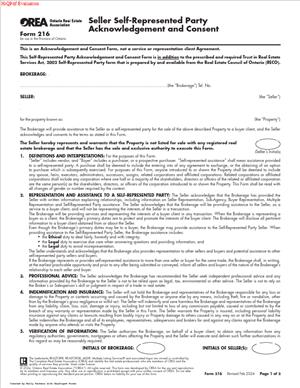
OREA Form 216 – Seller Self-Represented Party Acknowledgement and Consent
Fill out nowJurisdiction: Country: Canada | Province or State: Ontario
OREA Form 216 – Seller Self-Represented Party Acknowledgement and Consent is a short but important real estate document. It comes up when a property seller is not working with their own real estate representative.
This form focuses on clarity. It records that you understand your role as a self-represented seller. It also confirms what a brokerage and its representative are, and are not, doing for you.
If you are about to sign or complete this form, you are likely near an active transaction. You may be listing a property, reviewing an offer, or communicating with a buyer who has representation.
This document matters because it sets expectations early. It helps avoid confusion about advice, loyalty, and responsibility during the sale.
For self-represented sellers, this form often feels administrative. In practice, it plays a key role in how the transaction is handled and understood by everyone involved.
What is OREA Form 216 – Seller Self-Represented Party Acknowledgement and Consent?
Clear definition
OREA Form 216 – Seller Self-Represented Party Acknowledgement and Consent is a written acknowledgment. It confirms that you are selling a property without your own real estate representative.
The document records that you understand you are not receiving representation from the brokerage involved. It also captures your consent to proceed on that basis.
This form is typically used alongside other real estate paperwork. It does not replace an agreement of purchase and sale or listing documents.
You may also see this form referred to by its identifier, Form 216, within transaction paperwork.
Who typically uses this form/document?
This form is commonly used by property sellers who choose to handle the sale themselves. That includes individuals selling a home, condominium, or other real property.
It is also used by brokerages and real estate representatives when dealing with a self-represented seller. The form documents the relationship clearly.
Buyers do not usually complete this document. It is focused on the seller’s status and understanding.
In some transactions, more than one seller signs the same form. Each seller is acknowledging their self-represented position.
Why you might need this form/document
You may need this form when a brokerage is involved on the buyer’s side only. The form clarifies that the brokerage does not represent you as the seller.
The document helps set boundaries around advice, negotiation, and communication. It records that you understand those limits.
This form is often required before a transaction moves forward. It allows the brokerage to continue participating while recognizing your self-represented role.
It can also reduce later disputes about who was responsible for what during the sale process.
Typical real-life scenarios
- You are selling your home privately and receive an offer from a buyer working with a real estate representative. Before discussions continue, this form is presented to confirm your status.
- You agree to allow a brokerage to market a buyer’s interest in your property. The form records that the brokerage is not acting for you.
- You are negotiating terms directly with a buyer, while their representative handles paperwork on their side. The form documents that you are managing your own decisions.
- You list your property on your own, but allow showings arranged through a brokerage. The form clarifies the relationship before any offer is prepared.
When would you use OREA Form 216 – Seller Self-Represented Party Acknowledgement and Consent?
This form is used at the point where a brokerage interacts with you as a seller, without representing you. Timing can vary depending on how the transaction develops.
Often, the form appears before an offer is presented. It may also appear when negotiations are ongoing and communication becomes more formal.
You may encounter this form when reviewing documents prepared by a buyer’s representative. The form helps establish how information flows between parties.
In transactions with multiple sellers, the form may be introduced once all sellers are identified as self-represented. Each person’s acknowledgment matters.
The form can also be used when a transaction resumes after a pause. It reaffirms the relationship if circumstances have changed.
Legal characteristics of OREA Form 216 – Seller Self-Represented Party Acknowledgement and Consent
This document functions as a written acknowledgment and consent. Its effectiveness generally depends on clear completion and informed signing.
The form is typically valid when all required fields are completed and signed. Missing names, dates, or signatures often create problems.
Common issues arise when the form is misunderstood. Some sellers assume it provides advice or protection. The document does not do that.
Across jurisdictions, similar forms exist, but details can differ. In Ontario, this form aligns with how representation relationships are recognized in real estate transactions.
This document does not appoint a representative for you. It also does not set a sale price, commission, or terms of sale.
Is it legally binding?
This form is generally treated as binding once properly signed. It records your acknowledgment and consent at a specific point in time.
Its binding nature relates to the statements made within it. You are confirming your understanding of the relationship and agreeing to proceed that way.
The form does not bind you to sell the property. It also does not bind you to accept any particular offer.
Its main effect is evidentiary. It documents what was understood and agreed regarding representation during the transaction.
How to fill out OREA Form 216 – Seller Self-Represented Party Acknowledgement and Consent
Step 1 – Identify the parties
The form begins by identifying you as the seller. Names are entered exactly as they appear on ownership or transaction documents. Accuracy here avoids confusion later.
Step 2 – Confirm self-represented status
This section records that you are not represented by a real estate brokerage. The wording focuses on acknowledgment, not explanation. Read it carefully to understand what is being confirmed.
Step 3 – Review the brokerage role description
The form describes what the brokerage and its representative may do in the transaction. This section outlines limits on advice and advocacy. It helps frame expectations.
Step 4 – Acknowledge information and consent
You are asked to confirm that you understand the information provided. This includes consenting to continue the transaction with this arrangement in place.
Step 5 – Consider multiple sellers
If more than one person is selling the property, each seller is identified. Each person’s acknowledgment is treated separately, even within one form.
Step 6 – Check dates and timing
The date of signing is recorded on the form. This anchors the acknowledgment to a specific moment in the transaction timeline.
Step 7 – Signatures
You sign where indicated to confirm your acknowledgment and consent. Signatures are typically handwritten, but the format may vary depending on how the form is presented.
Step 8 – Brokerage completion
The brokerage or representative completes their portion of the form. This ties the acknowledgment to the specific transaction and parties involved.
Step 9 – Final review
Before submission or circulation, the completed form is reviewed for missing information. A complete form helps prevent delays or misunderstandings later in the process.
Legal terms you might encounter in OREA Form 216 – Seller Self-Represented Party Acknowledgement and Consent
- Self-Represented Party: This refers to you as the seller when you are not represented by your own brokerage. In this document, you confirm that you are choosing to proceed without a seller’s representative. The form records that this is your decision, not an oversight.
- Acknowledgement: An acknowledgement is your written confirmation that you received and reviewed specific information. In this form, you acknowledge that the brokerage explained its role and limits. It shows you were informed before moving forward.
- Consent: Consent means you agree to proceed under the conditions described. By signing, you consent to the brokerage’s involvement as outlined. This matters because it sets expectations about what the brokerage will and will not do.
- Brokerage: The brokerage is the real estate business involved in the transaction, typically representing the buyer. In this form, the brokerage identifies itself and explains its duties. The document clarifies that the brokerage is not acting for you as the seller.
- Designated Representative: This is the individual registrant acting on behalf of the brokerage. The form may name this person to show who you will be dealing with. It helps you know who is responsible for communications.
- Material Information: Material information is information that could affect a buyer’s decision. The form usually explains that the brokerage must treat certain information carefully. You acknowledge how this information will be handled during the transaction.
- Confidential Information: Confidential information includes details you do not want shared, such as your minimum acceptable price. The form outlines limits on what the brokerage can keep confidential. You confirm you understand those limits.
- Effective Date: The effective date is the date the form becomes active. It is often the last date of signature. This date helps determine when the acknowledgements and consents apply.
- Multiple Sellers: This term applies when more than one person owns the property. The form typically requires each seller to acknowledge and consent individually. It ensures everyone is informed in the same way.
FAQs
Do I need to sign OREA Form 216 – Seller Self-Represented Party Acknowledgement and Consent if I am selling without an agent?
Yes, if a brokerage is involved on the buyer’s side, this document is used to record that you are self-represented. You are confirming that you understand the brokerage does not act for you. Look for the section that states your status as a self-represented seller and make sure it matches your situation.
What information about me becomes part of the record when I sign this form?
Your name, the property reference, and the date are recorded. The document shows that you acknowledged the brokerage’s role and gave consent. Check that your legal name matches how you appear on the agreement of purchase and sale.
Where do I find the effective date and why does it matter?
The effective date is usually near the signature lines. It matters because it shows when your acknowledgement and consent start. Make sure the date reflects when you actually reviewed and signed the document.
What if there are two or more sellers, and one person signs later?
Each seller must sign to confirm their own understanding. If one person signs later, the effective date may change or be clarified. Review the dates beside each signature to ensure they make sense together.
Does signing this document change what the brokerage owes the buyer?
No, this document records your understanding of the brokerage’s role with you. The brokerage’s relationship with the buyer is set out elsewhere. You should read the sections describing duties so you know what the brokerage can and cannot do with you.
Can I change my mind about being self-represented after signing?
This form records your status at the time you sign. If your situation changes, that change is handled outside this document. Keep a copy so you can track what you agreed to at this stage.
What should I check if the property address or description is missing or wrong?
Look for the section identifying the transaction or property. If something is missing or incorrect, it should be fixed before you sign. The document should clearly tie to the correct property.
Do I receive a copy after it is completed?
You should receive a completed copy for your records. This helps you confirm what you acknowledged and when. Store it with the rest of your transaction paperwork.
Checklist: Before, During, and After OREA Form 216 – Seller Self-Represented Party Acknowledgement and Consent
Before
- Confirm you are choosing to proceed without a seller’s representative.
- Review the brokerage and registrant names for accuracy.
- Gather identification details used in the transaction.
- Check how many sellers must sign.
- Set aside time to read the role and duty explanations.
- Prepare questions about anything you do not understand.
During
- Read each acknowledgement statement slowly.
- Verify the property reference or transaction details.
- Confirm your name matches other documents exactly.
- Check the effective date section.
- Sign only after all blanks are complete.
- Ensure each seller signs in the correct place.
After
- Request a complete copy with all signatures.
- Save a digital and paper copy.
- Note the effective date for your records.
- Keep it with the agreement of purchase and sale.
- Refer back to it if questions about roles arise.
- Update your personal transaction checklist.
Common mistakes to avoid with OREA Form 216 – Seller Self-Represented Party Acknowledgement and Consent
- Mistake: Signing without reading the brokerage role explanation, often due to time pressure, which can lead to misunderstandings about who represents whom, so do not forget to review those paragraphs carefully.
- Mistake: Using a nickname or shortened name, which happens out of habit, can cause inconsistencies across documents, so do not forget to match your legal name exactly.
- Mistake: Leaving the effective date blank, often because it seems minor, which can create confusion about timing, so do not forget to check that a date is entered.
- Mistake: Assuming one signature covers all sellers, which happens in family situations, can invalidate the acknowledgement for others, so do not forget each seller must sign.
- Mistake: Overlooking an incorrect property description, which happens when copying from memory, can disconnect the form from the transaction, so do not forget to verify the address or identifier.
- Mistake: Not keeping a copy, which happens after a rushed signing, can make it hard to confirm what you agreed to, so do not forget to store the completed form.
What to do after filling out OREA Form 216 – Seller Self-Represented Party Acknowledgement and Consent
Once the form is signed, your focus should shift to organization and follow-through. This document supports transparency in your transaction, so keeping it accessible matters. Treat it as part of your core paperwork, not an extra.
- Step 1: Ask for a complete copy with all signatures and dates visible.
- Step 2: Check the copy against your original to confirm nothing changed after you signed.
- Step 3: Save a digital version in a clearly named folder for the transaction.
- Step 4: Place a paper copy with your other signed documents, if you keep physical records.
- Step 5: Note the effective date in your personal timeline of the sale.
- Step 6: Review the role descriptions again so expectations stay clear as negotiations continue.
- Step 7: If there are multiple sellers, confirm everyone has their own copy.
- Step 8: Refer back to this form if questions arise about confidentiality or communication.
- Step 9: Keep the form available until the transaction fully closes.
Staying organized helps you avoid confusion later. When everyone knows what was acknowledged and consented to, discussions tend to stay focused and practical.
Disclaimer: This guide is provided for informational purposes only and is not intended as legal advice. You should consult a legal professional.