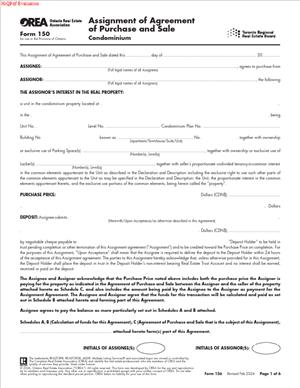
OREA Form 150 – Assignment of Agreement of Purchase and Sale (Condominium)
Fill out nowJurisdiction: Country: Canada | Province or State: Ontario
OREA Form 150 – Assignment of Agreement of Purchase and Sale (Condominium) is a document used in Ontario real estate transactions when a buyer transfers their rights in a condominium purchase agreement to another person. Instead of completing the purchase themselves, the original buyer assigns the deal to someone else.
You may come across this form if you agreed to buy a condo unit and later decided not to close the transaction personally. It allows another party to step into your place under the original agreement, subject to its terms.
This document matters because it changes who is entitled to complete the purchase. It also affects who is responsible for meeting the obligations in the original agreement. If it is not completed correctly, the assignment may not be effective.
Understanding how this form works helps you avoid delays, confusion, and disputes. Before you fill it out, you need to know what it does, what it does not do, and how each section fits into the larger real estate transaction.
What is OREA Form 150 – Assignment of Agreement of Purchase and Sale (Condominium)?
Clear definition
OREA Form 150 – Assignment of Agreement of Purchase and Sale (Condominium) is a written agreement that transfers a buyer’s interest in an existing condominium purchase agreement to a new buyer. The original agreement remains in place. The person buying the assignment takes over the rights and, depending on the wording, the obligations under that original contract.
In simple terms, the form does not create a brand-new purchase agreement. It links back to the earlier agreement of purchase and sale and confirms that another party is stepping into the original buyer’s position.
The document identifies the original buyer, the new buyer, the property, and the original agreement’s key details. It also sets out whether the original buyer remains responsible after the assignment or is released from further obligations, if permitted.
Who typically uses this form?
This form is commonly used by buyers who entered into a condominium purchase agreement but later decide to transfer their interest before closing. This often happens in pre-construction condo transactions, where there may be a long period between signing and final closing.
The original buyer is known as the assignor. The new buyer is known as the assignee. Both parties sign the assignment form to confirm the transfer.
In many cases, the seller of the condominium, often a developer, must consent to the assignment. Real estate professionals may also be involved in preparing and coordinating the document, but the form itself records the agreement between assignor and assignee.
Why might you need this form?
You might need this form if your financial situation changes after signing a condominium purchase agreement. For example, you may no longer qualify for financing or prefer not to complete the purchase.
You may also use it if the property has increased in value and you want to transfer your interest to another buyer before closing. In some situations, assignments are part of investment strategies involving pre-construction units.
The form is also used when life circumstances change. Relocation, family changes, or unexpected events can make it impractical to move forward with the original purchase. Rather than cancel the agreement, you transfer it.
Typical real-life scenarios
- A buyer signs an agreement to purchase a pre-construction condominium unit scheduled to close in three years. After one year, they received a job offer in another province. Instead of completing the purchase, they assign the agreement to another buyer who wants the unit.
- An investor enters into several condominium agreements during a new project launch. Before the buildings are completed, market conditions shift. The investor assigns one of the units to another purchaser under agreed financial terms.
- A buyer signs an agreement but later finds they cannot secure mortgage financing for the final closing. Rather than defaulting, they locate a new buyer willing to take over the agreement and complete the transaction.
- A family purchases a condominium unit as a future residence. Before construction finishes, their plans change, and they decide to purchase a different property. They assign their interest in the original agreement to someone else who is prepared to close.
When would you use OREA Form 150 – Assignment of Agreement of Purchase and Sale (Condominium)?
You would use this form after an agreement of purchase and sale for a condominium has already been signed, but before the transaction has closed. The key timing issue is that legal ownership has not yet transferred to the original buyer.
Assignments are most common in pre-construction projects because there is usually a long gap between signing and final closing. During this period, the original agreement may allow assignments with the seller’s written consent.
The assignor uses the form to transfer their contractual rights. The assignee uses it to confirm they are taking over those rights and any associated obligations. The seller’s involvement depends on what the original agreement says about consent and conditions.
This form is not used after closing. Once the title has transferred and the original buyer becomes the registered owner, a regular resale agreement would typically be used instead of an assignment.
Legal characteristics of OREA Form 150 – Assignment of Agreement of Purchase and Sale (Condominium)
This form operates as a contract between the assignor and the assignee. For it to be effective, it must clearly identify the original agreement being assigned, the property, and the parties involved. It also needs to be properly signed by those parties.
Many original condominium purchase agreements include specific clauses about assignment. These clauses may restrict assignments, require written consent from the seller, or impose fees and conditions. If those requirements are not followed, the assignment may not be recognized.
Common problems arise when the assignment conflicts with the original agreement. For example, if the original agreement prohibits assignment without consent and no consent is obtained, the seller may refuse to recognize the new buyer. Incomplete details, missing signatures, or unclear financial terms can also create disputes.
This form does not change the terms of the original purchase agreement unless the parties clearly agree to amendments and those amendments are permitted. The price, closing date, and other key terms usually remain as stated in the original contract, unless formally modified.
In Ontario, condominium transactions are subject to specific legislation and regulatory frameworks. While assignment practices are common, the details may differ depending on the project and the wording of the original agreement. The form itself reflects standard industry practice, but each transaction depends on its own terms.
Is it legally binding?
When properly completed and signed by the assignor and assignee, this document is generally legally binding between those parties. It sets out enforceable rights and obligations related to the transfer of the agreement.
However, the effectiveness of the assignment may depend on compliance with the original purchase agreement. If the original contract requires the seller’s consent and that consent is not obtained, the assignment may not fully transfer the buyer’s position as intended.
The binding nature also depends on clear terms. If the document specifies whether the assignor remains liable or is released, those terms shape future responsibility. If the wording is unclear, disputes can arise about who is responsible if something goes wrong before closing.
How to fill out OREA Form 150 – Assignment of Agreement of Purchase and Sale (Condominium)
Step 1 – Identify the original agreement
Start by entering the date of the original agreement of purchase and sale. Include the full legal names of the original buyer and the seller as they appear in that agreement. Confirm the municipal address and, if available, the legal description of the condominium unit. Accuracy here connects the assignment to the correct transaction.
Step 2 – Name the assignor and assignee
Clearly state the full legal name of the assignor, which is the original buyer transferring their interest. Then enter the full legal name of the assignee, the person who will take over the agreement. Use the exact legal spelling of names to avoid confusion at closing.
Step 3 – Describe the assignment of rights
Complete the section that states the assignor assigns all rights, title, and interest in the original agreement to the assignee. Ensure the wording reflects whether the assignment is of the entire interest. Review this section carefully so it matches the intention of both parties.
Step 4 – Set out consideration
Indicate any payment or other consideration the assignee is giving to the assignor for the assignment. This may include a specific dollar amount. Write the amount clearly and consistently in words and figures if required by the form.
Step 5 – Address deposits and adjustments
Specify how the original deposit paid under the condominium agreement will be handled. Clarify whether the assignee reimburses the assignor for deposits already paid. Ensure the amounts correspond with the records from the original transaction.
Step 6 – Confirm obligations and liability
Review the clause dealing with responsibility after the assignment. Indicate whether the assignor remains liable under the original agreement or whether the assignee assumes all obligations. This section affects who may be responsible if the transaction does not close.
Step 7 – Obtain required consents
If the original agreement requires the seller’s written consent, include the appropriate consent section. Provide space for the seller’s signature if needed. Confirm that any required conditions in the original agreement about assignment are reflected here.
Step 8 – Sign and date the form
Have the assignor and assignee sign and date the document in the spaces provided. Use the same names as written earlier in the form. Ensure all signatures are complete and legible.
Step 9 – Deliver copies to all parties
After signing, provide copies of the completed document to all relevant parties connected to the original transaction. Keep a copy for your records so you can refer to it before the final closing.
Legal terms you might encounter in OREA Form 150 – Assignment of Agreement of Purchase and Sale (Condominium)
- Assignor: This is the original buyer under the Agreement of Purchase and Sale. In this form, the assignor transfers their rights and, depending on the wording, some or all of their obligations to another person. You will need the assignor’s full legal name exactly as it appears on the original agreement.
- Assignee: This is the new buyer who takes over the agreement from the assignor. The assignee steps into the assignor’s position, subject to the terms set out in this document. The assignee’s legal name must match their identification and any future closing documents.
- Original Agreement of Purchase and Sale: This is the contract signed between the original buyer and the seller for the condominium unit. The assignment does not replace this agreement. It transfers the buyer’s interest in it. You must correctly identify the date and details of that original agreement.
- Consent of Seller: Many condominium agreements require the seller’s written consent before an assignment is valid. This form may include a section for the seller’s acknowledgment. Without consent where required, the assignment may not be effective.
- Consideration: This is the amount the assignee agrees to pay the assignor for the assignment. It is separate from the purchase price payable to the seller. The form sets out how much is paid and when it is paid.
- Deposit: This refers to the money already paid under the original agreement. The form should explain how that deposit is handled. It may be credited to the assignee, reimbursed to the assignor, or otherwise adjusted between them.
- Completion Date (Closing Date): This is the date the condominium transaction is scheduled to close under the original agreement. The assignment does not usually change this date unless all parties agree in writing. The assignee must be ready to close on that same timeline.
- Liability: This refers to who remains responsible if something goes wrong. Some assignments release the assignor from future liability. Others state that the assignor remains responsible if the assignee fails to close. You need to read this section carefully.
- Adjustments: These are financial items that are prorated on closing, such as property taxes or condominium fees. While adjustments are handled at final closing, the assignment may address how interim payments or credits are treated between assignor and assignee.
- Schedules and Attachments: These are additional pages attached to the form. They may include amendments to the original agreement, disclosure statements, or extra terms between assignor and assignee. If the form refers to a schedule, it must be attached to be effective.
FAQs
Does this form change the original purchase agreement with the builder or seller?
No. This document transfers the buyer’s position under the existing agreement. The original Agreement of Purchase and Sale stays in force. The assignee agrees to be bound by its terms, including the price, closing date, and any conditions that have not been waived or fulfilled. You should compare the assignment to the original contract to confirm that nothing is being unintentionally altered.
When does the assignment become legally effective?
The effective date is usually the date all required parties sign, including the seller if consent is required. Check the signature lines and any clause that states when the assignment takes effect. If the seller’s consent is a condition, the transfer is not complete until that consent is given in writing.
Do I need the seller’s written consent for OREA Form 150 – Assignment of Agreement of Purchase and Sale (Condominium)?
Often, yes. Many condominium agreements prohibit assignment without the seller’s prior written consent. Review the original agreement for any clause about assignment. If consent is required, make sure the seller signs in the space provided and that you keep proof of that consent with your records.
What happens to the deposit already paid under the original agreement?
This document should clearly state how the deposit is handled. It may confirm that the deposit is transferred for the benefit of the assignee, and that the assignee reimburses the assignor for it. Read the deposit section carefully and make sure the numbers match the amount actually paid under the original agreement.
Can the assignor still be responsible if the assignee fails to close?
Yes, depending on how the liability clause is written. Some assignments release the assignor completely once the seller consents. Others state that the assignor remains liable if the assignee defaults. You must locate the clause dealing with ongoing responsibility and confirm what it says before signing.
Do I need to attach the original agreement and amendments to this document?
In most cases, yes. The form refers to a specific agreement by date and parties. Attaching a copy of the original agreement and any amendments helps avoid disputes about what is being assigned. Make sure the dates, names, and property description match exactly.
What names should I use when completing the form?
Use full legal names exactly as they appear on the original agreement for the assignor. For the assignee, use the legal name that will appear on closing documents and identification. Inconsistent names can cause delays when the transaction is prepared for closing.
Does this assignment get registered on the title or change the public land records?
Typically, this form itself is not registered on the title. The transfer to the final buyer is registered at closing. However, the parties and the seller will rely on OREA Form 150 – Assignment of Agreement of Purchase and Sale (Condominium) to determine who has the right to complete the purchase. Keep a signed copy with your transaction records.
Checklist: Before, During, and After OREA Form 150 – Assignment of Agreement of Purchase and Sale (Condominium)
Before
- Review the original Agreement of Purchase and Sale for any assignment restrictions or consent requirements.
- Confirm the exact legal description and unit number of the condominium.
- Verify the amount of deposit already paid and obtain proof of payment.
- Agree in writing on the assignment consideration between the assignor and assignee.
- Check the scheduled closing date and any outstanding conditions.
- Confirm whether the seller charges an assignment fee and who will pay it.
- Gather copies of all amendments, waivers, and related schedules.
During
- Enter the correct date of the original agreement.
- Insert full legal names of assignor and assignee without abbreviations.
- Clearly state the consideration amount and payment terms.
- Specify how the deposit is treated and reimbursed.
- Review the liability clause to confirm who remains responsible.
- Attach all required schedules and supporting documents.
- Obtain signatures from assignor, assignee, and seller if required.
- Date all signatures consistently.
After
- Provide a signed copy to all parties immediately.
- Deliver the document to the seller as required under the original agreement.
- Confirm written acknowledgment or consent from the seller.
- Keep proof of any assignment fee payment.
- Update your closing file to reflect the assignee as the new buyer.
- Monitor timelines leading up to the original closing date.
- Ensure the assignee arranges financing and closing funds.
- Store the signed assignment with the original agreement and amendments.
Common mistakes to avoid with OREA Form 150 – Assignment of Agreement of Purchase and Sale (Condominium)
- Mistake: Leaving out the exact date of the original agreement because you assume everyone knows it, which can create confusion about what is being assigned and cause disputes over enforceability; do not forget to copy the date precisely as written in the original contract.
- Mistake: Using nicknames or incomplete legal names because it feels informal, which can delay closing or create identification issues; do not forget to match names exactly to the original agreement and government identification.
- Mistake: Failing to obtain the seller’s written consent when required, often because you overlook the assignment clause, which can make the assignment ineffective; do not forget to review the original contract for consent requirements.
- Mistake: Not clearly stating how the deposit is handled because you rely on a verbal understanding, which can lead to payment disputes; do not forget to spell out reimbursement and credit details in writing.
- Mistake: Ignoring the liability clause because it seems technical, which may leave the assignor unexpectedly responsible if the assignee defaults; do not forget to read and understand who remains liable after signing.
- Mistake: Forgetting to attach amendments and schedules because they seem repetitive, which can create uncertainty about the full terms being assigned; do not forget to include all referenced documents.
- Mistake: Changing key terms like closing date or purchase price in the assignment without proper authority, which can conflict with the original agreement; do not forget that the assignment transfers rights but does not automatically amend the original contract.
- Mistake: Failing to keep proof of delivery and signed copies because you assume email is enough, which can cause evidentiary problems later; do not forget to store complete, signed versions in a secure place.
What to do after filling out OREA Form 150 – Assignment of Agreement of Purchase and Sale (Condominium)
Once the form is completed and signed, your focus shifts to implementation and recordkeeping. An assignment is only useful if it is properly delivered, acknowledged, and reflected in the rest of the transaction file.
Start by organizing your documents. Place the signed assignment together with the original Agreement of Purchase and Sale and all amendments. This keeps a clear paper trail.
- Step 1: Make complete copies of the fully signed assignment for the assignor, assignee, and seller.
- Step 2: Deliver the signed document to the seller in the manner required by the original agreement, such as personal delivery or email if permitted.
- Step 3: Obtain written confirmation that the seller has received and, if required, consented to the assignment.
- Step 4: Confirm payment of any assignment fee charged by the seller and keep proof of payment.
- Step 5: Ensure the assignee has copies of all disclosure documents, amendments, and schedules related to the condominium.
- Step 6: Update any internal checklists or transaction summaries to show the assignee as the buyer going forward.
- Step 7: Remind the assignee of the existing closing date and any remaining obligations under the original agreement.
- Step 8: Confirm that financing, insurance, and closing arrangements are being made in the assignee’s name.
- Step 9: Keep all correspondence related to the assignment in one file, including emails and written acknowledgments.
- Step 10: Review the file shortly before closing to ensure no conditions or deadlines were overlooked.
Stay proactive. An assignment does not reset the transaction. The timeline continues under the original agreement. By staying organized and confirming each step in writing, you reduce the risk of misunderstandings and last-minute issues at closing.
Disclaimer: This guide is provided for informational purposes only and is not intended as legal advice. You should consult a legal professional.