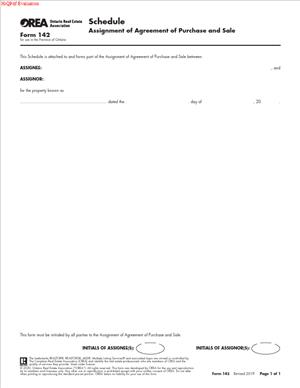
OREA Form 142 – Schedule – Assignment of Agreement of Purchase and Sale
Fill out nowJurisdiction: Country: Canada | Province or State: Ontario
OREA Form 142 – Schedule – Assignment of Agreement of Purchase and Sale is a real estate document used when a buyer transfers their purchase rights to another person. It works alongside an existing Agreement of Purchase and Sale. It does not replace that agreement. It adds a structured record of the assignment.
You usually encounter this form after an offer has been accepted but before closing. At that point, the original buyer may want someone else to take over the deal. This document captures that change clearly and in writing.
If you are filling this out, you are likely trying to avoid mistakes that could delay or derail a transaction. Small details matter here. Names, dates, and references to the original agreement all need to line up.
This form matters because multiple parties rely on it. The seller needs clarity on who is completing the purchase. The original buyer needs to define what rights are being transferred. The new buyer needs confirmation of what they are receiving.
Used correctly, this document helps keep the transaction organized and transparent. Used carelessly, it can create confusion about obligations, payments, and timing.
What is OREA Form 142 – Schedule – Assignment of Agreement of Purchase and Sale?
Clear definition
OREA Form 142 – Schedule – Assignment of Agreement of Purchase and Sale is a written schedule that records the assignment of an existing Agreement of Purchase and Sale. It sets out who is assigning their rights, who is receiving those rights, and which agreement is being assigned.
The form is not a standalone purchase agreement. It depends on a previously signed Agreement of Purchase and Sale. The schedule ties directly to that original contract and references it throughout.
This document focuses on the transfer of contractual rights, not the transfer of title itself. Title transfer still occurs at closing under the original agreement’s framework.
In practice, the form acts as a bridge. It connects the original deal to the new party stepping into the buyer’s position.
Who typically uses this form/document?
This form is commonly used by an original buyer who no longer plans to complete the purchase. That buyer becomes the assignor. The person taking over becomes the assignee.
Sellers also rely on this document to understand who they are dealing with going forward. Even though they may not be assigning anything, their transaction is directly affected.
Real estate professionals often prepare or coordinate this schedule as part of a broader transaction. Lawyers may review it as part of closing preparation.
Self-represented buyers and investors also encounter this form, especially in assignment-friendly markets or pre-construction contexts.
Why you might need this form/document
You may need this form if the original buyer cannot or does not want to close the purchase. Reasons vary. Financing issues, timing changes, or personal circumstances are common.
You may also need it if the original buyer intends to profit by assigning the contract to another buyer. The form records that transfer clearly.
This document helps avoid disputes about who is responsible for completing the purchase. It creates a paper trail showing when and how the assignment occurred.
Without this schedule, parties may rely on informal emails or assumptions. That often leads to confusion at closing.
Typical real-life scenarios
An investor buys a property with the intention of assigning it before closing. Once a new buyer is found, this schedule records the transfer of rights under the original agreement.
A buyer experiences a major life change after signing the purchase agreement. Rather than walking away, they arrange for another person to take over the contract using this form.
In a family situation, a buyer may assign the agreement to a relative who will ultimately own the property. The schedule captures that change without rewriting the entire deal.
In a joint purchase, one buyer may assign their interest to another party due to financing or partnership changes. The form clarifies who remains responsible under the agreement.
When would you use OREA Form 142 – Schedule – Assignment of Agreement of Purchase and Sale?
You would use OREA Form 142 – Schedule – Assignment of Agreement of Purchase and Sale after an Agreement of Purchase and Sale is already in place. The timing is important. The assignment happens before the original closing date.
This form is used when the original agreement allows assignment, or when the parties have otherwise agreed to permit it. The schedule reflects that the assignment is happening, not whether it is allowed.
It often comes into play in transactions involving investors, pre-construction purchases, or longer closing periods. These situations create more opportunity for a buyer’s plans to change.
The assignor, assignee, and seller are all typically involved in the process. Each party needs clarity on how the assignment affects their role in the transaction.
The document is also used when lenders, lawyers, or other professionals need written confirmation of who holds the buyer’s rights at a given time.
Legal characteristics of OREA Form 142 – Schedule – Assignment of Agreement of Purchase and Sale
This document is effective when it clearly identifies the original agreement and the parties involved. Accuracy and consistency are critical. Names, dates, and property descriptions must match the original Agreement of Purchase and Sale.
Problems often arise when the schedule is incomplete or vague. Missing signatures, unclear assignment terms, or incorrect references can create delays or disputes.
The form does not change the underlying terms of the original purchase agreement unless the assignment terms say otherwise. Price, closing date, and conditions usually remain the same.
Practices around assignment can vary by jurisdiction. In some areas, assignments are common and expected. In others, they may be restricted or require additional approvals.
This document does not transfer ownership of the property. It only transfers contractual rights and obligations under the purchase agreement.
Is it legally binding?
This form can be legally binding once properly completed and signed by the relevant parties. Its effect depends on how it is drafted and how it interacts with the original agreement.
It becomes meaningful because it documents a mutual understanding of the assignment. When parties rely on it, it can shape expectations and responsibilities.
If the form is inconsistent with the original Agreement of Purchase and Sale, questions may arise about which terms apply. Clarity reduces that risk.
Its binding nature is tied to the broader transaction. It works as part of a set of documents rather than on its own.
How to fill out OREA Form 142 – Schedule – Assignment of Agreement of Purchase and Sale
Step 1 – Identify the original agreement
Begin by clearly referencing the original Agreement of Purchase and Sale. This usually includes the date of the agreement and the names of the original parties. Accuracy here anchors the entire schedule.
Step 2 – Name the assignor and assignee
Set out the full legal names of the party assigning the agreement and the party receiving it. These names should be consistent with any other transaction documents to avoid confusion.
Step 3 – Describe the property
Include the property description exactly as it appears in the original agreement. This confirms that the assignment relates to the same transaction and not a different property.
Step 4 – State the assignment terms
Explain that the assignor is transferring their rights under the Agreement of Purchase and Sale to the assignee. This section establishes the scope of what is being assigned.
Step 5 – Address consideration, if any
If there is payment or other consideration for the assignment, it is typically referenced here. This helps clarify the financial aspect of the transfer between assignor and assignee.
Step 6 – Confirm seller acknowledgment or consent
Some assignments involve acknowledgment or consent by the seller. This step records how the seller is involved, if at all, in the assignment process.
Step 7 – Clarify ongoing obligations
This part often addresses whether the assignor remains responsible for any obligations under the original agreement. It helps set expectations between the parties.
Step 8 – Include dates and effective timing
State when the assignment takes effect. Timing matters, especially if other steps in the transaction are already underway.
Step 9 – Signatures
Complete the form with signatures from the relevant parties. Signed acknowledgment is what turns the written schedule into an operative document.
Legal terms you might encounter in OREA Form 142 – Schedule – Assignment of Agreement of Purchase and Sale
- Assignment: In this document, assignment means the transfer of a buyer’s rights under an existing Agreement of Purchase and Sale to another person. It does not create a new purchase contract. It relies entirely on the original agreement staying in force.
- Assignor: The assignor is the original buyer who signed the Agreement of Purchase and Sale and is now transferring their rights. In this form, the assignor is the party giving up the right to complete the purchase. Their name must match the original agreement exactly.
- Assignee: The assignee is the person or entity receiving the buyer’s rights under the agreement. This form records when the assignee steps into the buyer’s position. The assignee usually takes on the obligation to close on the same terms.
- Agreement of Purchase and Sale: This is the original contract being assigned. The form references its date and parties to avoid confusion. All key terms, like price and closing date, come from this agreement.
- Consideration: Consideration refers to anything of value exchanged for the assignment. In this document, it often means money paid by the assignee to the assignor. It may be stated even if the amount is not detailed.
- Effective Date: The effective date is when the assignment takes effect between the assignor and assignee. This date matters for responsibility and timing. It may be different from the original agreement date.
- Seller Acknowledgment: Some assignments include a section where the seller acknowledges the assignment. This does not always mean the seller releases the assignor. It simply records that the seller is aware of the change.
- Continuing Liability: This term refers to whether the assignor remains responsible if the assignee fails to close. In this form, it may be addressed directly or left to the original agreement. You need to know where that responsibility sits.
- Closing: Closing is when the title transfers and funds change hands under the original agreement. This form does not change the closing process itself. It only changes who is expected to complete it.
FAQs
Does OREA Form 142 – Schedule – Assignment of Agreement of Purchase and Sale change the purchase price or closing date?
No. This form records who is taking over the buyer’s rights, not new deal terms. You must copy the original price and closing date exactly as they appear in the underlying agreement and assume they stay the same unless another document says otherwise.
Who needs to sign this document for it to be effective?
At a minimum, the assignor and assignee sign. In many cases, the seller also signs to acknowledge the assignment. You need to check the signature lines and make sure every required party actually signs and dates the form.
What date should I use as the effective date of the assignment?
Use the date when the assignor and assignee agree that the transfer takes effect. This is often the last signature date, but not always. You should enter the date clearly so everyone knows when responsibilities shift.
Do the names on this form have to match other documents exactly?
Yes. Names must match the original Agreement of Purchase and Sale and any identification used at closing. Even small differences can cause delays when lawyers review the file.
What happens to the deposit after the assignment?
This document does not automatically move the deposit. You need to confirm where the deposit is held and whether it stays credited to the deal. Make sure the parties understand how the deposit applies after the assignment.
Is the assignor still responsible if the assignee does not close?
This depends on what this form says and what the original agreement allows. You must read both carefully. The form often records whether the assignor remains liable or is fully released.
Do I need to attach the original agreement to this document?
You usually reference the original agreement by date and parties rather than attaching it. Still, you should keep a copy of this form for your records. This helps anyone reviewing the file understand the full transaction.
Does this document change what appears in public land records?
No. This document does not register ownership. The public record changes only at closing when the title transfers. This form stays in the transaction file rather than the land registry.
Checklist: Before, During, and After OREA Form 142 – Schedule – Assignment of Agreement of Purchase and Sale
Before
- Confirm the original Agreement of Purchase and Sale allows assignment
- Gather the exact legal names of assignor, assignee, and seller
- Locate the original agreement date and property description
- Confirm how the deposit is being handled after assignment
- Decide whether there is consideration for the assignment
- Clarify whether the assignor remains liable after assignment
- Confirm who must sign and in what capacity
- Prepare copies of the original agreement for reference
During
- Enter the original agreement date exactly as written
- Copy the property description without changes
- List assignor and assignee names with correct spelling
- State clearly that the agreement is being assigned
- Record the effective date of the assignment
- Include consideration details if applicable
- Ensure seller acknowledgment is addressed if required
- Review the form line by line for internal consistency
After
- Obtain all required signatures and dates
- Distribute copies to all parties involved
- Confirm receipt and acceptance by the seller if applicable
- Update internal transaction notes and records
- Coordinate with professionals involved in closing
- Track any follow-up documents related to the assignment
- Store the signed form with the original agreement
- Monitor timelines leading up to closing
Common mistakes to avoid with OREA Form 142 – Schedule – Assignment of Agreement of Purchase and Sale
- Mistake: Using nicknames or shortened names, which happens out of habit, causes identity confusion, delays legal review, and you must not forget to match names exactly to the original agreement.
- Mistake: Entering the wrong agreement date, which often comes from guessing, can disconnect the assignment from the correct contract, and you must not forget to verify the date on the signed agreement.
- Mistake: Assuming the assignor is released automatically, which happens when liability is not discussed, can leave unexpected responsibility, and you must not forget to read the liability wording carefully.
- Mistake: Leaving the effective date blank, which happens when rushing signatures, creates uncertainty about timing, and you must not forget to clearly state when the assignment starts.
- Mistake: Forgetting seller acknowledgment where required, which happens when focusing only on buyer changes, can cause disputes later, and you must not forget to check signature requirements.
- Mistake: Changing deal terms in this form, which happens when trying to renegotiate, can invalidate expectations, and you must not forget that this document is not a new purchase agreement.
- Mistake: Misunderstanding deposit handling, which happens when assumptions are made, can disrupt closing funds, and you must not forget to confirm deposit treatment in writing.
- Mistake: Failing to keep a complete copy set, which happens after signing, can complicate future review, and you must not forget to store signed versions securely.
What to do after filling out OREA Form 142 – Schedule – Assignment of Agreement of Purchase and Sale
Once the form is fully completed and signed, your job is not done. How you handle the next steps can affect closing timelines and reduce stress later. Treat this document as part of a larger transaction file, not a one-off paper.
You should first make sure every party has a copy. This includes the assignor, assignee, seller, and anyone assisting with the transaction. Clear circulation prevents misunderstandings about who is now responsible for what.
Next, update your internal records. If you are tracking deadlines, deposits, or conditions, revise those notes to reflect the assignee as the buyer. This helps you stay organized as closing approaches.
You also need to confirm acceptance. If the seller signed to acknowledge the assignment, make sure that signature is dated and complete. If acknowledgment was provided separately, keep that confirmation with this form.
- Step 1: Review the signed form carefully to confirm no blanks or missing dates remain.
- Step 2: Make clear copies or scans for all parties and your own records.
- Step 3: Deliver copies to the seller and assignee promptly.
- Step 4: Update any checklists or timelines tied to the original agreement.
- Step 5: Confirm deposit arrangements reflect the assignment.
- Step 6: Keep the assignment schedule with the original Agreement of Purchase and Sale.
- Step 7: Monitor communications to ensure everyone refers to the correct buyer going forward.
- Step 8: Reconfirm closing details closer to the closing date.
- Step 9: Bring the assignment documents to closing or provide them in advance if requested.
Staying organized after signing helps avoid last-minute confusion. When everyone works from the same documents, the transaction moves more smoothly toward closing.
Disclaimer: This guide is provided for informational purposes only and is not intended as legal advice. You should consult a legal professional.