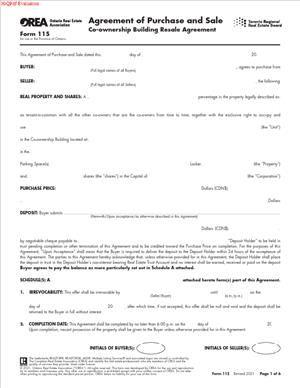
OREA Form 115 – Agreement of Purchase and Sale – Co-ownership Building Resale Agreement
Fill out nowJurisdiction: Canada | Ontario
What is an OREA Form 115 – Agreement of Purchase and Sale – Co-ownership Building Resale Agreement?
OREA Form 115 is a standard purchase agreement. You use it to buy or sell an interest in a co-ownership building in Ontario. It sets the key terms for the resale of a specific unit’s occupancy rights. It also sets terms for the seller’s percentage interest in the land and building. It aligns with how co-ownership buildings work in Ontario.
A co-ownership building is not a condo. You do not buy a separate unit in the registry. You buy an undivided interest in the entire property. You also take an exclusive right to occupy a named suite. That right comes from a co-ownership agreement or similar document. OREA Form 115 fits this legal setup. It addresses occupancy rights, the shared property, and common costs.
This form defines the price, deposit, and conditions. It covers closing, adjustments, title, and representations. It also deals with co-ownership documents and board approvals. It includes the transfer of parking or locker rights if applicable. You can add custom clauses through attached schedules.
Who typically uses this form?
Buyers and sellers in co-ownership buildings use it. Their real estate agents prepare and present it. Their lawyers rely on it to close the deal. Property managers and board members may also rely on it for approvals. Lenders and insurers may review the attached documents as well.
You need this form when you purchase a co-ownership interest on resale. You also need it when you sell your interest and occupancy rights. The form recognizes the unique risk points of co-ownership. It covers board consent, building rules, and shared debt. It helps you set clear rights and obligations before closing.
Typical usage scenarios
You found a one-bedroom in a midtown co-ownership building. You want to submit a formal offer through your agent. You own a share of a co-ownership building and want to sell. You inherited a co-ownership interest and need a proper agreement. You are an investor who wants to buy a rented co-ownership unit. The building has an underlying mortgage on the whole property. You need to assume your share as part of the purchase. Form 115 lets you address each of these points.
When Would You Use an OREA Form 115 – Agreement of Purchase and Sale – Co-ownership Building Resale Agreement?
Use this form when the property is a co-ownership building. The listing should confirm that it is co-ownership, not condo or freehold. The key signs are an undivided interest and an exclusive right to a suite. You may also see a reference to an underlying or blanket mortgage. The manager may collect monthly fees that cover debt service and expenses.
Use it when the building needs board consent for a sale. Many co-ownership agreements require buyer approval. Some buildings have a right of first refusal for other owners. The form and schedules let you set deadlines and steps for approval. You can also link the offer to the receipt of key documents.
Use it when financing is more complex. Lenders may require a larger down payment for co-ownership. Some lenders do not lend on co-ownership units at all. The form allows a financing condition that reflects this reality. You can add a schedule that sets proof and timelines.
Use it when there is a unit with a tenant. You may want vacant possession on closing. The form helps set that requirement. It can also confirm that the buyer assumes the tenant. You can attach the lease and rent details as a schedule.
Use it in estate sales or transfers by an attorney. The form captures capacity, spousal consent, and representations. It gives your lawyer a clear roadmap to closing. It also creates certainty for the buyer about title and occupancy rights.
Use it in private deals as well. Not every co-ownership sale is listed on MLS. Form 115 gives you a tested structure. It reduces missed terms and grey areas. It makes lawyer review and lender review easier.
Legal Characteristics of the OREA Form 115 – Agreement of Purchase and Sale – Co-ownership Building Resale Agreement
This is a legally binding agreement. Once the seller accepts and delivers the signed offer, it becomes binding. You must have clear essential terms. These include parties, property, price, and completion date. The agreement must be in writing and signed. Real estate agreements must meet that rule.
The form uses standard OREA language. That language supports enforceability. It covers acceptance, irrevocability, and delivery of notices. It defines conditions and how to waive them. It sets deadlines and what happens if you miss them. It also confirms that amendments must be in writing and signed.
Enforceability rests on clarity and certainty. The form describes the interest sold. It captures the exclusive occupancy rights for a named suite. It links the deal to the review of key co-ownership documents. It allows you to set approval and consent conditions. It manages risk if consent is refused or delayed.
The form addresses the title and searches. You get time to search the title and the co-ownership agreement. You can raise objections within a set period. The seller must address valid objections. If not, you may be able to terminate and get your deposit back. Exact outcomes depend on the wording and schedules.
The agreement sets standard closing mechanics. It lists adjustments for common expenses, taxes, and other items. It can address the buyer’s share of any building debt. It can also address planned special assessments. You can negotiate holdbacks to cover unresolved issues.
This form is not the same as the condo resale form. Co-ownership buildings are not governed by the condo statute. There is no statutory status certificate. You must request the right documents in the agreement itself. That is why the document list clause matters. Your lawyer must review the co-ownership agreement and rules. Your lender may need an estoppel certificate or manager’s letter. Form 115 accommodates those needs.
Remedies follow normal contract principles. If a party breaches, the other may seek damages. In some cases, a buyer may seek specific performance. Courts look at the clarity of the terms and the property’s uniqueness. You reduce risk by using the form’s timelines and conditions. Meet your deadlines. Send proper notices. Keep a clear paper trail.
How to Fill Out an OREA Form 115 – Agreement of Purchase and Sale – Co-ownership Building Resale Agreement
Follow these steps in order. Work with your agent and lawyer as needed. Keep sentences and terms clear and simple.
1) Identify the parties accurately
Enter the buyer’s full legal name. Include all buyers if more than one. Use full names that match identification. If a corporation is buying, use the exact corporate name. If a buyer buys in trust, state that clearly. For sellers, use the legal owners of record. Confirm with a title search or manager records.
If the property is a matrimonial home, address spousal consent. Include the spouse’s consent where required. If an estate sells, state the seller’s capacity. Use “Estate of” and the estate trustee’s name and authority. If a power of attorney signs, note that role. Attach the power of attorney for the lawyer to review.
2) Describe the property and interest correctly
Enter the municipal address and unit number. State the exclusive occupancy suite number. Include parking and locker identifiers if any. Identify the percentage or fractional interest in the property. Your agent can confirm this with the manager. Include the legal description of the land if available. Your lawyer will refine it before closing.
State that the sale includes the seller’s undivided interest. State that it includes the exclusive right to occupy the named unit. Reference the co-ownership agreement and house rules. Add the building’s common name if helpful.
3) Set the purchase price and the deposit
Enter the total purchase price in dollars. Enter the deposit amount and timing. Many offers include a first deposit on acceptance. State who holds the deposit in trust. This is usually the listing brokerage. State how the buyer will deliver the deposit. Use certified funds or electronic transfer as allowed. Set a timeline for any second deposit if used.
4) List included chattels and excluded fixtures
List chattels that stay with the unit. Examples include fridge, stove, dishwasher, and blinds. Include light fixtures that will stay. Exclude any items the seller plans to remove. Be specific to avoid disputes. If an item is a rental, list it under rental items. State who will assume the rental on closing.
5) Set the completion date and closing method
Select the closing date. Pick a date with enough time for approvals. Co-ownership approvals can take longer than a condo. Build in time for lender review as well. State that closing will be by electronic funds transfer. State that documents will be closed through lawyers by e-registrations, where possible.
6) Choose the irrevocable time
Set an irrevocable time and date for the offer. This is how long your offer stays open. Give enough time for the seller to review. Add time for the manager or board to comment if needed. Avoid overly tight timelines in co-ownership deals.
7) Add a title search and requisition date
Set a title search date. This is the last date to raise title issues. Give your lawyer time to review the co-ownership agreement. Tie the requisition date to the delivery of the documents. Many clauses set a number of days after document delivery.
8) Address HST and land transfer tax
Residential resales often state that HST is included. Confirm this with your lawyer. If HST applies, state who pays it. The buyer pays land transfer tax on closing. The APS does not change that. Plan for that cash outlay.
9) Insert key co-ownership conditions
Use Schedule A for clauses tailored to co-ownership. Include a condition for board or manager approval. Set who seeks approval and by when. Add a condition for the receipt and review of documents. List the documents you need. Include:
- The registered co-ownership agreement and any amendments.
- House rules and occupancy agreements.
- Financial statements and current budget.
- Any arrears reports and special assessments.
- Details of any blanket or underlying mortgage.
- Insurance summary and any major repairs plan.
Make the condition for lawyer review. Give a reasonable review period. Five to ten business days is common. Start that period on receipt of all documents. State that if documents are incomplete, the period extends. Include the right to terminate and get the deposit back. Keep the wording clear and objective.
10) Address financing conditions for co-ownership
Financing is often harder for co-ownership. Insert a financing condition that reflects that. State the minimum loan amount and acceptable lender types. State that the loan must be on terms satisfactory to the buyer. Give enough time to secure approval. Tie the deadline to receipt of documents if your lender needs them. Include the right to waive or fulfill the condition in writing.
11) Handle underlying or blanket mortgage matters
Many co-ownership buildings have a blanket mortgage. Owners pay a share through monthly fees. Your offer should address this clearly. Ask for full details of the debt and terms. Add a clause that the buyer must be approved to assume their share. If the lender or board refuses, allow the deal to end. Use a clause that returns the deposit to the buyer. If no blanket mortgage exists, confirm that in a representation.
12) Include right of first refusal, if applicable
Some co-ownership agreements include a right of first refusal. This allows other owners to buy on the same terms. Insert a clause that sets the notice process and timeline. Confirm that the seller will deliver notice as required. State what happens if the right is exercised. Usually, the buyer’s deal ends, and the deposit returns.
13) Representations and warranties
Add seller representations that matter in co-ownership. Examples include:
- The seller is not in arrears of fees.
- There are no notices of default for the unit.
- There are no special assessments not disclosed.
- The unit complies with building rules.
- There are no work orders or claims affecting the property.
- Chattels will be in working order on closing.
- The seller will deliver keys, fobs, and codes on closing.
Include a survival period for key representations. Thirty to ninety days is common. Your lawyer can advise on length.
14) Tenancy and vacant possession
State if the unit will be vacant on closing. If you need vacant possession, say so. If there is a tenant, attach the lease and rent details. State the rent, deposits, and any parking fees. Confirm the tenant’s status and if they are current. Address transfer of the last month’s rent credit. Attach a schedule for rental documents and estoppel.
15) Adjustments and holdbacks
Set standard adjustments. These include common expenses, taxes, and utilities. Include any share of the blanket mortgage. Confirm how prepaid amounts will adjust. If repairs or arrears are pending, set a holdback. State the holdback amount and release terms. Use the lawyer’s trust account for the holdback.
16) Insurance and risk
State when the risk passes to the buyer. Standard wording places risk on the seller until closing. Confirm building insurance is in place. Require the manager’s insurance certificate. The buyer should secure contents and liability insurance. If damage occurs before closing, set the options. You can include a right to terminate or take insurance proceeds.
17) Closing documents and delivery
List required closing documents. These often include:
- Transfer of the undivided interest in land.
- Assignment of exclusive occupancy rights for the unit.
- Board or manager consent to the transfer.
- Estoppel or manager’s letter confirming fees and arrears status.
- Statement of Adjustments.
- Undertaking to pay out any seller’s liens or charges.
- Keys, fobs, mail, bike, and locker keys.
Confirm the method for delivery and registration. Most lawyers use electronic systems. State that each party pays their own legal fees.
18) Notices and delivery provisions
Enter contact details for notices. Include email and fax if used. State that electronic delivery is valid. Ensure the brokerage details are correct. Confirm the cooperating and listing brokerages. Attach Schedule B if your brokerage uses one. It can address commission and other brokerage terms.
19) Signatures and initials
Initial every page and schedule. Sign where indicated. Use proper witnessing if needed. Electronic signing is often acceptable. If a corporation signs, include the signing officer’s title. If spousal consent is needed, include that signature. Date the signatures clearly. Check that all blanks are filled.
20) Attach schedules carefully
Schedule A holds your custom terms. Place all co-ownership conditions here. Keep the language clear and tied to dates. Schedule B often holds brokerage clauses. If you need a list of documents to be delivered, add a Schedule C. Label schedules consistently. Reference them in the main body.
21) Review and present the offer
Read the full form and schedules end-to-end. Confirm dates, amounts, and timelines align. Confirm the deposit holder and delivery method. Confirm that the completion date allows enough time. Present the offer before the irrevocable deadline. Keep proof of delivery.
22) Manage counteroffers and amendments
If the seller counters, review each change. Update related dates if the price or timing shifts. Keep financing and approval periods realistic. Use an amendment form for later changes. Ensure both parties sign any amendment. Track the new deadlines created by any change.
23) Satisfy conditions on time
Deliver condition waivers or fulfillments in writing. Use the form’s notice provisions. If a condition fails, send a notice of termination. Do so by the condition deadline. Make sure the deposit is released as set out. Keep copies of all notices.
24) Prepare for closing
Your lawyer will handle the closing steps. Respond fast to any document requests. Arrange your down payment and land transfer tax. Set up insurance and utilities. Book your elevator if needed. Plan your move after the lawyer confirms closing.
Real-world example
You offer a co-ownership one-bedroom. You include a financing condition of seven business days. You ask for the co-ownership agreement, financials, and insurance. You add a board approval condition with ten days. The manager discloses a planned window project. You negotiate a $5,000 holdback for 60 days. The board approves you. Your lender approves once it sees the documents. You waive conditions on time. You close as scheduled.
Another example: You buy a unit in a building with a blanket mortgage. Your offer requires confirmation of your share of the debt. It also requires approval from the blanket mortgage lender. The lender approves. You assume your share through the monthly fee. The manager’s estoppel confirms no arrears. The deal closes cleanly.
If you follow these steps, you reduce surprises. You also give your lawyer and lender what they need. OREA Form 115 supports a clear, enforceable co-ownership resale.
Legal Terms You Might Encounter
Agreement of Purchase and Sale means the full contract you sign. In this form, it sets the price, dates, and conditions. Co-ownership interest means you buy a percentage of the property, not a separate parcel. The form should state your exact percentage. Exclusive use area means the unit or space you alone occupy. The form should identify it clearly, often by suite number and plan. A co-ownership agreement is the governing document between all owners. Your offer should let you review and approve it. Common expenses are shared building costs, like maintenance and insurance. The form can require the seller to confirm no arrears. Statement of Adjustments is the final closing calculation. It splits costs and credits, like taxes and fees, as of closing. A deposit is the amount you pay on acceptance. The form sets who holds it and when it is due. Completion Date is the closing day. Title transfers and funds move on this date. The title search or requisition date is the deadline to raise title issues. The form sets this date to protect you. Encumbrances are claims on title, like mortgages or liens. The form should say you get the title free of them. Representations and warranties are the seller’s promises. They often cover arrears, disputes, and rule compliance. Conditions are “must-haves” before you commit. Common ones cover financing, document review, and inspection. Right of First Refusal lets others match your deal. If it applies, your timelines must allow for it.
FAQs
Do you need the co-ownership agreement before you sign?
You should review it early. It controls use, financing, resale, and default. Build a condition to review and accept it. Ask for all schedules and rules. Confirm if any amendments exist.
Do you need financing tailored to co-ownership?
Most lenders treat co-ownership as higher risk. Options can be limited. Ask your lender in advance. Include a financing condition with enough time. Confirm if the lender needs board consent or extra security.
Do you get a “status package” like a condo?
Co-ownerships do not use the same format. Ask for recent financials, budgets, reserve details, and meeting minutes. Request arrears reports and any special assessments. Ask for building insurance details and house rules.
Do you need consent or a right of first refusal?
Many co-ownerships require consent or a match right. Check the co-ownership agreement for procedures and timelines. If a right of first refusal applies, build that timing into your offer. Keep your irrevocable and closing dates realistic.
Do you pay property taxes on your share or the unit?
Structures vary. Some buildings pay taxes as one amount. Others allocate by percentage. Confirm how taxes are billed and adjusted. Make sure the statement of adjustments matches that method.
Do you include chattels and parking in this form?
Yes. List included items clearly, like appliances or window coverings. Identify exclusive-use parking and lockers by number. Confirm any fees tied to those spaces. Do not assume anything is included without listing it.
Do you need tenant documents if the unit is rented?
Yes. Ask for a copy of the lease and any renewals. Request a tenant acknowledgment of rent, deposits, and term. Adjust rent and deposits on closing. Add clauses to handle unpaid utilities or damage.
Do you need special insurance after closing?
Typically, the building carries insurance. You usually carry contents and liability. Ask for the building insurance summary. Confirm your coverage must meet co-ownership rules. Arrange coverage before closing.
Checklist: Before, During, and After the OREA Form 115 – Agreement of Purchase and Sale – Co-ownership Building Resale Agreement
Before signing
- Confirm your legal name and contact details.
- Identify the exact unit and exclusive-use areas.
- Verify your percentage ownership being purchased.
- Get the co-ownership agreement and all schedules.
- Ask for any house rules or policies.
- Request recent budgets, financial statements, and arrears lists.
- Check for any special assessments or planned projects.
- Review building insurance details and deductibles.
- Confirm how taxes are billed and allocated.
- Obtain utility billing arrangements and metering details.
- If rented, get the lease, renewals, and rent receipts.
- Ask for a tenant acknowledgment of rent and deposits.
- List all chattels to include or exclude.
- Confirm parking and locker numbers and fees.
- Inspect the unit and common areas.
- Arrange a professional inspection if you need one.
- Get written confirmation of any repairs or credits.
- Confirm right of first refusal or consent requirements.
- Ask for timelines and procedures for consent.
- Secure financing pre-approval that fits co-ownership.
- Confirm lender conditions and document needs.
- Prepare deposit funds and delivery method.
- Choose a realistic completion date.
- Confirm title will be free of liens and charges.
- Identify who will hold the deposit in trust.
- Confirm your signing authority if using a corporation.
- Gather ID and any required corporate documents.
- Note your preferred take-title structure and shares.
- Speak with your insurance provider about coverage.
During signing
- Verify property description and unit identifiers.
- Confirm your percentage interest on the title.
- Check the purchase price and deposit amount.
- Set the deposit due date and trust holder details.
- Select a clear completion date.
- Set a reasonable title search deadline.
- Add conditions for financing and document review.
- Include a condition to review the co-ownership agreement.
- Add an inspection condition if needed.
- Include a clause on the right of first refusal timing.
- Require seller confirmation of no arrears in common expenses.
- Require disclosure of special assessments or disputes.
- Specify how taxes and common expenses will be adjusted.
- List all included chattels and exclude any items clearly.
- Identify parking and locker spaces by number.
- Confirm whether HST applies and who pays it.
- If rented, include rent adjustments and deposit transfer.
- Add a clause for the delivery of tenant documents.
- Require keys, fobs, and codes on closing.
- Confirm the seller’s authority to sell the share.
- Verify that signatures match legal names.
- Initial all pages and any changes.
- Attach schedules with custom clauses.
- Cross-check that schedules do not conflict with the form.
- Confirm time zone for deadlines and irrevocability.
- Include a clause for electronic signatures and delivery.
- Set how disputes and notices will be delivered.
- Double-check dates, spelling, and numbers.
After signing
- Deliver the offer to the seller or agent as required.
- Calendar irrevocable, condition, and requisition dates.
- Deliver the deposit on time and get a receipt.
- Share the executed agreement with your lawyer and lender.
- Request all co-ownership documents promptly.
- Start the title search by the set deadline.
- Order an inspection if conditional on inspection.
- Obtain proof of no arrears and any assessment status.
- Request a letter confirming the seller’s standing as an owner.
- If rented, request tenant acknowledgement and rent ledger.
- Confirm insurance requirements and arrange coverage.
- Coordinate consent or right of first refusal steps.
- Send waivers or notices of fulfillment before deadlines.
- Negotiate amendments if dates or terms must change.
- Prepare closing funds with your lender and lawyer.
- Set up utilities and service accounts where allowed.
- Book elevator and move-in times if required.
- Plan a pre-closing walkthrough if permitted.
- On closing, confirm keys, fobs, and codes delivery.
- Store the final agreement, waivers, and receipts securely.
Common Mistakes to Avoid OREA Form 115 – Agreement of Purchase and Sale – Co-ownership Building Resale Agreement
- Don’t forget to confirm the exact percentage you are buying. If it’s wrong, the title and adjustments will be wrong. Fixing this later can delay closing and add costs.
- Don’t assume condo-style clauses fit co-ownership. Co-ownerships use different rules and documents. Using the wrong terms can leave gaps in your protections.
- Don’t skip a condition to review the co-ownership agreement. Without it, you may inherit unwanted rules or fees. You could also face restrictions that you cannot meet.
- Don’t ignore right of first refusal timelines. If others can match your offer, timing matters. Missing this can void your deal or push closing.
- Don’t leave the exclusive-use description vague. You must identify the unit, parking, and lockers precisely. Errors here cause disputes over space and rights.
What to Do After Filling Out the Form OREA Form 115 – Agreement of Purchase and Sale – Co-ownership Building Resale Agreement
- Submit the signed offer to the seller or the seller’s agent.
- Track your irrevocable deadline and follow up before it expires.
- If you receive a counteroffer, review each change carefully.
- Accept, reject, or counter in writing before the deadline.
- Once accepted, pay the deposit as the agreement requires.
- Send the executed agreement to your lawyer and lender.
- Request all co-ownership documents listed in your conditions.
- Start your title search and raise issues before the requisition date.
- Arrange an inspection and review the report promptly.
- Confirm how taxes and common expenses will be adjusted.
- If consent or a right of first refusal is required, start it at once.
- Keep proof of all notices and deliveries tied to conditions.
- When conditions are met, deliver waivers before the cutoff.
- If a condition cannot be met, deliver a notice to terminate on time.
- If timelines slip, sign an amendment to extend dates.
- Coordinate closing funds, insurance, and keys with your lawyer.
- Schedule move-in and elevator bookings if needed.
- On closing day, confirm transfer of keys, fobs, and documents.
- After closing, store all originals and digital copies securely.
- Update your address and service accounts as required.
Disclaimer: This guide is provided for informational purposes only and is not intended as legal advice. You should consult a legal professional.