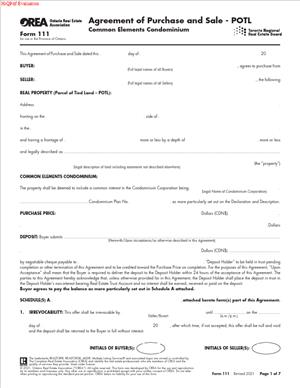
OREA Form 111 – Agreement of Purchase and Sale – POTL – Common Elements Condominium
Fill out nowJurisdiction: Country: Canada | Province or State: Ontario
The OREA Form 111 – Agreement of Purchase and Sale – POTL – Common Elements Condominium is a standardized real estate agreement used for a specific type of condominium ownership. It sets out the terms for buying or selling an interest in a parcel of tied land that shares common elements. You use it when the property is not a typical freehold or standard condominium unit.
This document matters because the POTL common elements condominiums combine private land ownership with shared facilities. The legal structure is different from other residential purchases. The form reflects those differences in how ownership, costs, and obligations are described.
If you are about to fill out this form, you are likely close to finalizing a transaction. Small details in the agreement can affect closing, ongoing costs, and how the property is used. Understanding what each part is meant to capture helps you complete it accurately.
This form is often used with professional support, but self-represented buyers and sellers still need to understand what they are signing. The agreement becomes the written record of what both sides agreed to. Once accepted, it guides the rest of the transaction.
What is OREA Form 111 – Agreement of Purchase and Sale – POTL – Common Elements Condominium?
Clear definition
OREA Form 111 – Agreement of Purchase and Sale – POTL – Common Elements Condominium is a written agreement that records the terms of a sale involving a parcel of tied land with shared common elements. It outlines the purchase price, deposit, closing date, and conditions, along with details specific to common elements ownership.
The form is designed to reflect the structure of POTL common elements condominiums. In this structure, you typically own your parcel outright while sharing ownership or use of common facilities. The agreement accounts for shared costs and governance tied to those common elements.
Who typically uses this form/document?
Buyers and sellers involved in POTL common elements condominium transactions typically use this document. These properties are common in planned communities with shared roads, private amenities, or services.
Real estate professionals often prepare or present the form during negotiations. Lawyers later review it as part of the closing process. Lenders may also rely on it to understand what is being purchased.
Why you might need this form/document
You may need this form because the property does not fit standard residential categories. A regular freehold agreement may not capture shared ownership features. This document includes language that reflects those shared arrangements.
Using the correct form helps ensure the agreement matches the legal structure of the property. That alignment reduces confusion later when reviewing budgets, fees, or shared responsibilities.
Typical real-life scenarios
You are buying a townhouse in a development where each owner holds a separate parcel of land. The roads, lighting, and landscaping are shared among all owners. This form records how those shared elements relate to your purchase.
You are selling a vacant POTL lot within a planned community. The buyer will become part of a common elements condominium corporation. The agreement needs to reflect that ongoing relationship.
You are purchasing a newly built home in a community with shared private services. The builder uses this form to set out how common elements costs are handled after closing.
You are transferring ownership of a POTL property between family members. Even without a traditional listing, the agreement still documents the transaction terms and shared obligations.
When would you use OREA Form 111 – Agreement of Purchase and Sale – POTL – Common Elements Condominium?
You would use OREA Form 111 – Agreement of Purchase and Sale – POTL – Common Elements Condominium when the property includes a parcel of tied land linked to common elements. This usually arises in developments designed with shared infrastructure or amenities.
The form is used once the buyer and seller have negotiated key terms. It captures those terms in writing so both sides can rely on a single document. It is typically completed before any conditions are fulfilled.
This document is used regardless of whether the property is owner-occupied or intended as an investment. The ownership structure, not the buyer’s plans, determines the form used.
In many transactions, one party prepares the form and the other reviews and accepts it. Once accepted, it becomes the reference point for the rest of the transaction timeline.
Legal characteristics of OREA Form 111 – Agreement of Purchase and Sale – POTL – Common Elements Condominium
This agreement functions as a contract once properly completed and accepted. Its effectiveness depends on clear identification of the parties, the property, and the essential terms of the deal. Missing or unclear information often leads to disputes or delays.
Problems commonly arise from incomplete property descriptions or misunderstandings about common elements fees. If the form does not align with the condominium documents, questions may arise later.
While the form is standardized, how it interacts with local condominium rules may vary. Some details are governed by separate declarations or bylaws that are not reproduced in the agreement.
The document does not replace condominium disclosure materials. It also does not handle financing approvals, inspections, or legal review on its own. Those matters are usually addressed through conditions or separate processes.
Is it legally binding?
The agreement is generally legally binding once it is signed by both parties and all required elements are present. Acceptance is usually communicated in writing within a set time.
Conditions included in the agreement may delay final commitment until they are satisfied or waived. Until that point, the agreement still sets out expectations and timelines.
If key terms are left blank or contradictory, enforceability can be questioned. Clear completion and mutual acceptance are what give the document its binding effect.
How to fill out OREA Form 111 – Agreement of Purchase and Sale – POTL – Common Elements Condominium
Step 1 – Identify the parties
Start by entering the full legal names of the buyer and seller. These names should match the names used in identification and ownership records. Accuracy here matters for the rest of the transaction.
Step 2 – Describe the property
Complete the section describing the parcel of tied land and its associated common elements. This often includes a legal description rather than a street address. The description connects the agreement to the correct property records.
Step 3 – Set the purchase price and deposit
Enter the agreed purchase price and details of the deposit. This includes the amount, how it will be delivered, and who will hold it. These terms clarify the financial commitment at the outset.
Step 4 – Define the closing date
State the date when ownership is intended to transfer. This date drives timelines for financing, document preparation, and possession. Any flexibility is usually addressed elsewhere in the agreement.
Step 5 – Outline included and excluded items
Note what is included in the sale and what is excluded. For POTL properties, this may involve shared fixtures or equipment tied to common elements. Clear entries reduce assumptions.
Step 6 – Address common elements costs
Complete sections dealing with common elements fees or expenses. These entries reflect ongoing financial obligations linked to shared ownership. The form usually anticipates adjustments on closing.
Step 7 – Insert conditions and timeframes
Record any conditions that must be met for the transaction to proceed. Each condition typically includes a deadline. These entries manage risk and expectations for both parties.
Step 8 – Review additional terms
Read and complete any additional terms or schedules attached to the agreement. These often expand on shared facilities or management arrangements. Consistency across all pages is important.
Step 9 – Signatures and acceptance
Ensure both parties sign and date the agreement in the correct places. Acceptance is usually time-sensitive. Once acceptance is communicated, the agreement governs the transaction going forward.
Legal terms you might encounter in OREA Form 111 – Agreement of Purchase and Sale – POTL – Common Elements Condominium
- Parcel of Tied Land (POTL): This refers to the specific piece of land you own outright. In this document, the parcel is legally tied to shared common elements. The form records both parts together, so there is no confusion about what transfers on closing.
- Common Elements Condominium: This describes the shared parts of the development, such as private roads, lighting, or services. The agreement acknowledges that ownership or use of these elements comes with the parcel. Your ongoing obligations are linked to this structure.
- Condominium Corporation: This is the legal entity that manages the common elements. The form assumes you will be subject to its rules and fees. It does not restate those rules but connects your purchase to them.
- Deposit: The deposit is the upfront amount paid after acceptance. This document, it shows commitment and sets consequences if the deal is not completed. The form records who holds it and how it is applied on closing.
- Completion Date: Also called the closing date, this is when ownership changes hands. The date you enter controls timelines for payment, possession, and adjustments. Missing or vague dates often cause disputes.
- Adjustments: Adjustments deal with shared costs that cross the closing date. This includes common elements expenses paid in advance or arrears. The agreement anticipates these calculations but leaves the math to closing.
- Conditions: Conditions are requirements that must be met before the deal becomes firm. In this form, they are often tied to financing, review of documents, or inspections. Each condition needs a deadline and a method of fulfillment or waiver.
- Inclusions and Exclusions: These terms clarify what stays with the property and what does not. For POTL properties, this can affect items linked to shared infrastructure. The form relies on you to be specific.
- Irrevocability: This sets the period during which an offer cannot be withdrawn. The date and time you enter here matter because acceptance must happen within that window. It controls when the agreement becomes binding.
FAQs
Do I use OREA Form 111 – Agreement of Purchase and Sale – POTL – Common Elements Condominium for every townhouse?
No. You use this form only when the property is a parcel of tied land connected to a common elements condominium. You confirm this by checking the legal description and the ownership structure, not the building style.
Where do I find the exact legal description to enter?
You usually find it on a prior deed, land registry document, or existing agreement. The wording needs to match the official record. Do not rely only on the street address when filling in this document.
What date counts as the effective date?
The effective date is the date when the last party signs and acceptance is communicated. You record this date in the designated space. It starts the clock for all conditions and timelines in this form.
Who is allowed to sign this document?
The signer must have legal authority to bind the buyer or seller. For individuals, this means the registered owner or purchaser. For entities, you confirm signing authority before completing the signature lines.
Do I attach schedules or extra terms?
Yes, if you need to add details not already covered. You must clearly reference each attachment in the agreement. Anything not attached and referenced is usually not enforceable.
What happens if a name is spelled differently than on title?
Name mismatches cause delays and amendments later. You should match the spelling and format used in ownership records. Fix errors before acceptance, not after.
Does this document get filed anywhere?
The agreement itself is not typically registered on title. It is kept by the parties and used by lawyers to prepare closing documents. Accuracy matters because it guides what gets registered later.
What changes in the public record after completion?
The transfer of the parcel is recorded in the land registry. Your connection to the common elements condominium follows automatically. The form supports this process by clearly describing what is transferred.
Checklist: Before, During, and After OREA Form 111 – Agreement of Purchase and Sale – POTL – Common Elements Condominium
Before
- Confirm the property is a parcel of tied land with common elements
- Obtain the full legal description from reliable records
- Verify the correct legal names of all buyers and sellers
- Discuss common elements fees, and shared expenses
- Decide on a realistic closing date
- Identify any conditions you need for protection
- Prepare any schedules or additional terms
- Confirm who will hold the deposit
During
- Enter all names exactly as confirmed
- Complete the property description without shortcuts
- Clearly state the purchase price and deposit terms
- Insert the closing date and irrevocability period
- List inclusions and exclusions in plain detail
- Write conditions with clear deadlines
- Reference any attached schedules
- Review every filled-in blank for consistency
After
- Confirm acceptance was communicated in writing
- Record the effective date accurately
- Deliver the deposit as agreed
- Keep a signed copy for your records
- Calendar all condition deadlines
- Provide a copy to your legal representative
- Begin gathering documents for closing
- Track common elements information for adjustments
Common mistakes to avoid with OREA Form 111 – Agreement of Purchase and Sale – POTL – Common Elements Condominium
- Mistake: Using a standard freehold agreement because the home looks detached, which happens when the ownership structure is misunderstood, leading to missing common elements obligations, and forgetting to confirm the legal description.
- Mistake: Writing only the street address, which happens for convenience, causing title errors later, and forgetting to copy the full legal description.
- Mistake: Leaving common elements fees vague, which happens when numbers are not yet known, leading to closing disputes, and forgetting to note how adjustments will be handled.
- Mistake: Incorrect or inconsistent buyer or seller names, which happens with informal ID checks, causing amendments and delays, and forgetting to match title records exactly.
- Mistake: Missing or unclear condition deadlines, which happens during rushed negotiations, creating uncertainty about when the deal becomes firm, and forgetting to insert specific dates.
- Mistake: Not referencing attached schedules, which happens when extra terms are added late, making them unenforceable, and forgetting to label and attach them properly.
- Mistake: Overlooking signing authority, which happens with corporate or family transactions, risking invalid signatures, and forgetting to confirm authority before signing.
- Mistake: Assuming acceptance is automatic, which happens with verbal confirmations, leading to disputes about timing, and forgetting to document written acceptance.
What to do after filling out OREA Form 111 – Agreement of Purchase and Sale – POTL – Common Elements Condominium
Once the form is fully completed and signed, your focus shifts to follow-through. This agreement becomes the roadmap for the transaction. Treat it as an active document that drives your next actions.
- Step 1: Make sure acceptance has been clearly communicated and note the effective date.
- Step 2: Deliver the deposit exactly as stated, including timing and method.
- Step 3: Save multiple copies of the signed agreement in secure locations.
- Step 4: Calendar every condition deadline so nothing is missed.
- Step 5: Begin reviewing any condominium-related documents tied to the common elements.
- Step 6: Share the agreement with your legal representative so they can prepare for closing.
- Step 7: Track any information needed for adjustments, such as shared expenses.
- Step 8: Confirm arrangements for utilities, insurance, and possession dates.
- Step 9: Respond promptly to requests for information tied to conditions.
- Step 10: Review the agreement again before closing to ensure nothing has changed.
Staying organized after signing reduces stress and avoids last-minute problems. The clearer your records, the smoother the closing process tends to be.
Disclaimer: This guide is provided for informational purposes only and is not intended as legal advice. You should consult a legal professional.